Market Summary
Executive Summary and Global Market Analysis
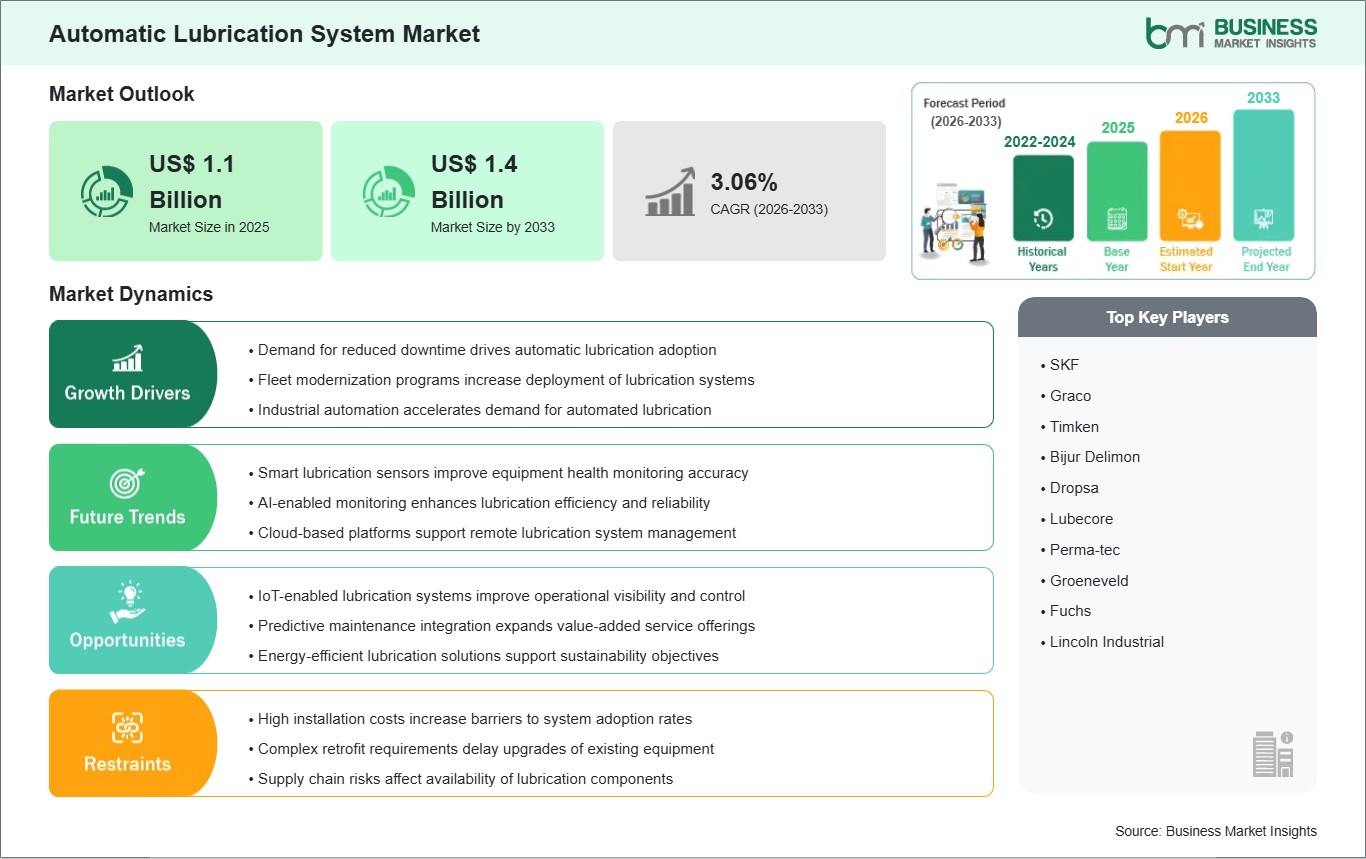
Automatic lubrication systems are designed to deliver controlled amounts of lubricant to machinery and equipment components at regular intervals without manual intervention. These systems help reduce equipment wear, improve operational efficiency, and extend machinery lifespan. They are widely used in construction equipment, mining machinery, automotive manufacturing facilities, and industrial production plants. The Automatic Lubrication System market is expanding as industries increasingly focus on preventive maintenance strategies, equipment reliability, and reducing unplanned downtime. The growing adoption of automation in industrial operations and the need for efficient fleet management are also supporting market demand. Single-line and dual-line lubrication systems remain widely used due to their suitability for different operating environments, while industrial machinery and heavy equipment applications continue to generate strong demand.
Despite the positive outlook, several factors can limit market growth. The installation cost of automatic lubrication systems can be significant, particularly for small and medium-sized businesses operating under budget constraints. Many companies continue to rely on conventional manual lubrication practices because of lower initial investment requirements. In addition, integrating lubrication systems into older machinery can be technically challenging and may require equipment modifications. Maintenance personnel must also be trained to manage system monitoring and troubleshooting. In remote industrial environments, harsh operating conditions can affect system components and increase maintenance requirements, creating additional operational challenges for end users.
The market is expected to benefit from ongoing advancements in smart lubrication technologies and predictive maintenance solutions. New systems equipped with sensors, remote monitoring capabilities, and data analytics are improving lubricant management and equipment performance. The increasing use of connected industrial machinery and Industry 4.0 practices is creating opportunities for intelligent lubrication systems that provide real-time operational insights. Growing investments in mining, infrastructure development, and manufacturing modernization are expected to support future demand. Additionally, environmentally responsible lubrication practices and improved lubricant efficiency are encouraging industries to adopt advanced systems that reduce waste while enhancing equipment productivity.
Segment Analysis
Automatic Lubrication System Market Segmentation
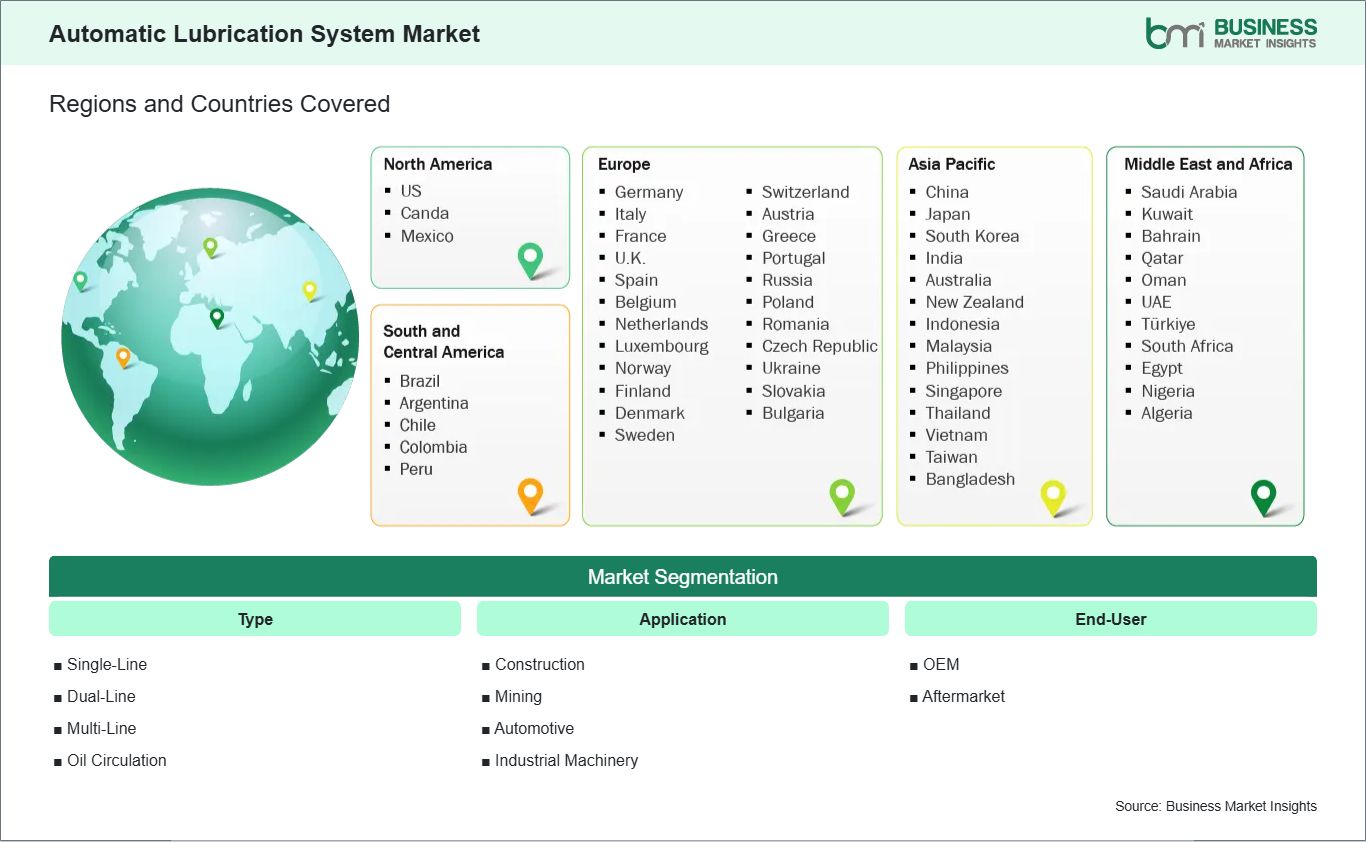
The Automatic Lubrication System market is segmented based on type, application, and end-user. Different lubrication technologies are designed to meet varying operational requirements across industries.
By Type
- Single-Line: Commonly used in small and medium-scale machinery requiring centralized lubrication.
- Dual-Line: Suitable for large industrial equipment operating across multiple lubrication points.
- Multi-Line: Provides dedicated lubricant delivery to several machine components simultaneously.
- Oil Circulation: Widely used in high-performance industrial systems requiring continuous lubrication.
By Application
- Construction: Used in excavators, loaders, cranes, and other heavy equipment.
- Mining: Supports continuous operation of mining machinery under demanding conditions.
- Automotive: Applied in vehicle manufacturing plants and automated production systems.
- Industrial Machinery: Helps improve equipment reliability and maintenance efficiency.
By End-User
- OEM: Integrated into machinery during manufacturing and equipment assembly.
- Aftermarket: Installed as upgrades or replacements in existing machinery fleets.
Market Forces
Automatic Lubrication System Market Drivers and Opportunities
Growing Demand for Equipment Reliability and Reduced Downtime
Industrial operators are increasingly prioritizing equipment uptime and operational efficiency. Unexpected machinery failures can result in production losses, maintenance expenses, and safety concerns. Automatic lubrication systems address these challenges by ensuring that critical machine components receive the correct amount of lubricant at predetermined intervals. This helps reduce friction, minimize component wear, and improve equipment performance.
The growing adoption of preventive and predictive maintenance programs across manufacturing, mining, and construction industries is further supporting demand. Companies are focusing on reducing manual maintenance activities while improving asset utilization. Regulatory attention toward workplace safety and equipment reliability also encourages the implementation of automated maintenance technologies. As industrial operations become more complex and equipment operates for longer periods under demanding conditions, the need for dependable lubrication solutions continues to increase. This trend is expected to remain a major factor supporting the growth of the Automatic Lubrication System market throughout the forecast period.
Integration of Smart Monitoring and Industry 4.0 Technologies
The evolution of connected industrial operations is creating new opportunities for the Automatic Lubrication System market. Modern lubrication systems are increasingly being equipped with sensors, wireless communication capabilities, and data analytics tools that enable real-time monitoring of lubricant consumption and equipment conditions. These technologies allow operators to identify maintenance requirements before equipment failures occur.
The adoption of Industry 4.0 initiatives across manufacturing and heavy industries is accelerating interest in intelligent maintenance systems. Smart lubrication solutions can be integrated into broader asset management platforms, enabling centralized monitoring and operational optimization. Remote monitoring capabilities are particularly valuable for mining sites, construction projects, and industrial facilities operating across multiple locations. Furthermore, advances in digital technologies are making lubrication systems more efficient, accurate, and user-friendly. As industries continue investing in automation and digital transformation, demand for advanced lubrication systems with enhanced monitoring capabilities is expected to create substantial growth opportunities.
Size and Share Analysis
Automatic Lubrication System Market Size and Share Analysis
The Automatic Lubrication System market size is expected to reach US$ 1.4 billion by 2033 from US$ 1.1 billion in 2025. The market is estimated to record a CAGR of 3.06% from 2026 to 2033.
By type, single-line systems account for a significant share due to their simple installation, cost-effectiveness, and suitability for a wide range of industrial equipment. Dual-line and multi-line systems are widely used in heavy-duty machinery operating in demanding environments where continuous lubrication is essential. Oil circulation systems are also gaining adoption in large industrial facilities that require precise lubricant management and improved equipment performance.
By application, construction and mining dominate the market owing to the extensive use of heavy equipment that operates under harsh conditions and requires regular lubrication. Automotive applications continue to expand with increasing automation in manufacturing facilities and assembly operations. Industrial machinery is also witnessing strong adoption as manufacturers focus on reducing maintenance downtime, extending equipment lifespan, and improving operational efficiency through automated lubrication solutions.
Report Coverage
Automatic Lubrication System Market Report Coverage and Deliverables
The "Automatic Lubrication System Market Size and Forecast (2022-2033)" report provides a detailed analysis of the market covering below areas:
- Market size and forecast at global, regional, and country levels for all the key market segments covered under the scope
- Market trends, as well as market dynamics such as drivers, restraints, and key opportunities
- Market analysis covering key market trends, global and regional framework, major players, regulations, and recent market developments
- Industry landscape and competition analysis covering market concentration, heat map analysis, prominent players, and recent developments for the market
- Detailed company profiles, including SWOT analysis
Geographic Insights
Automatic Lubrication System Market Geographic Insights
The Automatic Lubrication System Market shows diverse regional adoption patterns influenced by industrial automation, infrastructure development, and increasing emphasis on equipment reliability and preventive maintenance.
North America, being a developed region, has a well-established industrial sector and a high rate of adoption of advanced maintenance technologies. The region comprises the United States and Canada, where industries are investing in automation and productivity improvement initiatives. The region focuses on minimizing equipment downtime and improving operational efficiency across construction, mining, automotive, and manufacturing sectors. It has strong technological capabilities and a mature industrial infrastructure, supporting the widespread implementation of automatic lubrication systems across various applications.
Asia Pacific is growing significantly, driven by rapid industrialization, expanding manufacturing activities, and increasing infrastructure investments. The region comprises countries such as China, India, and Japan, where large-scale industrial projects and equipment modernization programs are creating strong demand for automated lubrication technologies. The region focuses on enhancing machinery performance, reducing maintenance costs, and improving operational reliability. Growth in mining, construction, and industrial manufacturing activities is further contributing to market expansion, supported by ongoing investments in industrial development and automation.
Both regions are contributing significantly to the growth of the Automatic Lubrication System Market, focusing on industrial modernization, increased equipment utilization, and the adoption of technologies that improve maintenance efficiency and operational performance.
Industry Activity
Recent Developments
The Automatic Lubrication System Market is analyzed using a mix of primary and secondary research sources, including corporate publications, industry associations, and verified databases. This approach ensures accurate tracking of innovation trends and strategic developments influencing the market.
- In January 2025, The Timken Company expanded its automated lubrication capabilities by scaling the deployment of its Groeneveld-BEKA Twin heavy-duty dual-line pump systems, introducing an upgraded high-capacity 20-litre reservoir package designed for mining and industrial equipment. This technological advancement shifts the competitive landscape, allowing tier-1 manufacturers to bundle heavy-duty mechanical grease hardware with data-driven condition monitoring ecosystems that stream accurate pressure metrics directly to plant-wide automated diagnostics suites.
- In November 2024, SKF Group completed the strategic acquisition of JSG Industrial Systems, a prominent provider of automated lubrication management systems and engineering solutions. This transaction directly broadens the regional technical portfolio and supply chain presence of the enterprise regarding specialized industrial fluid, greasing, and automatic delivery systems.
Trust & Transparency
Research Methodology
The market analysis combines proprietary research with secondary data from government agencies, company disclosures, regulatory filings, industry databases and expert interviews. Market estimates are validated through data triangulation, cross-market benchmarking and analyst
review.
View Full Research Methodology
Key Sources Referred:
World Bank - Global Trade IndicatorsWorld Trade Organization (WTO)International Monetary Fund (IMF)International Trade Administration (ITA)Company WebsitesCompany Annual ReportsCompany Investor Presentations