Market Summary
Executive Summary and Global Market Analysis
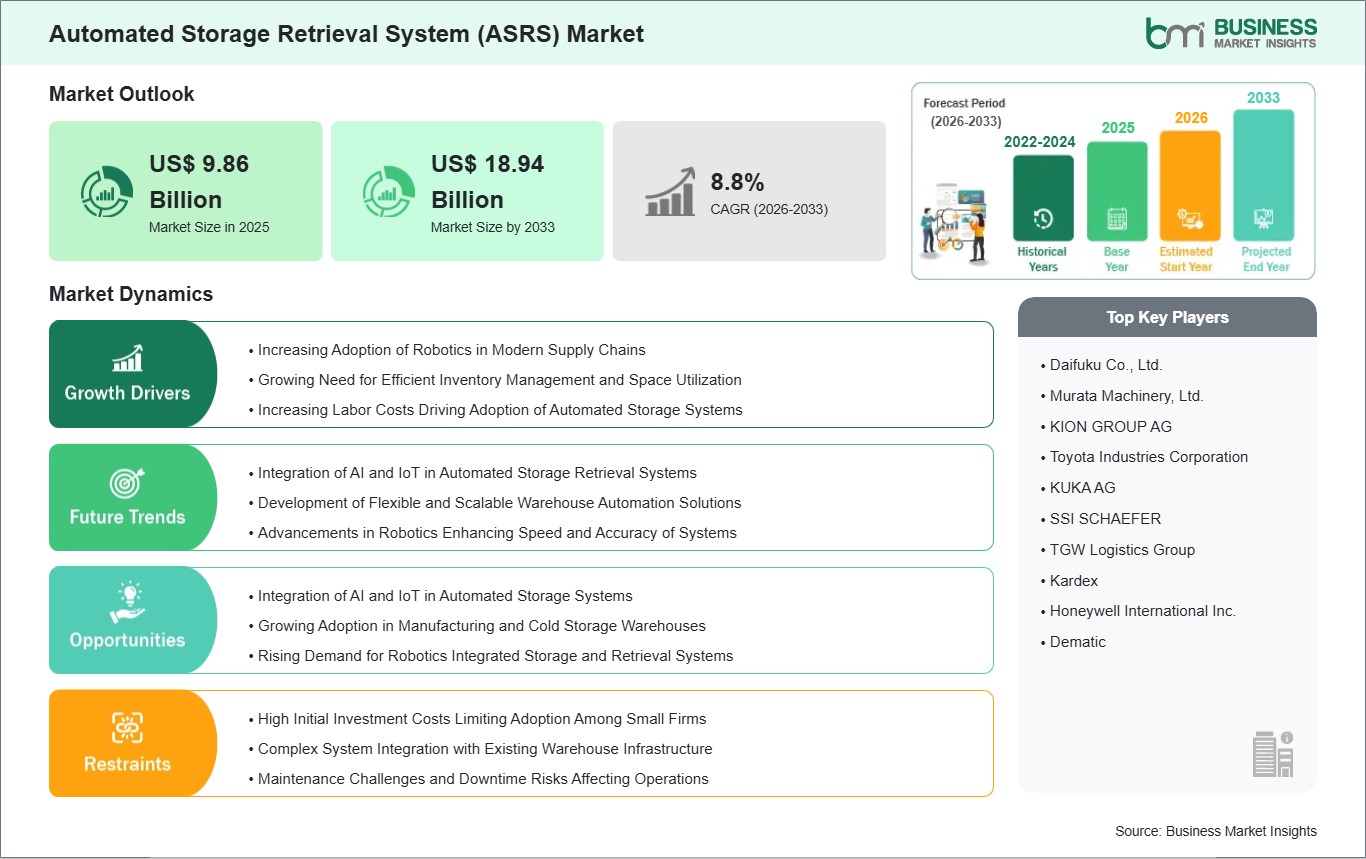
The global Automated Storage and Retrieval System (ASRS) market is an essential feature in today’s warehouse and logistics landscape due to the increasing need for efficiency, accuracy, and optimal storage space. ASRS solutions such as unit load systems, mini load systems, carousels, and robotic shuttles are gaining popularity for simplifying material handling and optimizing available warehouse space. Many industries, such as e-commerce, retail, pharmaceuticals, automotive, and food and beverage, are using ASRS technology to efficiently handle increasing order volumes and complex inventories while responding to dynamic supply chain requirements. The need for faster delivery and efficient fulfillment across e-commerce and omnichannel platforms is further increasing the need for automated solutions that minimize manual handling, errors, and increase overall throughput. Technology is playing an important role in the global Automated Storage and Retrieval System market. The increasing need for better visibility in warehouse operations and making informed decisions is possible through the integration of warehouse management systems, enterprise resource planning tools, and real-time analytics. Intelligent robotics and automation technologies are helping make the systems more flexible for different types of warehouse configurations and products. Energy-efficient designs and sustainable practices are also playing an important role in influencing purchasing decisions. These technologies are helping businesses achieve increased productivity and reduce operating costs while supporting a more sustainable supply chain. Despite the growth prospects for the industry, there are some challenges associated with the use of ASRS. For instance, the high cost of investment and the complexity of integrating the system into existing infrastructure are some of the challenges associated with the use of the system. Another challenge associated with the use of the system is the requirement for skilled labor. However, the development of modular, scalable, and user-friendly ASRS solutions has helped address these challenges. With businesses around the world focusing more on the use of automation and increasing the efficiency of operations and the supply chain, the global ASRS market is expected to play an important role in influencing the future of the industry.
Segment Analysis
Automated Storage Retrieval System (ASRS) Market Segmentation
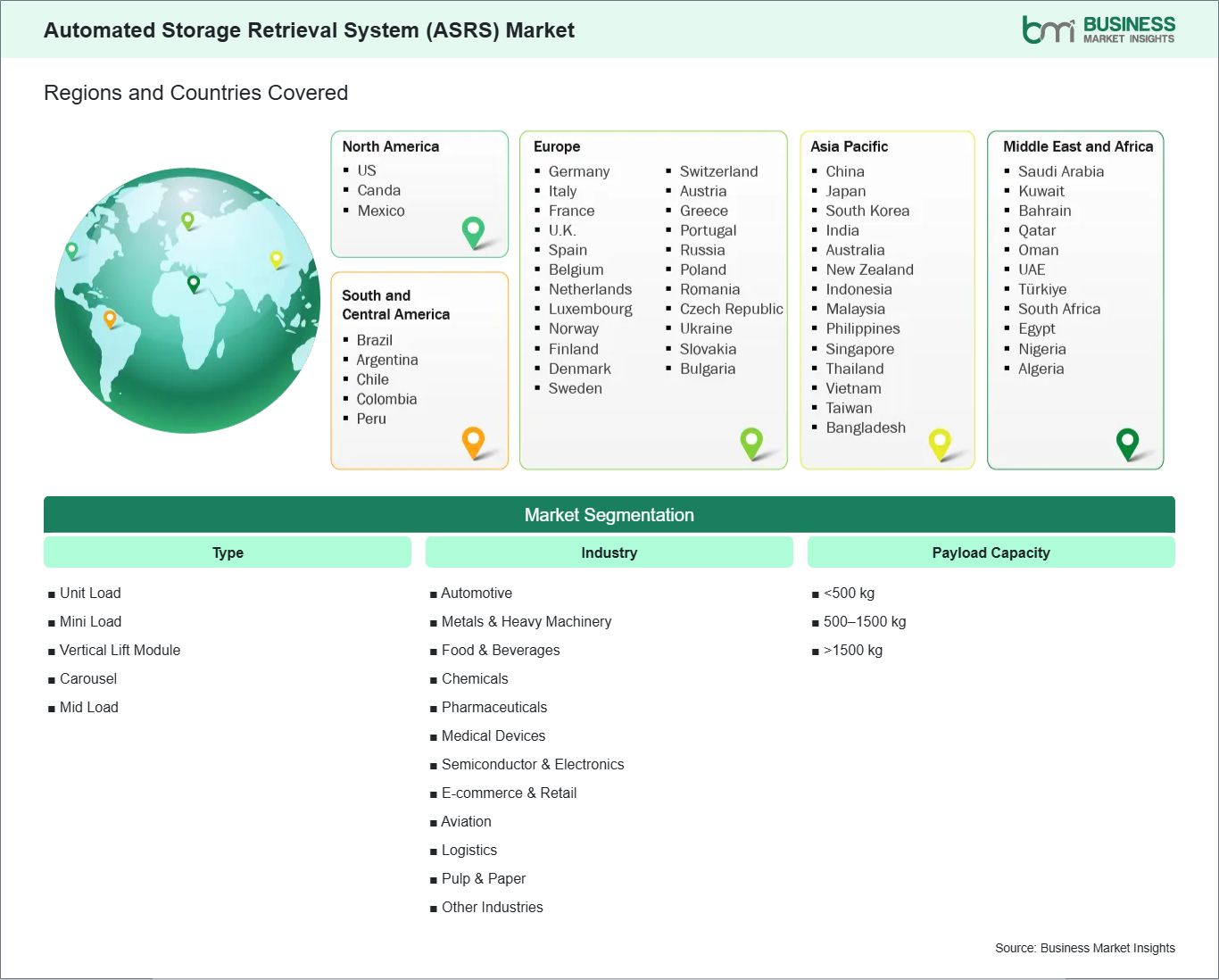
Key segments that contributed to the derivation of the automated storage retrieval system market analysis are type, industry and payload capacity.
- By type, the automated storage retrieval system (ASRS) market is segmented into unit load, mini load, vertical lift module (VLM), carousel, and mid load. The unit load segment dominated the market in 2025.
- Based on industry, the automated storage retrieval system (ASRS) market is categorized into automotive, metals & heavy machinery, food & beverages, chemicals, pharmaceuticals, medical devices, semiconductor & electronics, e-commerce & retail, aviation, logistics, pulp & paper, and other industries. The food & beverages segment dominated the market in 2025.
- In terms of payload capacity, the automated storage retrieval system (ASRS) market is categorized into <500 kg, 500 - 1500 kg, and >1500 kg. The 500 - 1500 kg segment dominated the market in 2025.
Market Forces
Automated Storage Retrieval System (ASRS) Market Drivers and Opportunities
Increasing Adoption of Robotics in Modern Supply Chains
Robotics is transforming supply chains worldwide by making storage and retrieval operations faster, more accurate, and highly efficient. Automated Storage and Retrieval Systems equipped with robotic shuttles, conveyor-guided vehicles, and robotic picking arms are increasingly deployed in North America and Europe to meet the rising demand for quick order fulfillment and precise inventory management. These systems reduce dependence on manual labor, increase throughput, and maximize warehouse space utilization. In Asia Pacific, rapid e-commerce growth and urban warehouse constraints are driving the adoption of autonomous mobile robots alongside fixed ASRS setups, creating flexible hybrid automation solutions. Advanced robotics, such as vision-guided arms and collaborative robots (cobots) that can safely work with human staff, are making automation accessible across industries. Globally, the emphasis on modular, scalable robotic solutions is enabling warehouses to adapt to fluctuating demand, enhance operational resilience, and set new benchmarks for efficiency in modern supply chain operations.
Integration of AI and IoT in Automated Storage Systems
AI and IoT are redefining automated storage systems by adding intelligence, connectivity, and predictive capabilities to warehouse operations. Machine learning algorithms optimize inventory placement, reduce retrieval times, and forecast demand, enabling smarter decision-making in distribution centers across North America, Europe, and Asia Pacific. IoT-enabled sensors provide real-time equipment monitoring, predictive maintenance, and operational analytics, minimizing downtime and improving reliability. Global warehouses increasingly leverage AI and IoT to connect equipment, management systems, and analytics platforms, creating data-driven, responsive environments. By combining automation with intelligent insights, companies can achieve operational agility, enhance productivity, and maintain consistent performance across multi-site and international operations. This convergence of AI and IoT ensures ASRS systems not only automate tasks but also enable strategic supply chain optimization on a global scale.
Size and Share Analysis
Automated Storage Retrieval System (ASRS) Market Size and Share Analysis
The automated storage retrieval system market demonstrates steady growth, with size and share analysis highlighting evolving trends and competitive dynamics among key players. The report examines subsegments categorized within type, industry and payload capacity, offering insights into their contribution to overall market performance.
By type, the unit load subsegment dominated the automated storage retrieval system market in 2025, driven by its ability to handle large volumes and heavy loads efficiently, making it ideal for high-capacity warehouse operations.
Based on industry, the food & beverages subsegment dominated the automated storage retrieval system market in 2025, driven by the growing demand for automated storage solutions to improve efficiency, ensure product safety, and maintain cold chain logistics.
In terms of payload capacity, the 500 - 1500 kg subsegment dominated the automated storage retrieval system market in 2025, driven by its suitability for handling the most common load sizes in industrial and commercial warehouse operations, balancing efficiency and flexibility.
Report Coverage
Automated Storage Retrieval System (ASRS) Market Report Coverage and Deliverables
The "Automated Storage Retrieval System Market Size and Forecast (2022 - 2033)" report provides a detailed analysis of the market covering below areas:
- Automated Storage Retrieval System Market size and forecast at global, regional, and country levels for all the key market segments covered under the scope
- Automated Storage Retrieval System Market trends, as well as drivers, restraints, and opportunities
- Automated Storage Retrieval System Market analysis covering key trends, global and regional framework, major players, regulations, and recent developments
- Industry landscape and competition analysis covering market concentration, heat map analysis, prominent players, and recent developments for the Automated Storage Retrieval System Market
- Detailed company profiles, including SWOT analysis
Geographic Insights
Automated Storage Retrieval System (ASRS) Market Geographic Insights
The geographical scope of the Automated Storage Retrieval System Market report is divided into North America, Asia Pacific, Europe, Middle East & Africa, and South & Central America. North America held the largest share in 2025.
North America holds the top position in the global ASRS market due to the high penetration of advanced warehouse automation technologies, a strong e-commerce environment, and high investments in state-of-the-art supply chain infrastructure. Organizations in this region are giving increasing importance to fast order fulfillment, high storage density, and reduced dependency on human resources. This has led to the increased adoption of a variety of ASRS solutions, ranging from high-density unit load systems to robotic shuttle solutions and carousel storage configurations. WMS connectivity, real-time monitoring, and smart robotics have further strengthened the position of this region in the global ASRS market. Europe is another prominent market for ASRS solutions, with growth driven by key industries such as manufacturing, automobiles, pharmaceuticals, and stringent industry norms for safety, energy savings, and environmental sustainability. Modular ASRS systems in Europe have made it possible for both large industrial establishments and smaller warehouses to optimize storage and operational efficiency. In addition, ongoing modernization of legacy systems has also contributed to increased adoption rates in Europe. In the Asia Pacific region, rapid industrialization, coupled with increased e-commerce and high-density urbanization, has led to high adoption rates for ASRS systems. Companies in this region are increasingly using ASRS systems to manage increased order volumes and achieve greater precision and speed in order fulfillment. In the Middle East & Africa region, ASRS systems have shown promise in high-value industries such as oil & gas, pharmaceuticals, and logistics, which have labor challenges and require high precision in operations. In South & Central America, which is still in the development stage, ASRS systems have shown gradual adoption in various industries such as manufacturing, retail, and distribution, which require increased efficiency and reduced labor costs. These regions have shown different stages in adoption, with North America being a benchmark in terms of technology’s sophistication and maturity, followed by others with specific strategies in mind in achieving efficiency, space optimization, and cost-effectiveness.
Industry Activity
Recent Developments
The Automated Storage Retrieval System Market is evaluated by gathering qualitative and quantitative data post primary and secondary research, which includes important corporate publications, association data, and databases. A few of the key developments in the automated storage retrieval system market are:
- In July 2024, Rapyuta Robotics Inc. announced that it launched its ASRS (Automated Storage and Retrieval System) solution in the U.S. market, introducing a flexible and modular warehouse automation platform designed to improve storage efficiency and productivity across logistics operations. This product launch marked a significant expansion of the company’s ASRS offerings into North America, targeting broad warehouse automation adoption.
- In June 2025, Conveyco and Hai Robotics announced a strategic partnership to integrate Hai Robotics’ ASRS solutions into Conveyco’s material handling portfolio, enabling businesses to optimize warehouse storage, streamline fulfillment processes, and enhance operational efficiency with cutting‑edge automation equipment. This collaboration enhances ASRS accessibility by combining Conveyco’s system integration expertise with Hai Robotics’ advanced goods‑to‑person systems.
Trust & Transparency
Research Methodology
The market analysis combines proprietary research with secondary data from government agencies, company disclosures, regulatory filings, industry databases and expert interviews. Market estimates are validated through data triangulation, cross-market benchmarking and analyst
review.
View Full Research Methodology
Key Sources Referred:
World Health Organization (WHO)Organisation for Economic Cooperation and Development (OECD)The World Bank GroupWorldometerThe LancetInternational Bar AssociationInternational Trade Administration