Market Summary
Executive Summary and Global Market Analysis
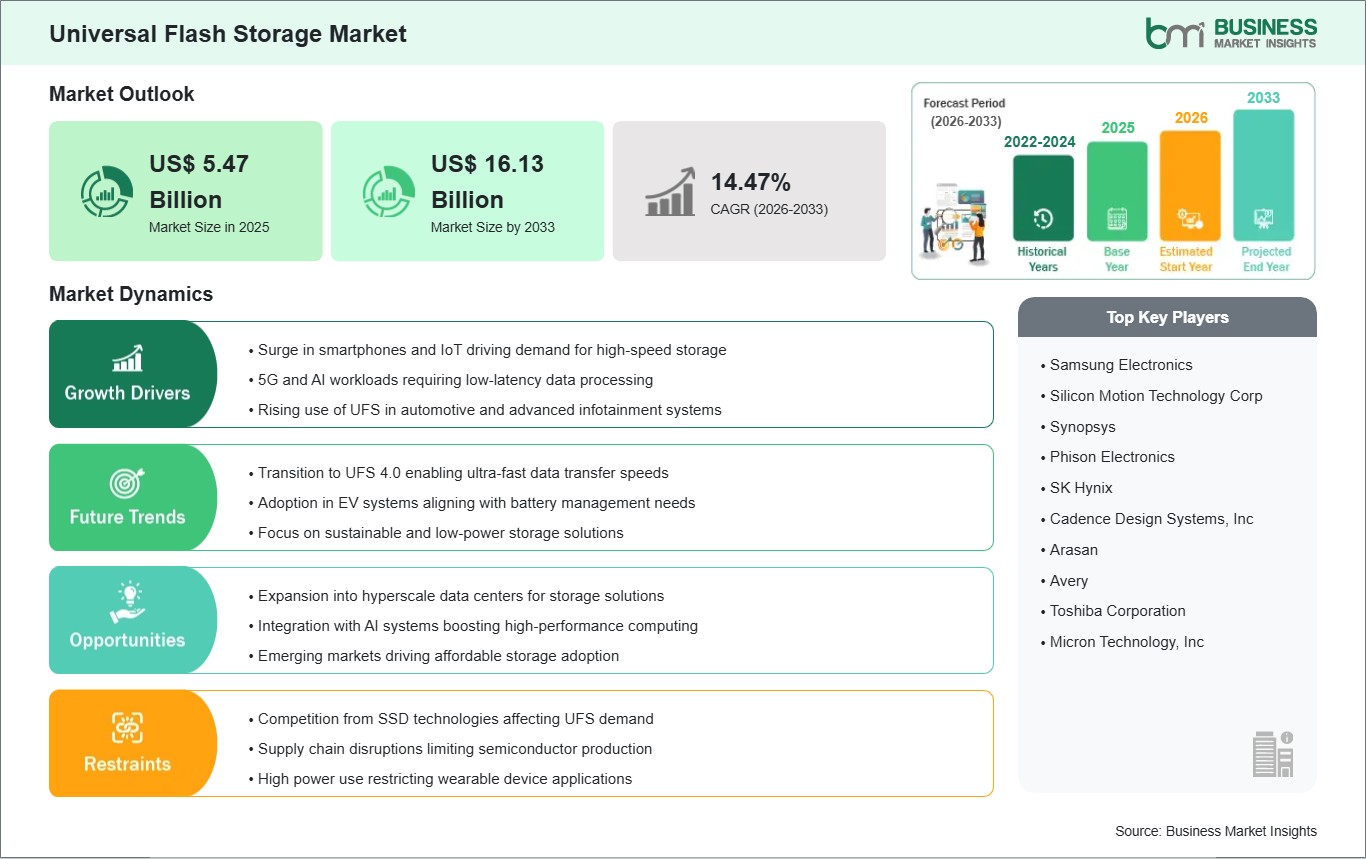
Universal Flash Storage (UFS) represents the pinnacle of high-performance flash memory solutions, engineered specifically to address the intensive data throughput requirements of modern mobile and embedded ecosystems. Built upon a sophisticated serial interface that supports full-duplex communication, UFS facilitates simultaneous read and write operations, a critical evolution over legacy half-duplex standards like eMMC. This architectural advantage enables the rapid data processing necessary for high-resolution imaging, 4K/8K video playback, and the seamless execution of complex software environments. As the digital landscape shifts toward 5G-Advanced and AI-integrated hardware, UFS has become indispensable for maintaining system responsiveness in smartphones, automotive telematics, and industrial edge computing.
However, the market faces notable challenges, including the high manufacturing complexity associated with ultra-fine semiconductor nodes and the significant cost premiums of UFS 4.0 controllers. Additionally, market growth is tempered by stringent reliability and thermal management standards required for automotive-grade storage, alongside persistent fluctuations in the global NAND flash supply chain that impact pricing stability.
Despite these restraints, the market is buoyed by substantial opportunities. The transition toward Software-Defined Vehicles (SDVs) and the integration of Lidar-based autonomous driving systems demand high-capacity, low-latency storage that only UFS can provide. Furthermore, the burgeoning demand for generative AI at the edge necessitates local storage solutions capable of handling massive datasets without cloud latency. As manufacturers innovate with 3D NAND scaling and power-efficient designs, the Universal Flash Storage market is poised for robust expansion, driven by the relentless global push toward hyper-connected, intelligent devices.
Segment Analysis
Universal Flash Storage Market Segmentation
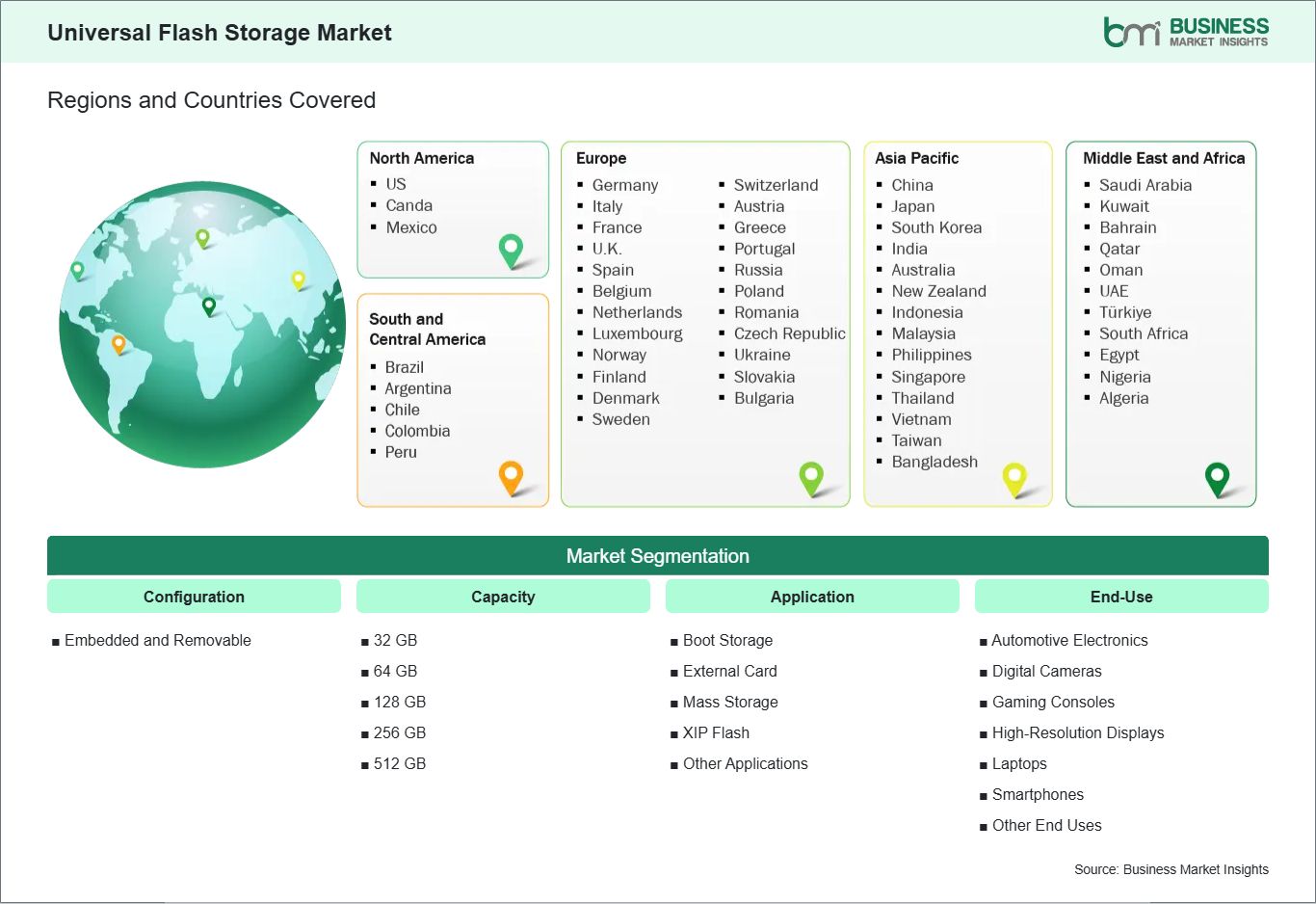
Key segments that contributed to the derivation of the Universal Flash Storage market analysis are Configuration, Capacity, application, and end use.
- By Configuration, the market is segmented into embedded and Removable.
- By Capacity, the market is divided into 32 GB, 64 GB, 128 GB, 256 GB, and 512 GB.
- By Application, the market is categorized into Boot Storage, External Card, Mass Storage, XIP Flash, and Others.
- By End-Use, the market is segmented into Automotive Electronics, Digital Cameras, Gaming Consoles, High-Resolution Displays, Laptops, Smartphones, and Others.
Market Forces
Universal Flash Storage Market Drivers and Opportunities
Proliferation of 5G-Advanced and Generative AI on Mobile Devices
The global shift toward 5G-Advanced networks and the integration of sophisticated Generative Artificial Intelligence within mobile hardware serve as the primary drivers for the Universal Flash Storage market. Modern smartphones have transitioned from simple communication tools into high-performance computing hubs that must process immense datasets locally as telecommunication infrastructure evolves to support ultra-fast, low-latency connectivity the burden of data management shifts to the internal storage architecture. Standard memory solutions often create system-wide bottlenecks that prevent users from experiencing the full potential of high-speed networks. Universal Flash Storage addresses this by utilizing a serial interface and full-duplex communication, which allows for the simultaneous reading and writing of data. This capability is essential for modern mobile experiences, such as capturing ultra-high-definition video while background applications synchronize with the cloud.
Furthermore, the rise of on-device AI requires the rapid loading of large language models and neural network weights into the active memory. Without the high bandwidth provided by the latest storage standards, AI-driven tasks—such as real-time language translation, image enhancement, and predictive text—would suffer from noticeable lag. Consequently, as consumers demand more intelligent and responsive devices, hardware manufacturers are increasingly making advanced flash storage a mandatory specification in their product roadmaps, ensuring that the storage pipeline can keep pace with the rapid computational demands of the next generation of mobile software.
Expansion of Automotive Edge Computing and Software-Defined Vehicles
The ongoing transformation of the automotive industry toward Software-Defined Vehicles (SDVs) presents a substantial and lucrative growth opportunity for the Universal Flash Storage market. Modern vehicles are no longer purely mechanical entities; they are evolving into localized data centers that rely on complex electronic control units and centralized high-performance computing. As manufacturers move toward higher levels of driving automation, the volume of data generated by onboard sensors, including Lidar, Radar, and high-resolution cameras, increases exponentially. This sensor fusion requires immediate, reliable, and high-speed data logging to ensure that safety-critical decision-making algorithms can operate without latency.
Universal Flash Storage provides the necessary architectural foundation to handle these intense workloads while maintaining the thermal and physical resilience required for automotive environments. Beyond safety, the surging consumer demand for immersive digital cockpits and advanced infotainment systems further fuels this need. These systems offer high-definition mapping, augmented reality heads-up displays, and rich multimedia streaming, all of which require high-bandwidth storage to function seamlessly. As vehicles become more connected and reliant on over-the-air updates to improve functionality over their lifespan, the need for scalable and durable storage solutions becomes paramount. This shift creates a massive opening for semiconductor providers to develop application-specific storage modules that can endure extreme temperatures and vibrations while delivering the performance levels previously reserved for high-end consumer electronics.
Size and Share Analysis
Universal Flash Storage Market Size and Share Analysis
The Universal Flash Storage market demonstrates steady growth, with size and share analysis revealing evolving trends and competitive positioning among key players. The report further examines subsegments categorized within Configuration, Capacity, Application, and end use, offering insights into their contribution to overall market performance.
Within the configuration segment, the Embedded sub-segment maintains a massive presence due to its integration into nearly all flagship and mid-range mobile devices.
Regarding Capacity, the 256 GB sub-segment is emerging as the preferred standard for consumers seeking a balance between high-resolution media storage and cost-efficiency.
From an application perspective, the Mass Storage sub-segment remains the dominant contributor as data-rich environments demand extensive local caches.
Finally, in the end-use category, the Smartphones sub-segment continues to lead the market share, fueled by the rapid replacement cycles of mobile hardware and the transition of budget models from eMMC to UFS technology.
Report Coverage
Universal Flash Storage Market Report Coverage and Deliverables
The "Universal Flash Storage Market Size and Forecast (2022–2033)" report provides a detailed analysis of the market covering below areas:
- Universal Flash Storage market size and forecast at global, regional, and country levels for all the key market segments covered under the scope
- Universal Flash Storage market trends, as well as market dynamics such as drivers, restraints, and key opportunities
- Universal Flash Storage market analysis covering key market trends, global and regional framework, major players, regulations, and recent market developments
- Industry landscape and competition analysis covering market concentration, heat map analysis, prominent players, and recent developments for the Universal Flash Storage market
- Detailed company profiles, including SWOT analysis
Geographic Insights
Universal Flash Storage Market Geographic Insights
The geographical scope of the Universal Flash Storage market report is divided into five regions: North America, Asia Pacific, Europe, the Middle East & Africa, and South & Central America.
In North America, the market is characterized by a high concentration of technology pioneers and a robust ecosystem for aerospace and defense, where high-speed, reliable data processing is a fundamental requirement for mission-critical systems. The European market is heavily influenced by the presence of a sophisticated automotive industry that is rapidly integrating advanced storage solutions to support the evolution of connected and autonomous vehicle platforms. The Asia-Pacific region functions as a primary engine for both the production and consumption of flash storage, benefiting from a massive semiconductor manufacturing infrastructure and an expansive consumer base for high-end mobile electronics.
In the Middle East & Africa, market growth is primarily supported by the aggressive modernization of telecommunications infrastructure and the increasing digital transformation of government and smart city initiatives. Meanwhile, South & Central America are witnessing steady progress as regional industrial sectors adopt automated processing facilities and modernize their local digital frameworks to keep pace with global technological standards. This diversified regional presence ensures a resilient global market as various local economies continue to prioritize the expansion of their digital and industrial capabilities.
Industry Activity
Recent Developments
The Universal Flash Storage market is evaluated by gathering qualitative and quantitative data post primary and secondary research, which includes important corporate publications, association data, and databases. A few of the key developments in the Universal Flash Storage market are:
- In February 2024, Micron Technology, Inc. announced that it delivered qualification samples of an enhanced version of its Universal Flash Storage (UFS) 4.0 mobile solution, which featured breakthrough proprietary firmware integrated into the world's most compact package at 9x13 millimeters. This innovation, built on advanced 232-layer 3D NAND and offering up to 1 terabyte capacity, utilized a high-performance Universal Flash Storage architecture to enable faster and more responsive experiences on flagship smartphones. By reducing the physical footprint of the storage module, the company provided mobile manufacturers with greater design flexibility for internal components like larger batteries.
- In September 2025, SK hynix Inc. announced that it began supplying its high-performance mobile NAND solution, ZUFS 4.1, to customers, marking the world's first mass production of this technology. This specialized Universal Flash Storage (UFS) solution, known as Zoned UFS, was designed to optimize data management by organizing storage into distinct zones, thereby reducing read performance degradation. By integrating this advanced Universal Flash Storage standard, the company aimed to enhance on-device AI capabilities and system responsiveness in the latest flagship smartphones.
Trust & Transparency
Research Methodology
The market analysis combines proprietary research with secondary data from government agencies, company disclosures, regulatory filings, industry databases and expert interviews. Market estimates are validated through data triangulation, cross-market benchmarking and analyst
review.
View Full Research Methodology
Key Sources Referred:
World Bank – Global Trade Indicators World Trade Organization (WTO) (International Monetary Fund )IMF International Trade Administration (ITA) Company website Company annual reports Company investor presentations