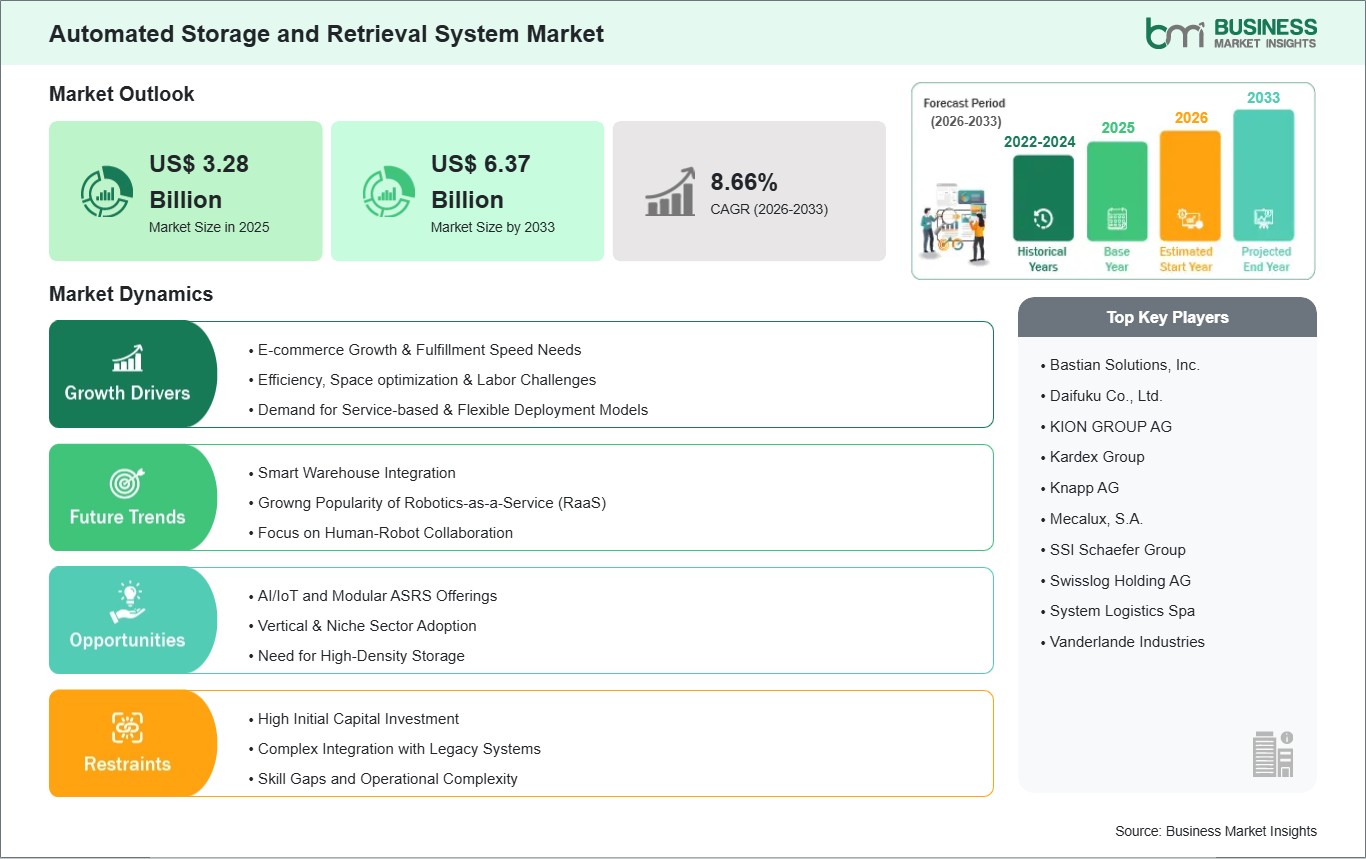
The automated storage and retrieval system market size is expected to reach US$ 6.38 billion by 2033 from US$ 3.28 billion in 2025. The market is estimated to record a CAGR of 8.7% from 2026 to 2033.
A automated storage and retrieval system is a localized energy system that can operate independently or in coordination with the An automated storage and retrieval system (ASRS) refers to a computer-controlled solution used in warehouses and distribution centers to automatically place and retrieve goods from defined storage locations with minimal human intervention. These systems improve inventory accuracy, optimize space utilization, and significantly reduce labor costs and handling errors, making them highly beneficial for high-volume and fast-paced operations. ASRS is widely used across industries such as e-commerce, retail, automotive, food and beverage, pharmaceuticals, and manufacturing, where efficiency and speed are critical.
Key demand factors driving market growth include rapid expansion of e-commerce, increasing warehouse automation, rising labor shortages, and the need for real-time inventory management. However, high initial investment costs, complex system integration, and maintenance challenges act as major restraints, particularly for small and medium-sized enterprises. Despite these limitations, the market presents strong opportunities through advancements in robotics, artificial intelligence, and software integration, which are making ASRS more flexible and scalable. Emerging trends such as smart warehouses, Industry 4.0 adoption, energy-efficient systems, and growing demand for cold storage and urban fulfillment centers are further accelerating the adoption of automated storage and retrieval systems, positively influencing overall market growth.

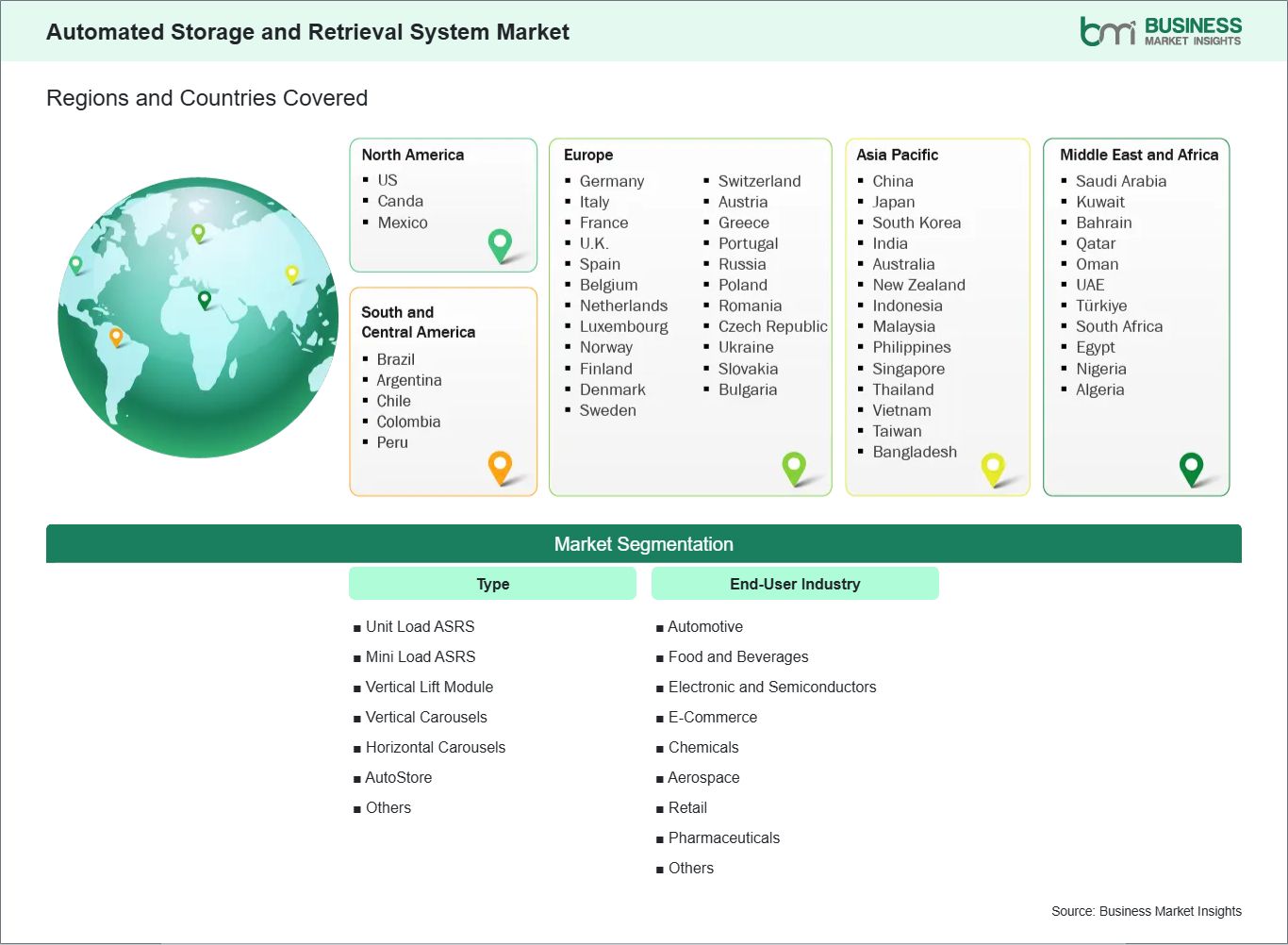
Key segments that contributed to the derivation of the automated storage and retrieval system market analysis are type and end-user industry.
The rapid growth of e-commerce has become a central driver of automated storage and retrieval system (ASRS) market growth, as online retailers face mounting pressure to process orders faster, more accurately, and at greater scale. The surge in online shopping volumes—fueled by consumer expectations for same-day or next-day delivery—has significantly increased the complexity of warehouse and fulfillment operations. Traditional manual storage and picking methods struggle to keep pace with high order frequencies, SKU proliferation, and fluctuating demand patterns typical of e-commerce environments. ASRS directly addresses these challenges by automating storage, retrieval, and inventory management processes, enabling warehouses to handle higher throughput with minimal human intervention. By optimizing space utilization through vertical storage and high-density configurations, ASRS allows e-commerce operators to maximize warehouse capacity while reducing real estate costs, a critical factor in urban and last-mile fulfillment centers. Additionally, the precision and speed of automated retrieval systems reduce picking errors, improve order accuracy, and shorten fulfillment cycles—key performance indicators in competitive online retail.
As fulfillment speed becomes a differentiating factor for customer satisfaction and brand loyalty, retailers increasingly view ASRS as a strategic investment rather than a cost center. The integration of ASRS with warehouse management systems (WMS), robotics, and AI-driven analytics further enhances real-time inventory visibility and demand forecasting, supporting seamless omnichannel operations. Consequently, the expanding e-commerce sector is not only increasing warehouse automation adoption but also accelerating technological advancements within the ASRS market. This strong alignment between e-commerce growth and the need for rapid, reliable fulfillment continues to propel sustained demand for ASRS solutions, making fulfillment speed requirements a foundational pillar of long-term ASRS market expansion.
The Automated Storage and Retrieval System (ASRS) market is poised for significant growth as industry players and end-users increasingly embrace digital transformation, driven by a convergence of AI-driven optimization, IoT connectivity, and modular, scalable ASRS designs that unlock new value propositions and use cases. As automation becomes central to modern supply chains, AI technologies are enhancing system intelligence by enabling predictive analytics, optimizing storage layouts, minimizing retrieval errors, and improving throughput — capabilities that directly address operational bottlenecks and align with broader Industry 4.0 strategies. Similarly, IoT-enabled ASRS solutions facilitate real-time data collection, system monitoring, and seamless communication across equipment and warehouse management systems, enhancing visibility and interoperability across distributed operations. These smart systems not only improve efficiency and accuracy but also provide proactive maintenance insights that reduce downtime and extend asset life. At the same time, modular and scalable ASRS offerings are lowering barriers to adoption by allowing businesses of varying sizes — especially small and medium enterprises — to tailor and expand automated storage infrastructure without prohibitive upfront investments, catalyzing broader market penetration; modular configurations can reduce setup costs and support flexible growth as business needs evolve. Together, these innovations are creating differentiated value by enabling ASRS deployments that are not only faster and more efficient but also more adaptable and data-rich, supporting diverse use cases from e-commerce and cold chain logistics to complex manufacturing environments. The result is a robust growth trajectory for the ASRS market, with emerging opportunities rooted in intelligent, connected, and flexible automation architectures.
By type, the market is segmented into unit load ASRS, mini load ASRS, vertical lift module, vertical carousels, horizontal carousels, autostore, and others. The vertical lift module segment held the largest share of the market in 2025 A vertical lift module (VLM) is an automated storage system that stores items in vertically arranged trays and delivers them ergonomically to operators. Its adoption drives the ASRS market by improving space utilization, inventory accuracy, picking efficiency, and labor productivity across warehouses and manufacturing facilities.
By end-user industry, the market is segmented into automotive, food and beverages, electronic and semiconductors, e-commerce, chemicals, aerospace, retail, pharmaceuticals, and others. The e-commerce segment held the largest share of the market in 2025. The adoption of automated storage and retrieval systems (ASRS) in e-commerce is driven by rising order volumes, demand for faster fulfillment, labor shortages, and the need for space optimization. ASRS improves accuracy, scalability, and operational efficiency while reducing costs and enabling reliable, 24/7 warehouse operations.
| Report Attribute | Details |
|---|---|
| Market size in 2025 | US$ 3.28 Billion |
| Market Size by 2033 | US$ 6.37 Billion |
| Global CAGR (2026 - 2033) | 8.66% |
| Historical Data | 2022-2024 |
| Forecast period | 2026-2033 |
| Segments Covered | By Type
|
| Regions and Countries Covered | North America
|
| Market leaders and key company profiles |
|
The "Automated Storage and Retrieval System Market Size and Forecast (2022–2033)" report provides a detailed analysis of the market covering below areas:
The geographical scope of the automated storage and retrieval system market report is divided into five regions: North America, Asia Pacific, Europe, Middle East & Africa, and South & Central America. The automated storage and retrieval system market in Asia Pacific is expected to grow significantly during the forecast period. The Asia-Pacific automated storage and retrieval system market is segmented into China, Japan, South Korea, India, Australia, New Zealand, Indonesia, Malaysia, the Philippines, Singapore, Thailand, Vietnam, Taiwan, Bangladesh, and the Rest of Asia.
The demand factor driving the growth of the automated storage and retrieval system market in the Asia Pacific region is driven by a combination of rapid industrialization, expanding e-commerce, and structural changes in supply chain management across the region. One of the most significant factors is the explosive growth of e-commerce and omnichannel retail in countries such as China, India, Japan, and Southeast Asian nations, which has intensified the need for fast, accurate, and space-efficient warehousing solutions. ASRS enables high-throughput order fulfillment, reduced picking errors, and efficient inventory management, making it essential for modern distribution centers. Additionally, rising labor costs and persistent labor shortages in developed and emerging Asia Pacific economies are accelerating the adoption of automation to reduce dependence on manual labor while improving productivity and operational consistency. Urbanization and limited availability of warehouse space in densely populated cities further drive demand for vertical storage solutions, where ASRS offers optimal space utilization.
The manufacturing sector also plays a crucial role, particularly in automotive, electronics, food & beverage, and pharmaceuticals, where ASRS supports just-in-time production, traceability, and stringent quality requirements. Government initiatives promoting smart manufacturing, Industry 4.0, and digital transformation—especially in China, Japan, South Korea, and Singapore—are encouraging investments in warehouse automation technologies. Moreover, advancements in robotics, sensors, warehouse management software, and artificial intelligence have improved the flexibility, scalability, and return on investment of ASRS, making it accessible to a broader range of enterprises, including small and medium-sized businesses. The growth of cold chain logistics, driven by rising consumption of frozen foods, biologics, and vaccines, also contributes to market expansion, as ASRS systems are well-suited for temperature-controlled environments. Collectively, these economic, technological, and logistical factors are creating a strong foundation for sustained growth of the ASRS market across the Asia Pacific region.

The automated storage and retrieval system market is evaluated by gathering qualitative and quantitative data post primary and secondary research, which includes important corporate publications, association data, and databases. A few of the key developments in the automated storage and retrieval system market are:
The Automated Storage and Retrieval System Market is valued at US$ 3.28 Billion in 2025, it is projected to reach US$ 6.37 Billion by 2033.
As per our report Automated Storage and Retrieval System Market, the market size is valued at US$ 3.28 Billion in 2025, projecting it to reach US$ 6.37 Billion by 2033. This translates to a CAGR of approximately 8.66% during the forecast period.
The Automated Storage and Retrieval System Market report typically cover these key segments-
The historic period, base year, and forecast period can vary slightly depending on the specific market research report. However, for the Automated Storage and Retrieval System Market report:
The Automated Storage and Retrieval System Market is populated by several key players, each contributing to its growth and innovation. Some of the major players include:
The Automated Storage and Retrieval System Market report is valuable for diverse stakeholders, including:
Essentially, anyone involved in or considering involvement in the Automated Storage and Retrieval System Market value chain can benefit from the information contained in a comprehensive market report.
Please tell us your area of interest
(Market Segments/ Regions and Countries/ Companies)