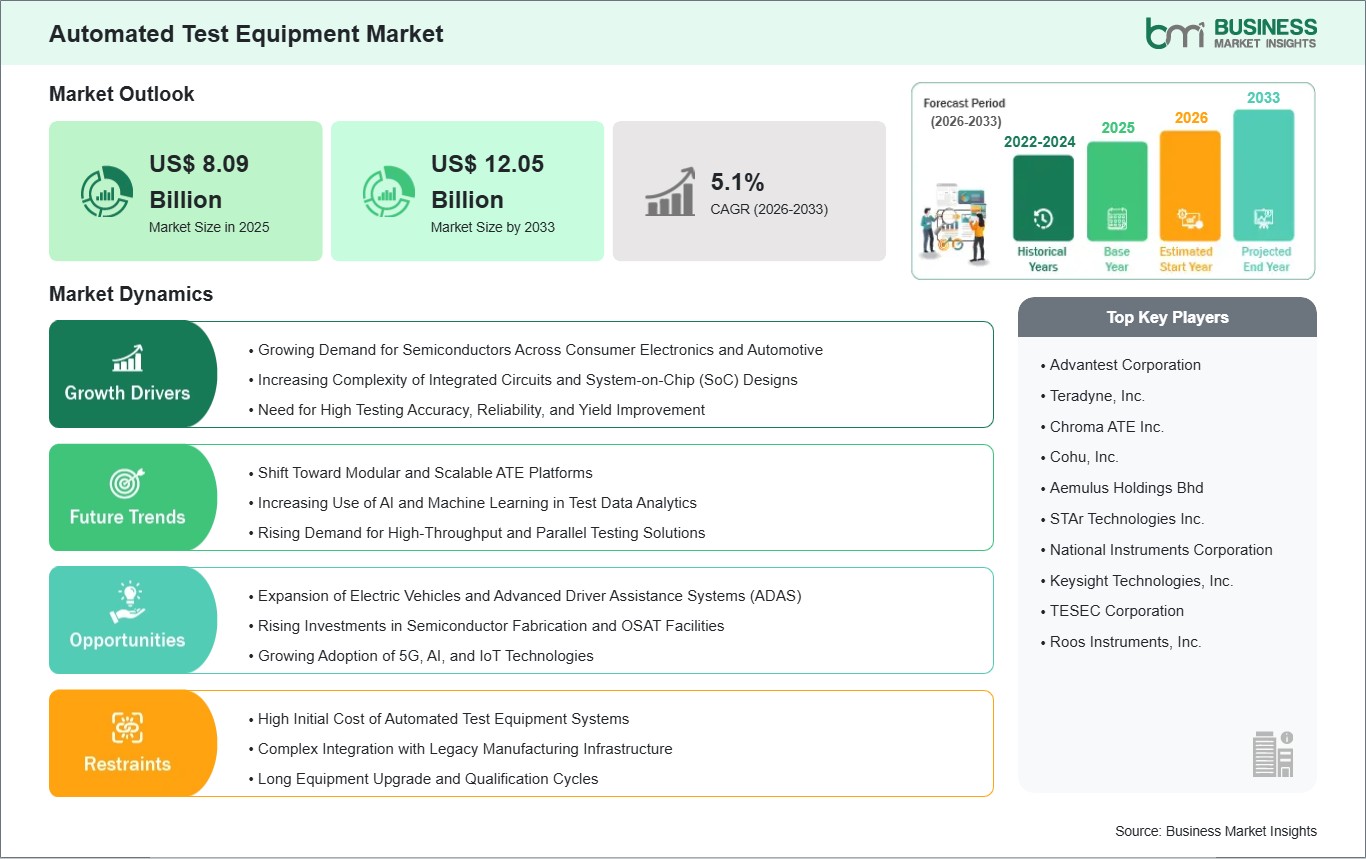
The automated test equipment market size is expected to reach US$ 12.05 billion by 2033 from US$ 8.09 billion in 2025. The market is estimated to record a CAGR of 5.1% from 2026 to 2033.
Automated test equipment (ATE) refers to computer-controlled systems used to test and validate electronic devices, components, and systems to ensure functionality, performance, and reliability. These solutions integrate sophisticated hardware—such as testers, handlers, probers, and mass interconnects—with advanced software platforms to perform high-speed, high-precision testing across large production volumes. By replacing manual and semi-automated testing processes, ATE systems significantly improve test accuracy, reduce time-to-market, and lower manufacturing costs, making them indispensable in modern electronics production environments.
The global automated test equipment market is witnessing steady growth driven by increasing semiconductor complexity, rising demand for consumer electronics, and rapid advancements in automotive electronics, including electric and autonomous vehicles. Continuous innovation in technologies such as artificial intelligence (AI), machine learning (ML), and data analytics is enhancing test coverage, fault detection, and predictive maintenance capabilities. Although high system costs and complex integration requirements pose challenges, growing investments in semiconductor fabrication and electronics manufacturing are reinforcing the long-term importance of ATE in ensuring product quality and manufacturing efficiency.

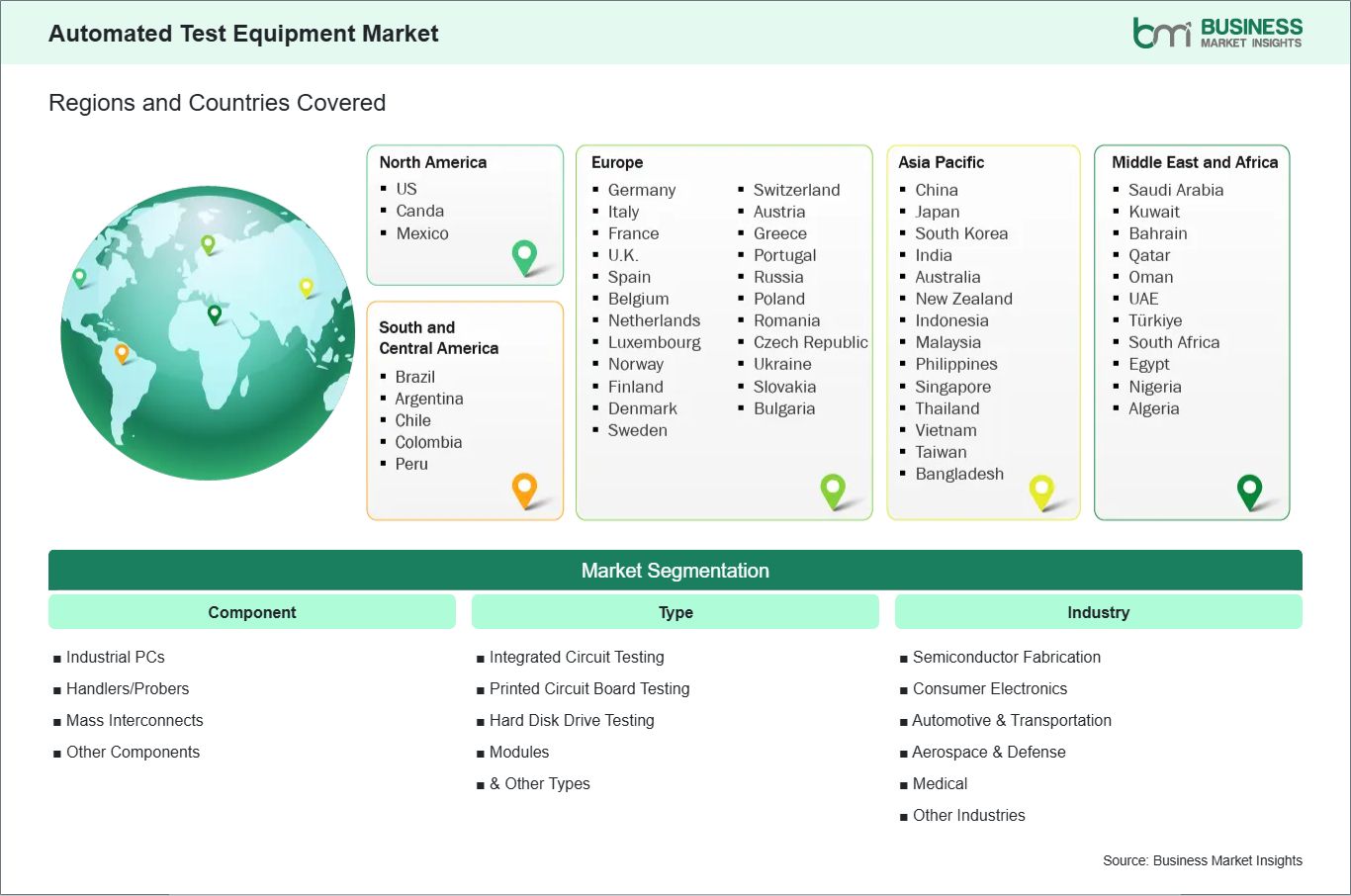
Key segments that contributed to the derivation of the automated test equipment market analysis are component, type, and industry.
The growing complexity of semiconductor devices and the increasing scale of electronics production are major drivers of the automated test equipment market. Advanced technologies such as system-on-chip (SoC), advanced packaging, and smaller process nodes require precise, high-speed, and repeatable testing to ensure performance and reliability. ATE solutions enable manufacturers to test large volumes of integrated circuits and electronic components with minimal human intervention, reducing defect rates and improving yield. As demand for high-performance chips rises across consumer electronics, data centers, automotive electronics, and industrial applications, the adoption of automated test equipment continues to accelerate.
The integration of artificial intelligence (AI), machine learning (ML), and advanced data analytics into automated test equipment presents significant growth opportunities. AI-enabled ATE systems can enhance fault detection, optimize test coverage, and enable predictive maintenance by analyzing large volumes of test data in real time. Connectivity with Industry 4.0 frameworks and smart manufacturing ecosystems allows seamless integration with factory automation systems, improving production visibility and decision-making. As electronics manufacturers increasingly prioritize intelligent, data-driven quality control and operational efficiency, next-generation ATE solutions are expected to unlock new revenue opportunities and drive long-term market growth.
By Component, the Automated Test Equipment Market is segmented into Industrial PCs, Handlers/Probers, Mass Interconnects, and Others. The Industrial PCs segment held a significant share of the market in 2025. Industrial PC-based systems serve as the backbone of ATE solutions and are critical for coordinating test execution, data acquisition, and system control across diverse semiconductor and electronics testing environments. These systems are widely adopted due to their flexibility, scalability, and ability to integrate with a range of testing modules, making them suitable for high-throughput production lines in consumer electronics, automotive electronics, and communication equipment manufacturing. Increasing complexity of semiconductor devices and the need for efficient, automated control infrastructure have driven demand for this component globally.
By Type, the market is segmented into Integrated Circuit (IC) Testing, Printed Circuit Board (PCB) Testing, Hard Disk Drive Testing, and Modules & Others. The Integrated Circuit (IC) Testing segment held the largest market share in 2025. IC testing ATE systems are extensively deployed across semiconductor fabs and assembly lines to verify the functionality, performance, and reliability of chips before packaging and shipment. With rising adoption of advanced integrated circuits in consumer electronics, automotive control units, and telecommunications infrastructure, IC testing remains the dominant ATE category. These systems support high-volume and high-complexity test workloads, making them essential for modern semiconductor production.
By Vertical, the market is segmented into Semiconductor Fabrication, Consumer Electronics, Automotive & Transportation, Aerospace & Defense, Medical, and Others. The Semiconductor Fabrication segment held the largest share of the market in 2025. Automated test equipment is fundamental to fabrication facilities (fabs) where integrated circuits and semiconductor components are produced at scale. ATE solutions help fabs reduce defects, improve yield, and ensure compliance with stringent quality standards in highly competitive semiconductor manufacturing. Rapid investments in semiconductor production capacity, especially in Asia Pacific and North America, along with rising complexity of chip architectures (e.g., AI, 5G, automotive processors), continue to drive demand in this vertical.

| Report Attribute | Details |
|---|---|
| Market size in 2025 | US$ 8.09 Billion |
| Market Size by 2033 | US$ 12.05 Billion |
| Global CAGR (2026 - 2033) | 5.1% |
| Historical Data | 2022-2024 |
| Forecast period | 2026-2033 |
| Segments Covered | By Component
|
|
Regions and Countries Covered
| |
| North America | US, Canada, Mexico |
| Europe | Belgium, Austria, Finland, Denmark, Greece, Poland, Romania, Russia, Ukraine, Czech Republic, Slovakia, Bulgaria, Italy, Luxembourg, Germany, Switzerland, France, Netherlands, Norway, Portugal, Spain, Sweden, United Kingdom |
| Asia-Pacific | Australia, China, India, Japan, South Korea, Indonesia, Malaysia, Philippines, Singapore, Thailand, Vietnam, Bangladesh, New Zealand, Taiwan |
| South and Central America | Brazil, Argentina, Peru, Chile, Colombia |
| Middle East and Africa | Bahrain, Kuwait, Oman, Qatar, Saudi Arabia, United Arab Emirates, Turkiye, South Africa, Egypt, Algeria, Nigeria |
| Market leaders and key company profiles |
|
The "Automated Test Equipment Market Size and Forecast (2022-2033)" report provides a detailed analysis of the market covering below areas:
The geographical scope of the automated test equipment market report is divided into five regions: North America, Asia Pacific, Europe, Middle East & Africa, and South & Central America. The automated test equipment market in Asia Pacific is expected to grow significantly during the forecast period.
Asia Pacific has emerged as one of the fastest-growing regions for the Automated Test Equipment market, driven by the rapid expansion of the semiconductor, consumer electronics, and automotive electronics industries. Countries such as China, Japan, South Korea, Taiwan, and India are at the forefront of this growth, supported by strong semiconductor manufacturing ecosystems and increasing investments in chip fabrication and testing facilities. The rising demand for advanced integrated circuits used in smartphones, electric vehicles, 5G infrastructure, and industrial automation is significantly boosting the adoption of automated test equipment across the region.
In addition, Asia Pacific benefits from a well-established electronics manufacturing base, high-volume production capabilities, and the presence of leading semiconductor foundries and OSAT (Outsourced Semiconductor Assembly and Test) providers. Government initiatives aimed at strengthening domestic semiconductor supply chains, promoting Industry 4.0, and reducing dependence on imports are further accelerating investments in ATE systems. The growing complexity of semiconductor devices, along with the need to improve yield, reduce test time, and ensure high product reliability, is expected to sustain strong market growth across consumer electronics, automotive, telecommunications, and industrial applications in the region.

The automated test equipment market is evaluated by gathering qualitative and quantitative data post primary and secondary research, which includes important corporate publications, association data, and databases. A few of the key developments in the automated test equipment market are:
The Automated Test Equipment Market is valued at US$ 8.09 Billion in 2025, it is projected to reach US$ 12.05 Billion by 2033.
As per our report Automated Test Equipment Market, the market size is valued at US$ 8.09 Billion in 2025, projecting it to reach US$ 12.05 Billion by 2033. This translates to a CAGR of approximately 5.1% during the forecast period.
The Automated Test Equipment Market report typically cover these key segments-
The historic period, base year, and forecast period can vary slightly depending on the specific market research report. However, for the Automated Test Equipment Market report:
The Automated Test Equipment Market is populated by several key players, each contributing to its growth and innovation. Some of the major players include:
The Automated Test Equipment Market report is valuable for diverse stakeholders, including:
Essentially, anyone involved in or considering involvement in the Automated Test Equipment Market value chain can benefit from the information contained in a comprehensive market report.
Please tell us your area of interest
(Market Segments/ Regions and Countries/ Companies)