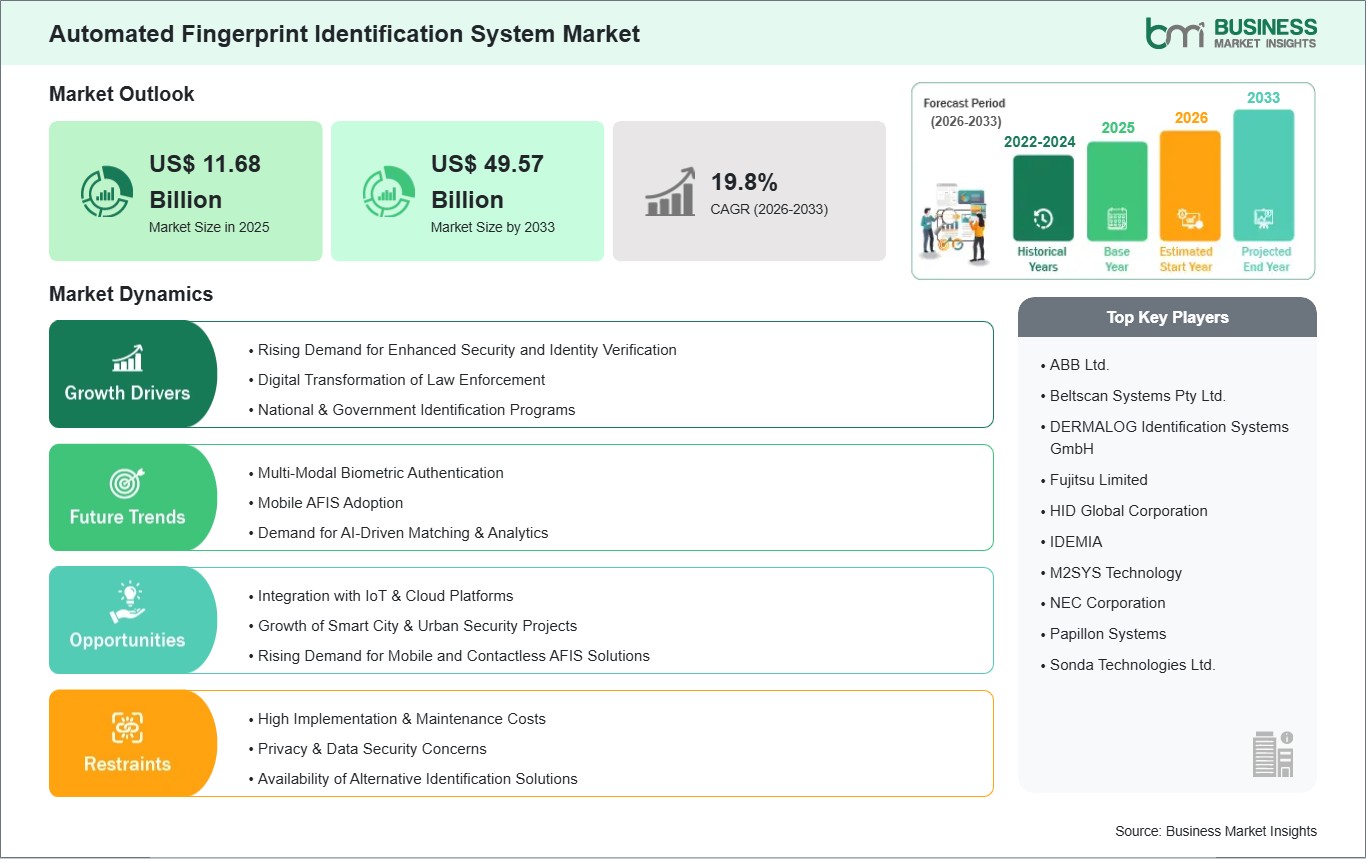
The automated fingerprint identification system market size is expected to reach US$ 49.57 billion by 2033 from US$ 11.68 billion in 2025. The market is estimated to record a CAGR of 19.8% from 2026 to 2033.
The Automated Fingerprint Identification System (AFIS) is a biometric technology designed to capture, store, and compare fingerprint data for identifying or verifying individuals. The meaning of AFIS lies in its ability to provide accurate, fast, and reliable identification, making it a cornerstone in modern security and law enforcement operations. Its usage spans criminal investigations, background checks, border control, access management, and national ID programs, where precise identification is crucial. AFIS enhances investigative efficiency by allowing authorities to match fingerprints against large databases within minutes, significantly reducing manual workload and errors. The demand for AFIS is driven by multiple factors, including the rising need for enhanced security and identity verification, the growth of government and law enforcement initiatives, and increasing incidences of cybercrime and fraud.
Technological advancements such as improved fingerprint scanning sensors, integration with AI and machine learning, and interoperability with other biometric systems further boost its adoption. Additionally, the growing emphasis on secure access to sensitive areas, digital identity management, and criminal justice efficiency continues to propel the global AFIS market, reflecting its critical role in modern security infrastructure.

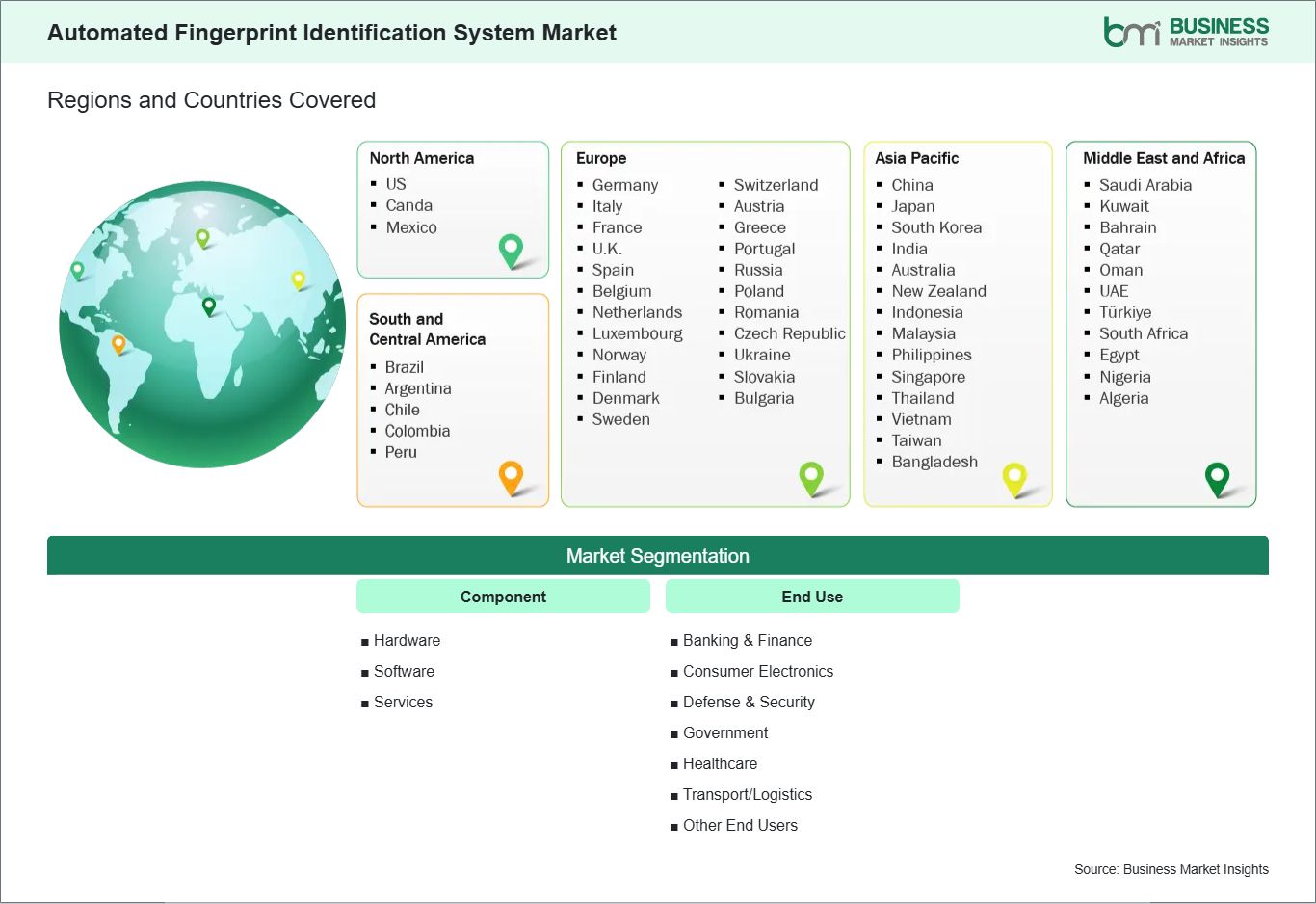
Key segments that contributed to the derivation of the automated fingerprint identification system market analysis are component and end users.
Rising demand for enhanced security and reliable identity verification is a major factor driving the growth of the automated fingerprint identification system (AFIS) market. Governments worldwide are strengthening national security frameworks to address increasing concerns related to crime, terrorism, illegal migration, and identity fraud. As a result, law enforcement and border control agencies are rapidly adopting AFIS solutions to enable accurate, fast, and large-scale identification of individuals. Fingerprint-based systems offer high reliability, uniqueness, and efficiency compared to traditional identification methods, making them essential for criminal investigations, immigration control, and civil identification programs. Additionally, the growing incidence of identity theft and document forgery has encouraged public sector organizations to deploy biometric technologies for secure access control and citizen authentication.
Large-scale initiatives such as national ID programs, e-passports, and voter registration systems further accelerate AFIS adoption. Together, these factors significantly boost demand for advanced fingerprint identification technologies, positioning AFIS as a critical component of modern security and identity management infrastructures globally.
Integration with new technologies such as cloud computing, IoT, and mobile platforms is creating strong growth opportunities for the Automated Fingerprint Identification System (AFIS) market. Cloud-based AFIS solutions enable scalable and cost-efficient storage and processing of large biometric databases, allowing organizations to reduce infrastructure costs while improving system performance and accessibility. Mobile AFIS applications further expand market reach by supporting remote identity verification through smartphones and handheld devices, which is especially valuable for law enforcement, border control, and field operations. In addition, integration with IoT devices enhances real-time fingerprint capture and authentication across smart cities, connected workplaces, and security systems. These technologies support faster deployment, seamless updates, and improved interoperability across platforms.
As governments and commercial sectors increasingly demand flexible, remote, and high-accuracy biometric services, cloud-, mobile-, and IoT-enabled AFIS solutions are becoming essential. This technological convergence is accelerating adoption, encouraging innovation, and driving sustained market expansion worldwide.

By component, the market is segmented into hardware, software, and services. The hardware segment held the largest share of the market in 2025. Rising security needs and government investments are driving strong demand for hardware in the automated fingerprint identification system market, including sensors, scanners, and biometric devices worldwide, across public sectors globally.
By end-use, the market is segmented into banking & finance, consumer electronics, defense & security, government, healthcare, transport/logistics, and others. The banking & finance segment held the largest share of the market in 2025. Growing fraud risks, digital banking expansion, regulatory compliance, need for secure authentication, customer convenience, cost efficiency, verification, and mobile payments adoption are increasing fingerprint identification systems in banking and finance.
| Report Attribute | Details |
|---|---|
| Market size in 2025 | US$ 11.68 Billion |
| Market Size by 2033 | US$ 49.57 Billion |
| Global CAGR (2026 - 2033) | 19.8% |
| Historical Data | 2022-2024 |
| Forecast period | 2026-2033 |
| Segments Covered | By Component
|
|
Regions and Countries Covered
| |
| North America | US, Canada, Mexico |
| Europe | Belgium, Austria, Finland, Denmark, Greece, Poland, Romania, Russia, Ukraine, Czech Republic, Slovakia, Bulgaria, Italy, Luxembourg, Germany, Switzerland, France, Netherlands, Norway, Portugal, Spain, Sweden, United Kingdom |
| Asia-Pacific | Australia, China, India, Japan, South Korea, Indonesia, Malaysia, Philippines, Singapore, Thailand, Vietnam, Bangladesh, New Zealand, Taiwan |
| South and Central America | Brazil, Argentina, Peru, Chile, Colombia |
| Middle East and Africa | Bahrain, Kuwait, Oman, Qatar, Saudi Arabia, United Arab Emirates, Turkiye, South Africa, Egypt, Algeria, Nigeria |
| Market leaders and key company profiles |
|
The "Automated Fingerprint Identification System Market Size and Forecast (2022-2033)" report provides a detailed analysis of the market covering the below areas:
The geographical scope of the automated fingerprint identification system market report is divided into five regions: North America, Asia Pacific, Europe, Middle East & Africa, and South & Central America. The automated fingerprint identification system market in North America is expected to grow significantly during the forecast period.
The North America automated fingerprint identification system market is segmented into the United States, Canada, and Mexico. North America emerges as a dominating region in the global automated fingerprint identification system market, accounting for a significant share of total revenue in 2025. Rising concerns over public safety and national security have driven law enforcement agencies to adopt advanced biometric technologies for accurate and rapid identification. Growing crime rates, cross-border security challenges, and the need for efficient criminal investigations further support AFIS deployment. In addition, strong government initiatives and funding for modernizing law enforcement infrastructure in the United States and Canada accelerate market growth. Technological advancements, such as the integration of artificial intelligence, machine learning, and cloud-based platforms, have improved fingerprint matching accuracy and processing speed, making AFIS more reliable and cost-effective.
The expanding use of biometrics beyond law enforcement—such as in border control, civil identification, healthcare, and financial services—also contributes to higher adoption. Moreover, strict regulatory requirements for identity verification and the presence of major biometric technology providers in North America strengthen market penetration and continuous innovation.

The automated fingerprint identification system market is evaluated by gathering qualitative and quantitative data post primary and secondary research, which includes important corporate publications, association data, and databases. A few of the key developments in the automated fingerprint identification system market are:
The Automated Fingerprint Identification System Market is valued at US$ 11.68 Billion in 2025, it is projected to reach US$ 49.57 Billion by 2033.
As per our report Automated Fingerprint Identification System Market, the market size is valued at US$ 11.68 Billion in 2025, projecting it to reach US$ 49.57 Billion by 2033. This translates to a CAGR of approximately 19.8% during the forecast period.
The Automated Fingerprint Identification System Market report typically cover these key segments-
The historic period, base year, and forecast period can vary slightly depending on the specific market research report. However, for the Automated Fingerprint Identification System Market report:
The Automated Fingerprint Identification System Market is populated by several key players, each contributing to its growth and innovation. Some of the major players include:
The Automated Fingerprint Identification System Market report is valuable for diverse stakeholders, including:
Essentially, anyone involved in or considering involvement in the Automated Fingerprint Identification System Market value chain can benefit from the information contained in a comprehensive market report.
Please tell us your area of interest
(Market Segments/ Regions and Countries/ Companies)