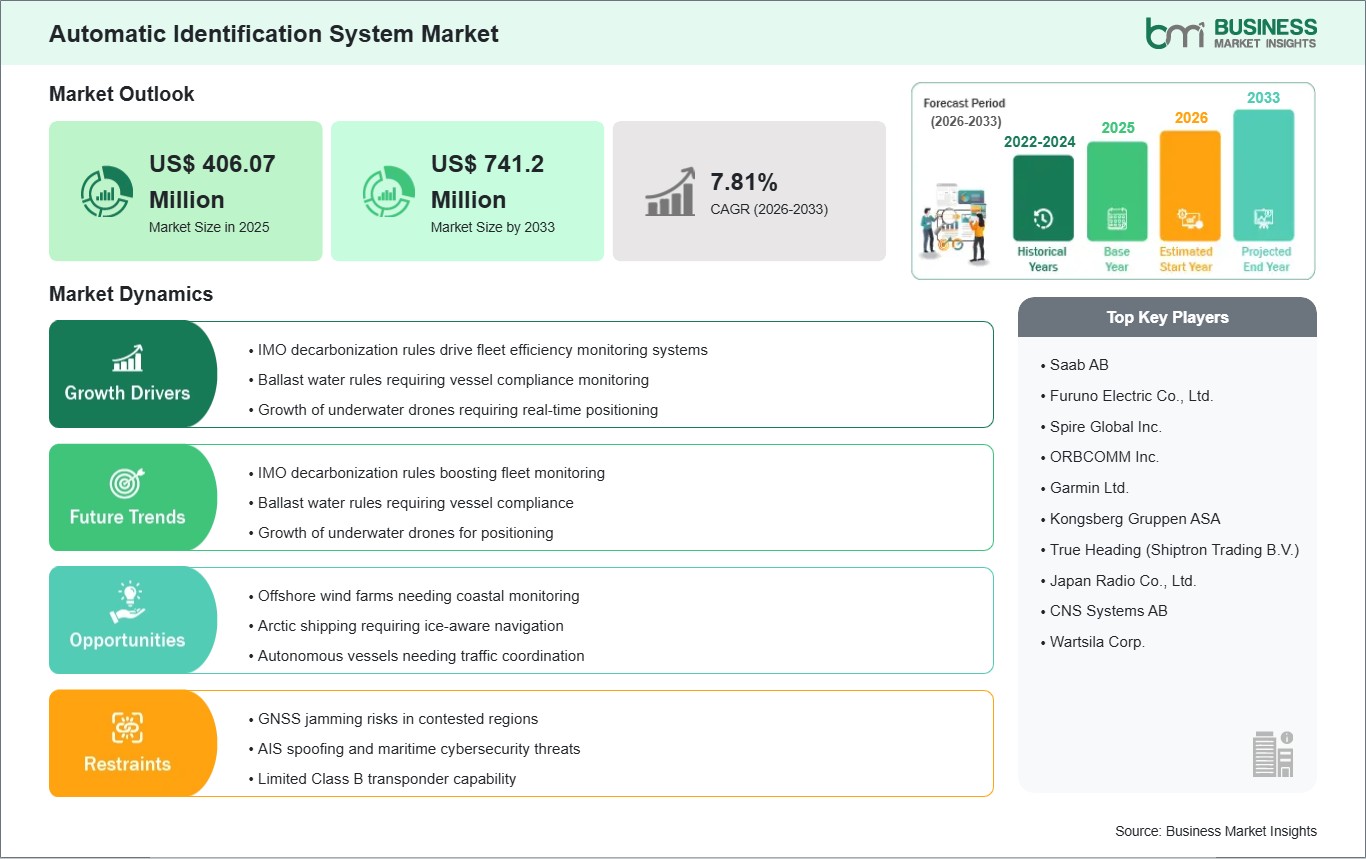
The Automatic Identification System Market size is expected to reach US$ 741.2 Million by 2033 from US$ 406.07 Million in 2025. The market is estimated to record a CAGR of 7.81% from 2026 to 2033.
The global automatic identification system (AIS) market leverages satellite, connected transponders, AI, powered collision avoidance, and dynamic positioning algorithms to enable collision-free navigation in densely trafficked sea lanes as well as on isolated offshore platforms. Such setups combine LTE, V2X receivers, predictive trajectory models, and encrypted SOTDMA protocols, thus achieving up to a 90% risk reduction when compared to traditional radar systems. As a result, autonomous vessels, offshore wind farms, and port digital twins work together smoothly, eliminating collisions. Among the major benefits are 55% lower latency as compared to traditional VHF, 35% reduction in size owing to compact antennas, and asset zoning based on the dashboard, thereby positioning AIS as a key factor in maritime digitization, drone, ship hybrids, and green shipping networks. LEO satellite constellations, IMO safety regulations, and metaverse training simulators are the major growth drivers in the market amid the overwhelming volume of maritime data. Propulsion is the result of decarbonization measures such as IMO 2050 and the decreasing price of eLoran receivers. Issues remain with cyber vulnerabilities in GNSS jamming areas and DSC protocol harmonization. New horizons include quantum, secured beacons, 1ms latency arrays, and subsea drone fleets.

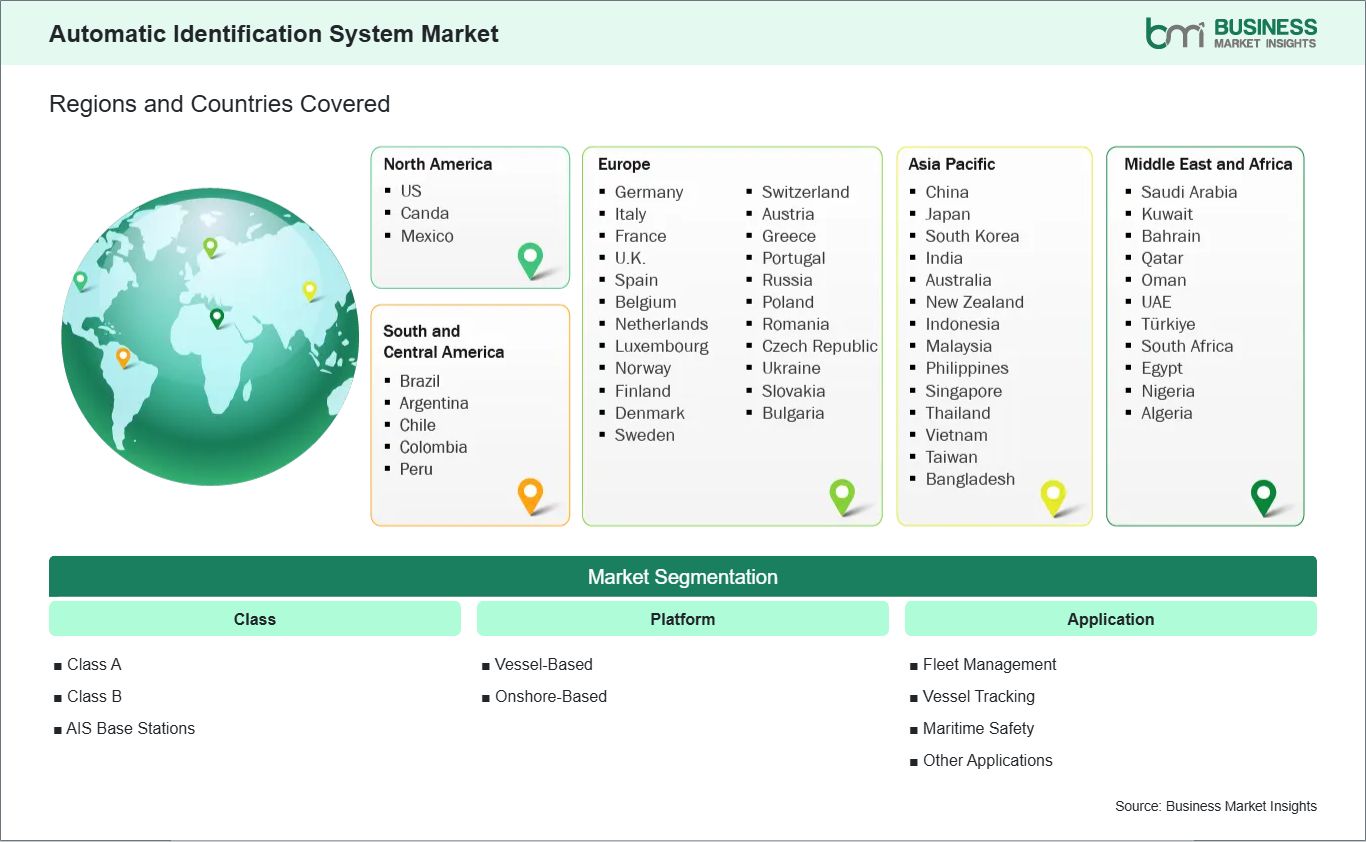
Key segments shaping the global automatic identification system market include class, platform and application.
The automatic identification segment underwent a significant upgrade through the extensive modernization of legacy radars with AI, driven S, AIS decoding, focusing first and foremost on ultra-reliable, adaptive 161.975/162.025MHz links. Saab and Kongsberg transponders can be synchronized with Furuno base stations in order to facilitate dynamic routing. This is how the combination of these two technologies can offer 45% fuel savings through the use of sub-0.5 nm precision for over 200nm horizons, which is the case of crewless bulk carriers.
In compliance with IMO SOLAS regulations, the replacement of a transponder is performed at a rate of 28% per year, thus gradually creating a pipeline that will exceed 2.5M units by 2030. The increase of L-band receiver plants has been helped by the American shipyards, which, besides receiving U.S. Jones Act grants, are also catching up with the latest technology, thus merging the stresses of antennas along the coast in LNG shuttles with LRIT analytics. SOTDMA is the one that performs the best in the fishing grounds which are often very stormy, eLoran, to, AIS conversions bring about a quick return of the investment so, it is the case that AIS networks open the way to hands, free constellations that will be able to deal with zettabyte, scale voyage data, cryogenic, cooled arrays, and carbon targets under 0.5g/km.
One should also note that cyber attacks in the Baltic have been the reason for the development of multispectral sensors that integrate MMSI, heading, and drift detectors to avert spoofing in waters that are contested. GaAs amplifiers are located in the salty HVDC wind farms and are the ones that have experienced a 32% increase in fidelity over their silicon competitors.
Class B and base stations will benefit from the expansion of renewable maritime plus Industry 4.0 bridges, which make it possible for ice, class halos and robotic patrols. NextGen standards combine onshore relays with Starlink for remote monitoring, thus decreasing the amount of cabling needed by 58% as compared to old RDF for trade shows/drills. EU ETS, like mandates, make stations cost less than $8k/unit. At the same time, autonomy requires 50nm/s vessel units under the threshold of US$ 5k. Nano, beacons are reduced to 2cm in size, thus cutting the costs for coastal nodes by half. Offshore sectors use Class A in 24V grids according to IEC 60945. These changes orient the vendors towards US$ 1.2B contracts to 2034, with AIS being the modular hubs for the fragmented satcom and the virtual seas.

By class, the global automatic identification system market splits into Class A, Class B, and AIS Base Stations. The Class A segment topped in 2025. Powers 62% deployments: self-organizing scalability accelerates tanker adoption in SOLAS corridors.
By platform, splits are Vessel-Based, Onshore-Based. The Vessel-Based segment topped in 2025. Secures 70% share; compliance schemes spur swift port-to-vessel expansion.
By application, areas include Fleet Management, Vessel Tracking, Maritime Safety, and Others. The Fleet Management segment owned the biggest slice in 2025. Flexible 1-500nm range supports fluid global handoffs.
| Report Attribute | Details |
|---|---|
| Market size in 2025 | US$ 406.07 Million |
| Market Size by 2033 | US$ 741.2 Million |
| Global CAGR (2026 - 2033) | 7.81% |
| Historical Data | 2022-2024 |
| Forecast period | 2026-2033 |
| Segments Covered | By Class
|
|
Regions and Countries Covered
| |
| North America | US, Canada, Mexico |
| Europe | Belgium, Austria, Finland, Denmark, Greece, Poland, Romania, Russia, Ukraine, Czech Republic, Slovakia, Bulgaria, Italy, Luxembourg, Germany, Switzerland, France, Netherlands, Norway, Portugal, Spain, Sweden, United Kingdom |
| Asia-Pacific | Australia, China, India, Japan, South Korea, Indonesia, Malaysia, Philippines, Singapore, Thailand, Vietnam, Bangladesh, New Zealand, Taiwan |
| South and Central America | Brazil, Argentina, Peru, Chile, Colombia |
| Middle East and Africa | Bahrain, Kuwait, Oman, Qatar, Saudi Arabia, United Arab Emirates, Turkiye, South Africa, Egypt, Algeria, Nigeria |
| Market leaders and key company profiles |
|
The "Automatic identification system market Size and Forecast (2022 - 2033)" report provides a detailed analysis of the market covering below areas:
The geographical scope of the automatic identification system market report is divided into five regions: North America, Asia Pacific, Europe, the Middle East & Africa, and South & Central America. The automatic identification system market in North America registered the highest market share in 2025.
North America still leads with the most extensive fleets and the use of coastal nets in the US, Canada, and Mexico. The US is experiencing a major surge in growth where 162MHz Class A units are powering Maersk's Gulf hubs and Crowley nodes for strategic rerouting. On the other hand, the Canadian coast guard is installing 161MHz stations for Arctic routes. Meanwhile, Mexican shipyards are upgrading onshore base stations to Class 1 standards. Europe is making headway by aligning with Green Voyage 2050 and emission caps. For instance, Norway's Kongsberg is producing the Class B for wind energy arrays, while the UK's Clyde bays have been adapted for RN drills. Frances Naval Group is focusing on low-power transponders for the Atlantic clouds. The Middle East is constructing trade hubs like Saudi Aramco's AIS grids and Dubai's DP World beacons for 6G lanes. Asia Pacific is flourishing through the Belt & Road initiative and fleet targets. As an example, COSCO is grabbing nano, Class A relays. India is still heavily dependent on 100nm/s upgrades but faces problems with the shortage of antennas. South and Central America continue to develop through projections.

The automatic identification system market is evaluated by gathering qualitative and quantitative data post-primary and secondary research, which includes important corporate publications, association data, and databases. A few of the key developments in the automatic identification system market are:
The Automatic Identification System Market is valued at US$ 406.07 Million in 2025, it is projected to reach US$ 741.2 Million by 2033.
As per our report Automatic Identification System Market, the market size is valued at US$ 406.07 Million in 2025, projecting it to reach US$ 741.2 Million by 2033. This translates to a CAGR of approximately 7.81% during the forecast period.
The Automatic Identification System Market report typically cover these key segments-
The historic period, base year, and forecast period can vary slightly depending on the specific market research report. However, for the Automatic Identification System Market report:
The Automatic Identification System Market is populated by several key players, each contributing to its growth and innovation. Some of the major players include:
The Automatic Identification System Market report is valuable for diverse stakeholders, including:
Essentially, anyone involved in or considering involvement in the Automatic Identification System Market value chain can benefit from the information contained in a comprehensive market report.
Please tell us your area of interest
(Market Segments/ Regions and Countries/ Companies)