
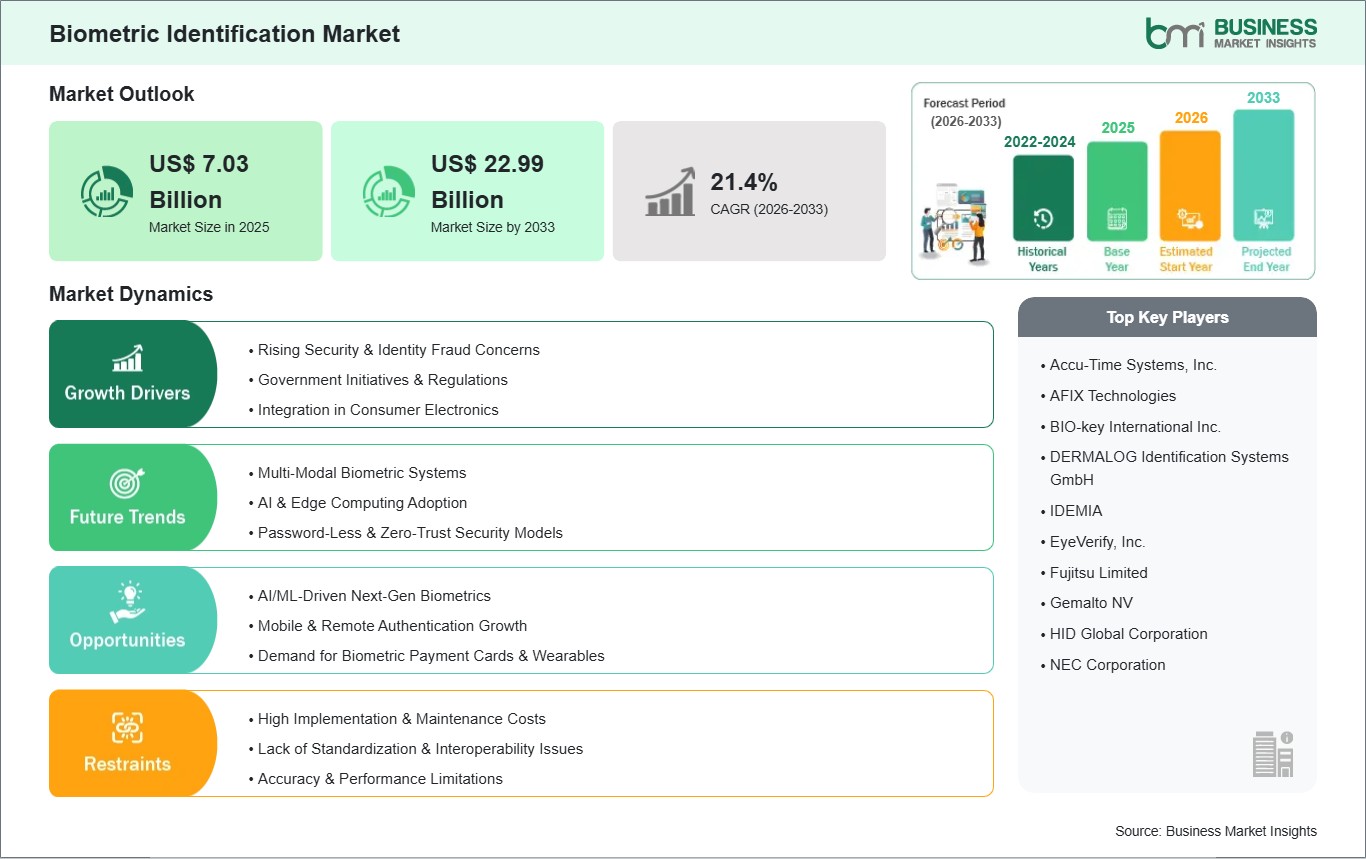
The biometric identification market size is expected to reach US$ 22.99 billion by 2033 from US$ 7.03 billion in 2025. The market is estimated to record a CAGR of 21.4% from 2026 to 2033.
The biometric identification market revolves around technologies that authenticate individuals based on unique physiological or behavioral traits such as fingerprints, facial features, iris patterns, voice, and even gait. The meaning of biometric identification lies in its ability to enhance security, streamline authentication, and reduce reliance on traditional password or ID-based systems, offering both convenience and fraud prevention. Its usage spans multiple sectors, including banking, healthcare, law enforcement, border control, and consumer electronics, where secure access and identity verification are critical.
The market’s growth is primarily driven by demand factors such as increasing security concerns, the rising adoption of smartphones and smart devices equipped with biometric sensors, and the need for seamless, contactless authentication solutions. Moreover, government initiatives for national ID programs, regulatory compliance requirements, and technological advancements like AI-powered recognition systems further fuel adoption. As organizations prioritize data protection and efficient access management, the biometric identification market continues to expand, reflecting a global shift toward safer, more reliable, and user-friendly identity verification solutions across both public and private sectors.

Key segments that contributed to the derivation of the biometric identification market analysis are component, technology, authentication type, and end users.
Rising security and identity fraud concerns are emerging as key drivers of the automated fingerprint identification system (AFIS) Rising security and identity fraud concerns are becoming a major catalyst for the growth of the biometric identification market. As cyberattacks, data breaches, and identity theft incidents increase, both enterprises and governments are seeking more robust methods to protect sensitive information and secure access to critical systems. Traditional authentication methods, such as passwords or PINs, are increasingly seen as vulnerable to hacking, phishing, and social engineering attacks. In response, organizations are turning to biometric technologies—such as fingerprint scanning, facial recognition, iris recognition, and voice authentication—that provide unique, difficult-to-replicate identifiers for individuals.
Biometric authentication not only enhances security but also streamlines access control, reduces fraud, and improves user convenience. Governments are also adopting biometric solutions for border control, national ID programs, and e-governance initiatives, further boosting demand. Overall, escalating concerns over security and identity fraud are driving enterprises and public institutions toward advanced biometric systems to safeguard data and ensure trust.
The integration of AI and machine learning into next-generation biometric systems is driving significant growth opportunities in the biometric identification market. By leveraging advanced analytics, these systems can process complex patterns in fingerprints, facial features, iris scans, and voice recognition with remarkable speed and accuracy. AI/ML-driven biometrics continuously learn and adapt to new data, reducing false positives and negatives, which enhances reliability in critical applications such as border security, banking, and healthcare.
This increased precision not only improves user trust but also enables broader adoption across industries that require secure and seamless identification. Additionally, predictive analytics and anomaly detection capabilities allow organizations to proactively identify fraudulent or unauthorized access, creating new avenues for service offerings. As governments and enterprises prioritize security and efficiency, the deployment of AI/ML-enhanced biometrics is expanding market demand, driving innovation, and opening revenue streams in software, hardware, and integrated security solutions.
By component, the market is segmented into hardware, software, and services. The hardware segment held the largest share of the market in 2025. Rising security needs and government investments are driving strong demand for hardware in the automated fingerprint identification system market, including sensors, scanners, and biometric devices worldwide, across public sectors globally.
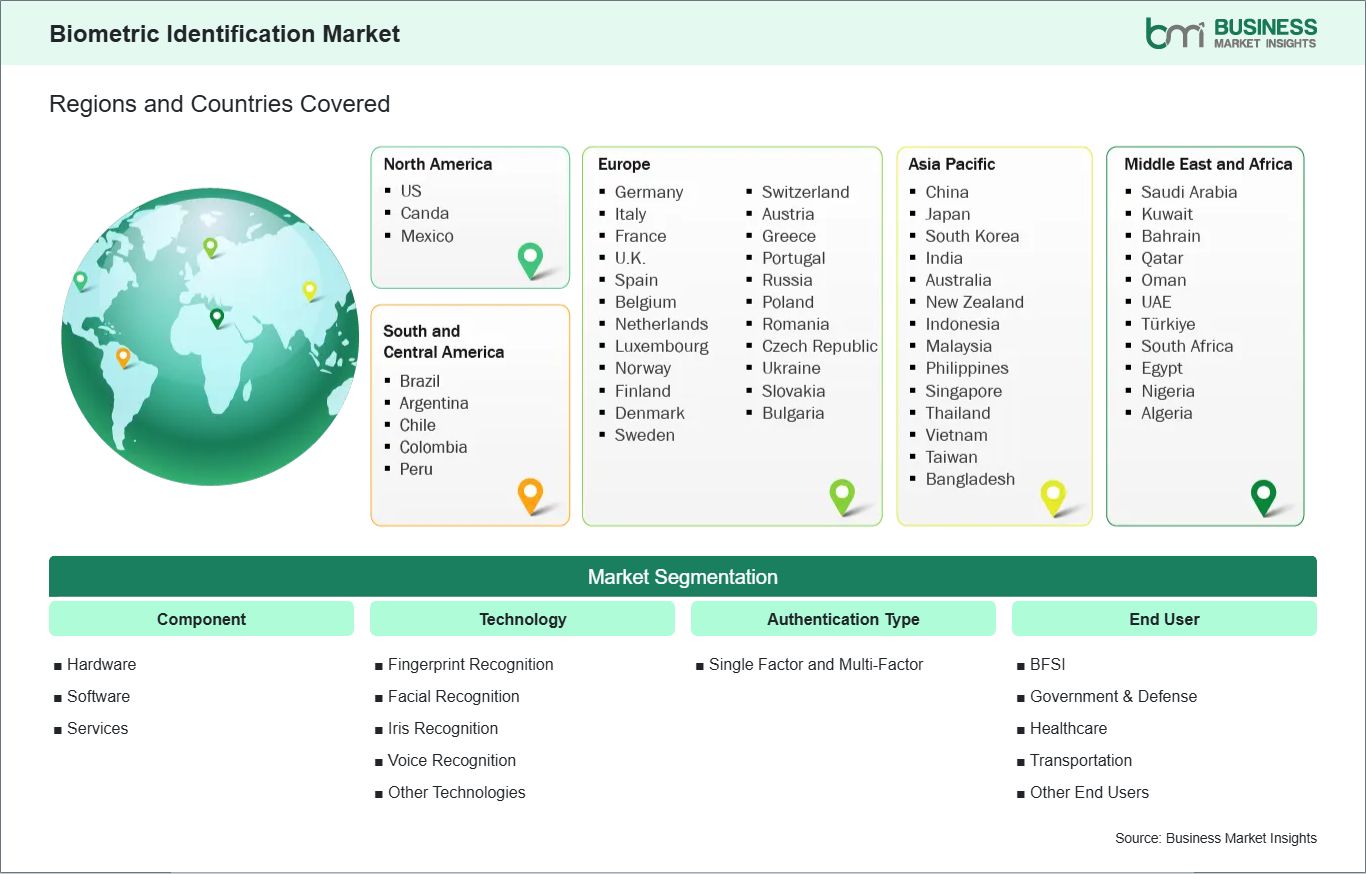
By technology, the market is segmented into fingerprint recognition, facial recognition, iris recognition, voice recognition, and others. The fingerprint recognition segment held the largest share of the market in 2025. Increasing security concerns, rising smartphone and smart device usage, government regulations, growing adoption in banking and healthcare, technological advancements, and the need for convenient, contactless authentication are key factors boosting fingerprint recognition demand.
By authentication type, the market is segmented into single factor and multi-factor. The single factor segment held the largest share of the market in 2025. Rising demand for single-factor biometric identification is driven by convenience, faster authentication, enhanced security, growing mobile device use, e-commerce expansion, financial services adoption, identity verification needs, and regulatory compliance requirements.
By end user, the market is segmented into BFSI, government & defense, healthcare, transportation, and others. The BFSI segment held the largest share of the market in 2025. The adoption of biometric identification in BFSI is driven by enhanced security, faster authentication, reduced fraud, regulatory compliance, customer convenience, technological advancements, cost efficiency, and growing digital banking demand, ensuring trust.
| Report Attribute | Details |
|---|---|
| Market size in 2025 | US$ 7.03 Billion |
| Market Size by 2033 | US$ 22.99 Billion |
| Global CAGR (2026 - 2033) | 21.4% |
| Historical Data | 2022-2024 |
| Forecast period | 2026-2033 |
| Segments Covered | By Component
|
|
Regions and Countries Covered
| |
| North America | US, Canada, Mexico |
| Europe | Belgium, Austria, Finland, Denmark, Greece, Poland, Romania, Russia, Ukraine, Czech Republic, Slovakia, Bulgaria, Italy, Luxembourg, Germany, Switzerland, France, Netherlands, Norway, Portugal, Spain, Sweden, United Kingdom |
| Asia-Pacific | Australia, China, India, Japan, South Korea, Indonesia, Malaysia, Philippines, Singapore, Thailand, Vietnam, Bangladesh, New Zealand, Taiwan |
| South and Central America | Brazil, Argentina, Peru, Chile, Colombia |
| Middle East and Africa | Bahrain, Kuwait, Oman, Qatar, Saudi Arabia, United Arab Emirates, Turkiye, South Africa, Egypt, Algeria, Nigeria |
| Market leaders and key company profiles |
|
The "Biometric Identification Market Size and Forecast (2022-2033)" report provides a detailed analysis of the market covering below areas:
The geographical scope of the biometric identification market report is divided into five regions: North America, Asia Pacific, Europe, Middle East & Africa, and South & Central America. The biometric identification market in North America is expected to grow significantly during the forecast period.
The North America biometric identification market is segmented into United States, Canada, and Mexico. North America emerges as a dominating region in the global biometric identification market, accounting for a significant share of total revenue in 2025. Increasing security concerns in both public and private sectors have made organizations prioritize accurate and reliable identity verification, positioning biometrics as a preferred solution over traditional methods such as passwords or ID cards. The rise of digital transformation across industries, including banking, healthcare, and government services, has created a strong demand for faster, seamless, and contactless authentication solutions.
Technological advancements in fingerprint, facial recognition, and iris scanning systems, coupled with decreasing costs and improved accuracy, further accelerate adoption. Regulatory support and growing awareness of data privacy and fraud prevention also encourage businesses to integrate biometric systems. Additionally, the widespread use of smartphones and wearable devices with built-in biometric sensors has familiarized consumers with this technology, fostering trust and acceptance. Collectively, these factors are driving robust growth in North America’s biometric identification market.

The biometric identification market is evaluated by gathering qualitative and quantitative data post primary and secondary research, which includes important corporate publications, association data, and databases. A few of the key developments in the biometric identification market are:
The Biometric Identification Market is valued at US$ 7.03 Billion in 2025, it is projected to reach US$ 22.99 Billion by 2033.
As per our report Biometric Identification Market, the market size is valued at US$ 7.03 Billion in 2025, projecting it to reach US$ 22.99 Billion by 2033. This translates to a CAGR of approximately 21.4% during the forecast period.
The Biometric Identification Market report typically cover these key segments-
The historic period, base year, and forecast period can vary slightly depending on the specific market research report. However, for the Biometric Identification Market report:
The Biometric Identification Market is populated by several key players, each contributing to its growth and innovation. Some of the major players include:
The Biometric Identification Market report is valuable for diverse stakeholders, including:
Essentially, anyone involved in or considering involvement in the Biometric Identification Market value chain can benefit from the information contained in a comprehensive market report.
Please tell us your area of interest
(Market Segments/ Regions and Countries/ Companies)