Market Summary
Executive Summary and Global Market Analysis
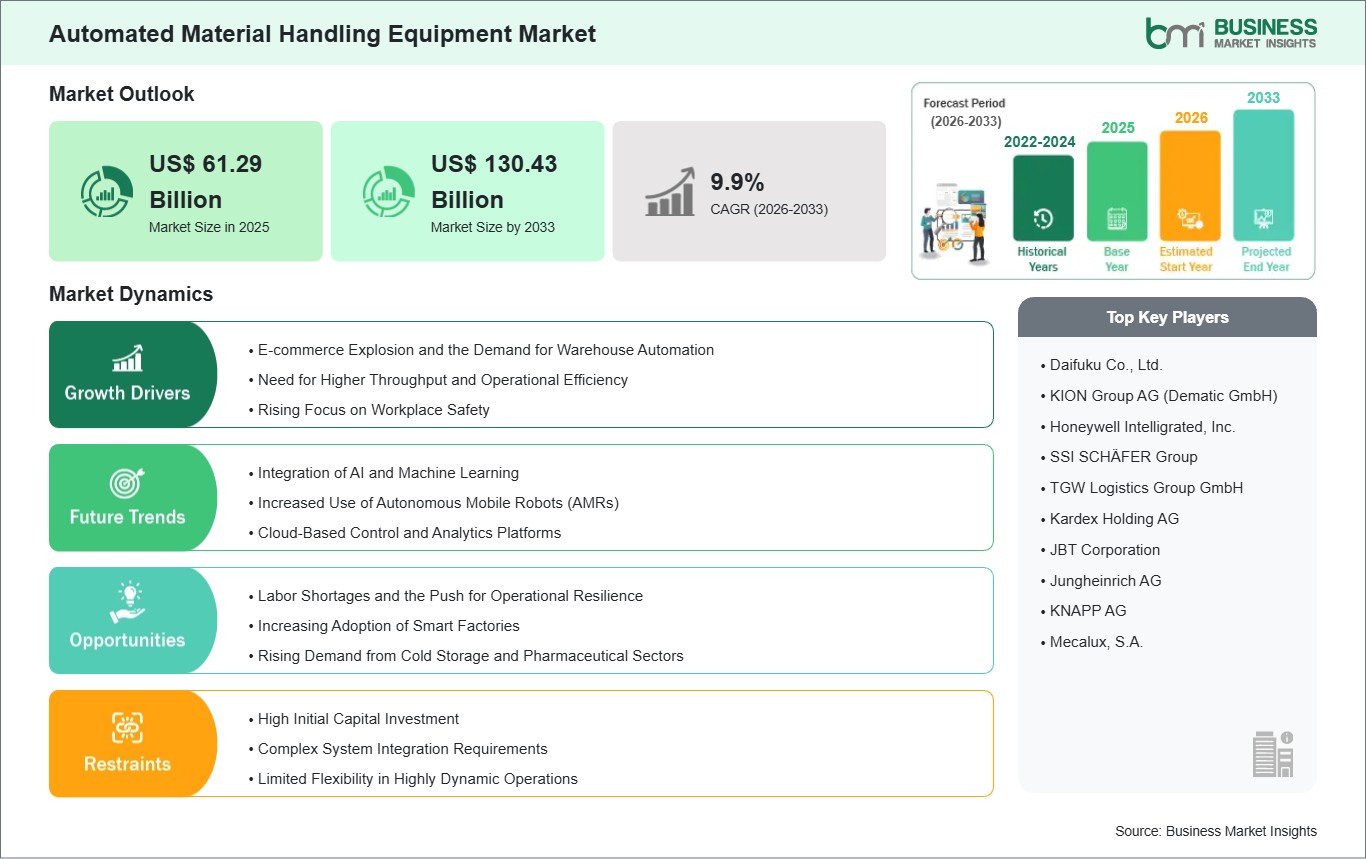
The global automated material handling equipment (AMHE) market is experiencing transformative growth, driven by the relentless pursuit of operational efficiency, accuracy, and scalability across logistics, manufacturing, and distribution networks worldwide. This market encompasses a broad array of technologies—from autonomous mobile robots (AMRs) and automated guided vehicles (AGVs) to sophisticated automated storage and retrieval systems (AS/RS) and intelligent conveyor systems—designed to move, store, control, and protect materials without direct human intervention. Core growth drivers include the exponential rise of e-commerce, which demands faster and more flexible fulfillment solutions; persistent labor shortages and rising wage costs; and the overarching adoption of Industry 4.0 principles, integrating robotics, IoT, and AI to create smart, interconnected factories and warehouses.
Despite its strong trajectory, the market contends with significant challenges, including high initial capital expenditure for advanced systems, complexities in integrating new technologies with legacy infrastructure, and ongoing concerns regarding cybersecurity in connected industrial environments. However, compelling opportunities emerging from the miniaturization and cost-reduction of robotic components, the proliferation of flexible "as-a-service" and robotic leasing models, and the growing need for automation in sectors like pharmaceuticals and food & beverage to ensure stringent hygiene, traceability, and compliance standards.
Segment Analysis
Automated Material Handling Equipment Market Segmentation
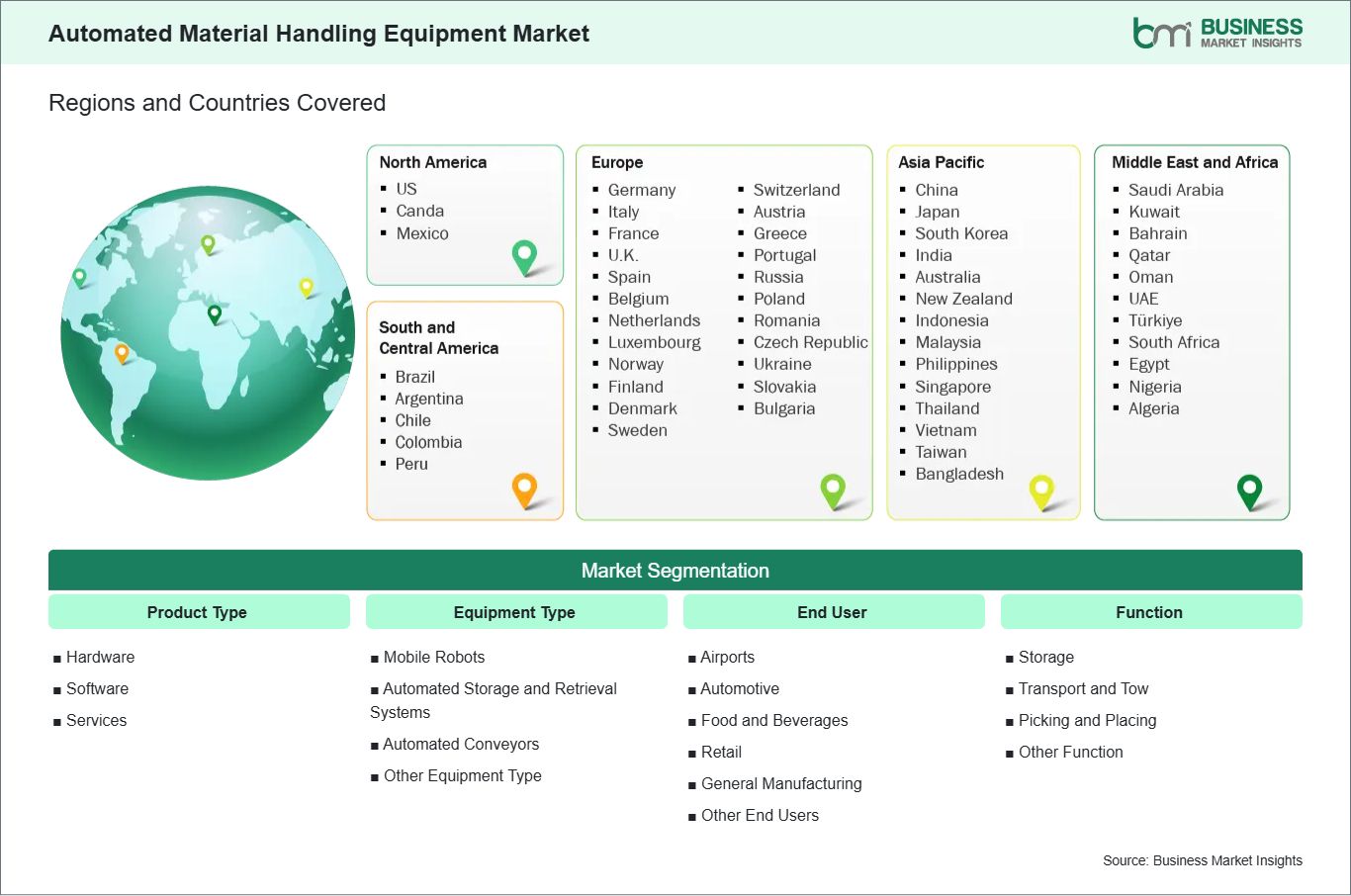
Key segments that contributed to the derivation of the automated material handling equipment market analysis are product type, equipment type, end user, and function.
- By product type, the automated material handling equipment market is segmented into hardware, software, and services. The hardware segment, comprising the physical robots, conveyors, and AS/RS, dominated the market in 2025.
- By equipment type, the market is categorized into mobile robots, automated storage and retrieval systems (AS/RS), automated conveyors, and others. The mobile robots segment held a substantial and rapidly growing share in 2025, fueled by their flexibility and ease of deployment.
- By end user, the automated material handling equipment market is segmented into airports, automotive, food and beverages, retail, general manufacturing, and others. The e-commerce and general manufacturing segment accounted for the largest share in 2025, driven by massive investments in warehouse automation.
- By function, the market is segmented into storage, transport and tow, picking and placing, and others. The transport and tow function held a leading share, as the movement of goods is the most fundamental and widespread application of automation.
Market Forces
Automated Material Handling Equipment Market Drivers and Opportunities
E-commerce Explosion and the Demand for Warehouse Automation
The unprecedented growth of online retail is the single most powerful driver for the automated material handling equipment market. E-commerce companies face immense pressure to fulfill orders faster, with higher accuracy, and at lower costs. This has led to massive investments in automated fulfillment centers equipped with mobile robots for goods-to-person picking, high-density AS/RS for inventory management, and sophisticated sortation conveyors. The need to manage high-volume, multi-SKU (stock-keeping unit) environments with seasonal peaks makes automation not just advantageous but essential for competitive survival and scalability.
Labor Shortages and the Push for Operational Resilience
Persistent and widespread labor shortages in logistics, manufacturing, and warehousing are compelling companies to adopt automation as a strategic solution. Automated material handling equipment provides a reliable, consistent, and scalable workforce that can operate 24/7, mitigating risks associated with human resource volatility. This driver is particularly strong in developed economies with aging demographics and high labor costs, but is increasingly relevant globally. The opportunity lies not in replacing all human labor, but in creating collaborative environments where robots handle repetitive, strenuous, or dangerous tasks, thereby augmenting human workers and improving overall workplace safety and productivity.
Size and Share Analysis
Automated Material Handling Equipment Market Size and Share Analysis
By product type, the automated material handling equipment market is segmented into hardware, software, and services. The hardware segment held the dominant share in 2025, as it represents the substantial capital investment in physical automation assets. However, the software and services segments are growing at an accelerated pace, driven by the critical need for fleet management software, system integration, and ongoing maintenance and optimization services.
By equipment type, mobile robots (including AMRs and AGVs) are capturing the fastest-growing share, owing to their modularity, declining costs, and ability to work alongside humans without major fixed infrastructure changes. Automated Storage and Retrieval Systems (AS/RS) continue to hold a major share in high-throughput distribution and manufacturing applications where space optimization is critical.
By end user, the e-commerce/retail and general manufacturing sectors are the largest consumers, driven by their scale and continuous pressure to optimize supply chains. The automotive sector remains a significant and mature adopter, especially for assembly line and parts handling automation.
By function, while transport and tow applications dominate in volume, the picking and placing function is witnessing explosive growth, directly correlated to e-commerce fulfillment needs where order picking is the most labor-intensive and costly process.
Report Coverage
Automated Material Handling Equipment Market Report Coverage and Deliverables
The "Automated Material Handling Equipment Market Size and Forecast (2022–2033)" report provides a detailed analysis of the market covering below areas:
- Automated Material Handling Equipment Market size and forecast at global, regional, and country levels for all the key market segments covered under the scope
- Automated Material Handling Equipment Market trends, as well as market dynamics such as drivers, restraints, and key opportunities
- Automated Material Handling Equipment Market analysis covering key market trends, global and regional framework, major players, regulations, and recent market developments
- Industry landscape and competition analysis covering market concentration, heat map analysis, prominent players, and recent developments for the automated material handling equipment market
- Detailed company profiles, including SWOT analysis
Geographic Insights
Automated Material Handling Equipment Market Geographic Insights
The geographical scope of the automated material handling equipment market report is divided into five regions: North America, Asia Pacific, Europe, Middle East & Africa, and South & Central America. The automated material handling equipment market in Asia Pacific is expected to register the highest growth during the forecast period, while North America currently represents the largest revenue share.
The Asia-Pacific automated material handling equipment market, segmented across China, Japan, India, South Korea, and Southeast Asia, is the primary growth engine. This is driven by the region's status as the "world's factory," massive investments in smart manufacturing (e.g., China's "Made in China 2025"), booming domestic e-commerce markets, and government initiatives promoting industrial automation to maintain competitiveness. China, in particular, is both a massive consumer and a leading manufacturer of AMHE.
North America, led by the United States, holds the largest market share due to its advanced logistics infrastructure, high labor costs, and the presence of global e-commerce and retail giants that are at the forefront of warehouse automation. Europe follows as a mature market with strong adoption in automotive manufacturing and a growing focus on automating logistics to address labor shortages and improve sustainability in the supply chain.
Industry Activity
Recent Developments
The automated material handling equipment market is evaluated by gathering qualitative and quantitative data post primary and secondary research, which includes important corporate publications, association data, and databases. A few of the key developments in the automated material handling equipment market are:
- In December 2025, OMRON Robotics and Safety Technologies has announced a major expansion and upgrade to its TM S Series of collaborative robots. This comprehensive release introduces three new high-performance robots—the TM30S, TM20S, and TM6S—alongside critical hardware enhancements and the launch of the powerful TMflow 2.22 software platform.
- In December 2025, Applied Manufacturing Technologies (AMT), North America's leader in automation engineering, specializing in advanced material handling, end-of-line solutions, on-demand engineering services, and autonomous mobile robots (AMRs) for manufacturing, warehousing, and logistics, announced the deployment of four robotic roll handling systems designed for converting industry applications.
- In October 2025, Toyota Material Handling North America (TMHNA), comprised of the Raymond Corporation and Toyota Material Handling brands, is making a strategic investment in Advanced Charging Technologies (ACT). ACT, a long-standing provider of charging solutions to both Raymond and Toyota, develops advanced battery charging technologies for the material handling industry. Through this investment, ACT will continue to serve TMHNA’s distribution network and expand its reach as a preferred provider of next-generation energy solutions.
Trust & Transparency
Research Methodology
The market analysis combines proprietary research with secondary data from government agencies, company disclosures, regulatory filings, industry databases and expert interviews. Market estimates are validated through data triangulation, cross-market benchmarking and analyst
review.
View Full Research Methodology
Key Sources Referred:
World Bank – Global Trade Indicators World Trade Organization (WTO) International Monetary Fund (IMF) International Trade Administration (ITA) Company website Company annual reports Company investor presentations