Automated Feeding Systems Market Outlook (2022-2033)

Historic Data: 2022-2024   |   Base Year: 2025   |   Forecast Period: 2026-2033
Report Content: Market Scope, Market Segmentation, Market Dynamics, and Competitive Analysis

Report Coverage:
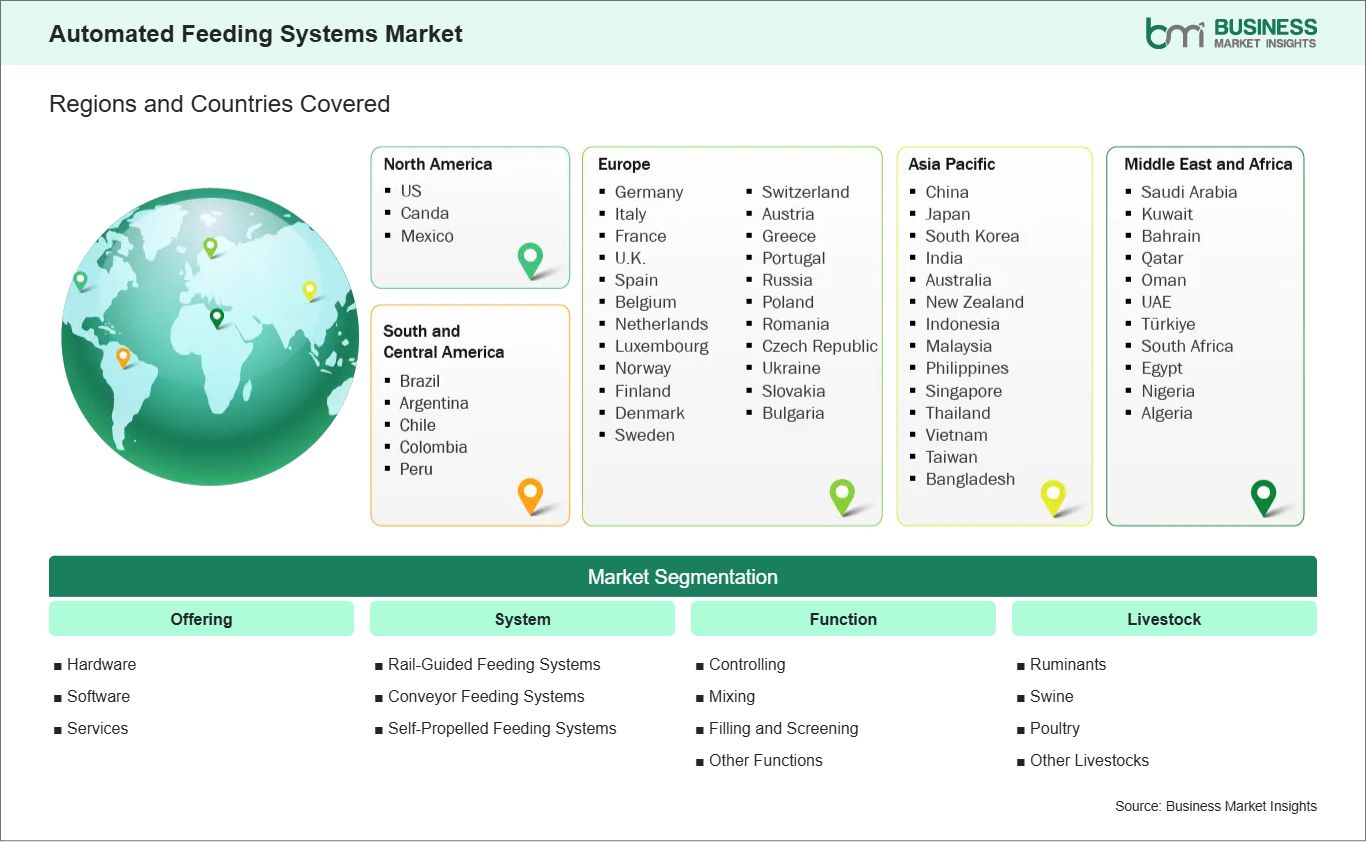
  • Offering (Hardware, Software, and Services)
  • System (Rail-Guided Feeding Systems, Conveyor Feeding Systems, and Self-Propelled Feeding Systems)
  • Function (Controlling, Mixing, Filling and Screening, and Other Functions)
  • Livestock (Ruminants, Swine, Poultry, and Other Livestocks)

No. of Pages: 400
Report Code: BMIPUB00033282
Category: Electronics and Semiconductor
Automated Feeding Systems Market
Buy Now

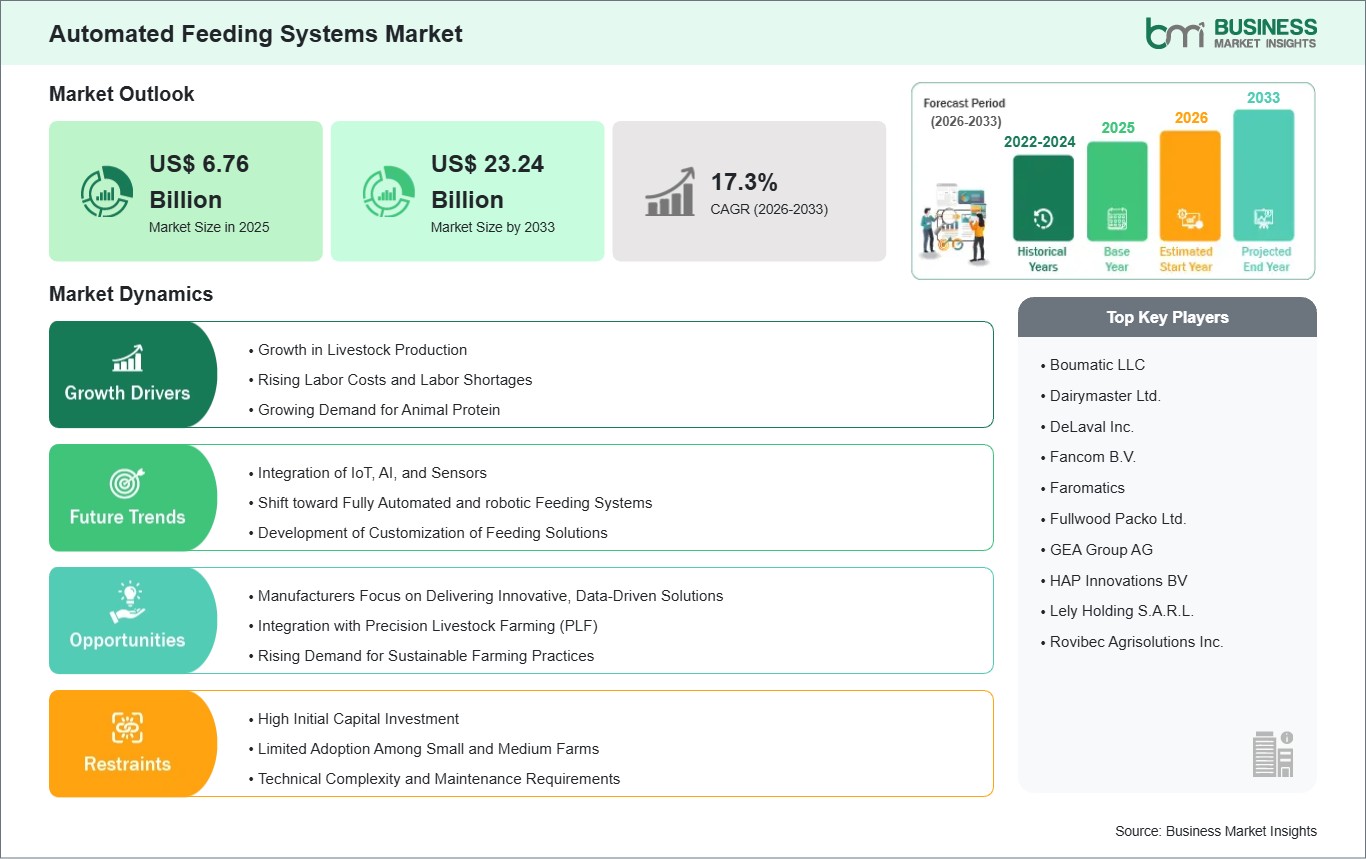
The automated feeding systems market size is expected to reach US$ 23.24 billion by 2033 from US$ 6.76 billion in 2025. The market is estimated to record a CAGR of 17.3% from 2026 to 2033.

Executive Summary and Global Market Analysis:

The global automated feeding systems market is experiencing strong growth driven by the increasing need for efficiency, productivity, and precision in livestock and aquaculture operations. With rising livestock populations worldwide and a shift toward technologically advanced farm operations, the market is projected to expand significantly over the coming years. Automated feeding solutions reduce labor dependency, minimize feed wastage, and enhance overall animal health by ensuring precise feed delivery, which is particularly crucial amid rising operational costs and labor shortages. Developed regions like North America and Europe currently lead in adoption owing to large commercial farms and advanced agricultural practices, while Asia-Pacific markets are rapidly growing due to expanding commercial farming, increased awareness of precision agriculture, and investments in modern livestock technologies. Key market players are innovating with IoT-enabled systems, robotics, and AI to optimize feeding schedules, monitor consumption patterns, and integrate data analytics for better farm management. Challenges remain, including high upfront equipment costs and integration barriers for smaller farms. However, ongoing collaborations between technology and agricultural firms are expected to drive further innovation. Overall, the market is poised for continued expansion as smart farming and sustainable livestock management gain prominence globally.

Automated Feeding Systems Market - Strategic Insights:

global-market-strategic-framework
Get more information on this report

Automated Feeding Systems Market Segmentation Analysis:

Key segments that contributed to the derivation of the automated feeding systems market analysis are offering, system, function, livestock, and technology.

  • By offering, the market is segmented into hardware, software, and services. The hardware segment held the largest share of the market in 2025.
  • By system, the market is divided into rail-guided feeding systems, conveyor feeding systems, and self-propelled feeding systems. The conveyor feeding systems segment held the largest share of the market in 2025.
  • By function, the market is segmented into controlling, mixing, filling and screening, and others. The controlling segment held the largest share of the market in 2025.
  • By livestock, the market is segmented into ruminants, swine, poultry, and others. The poultry segment held the largest share of the market in 2025.
  • By technology, the market is segmented into guidance and remote sensing technology, robotics and telemetry, RFID technology, and others. The guidance and remote sensing technology segment held the largest share of the market in 2025.

Automated Feeding Systems Market Drivers and Opportunities:

Growth in Livestock Production

One of the primary drivers of the automated feeding systems market is the growth in livestock production, which stems from rising global demand for animal protein such as poultry, dairy, and meat products. As consumer preferences shift toward higher protein diets, especially in emerging economies—livestock operations are expanding in scale and intensiveness to meet this demand, necessitating more efficient and reliable feeding solutions. Modern automated feeding systems play a crucial role by delivering precise and consistent nutrition, which directly supports improved animal health, productivity, and yield outcomes. This precision reduces feed wastage, ensures uniform feed distribution, and optimizes nutritional intake, which becomes vital in large-scale operations where manual feeding is inefficient and labor-intensive. Stricter animal welfare standards and heightened regulations focus on nutrition and sustainability further push producers toward advanced feeding automation. Consequently, this surge in livestock production and operational sophistication significantly boosts adoption rates of automated feeding technologies worldwide.

Manufacturers Focus on Delivering Innovative, Data-Driven Solutions

A significant opportunity for the automated feeding systems market lies in collaboration with technology companies to deliver innovative, data-driven solutions. Feeding system manufacturers can partner with firms specializing in artificial intelligence (AI), machine learning (ML), and the Internet of Things (IoT) to enhance the intelligence and automation capabilities of feeding platforms. By integrating advanced sensors and real-time analytics, these collaborations can enable precision feed delivery, monitor animal behavior and health metrics, and offer predictive insights that improve decision-making on the farm. Such smart feeding ecosystems not only drive operational efficiency and feed utilization but also help farmers minimize waste and lower overall costs. As livestock producers increasingly adopt digital farm management tools, this technological integration represents a lucrative pathway for market expansion. Moreover, AI-enabled feeding systems can address broader industry goals around sustainability and traceability by optimizing resource use and reducing environmental impact, opening doors to new revenue streams and value-added services.

Automated Feeding Systems Market Size and Share Analysis:

By offering, the market is segmented into hardware, software, and services. The hardware segment held the largest share of the market in 2025. Hardware dominates the offering segment, driven by strong demand for automated feeders, conveyors, sensors, and controllers. These physical components form the backbone of automated feeding systems, enabling reliable operation, durability, and seamless integration with advanced farm management technologies.

By system, the market is divided into rail-guided feeding systems, conveyor feeding systems, and self-propelled feeding systems. The conveyor feeding systems segment held the largest share of the market in 2025. Conveyor feeding systems hold a dominant position as they enable efficient, uniform feed distribution across large livestock facilities. Their reliability, scalability, and ability to reduce labor costs make them a preferred choice for modern commercial farming operations.

By function, the market is segmented into controlling, mixing, filling and screening, and others. The controlling segment held the largest share of the market in 2025. The controlling function dominates the market as it ensures precise feed distribution, optimizes feeding schedules, minimizes waste, and improves livestock productivity. Advanced control systems enable real-time monitoring, automation, and data-driven decision-making for efficient farm operations.

By livestock, the market is divided into ruminants, swine, poultry, and others. The poultry segment held the largest share of the market in 2025. Poultry represents the leading livestock segment due to high global demand for poultry meat and eggs. Automated feeding systems support large-scale operations by improving feed efficiency, ensuring uniform nutrition, reducing labor dependency, and enhancing overall flock health and productivity.

By technology, the market is segmented into guidance and remote sensing technology, robotics and telemetry, RFID technology, and others. The guidance and remote sensing technology segment held the largest share of the market in 2025. Guidance and remote sensing technology leads the market by enabling precise feed delivery and continuous monitoring of livestock behavior. This technology improves operational efficiency, reduces wastage, and supports data-driven management through real-time tracking and environmental sensing capabilities.

Automated Feeding Systems Market Report Highlights:

Report Attribute Details
Market size in 2025 US$ 6.76 Billion
Market Size by 2033 US$ 23.24 Billion
Global CAGR (2026 - 2033)17.3%
Historical Data 2022-2024
Forecast period 2026-2033
Segments Covered By Offering
  • Hardware
  • Software
  • Services
By System
  • Rail-Guided Feeding Systems
  • Conveyor Feeding Systems
  • Self-Propelled Feeding Systems
By Function
  • Controlling
  • Mixing
  • Filling and Screening
  • Other Functions
By Livestock
  • Ruminants
  • Swine
  • Poultry
  • Other Livestocks
Regions and Countries Covered North America
  • US
  • Canada
  • Mexico
Europe
  • Belgium
  • Austria
  • Finland
  • Denmark
  • Greece
  • Poland
  • Romania
  • Russia
  • Ukraine
  • Czech Republic
  • Slovakia
  • Bulgaria
  • Italy
  • Luxembourg
  • Germany
  • Switzerland
  • France
  • Netherlands
  • Norway
  • Portugal
  • Spain
  • Sweden
  • United Kingdom
Asia-Pacific
  • Australia
  • China
  • India
  • Japan
  • South Korea
  • Indonesia
  • Malaysia
  • Philippines
  • Singapore
  • Thailand
  • Vietnam
  • Bangladesh
  • New Zealand
  • Taiwan
South and Central America
  • Brazil
  • Argentina
  • Peru
  • Chile
  • Colombia
Middle East and Africa
  • Bahrain
  • Kuwait
  • Oman
  • Qatar
  • Saudi Arabia
  • United Arab Emirates
  • Turkiye
  • South Africa
  • Egypt
  • Algeria
  • Nigeria
Market leaders and key company profiles
  • Boumatic LLC
  • Dairymaster Ltd.
  • DeLaval Inc.
  • Fancom B.V.
  • Faromatics
  • Fullwood Packo Ltd.
  • GEA Group AG
  • HAP Innovations BV
  • Lely Holding S.A.R.L.
Get more information on this report

Automated Feeding Systems Market Report Coverage and Deliverables:

The "Automated Feeding Systems Market Size and Forecast (2022–2033)" report provides a detailed analysis of the market covering below areas:

  • Automated feeding systems market size and forecast at global, regional, and country levels for all the key market segments covered under the scope
  • Automated feeding systems market trends, as well as market dynamics such as drivers, restraints, and key opportunities
  • Automated feeding systems market analysis covering key market trends, global and regional framework, major players, regulations, and recent market developments
  • Industry landscape and competition analysis covering market concentration, heat map analysis, prominent players, and recent developments for the air circuit breaker market
  • Detailed company profiles, including SWOT analysis

Automated Feeding Systems Market Geographic Insights:

The geographical scope of the automated feeding systems market report is divided into five regions: North America, Asia Pacific, Europe, Middle East & Africa, and South & Central America. The automated feeding systems market in North America is expected to grow significantly during the forecast period.

The North America automated feeding systems market is segmented into United States, Canada, and Mexico. North America emerges as a dominating region in the global automated feeding systems market, accounting for a significant share of total revenue in 2024. The strong presence of large commercial livestock operations in the United States and Canada, coupled with advanced agricultural infrastructure and early adoption of automation technologies, underpins this leadership. North American farms are increasingly integrating precision feeding solutions to optimize feed efficiency, reduce labor costs, and enhance overall productivity, which has bolstered the uptake of automated feeding systems in dairy, poultry, and swine sectors. The region’s dominance is further supported by established market players headquartered there, ongoing investments in smart farming solutions, and favorable policies promoting mechanization across livestock operations. This strategic advantage positions North America at the forefront of market growth through the forecast period, as adoption of automated and IoT-enabled feeding systems continues to accelerate in response to rising demand for efficiency and sustainability in livestock management.

global-market-geography
Get more information on this report

Automated Feeding Systems Market Research Report Guidance:

  • The report includes qualitative and quantitative data in the automated feeding systems market across offering, system, function, livestock, technology, and geography.
  • The report starts with the key takeaways (chapter 2), highlighting the key trends and outlook of the automated feeding systems market.
  • Chapter 3 includes the research methodology of the study.
  • Chapter 4 further includes ecosystem analysis.
  • Chapter 5 highlights the major industry dynamics in the automated feeding systems market, including factors that are driving the market, prevailing deterrents, potential opportunities, as well as future trends. Impact analysis of these drivers and restraints is also covered in this section.
  • Chapter 6 discusses the automated feeding systems market scenario, in terms of historical market revenues, and forecast till the year 2031.
  • Chapters 7 to 10 cover automated feeding systems market segments by offering, system, function, livestock, technology, and geography across North America, Europe, Asia Pacific, Middle East and Africa, and South and Central America. They cover the market volume revenue forecast and factors driving the market.
  • Chapter 11 describes the competitive analysis along with the heat map analysis for the key players operating in the market.
  • Chapter 12 describes the industry landscape analysis. It provides detailed descriptions of business activities such as market initiatives, new developments, mergers, and joint ventures globally, along with a competitive landscape.
  • Chapter 13 provides detailed profiles of the major companies operating in the automated feeding systems market. Companies have been profiled on the basis of their key facts, business descriptions, products and services, financial overview, SWOT analysis, and key developments.
  • Chapter 14, i.e., the appendix is inclusive of a brief overview of the company, list of abbreviations, and disclaimer.

Automated Feeding Systems Market News and Key Development:

The automated feeding systems market is evaluated by gathering qualitative and quantitative data post primary and secondary research, which includes important corporate publications, association data, and databases. A few of the key developments in the automated feeding systems market are:

  • In January 2026, Eurofins Agro Testing and trinamiX GmbH, announce a jointly developed mobile feed analysis solution for the equine sector that brings best-in-class forage testing directly to stables and pastures across Europe. This empowers stable owners, horse feed producers, equine nutritionists, forage dealers and veterinary professionals to make informed decisions based on real-time nutritional insights. The solution is intended for the full range of equine segments, from sport horses and breeding to leisure and rehabilitation.
  • In June 2025, Yanmar Holdings Co., Ltd., FOOD & LIFE COMPANIES LTD. (F&LC) and Owasebussan Co., Ltd. have officially launched a joint demonstration test in June 2025 to promote sustainability in aquaculture through the use of a remote automated feeding system for farmed yellowtail (Buri).

Key Sources Referred:

  • World Bank – Global Trade Indicators
  • World Trade Organization (WTO)
  • International Monetary Fund (IMF)
  • International Trade Administration (ITA)
  • Company website
  • Company annual reports
  • Company investor presentations

The List of Companies - Automated Feeding Systems Market

  • Boumatic LLC
  • Dairymaster Ltd.
  • DeLaval Inc.
  • Fancom B.V.
  • Faromatics
  • Fullwood Packo Ltd.
  • GEA Group AG
  • HAP Innovations BV
  • Lely Holding S.A.R.L.
  • Rovibec Agrisolutions Inc.
Frequently Asked Questions
How big is the Automated Feeding Systems Market?

The Automated Feeding Systems Market is valued at US$ 6.76 Billion in 2025, it is projected to reach US$ 23.24 Billion by 2033.

What is the CAGR for Automated Feeding Systems Market by (2026 - 2033)?

As per our report Automated Feeding Systems Market, the market size is valued at US$ 6.76 Billion in 2025, projecting it to reach US$ 23.24 Billion by 2033. This translates to a CAGR of approximately 17.3% during the forecast period.

What segments are covered in this report?

The Automated Feeding Systems Market report typically cover these key segments-

  • Offering (Hardware, Software, and Services)
  • System (Rail-Guided Feeding Systems, Conveyor Feeding Systems, and Self-Propelled Feeding Systems)
  • Function (Controlling, Mixing, Filling and Screening, and Other Functions)
  • Livestock (Ruminants, Swine, Poultry, and Other Livestocks)

What is the historic period, base year, and forecast period taken for Automated Feeding Systems Market?

The historic period, base year, and forecast period can vary slightly depending on the specific market research report. However, for the Automated Feeding Systems Market report:

  • Historic Period : 2022-2024
  • Base Year : 2025
  • Forecast Period : 2026-2033
  • Who are the major players in Automated Feeding Systems Market?

    The Automated Feeding Systems Market is populated by several key players, each contributing to its growth and innovation. Some of the major players include:

  • Boumatic LLC
  • Dairymaster Ltd.
  • DeLaval Inc.
  • Fancom B.V.
  • Faromatics
  • Fullwood Packo Ltd.
  • GEA Group AG
  • HAP Innovations BV
  • Lely Holding S.A.R.L.
  • Rovibec Agrisolutions Inc.
  • Who should buy this report?

    The Automated Feeding Systems Market report is valuable for diverse stakeholders, including:

    • Investors: Provides insights for investment decisions pertaining to market growth, companies, or industry insights. Helps assess market attractiveness and potential returns.
    • Industry Players: Offers competitive intelligence, market sizing, and trend analysis to inform strategic planning, product development, and sales strategies.
    • Suppliers and Manufacturers: Helps understand market demand for components, materials, and services related to concerned industry.
    • Researchers and Consultants: Provides data and analysis for academic research, consulting projects, and market studies.
    • Financial Institutions: Helps assess risks and opportunities associated with financing or investing in the concerned market.

    Essentially, anyone involved in or considering involvement in the Automated Feeding Systems Market value chain can benefit from the information contained in a comprehensive market report.

    Available Report Formats

    pdf-format excel-format pptx-format
    Buy Now

    Customization Form

    Please tell us your area of interest
    (Market Segments/ Regions and Countries/ Companies)