Market Summary
Executive Summary and Global Market Analysis
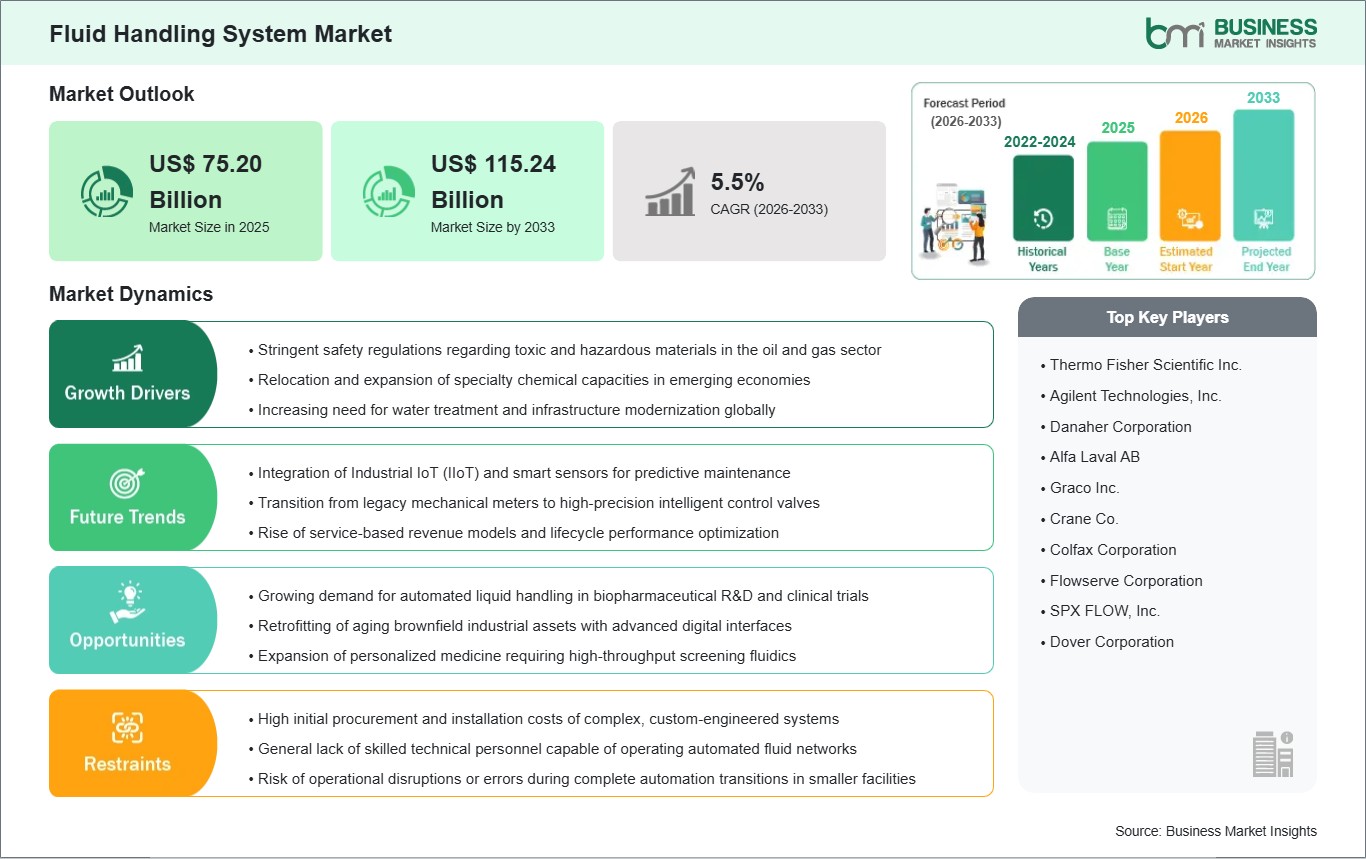
Fluid handling systems refer to the integrated application of equipment and technology engineered to manage the movement, measurement, and control of liquids and gases within industrial environments. By utilizing a coordinated network of hardware, primarily pumps, control valves, flow meters, and storage tanks, these systems facilitate the precise transport of diverse fluids across complex production cycles. This technology is fundamental to the operational architecture of the oil and gas industry, pharmaceutical manufacturing, and water treatment facilities. Market expansion is being propelled by the global transition toward industrial automation, the rising institutional requirement for energy-efficient fluid transport to reduce operational costs, and the increasing integration of smart sensors that enable real-time monitoring of flow rates and pressure levels.
However, several factors may restrain market progression. The high capital intensity associated with the initial procurement and installation of integrated fluid management platforms remains a primary hurdle for small and medium-sized enterprises. The industry also faces persistent technical challenges regarding material compatibility, where the handling of corrosive or highly reactive chemicals necessitates the use of specialized, expensive alloys and seals to prevent system degradation. Additionally, the proliferation of digitalized control nodes has intensified concerns regarding cybersecurity, as interconnected valves and pumps represent potential vulnerabilities within critical infrastructure. These hurdles, compounded by global supply chain volatility for precision-engineered components and a scarcity of technical personnel proficient in advanced fluid dynamics, increase the total cost of ownership and may lengthen the implementation phase for large-scale industrial projects.
Despite these hurdles, the market outlook remains highly favorable as the sector transitions toward intelligent and data-driven fluid management. Opportunities are emerging through the adoption of Industrial IoT (IIoT) Integration; the market is witnessing a surge in systems that utilize edge computing to perform predictive maintenance, identifying potential component failures before they result in costly downtime. The pharmaceutical and biotechnology segment is gaining significant traction, with a rising requirement for single-use fluid handling components that eliminate the risk of cross-contamination and reduce the need for extensive sterilization processes. Furthermore, the growth of Smart Pumping Solutions, which autonomously adjust flow speeds based on real-time demand, aligns with global goals for carbon footprint reduction and resource conservation. Collectively, these innovations position the fluid handling systems industry for sustained evolution as a cornerstone of the modern, hyper-efficient, and safety-conscious global industrial landscape.
Segment Analysis
Fluid Handling System Market Segmentation
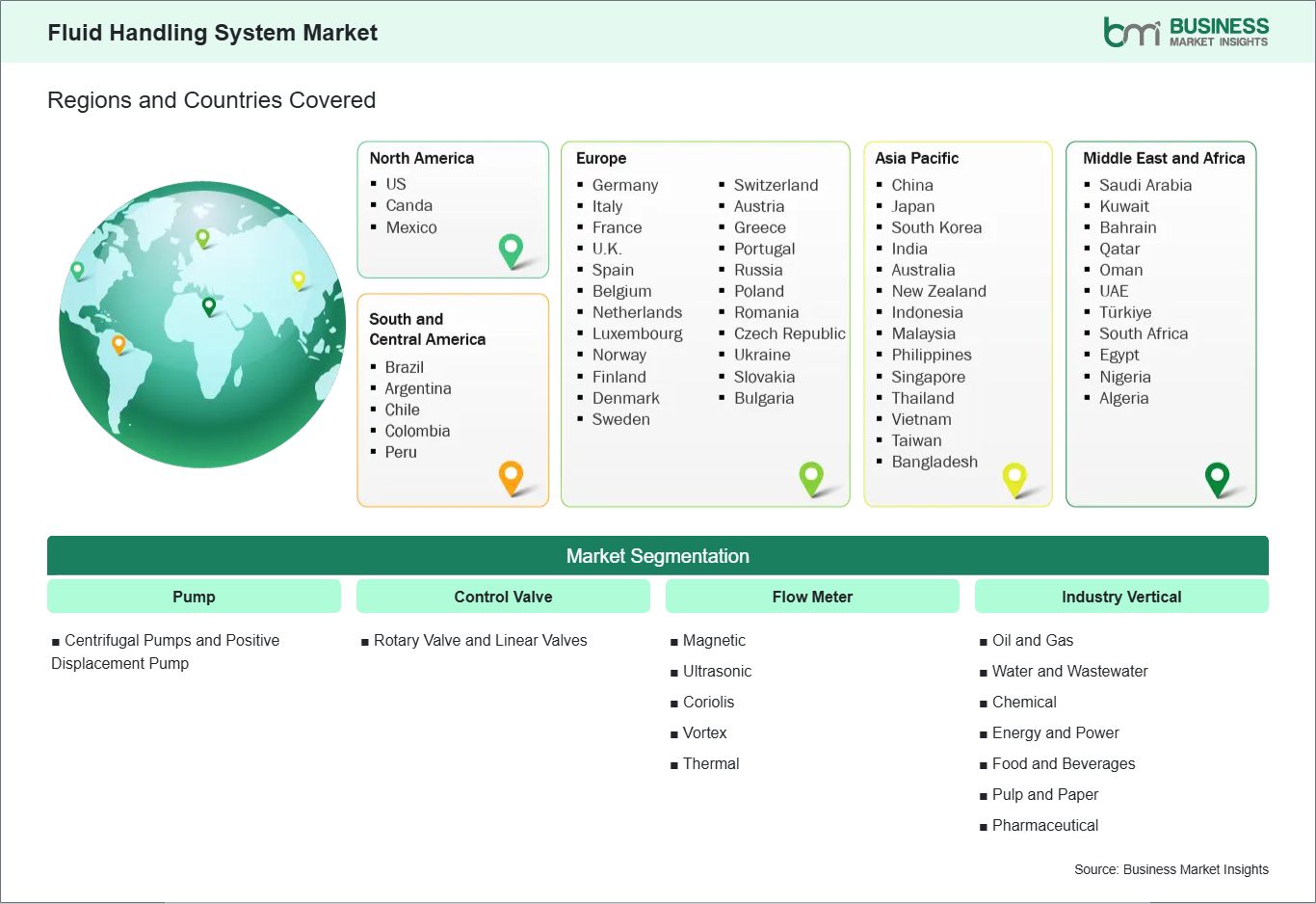
Key segments that contributed to the derivation of the Fluid Handling System market analysis are pump, control valve, flow meter, and industry vertical.
- By Pump, the market is segmented into Centrifugal Pumps and Positive Displacement Pump.
- By Control Valve, the market is divided into Rotary Valve and Linear Valves.
- By Flow Meter, the market is categorized into Magnetic, Ultrasonic, Coriolis, Vortex, and Thermal.
- By Industry Vertical, the market is segmented into Oil and Gas, Water and Wastewater, Chemical, Energy and Power, Food and Beverages, Pulp and Paper, and Pharmaceutical.
Market Forces
Fluid Handling System Market Drivers and Opportunities
Rising Demand for Automation, Efficiency, and Safety
The fluid handling system market is being driven by the growing need for automation, operational efficiency, and safety across industries such as oil & gas, chemicals, pharmaceuticals, food & beverage, and water treatment. Fluid handling systems, comprising pumps, valves, meters, and piping, are critical for transporting, measuring, and controlling liquids and gases in industrial processes. Rising demand for precision and reliability in production environments is amplifying adoption, as companies seek to minimize downtime and optimize resource utilization. The expansion of pharmaceutical and biotech industries is reinforcing growth, with fluid handling systems ensuring sterile, contamination‑free operations. In food & beverage, stricter hygiene standards are propelling investment in advanced systems that meet regulatory compliance. Additionally, the surge in water and wastewater treatment projects is fueling demand for efficient fluid management solutions to address global water scarcity. Collectively, automation priorities, efficiency requirements, and safety standards are sustaining momentum in the global fluid handling system market.
Rising Integration of IoT, Sustainability, and Emerging Applications
Opportunities in the fluid handling system market are expanding through the integration of IoT ecosystems, sustainability initiatives, and emerging cross‑industry applications. IoT‑enabled systems are opening lucrative opportunities by offering real‑time monitoring, predictive maintenance, and adaptive control of pumps and valves. AI‑driven platforms are gaining traction, enabling anomaly detection, automated adjustments, and energy optimization in complex industrial environments. The growing emphasis on sustainability is fueling demand for eco‑friendly, energy‑efficient fluid handling solutions that reduce emissions and align with global environmental goals. Emerging applications in renewable energy are driving innovation, as fluid handling systems support biofuel production, hydrogen transport, and cooling in solar and wind facilities. Healthcare and semiconductor industries are reinforcing opportunities, where precision fluid control is essential for cleanroom environments and advanced manufacturing. Additionally, the expansion of smart factories and digital transformation initiatives is creating new pathways for adoption, with fluid handling systems integrated into Industry 4.0 frameworks. Vendors who focus on IoT‑ready, AI‑driven, and sustainable fluid handling solutions are well‑positioned to capture growth. The convergence of smart technology, sustainability, and advanced manufacturing underscores a transformative trajectory for the global fluid handling system market.
Size and Share Analysis
Fluid Handling System Market Size and Share Analysis
The Fluid Handling System market demonstrates steady growth, with size and share analysis revealing evolving trends and competitive positioning among key players. The report examines subsegments categorized within pump, control valve, flow meter, and industry vertical, offering insights into their contribution to overall market performance.
Based on Pump, the Centrifugal Pumps subsegment holds a strong presence, as they are indispensable for moving large volumes of fluids in industries such as water treatment, chemical processing, and power generation. Their efficiency, reliability, and ability to handle continuous operations make them critical for large‑scale applications. The Positive Displacement Pumps subsegment is essential for precise fluid transfer, particularly in industries requiring accurate dosing and handling of viscous or sensitive fluids, such as pharmaceuticals and food & beverages. Together, centrifugal and positive displacement pumps highlight the adaptability of fluid handling systems across high‑volume and precision‑driven applications.
Report Coverage
Fluid Handling System Market Report Coverage and Deliverables
The “Fluid Handling System Market Size and Forecast (2022–2033)” report provides a detailed analysis of the market covering below areas:
- Market size and forecast at global, regional, and country levels for all market segments covered under the scope
- Market trends, as well as drivers, restraints, and opportunities
- Market analysis covering key trends, global and regional framework, major players, and recent developments
- Market concentration, heat map analysis, prominent players, and recent developments
- Detailed company profiles, including SWOT analysis
Geographic Insights
Fluid Handling System Market Geographic Insights
The geographical scope of the Fluid Handling System market report is divided into five regions: North America, Asia Pacific, Europe, Middle East & Africa, and South & Central America.
North America maintains a preeminent position within the global industry, a status reinforced by the region's advanced industrial infrastructure and the rapid adoption of automated laboratory and process workflows. The regional landscape is characterized by a high concentration of research institutions and manufacturing hubs in the United States and Canada, where North America accounts for a leading portion of the global market share. This market leadership is supported by an established ecosystem of technology pioneers, including Thermo Fisher Scientific Inc., Agilent Technologies, Inc., Graco Inc., and Flowserve Corporation, who drive the development of sophisticated pumps, valves, and automated liquid handling workstations.
Industrial and enterprise trends in the region reflect a decisive shift toward Digitalization and Industrial Internet of Things (IIoT) Integration. Organizations across the chemical, oil and gas, and pharmaceutical sectors are increasingly moving away from reactive maintenance to adopt smart pumping systems equipped with edge sensing and real-time diagnostics. Furthermore, the region is witnessing an escalating demand for Automated Liquid Handling in Life Sciences. This focus on Laboratory Automation is accelerated by the growth in genomics, drug discovery, and cell and gene therapy manufacturing, where high-throughput screening and the reduction of human error are critical for maintaining reproducibility and accelerating time-to-market for advanced biopharmaceuticals.
Industry Activity
Recent Developments
The Fluid Handling System market is evaluated by gathering qualitative and quantitative data post primary and secondary research, which includes important corporate publications, association data, and databases. A few of the key developments in the Fluid Handling System market are:
- In January 2026, Armstrong Fluid Technology launched the Systems Envelope-Fluid Management Station (SE-FMS), a modular solution designed to optimize HVAC fluid systems. The SE-FMS leverages digital twinning, real-time performance tracking, and intelligent staging to reduce energy use by up to 30% and lower installed costs. Its compact, modular design supports flexible layouts and rapid commissioning, enhancing efficiency and reliability. This launch strengthens Armstrong’s position in the fluid handling systems market, driving adoption of energy-efficient, smart fluid management solutions.
- In April 2025, Graco Inc. expanded its QUANTM™ electric double diaphragm (EODD) pump line, introducing enhancements including 480V input power and XTREME TORQUE™ (XT™) motor technology. The upgrades improve energy efficiency, reduce maintenance complexity, and enable seamless integration into automated industrial systems. These developments highlight Graco’s commitment to advancing fluid handling solutions, offering cost-effective, high-performance pumps that support modern manufacturing and process automation.
Trust & Transparency
Research Methodology
The market analysis combines proprietary research with secondary data from government agencies, company disclosures, regulatory filings, industry databases and expert interviews. Market estimates are validated through data triangulation, cross-market benchmarking and analyst
review.
View Full Research Methodology
Key Sources Referred:
World Bank & Global Trade Indicators World Trade Organization (WTO) International Monetary Fund (IMF) International Trade Administration (ITA) Company Websites Company Annual Reports Company Investor Presentations