Market Summary
Executive Summary and Global Market Analysis
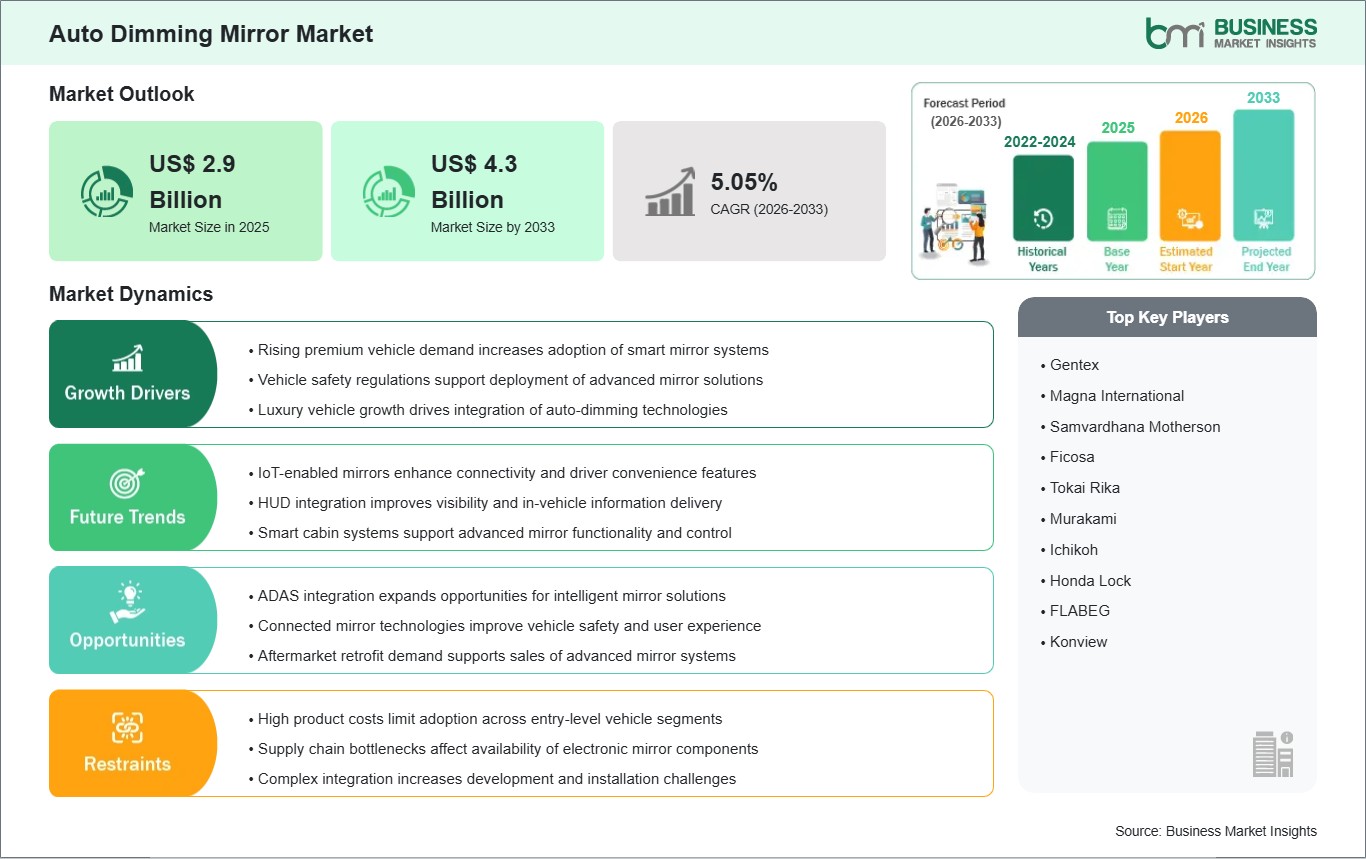
Auto Dimming Mirror systems are advanced automotive components designed to reduce glare from headlights automatically and other bright light sources reflected in vehicle mirrors. These mirrors improve driver visibility, comfort, and road safety, particularly during nighttime driving and adverse weather conditions. Auto Dimming Mirror technology is increasingly being integrated into modern vehicles as manufacturers focus on enhancing safety features and driving convenience. Growing consumer awareness regarding road safety, along with the adoption of advanced driver assistance systems, is supporting market expansion across various vehicle categories. The market is also benefiting from the increasing incorporation of connected vehicle technologies and smart interior features that improve the overall driving experience.
Several factors present challenges to market growth. The integration of advanced mirror technologies increases vehicle production costs, making adoption slower in price-sensitive vehicle segments. The growing use of camera monitoring systems in some regions may also create competition for traditional mirror technologies. In addition, supply chain disruptions affecting electronic components and sensors can impact manufacturing timelines and product availability. Regulatory variations across different countries may further influence the pace of technology adoption and standardization. These challenges require manufacturers to balance performance improvements with cost efficiency while ensuring compliance with evolving automotive safety requirements.
Despite these challenges, the market is expected to benefit from continuous innovation in automotive electronics and smart sensing technologies. Electrochromic materials are becoming more efficient and durable, while sensor-based systems are providing faster response times and improved glare detection capabilities. Luxury and premium vehicle segments continue to drive technology adoption, with increasing penetration into mid-range passenger vehicles. The rising demand for connected and autonomous vehicles is creating additional opportunities for intelligent mirror systems that can integrate with broader vehicle safety platforms. As automotive manufacturers focus on enhancing safety, comfort, and driving assistance features, the Auto Dimming Mirror market is expected to experience sustained growth over the forecast period.
Segment Analysis
Auto Dimming Mirror Market Segmentation
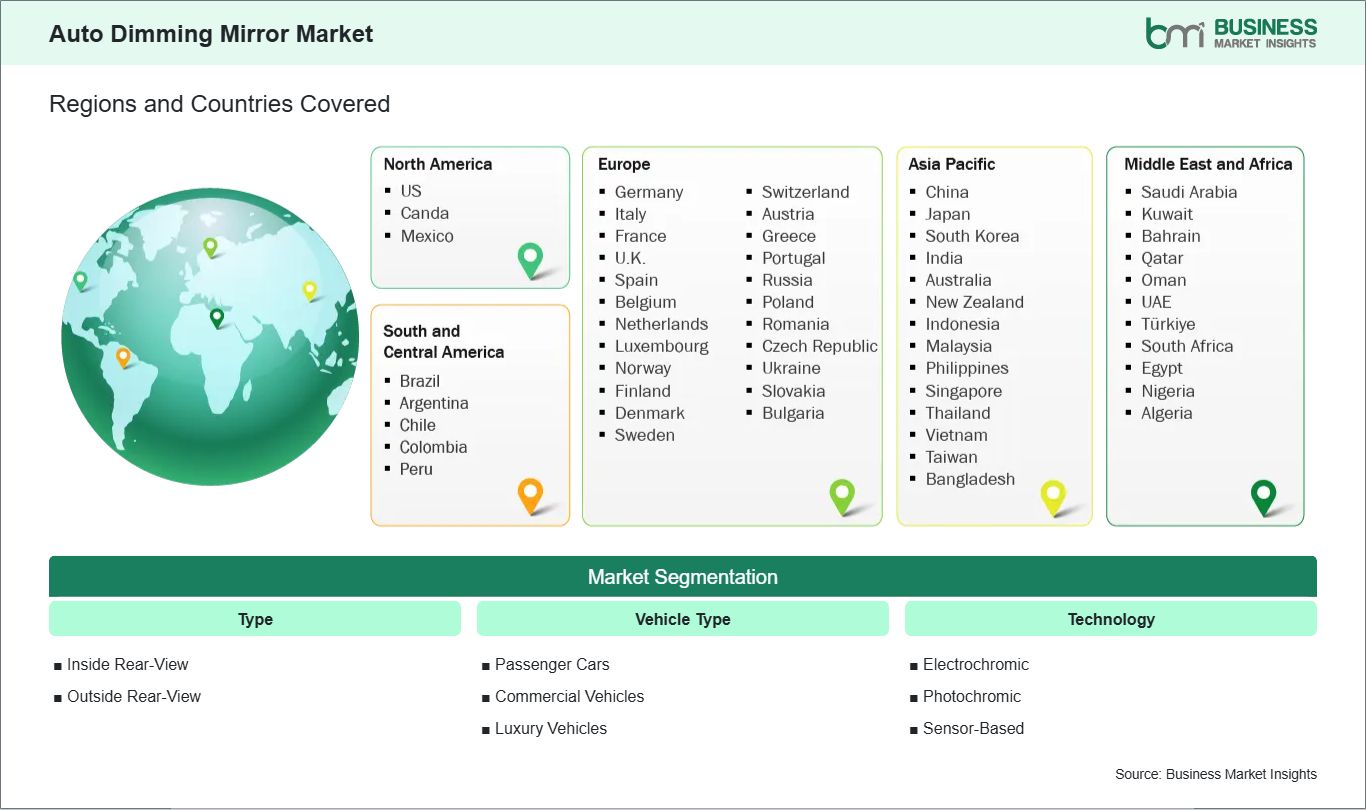
The Auto Dimming Mirror market is segmented based on type, vehicle type, and technology. These segments help identify key demand trends and adoption patterns across the automotive industry.
By Type
- Inside Rear-View: Widely used to reduce glare from vehicles approaching from behind and improve driver comfort.
- Outside Rear-View: Increasingly adopted in premium vehicles to enhance visibility and safety during nighttime driving.
By Vehicle Type
- Passenger Cars: Largest adoption segment due to rising vehicle production and consumer preference for safety features.
- Commercial Vehicles: Adoption is increasing as fleet operators focus on driver safety and accident prevention.
- Luxury Vehicles: Strong demand driven by advanced comfort, convenience, and safety requirements.
By Technology
- Electrochromic: Most commonly used technology due to its reliable glare reduction and durability.
- Photochromic: Uses light-sensitive materials to adjust mirror tint levels automatically.
- Sensor-Based: Integrates sensors and electronic controls for enhanced responsiveness and intelligent operation.
Market Forces
Auto Dimming Mirror Market Drivers and Opportunities
Growing Emphasis on Vehicle Safety and Driver Assistance Technologies
Road safety remains a major focus area for automotive manufacturers and regulatory authorities worldwide. Increasing traffic density, rising awareness of accident prevention, and stricter vehicle safety standards are encouraging the adoption of technologies that improve driver visibility and situational awareness. The Auto Dimming Mirror system is an essential aspect that helps reduce the glare from vehicles coming behind to ensure that drivers remain focused on the road ahead and act accordingly to any prevailing condition.
The integration of advanced driver assistance systems has further increased the relevance of intelligent mirror technologies. Modern vehicles increasingly combine multiple safety features into integrated platforms designed to enhance driving comfort and reduce the likelihood of accidents. Auto Dimming Mirror systems complement these technologies by improving visibility during nighttime and low-light conditions. Vehicle manufacturers are also emphasizing differentiation through improved vehicle features related to both comfort and safety. With an increasing awareness among consumers about new automotive technologies, the need for such features will continue to rise. There is also a regulatory environment that favors automotive safety improvements, as well as innovations in automotive electronics that are likely to increase demand for Auto Dimming Mirrors.
Expansion of Smart and Connected Vehicle Technologies
The growing adoption of smart and connected vehicle technologies presents significant opportunities for the Auto Dimming Mirror market. Modern vehicles increasingly rely on electronic systems, sensors, and communication platforms to improve safety, convenience, and operational efficiency. Auto Dimming Mirror systems are evolving from standalone components into intelligent systems capable of interacting with broader vehicle networks. Advancements in sensor technology, electronic control systems, and smart materials are enabling manufacturers to develop mirrors with enhanced functionality. Future systems may integrate additional features such as blind-spot monitoring support, camera-based visibility enhancements, and connectivity with vehicle safety platforms. These developments can improve the overall value proposition of Auto Dimming Mirror solutions.
The growing popularity of electric vehicles and premium vehicle platforms is also creating opportunities for advanced mirror technologies. Consumers increasingly expect vehicles to offer sophisticated comfort and safety features as standard equipment. Furthermore, the development of autonomous and semi-autonomous driving technologies may increase demand for intelligent visibility systems capable of supporting complex driving environments. These trends position the Auto Dimming Mirror market for continued innovation and long-term growth.
Size and Share Analysis
Auto Dimming Mirror Market Size and Share Analysis
The Auto Dimming Mirror market size is expected to reach US$ 4.3 billion by 2033 from US$ 2.9 billion in 2025. The market is estimated to record a CAGR of 5.05% from 2026 to 2033.
By type, Inside Rear-View mirrors account for a significant share of the market due to their widespread installation across passenger and commercial vehicles. Outside Rear-View mirrors are gaining traction as manufacturers increasingly incorporate glare-reduction technology into external mirror systems to enhance driver visibility and safety.
By vehicle type, Passenger Cars dominate the market owing to high production volumes and increasing consumer demand for advanced safety and comfort features. Luxury Vehicles continue to represent a strong growth segment due to the early adoption of premium automotive technologies, while Commercial Vehicles are witnessing steady demand as fleet operators prioritize driver safety and operational efficiency.
By technology, Electrochromic systems hold a major share because of their proven effectiveness, reliability, and durability. Sensor-Based technologies are gaining momentum with advancements in intelligent vehicle systems, while Photochromic solutions continue to find applications in specific vehicle models requiring adaptive glare management capabilities.
Report Coverage
Auto Dimming Mirror Market Report Coverage and Deliverables
The "Auto Dimming Mirror Market Size and Forecast (2022-2033)" report provides a detailed analysis of the market covering below areas:
- Market size and forecast at global, regional, and country levels for all the key market segments covered under the scope
- Market trends, as well as market dynamics such as drivers, restraints, and key opportunities
- Market analysis covering key market trends, global and regional framework, major players, regulations, and recent market developments
- Industry landscape and competition analysis covering market concentration, heat map analysis, prominent players, and recent developments for the market
- Detailed company profiles, including SWOT analysis
Geographic Insights
Auto Dimming Mirror Market Geographic Insights
The Auto Dimming Mirror Market shows diverse regional adoption patterns influenced by automotive production trends, vehicle safety regulations, technological advancements, and increasing consumer demand for enhanced driving comfort.
North America, being a developed automotive market, demonstrates strong adoption of advanced vehicle safety technologies and intelligent driver assistance systems. The region comprises the United States and Canada, where automotive manufacturers increasingly integrate Auto Dimming Mirror systems into passenger cars, commercial vehicles, and premium vehicle models. The region focuses on improving road safety standards and enhancing vehicle comfort through advanced automotive electronics. Well-established automotive manufacturing infrastructure, mature supply chains, and strong consumer awareness support the adoption of advanced mirror technologies. The presence of extensive research and development activities further contributes to innovation and product integration across various vehicle categories.
Asia Pacific is experiencing significant growth driven by expanding automotive production, rising vehicle ownership, and increasing demand for advanced safety features. The region comprises countries such as China, India, Japan, and South Korea, where automotive manufacturers are incorporating modern safety technologies into both domestic and export-oriented vehicle models. The region focuses on enhancing vehicle quality standards and supporting the adoption of intelligent transportation technologies. Rapid industrialization, expanding manufacturing capabilities, and investments in automotive innovation continue to strengthen market development. Growing consumer preference for comfort-oriented and technology-enabled vehicles is also encouraging wider adoption of Auto Dimming Mirror systems across multiple vehicle segments.
Both regions are contributing significantly to the growth of the Auto Dimming Mirror Market, focusing on vehicle safety improvements, technological innovation, and increasing integration of advanced automotive systems.
Industry Activity
Recent Developments
The Auto Dimming Mirror Market is analyzed using a mix of primary and secondary research sources, including corporate publications, industry associations, and verified databases. This approach ensures accurate tracking of innovation trends and strategic developments influencing the market.
- In January 2026, Gentex Corporation unveiled its next-generation Full Display Mirror equipped with Dynamic View Assist at CES 2026. The updated digital rearview mirror system features dynamic viewing modes that automatically expand the camera view when driving slowly, tilt downward when reversing, and expand sideward to track vehicles in blind spots. Supported by a comprehensive safety software suite, this system tracks cabin metrics like passenger presence, cognitive impairment, and post-crash communications to meet strict global safety requirements.
- In April 2025, Gentex Corporation completed the strategic acquisition of VOXX International Corporation in an all-cash transaction. This finalized merger was intended to significantly enhance the engineering capabilities and product portfolio of the organization regarding advanced vision systems, sensing technologies, and biometrics within the automotive sector.
Trust & Transparency
Research Methodology
The market analysis combines proprietary research with secondary data from government agencies, company disclosures, regulatory filings, industry databases and expert interviews. Market estimates are validated through data triangulation, cross-market benchmarking and analyst
review.
View Full Research Methodology
Key Sources Referred:
World Bank - Global Trade IndicatorsWorld Trade Organization (WTO)International Monetary Fund (IMF)International Trade Administration (ITA)Company WebsitesCompany Annual ReportsCompany Investor Presentations