Market Summary
Executive Summary and Global Market Analysis
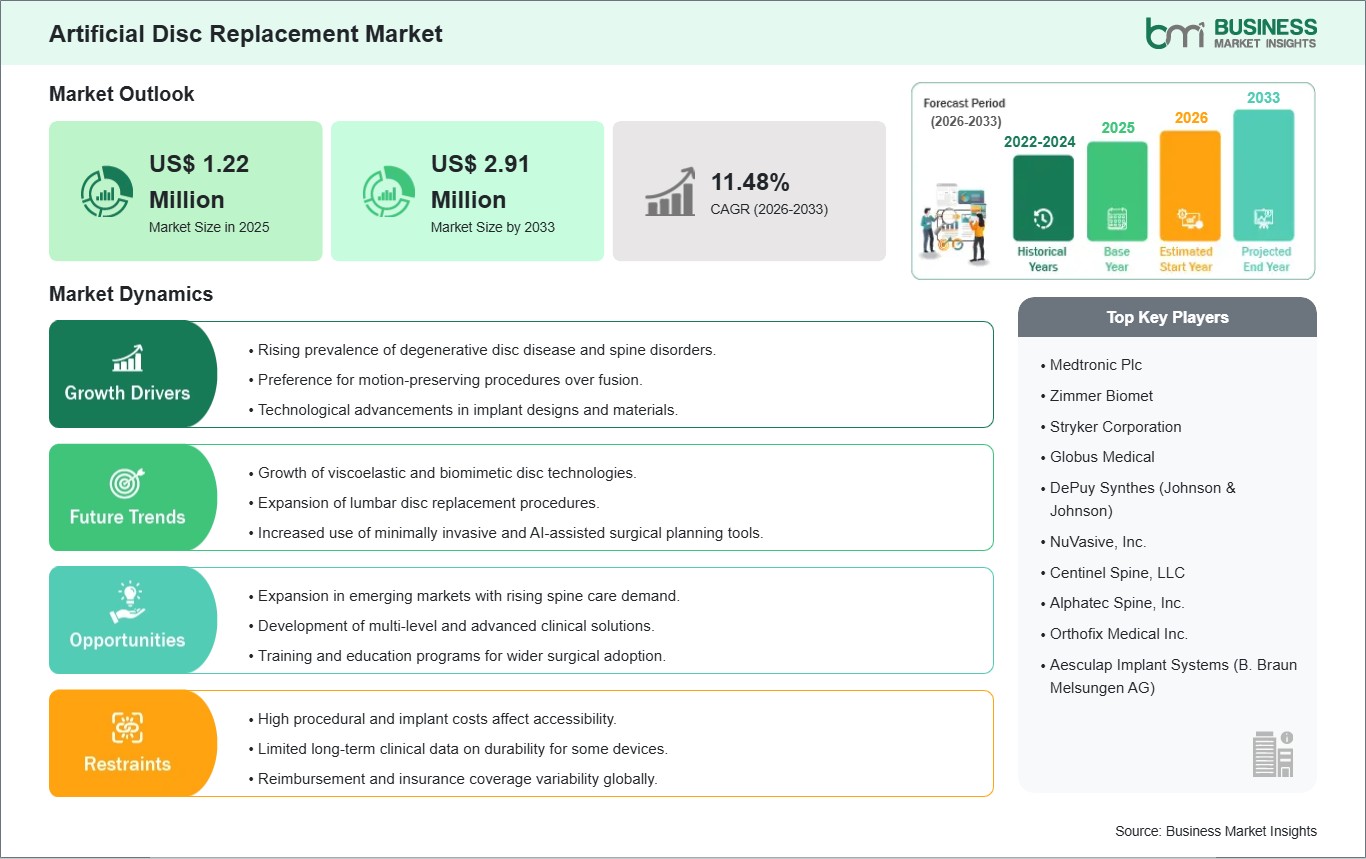
Artificial disc replacement (ADR) devices serve as essential components within contemporary spine treatments because they enable spinal movement while providing relief from pain resulting from degenerative disc disorders. The devices function as intervertebral disc replacements which medical professionals utilize during surgical procedures for both cervical and lumbar spine treatments. The use of artificial disc replacement maintains natural motion capacity while decreasing adjacent segment degeneration and enabling faster patient recovery when compared to traditional spinal fusion methods.
The global artificial disc replacement market is witnessing steady growth because of two main factors which include rising numbers of people with degenerative spinal conditions and chronic back and neck pain and the increasing preference for surgical methods that allow natural movement. The market experiences additional growth because of technological improvements in spinal implants and advancements in surgical procedures and increased acceptance of minimally invasive spine operations by both doctors and patients.
The market experiences growth potential but faces several difficulties which include expensive procedures and restricted payment options in certain areas and the requirement for specialized spine surgeon expertise. The forecast period will create major growth possibilities because of three factors which include better access to cutting-edge spinal treatment and rising understanding of fusion surgery long-term benefits and ongoing research for new implant material and design solutions.
Segment Analysis
Artificial Disc Replacement Market Segmentation
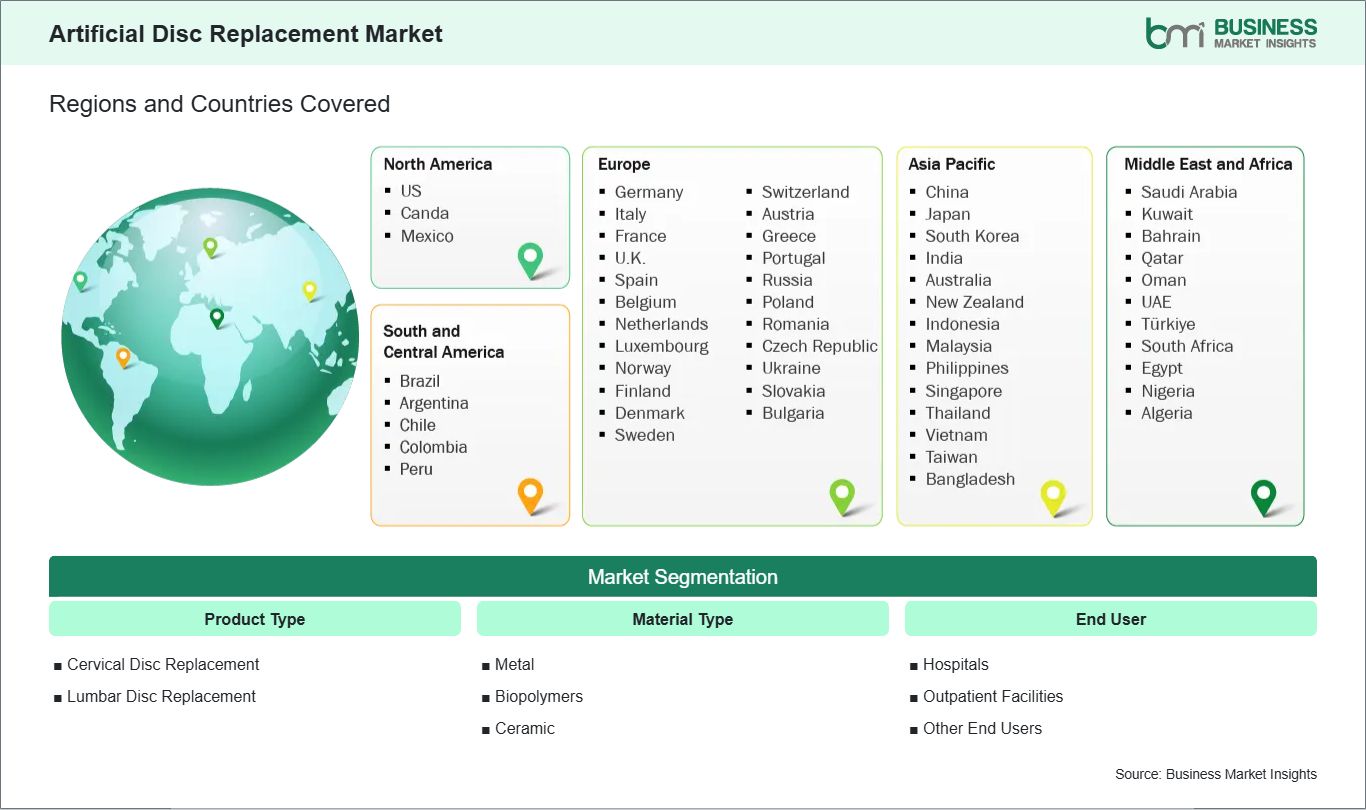
Key segments that contributed to the derivation of the artificial disc replacement market analysis are product type, material type, and end user.
- By product type, the artificial disc replacement market is segmented into cervical disc replacement, lumbar disc replacement. The cervical disc replacement segment dominated the market in 2025.
- By material type, the artificial disc replacement market is segmented into metal, biopolymers, and ceramic. The metal segment dominated the market in 2025.
- By end user, the artificial disc replacement market is segmented into hospitals, outpatient facilities, and others. The hospitals segment dominated the market in 2025.
Market Forces
Artificial Disc Replacement Market Drivers and Opportunities
Rising Prevalence of Degenerative Disc Disease and Spinal Disorders
The artificial disc replacement market has expanded because companion animals and farm animals now experience more chronic the artificial disc replacement market is strongly driven by the growing global incidence of degenerative disc disease, cervical and lumbar disc degeneration, and chronic spine-related pain conditions. The rising number of patients with persistent neck and lower back pain results from several factors including aging populations and sedentary lifestyles and obesity and poor posture and occupational stress. Degenerative disc disease creates a clinical need for effective long-term treatment options because it causes reduced mobility and nerve compression and diminished quality of life.
Artificial disc replacement provides a motion-preserving solution to spinal fusion because it enables natural spinal movement while decreasing stress on adjacent vertebrae. The growing awareness of clinical benefits among surgeons and patients has resulted in rising popularity of ADR procedures which sustain market growth for eligible candidates.
Technological Advancements and Expanding Surgical Applications
Artificial disc replacement procedures have become more common in clinical practice because of ongoing progress in artificial disc design and material development. The development of titanium alloys, cobalt-chromium materials, polyethylene core systems, and ceramic elements as biomaterials has resulted in more durable implant systems that maintain their compatibility with human body tissues throughout their operational lifespan. Next-generation artificial discs have become the preferred option for surgeons because these devices deliver superior motion capabilities and create less material wear during use.
The combination of minimally invasive operating methods with better imaging systems and more developed implantation techniques has successfully delivered better patient results while decreasing the time needed for patients to recover. The growing clinical evidence base which demonstrates that artificial disc replacement is both safe and effective has prompted manufacturers to develop new products while seeking approval for distribution in different international markets. The artificial disc replacement market around the world will experience consistent expansion because of increasing healthcare spending and developing surgical capabilities among doctors.
The development of new technologies has brought about major advancements in both implant functionality and surgical accuracy. The introduction of anatomically designed discs together with mobile-core systems and personalized sizing solutions has enabled improved patient movement capacity while decreasing surgical complications and boosting patient contentment. The development of these technologies has enabled artificial disc replacement to be used in specialized spinal treatment facilities and advanced medical centers.
Size and Share Analysis
Artificial Disc Replacement Market Size and Share Analysis
By product type, the artificial disc replacement market is segmented into cervical disc replacement, lumbar disc replacement. The cervical disc replacement segment dominated the market in 2025. Share growth in this market segment occurs because cervical disc degeneration cases show higher rates of increase than lumbar disc degeneration cases. The segment development will receive a boost from the extensive selection of artificial cervical disc replacement products currently available in the market.
By material type, the artificial disc replacement market is segmented into metal, biopolymers, and ceramic. The metal segment dominated the market in 2025. Most FDA-approved cervical total disc replacement implants use metal-alloy-based prosthetic endplates, with superior and inferior designs that move together via a central medical-grade plastic core. Metal-and-plastic artificial disc replacement operations achieve high success rates, driving market expansion.
By end user, the artificial disc replacement market is segmented into hospitals, outpatient facilities, and others. The hospitals segment dominated the market in 2025. The growing popularity of artificial disc replacement surgery results from two factors, improved surgical techniques and implant design, combined with the push for healthcare organizations to adopt new technologies. The implementation of this groundbreaking procedure increased patient numbers at hospitals that offer it, demonstrating favorable market development.
Report Coverage
Artificial Disc Replacement Market Report Coverage and Deliverables
The "Artificial disc replacement Market Size and Forecast (2022&2033)" report provides a detailed analysis of the market covering below areas:
- Artificial disc replacement market size and forecast at global, regional, and country levels for all the key market segments covered under the scope
- Artificial disc replacement market trends, as well as market dynamics such as drivers, restraints, and key opportunities
- Artificial disc replacement market analysis covering key market trends, global and regional framework, major players, regulations, and recent market developments
- Industry landscape and competition analysis covering market concentration, heat map analysis, prominent players, and recent developments for the artificial disc replacement market
- Detailed company profiles, including SWOT analysis
Geographic Insights
Artificial Disc Replacement Market Geographic Insights
The geographical scope of the artificial disc replacement market report is divided into five regions: North America, Asia Pacific, Europe, Middle East & Africa, and South & Central America. The artificial disc replacement market in Asia Pacific is expected to grow significantly during the forecast period.
The Asia-Pacific artificial disc replacement market is segmented into China, Japan, South Korea, India, Australia, New Zealand, Indonesia, Malaysia, the Philippines, Singapore, Thailand, Vietnam, Taiwan, Bangladesh, and the Rest of Asia. The Asia-Pacific artificial disc replacement market is experiencing rapid growth because of three factors, which include rising spinal disorder cases and expanding healthcare systems and growing usage of modern orthopedic and spinal treatment methods. The market development receives additional support when patients from China and Japan and India and South Korea, and Australia gain better access to specialized spinal treatment facilities.
China, Japan and India represent significant market expansion possibilities because they have substantial patient bases and their elderly population numbers keep increasing and people become more aware of modern spinal treatment methods. The adoption of artificial disc replacement technologies throughout the region receives acceleration from government programs which improve surgical procedures and extend insurance benefits and create better medical device control systems.
The market demand received a major boost from various technological breakthroughs which include next-generation disc models and motion-preserving implant technology. The medical field sees a rising demand for less invasive spine operations which enable faster recovery times because spine specialty centers continue to extend their reach. The Asia-Pacific region will maintain its position as the second-fastest-growing artificial disc replacement market during the entire prediction period.
Industry Activity
Recent Developments
The artificial disc replacement market is evaluated by gathering qualitative and quantitative data post primary and secondary research, which includes important corporate publications, association data, and databases. A few of the key developments in the artificial disc replacement market are:
- In February 2024, NGMedical GmbH announced the launch of sales and the completion of the first surgery using its MOVE-C cervical artificial disc replacement in the UAE. This followed the approval of the MOVE-C device in Mexico, marking a significant step in NGMedical's global commercialization efforts. The first MOVE-C disc was implanted in Abu Dhabi
- In August 2023, the FDA approved a new, smaller-height version of the ZimVie Inc. Mobi-C Cervical Disc in seven sizes to better meet the anatomical needs of the U.S. population. The Mobi-C device, used for cervical disc replacement, has been available in France since 2004 and in the U.S. since 2013, when it was first approved for use at one or two contiguous levels.
Trust & Transparency
Research Methodology
The market analysis combines proprietary research with secondary data from government agencies, company disclosures, regulatory filings, industry databases and expert interviews. Market estimates are validated through data triangulation, cross-market benchmarking and analyst
review.
View Full Research Methodology
Key Sources Referred:
World Bank - Global Trade IndicatorsAmerican Medical Association (AMA)National Center for Biotechnology Information (NCBI)National Library of Medicine (NLM)Centers for Disease Control and Prevention (CDC)Company websiteNational Institutes of Health (NIH)International Hospital Federation (IHF)Company annual reportsCompany investor presentations