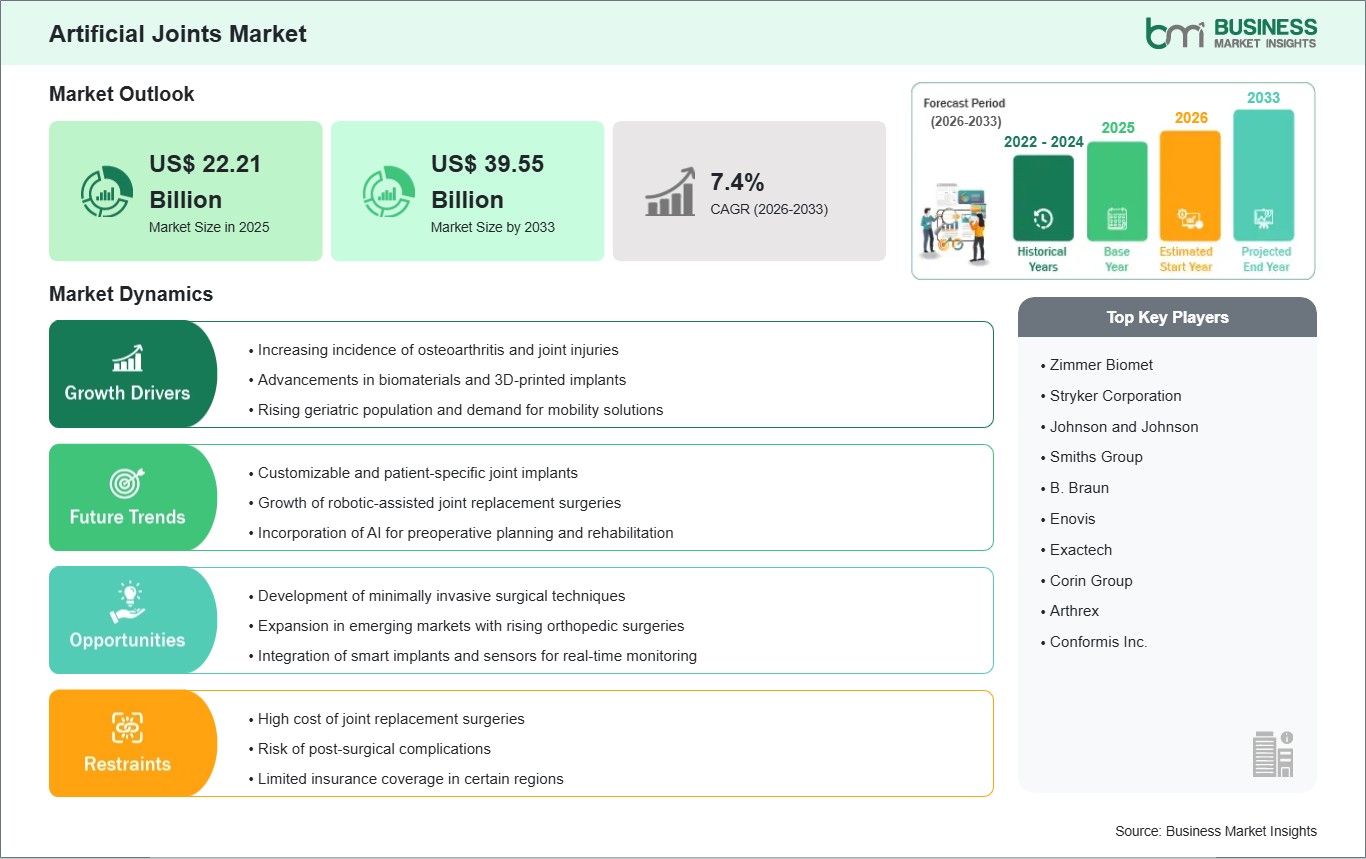
The Artificial Joints Market size is expected to reach US$ 39.55 billion by 2033 from US$ 22.21 billion in 2025. The market is estimated to record a CAGR of 7.4% from 2026 to 2033.
Artificial joints, which are also sometimes called prosthetic or orthopedic implants, are essentially medical apparatus that can take the place of the damaged or diseased body’s natural joints, thus granting patients with otherwise very immobile or painful conditions (like arthritis, trauma, or congenital deformities) mobility and comfort through pain relief. Out of all the implants, the most common are hip, knee, shoulder, and elbow joints, which are made of biocompatible materials—like titanium, cobalt-chromium alloys, and medical-grade polymers—that ensure durability, strength, and body compatibility.
The worldwide artificial joints market is growing steadily as a result of factors such as the rising number of people with musculoskeletal disorders, the increase in the number of old people, and the higher acceptance of advanced surgical interventions. Technologies are coming up with innovations like 3D-printed implants, patient-specific prosthetics, and minimally invasive surgical techniques, which are not only improving outcomes significantly but also increasing the percentage of people who accept such treatments. Moreover, the emerging markets of healthcare infrastructures and improved reimbursement policies in developed regions are the main forces propelling the market growth. The market has been very competitive with research and development, forming strategic alliances, and expanding geographically among the established players as the main competition areas. The emphasis is on improving the quality of life, reducing recovery time, and implant longevity. So, the artificial joints market will be continuously innovating, making it a very important segment in the global orthopedic devices industry.

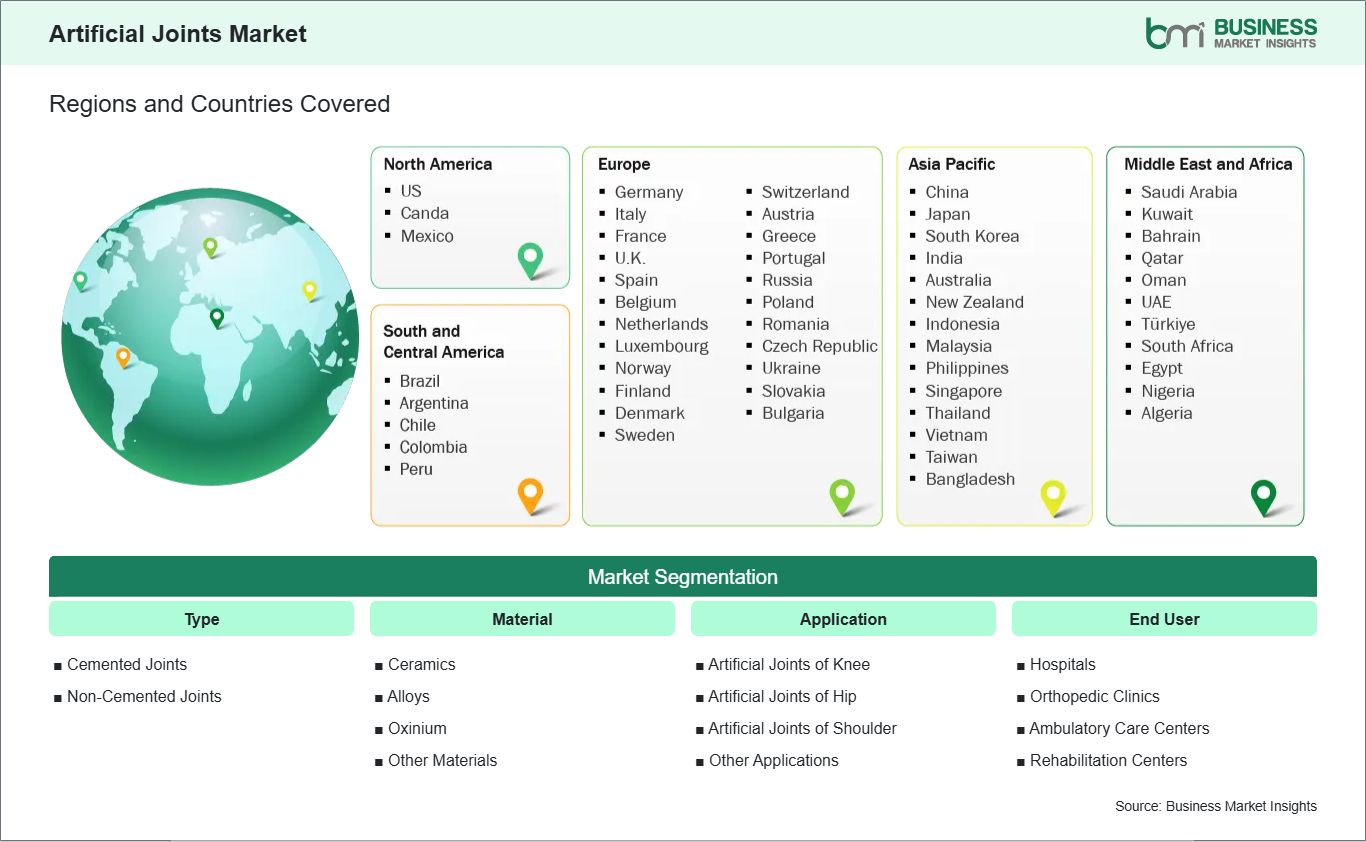
Key segments that contributed to the derivation of the artificial joints market analysis are type, material, application, and end user.
The increasing life expectancy around the globe, especially in developed areas like North America and Europe, brings a bigger proportion of the population among the elderly who are most likely to suffer from osteoarthritis and rheumatoid arthritis, leading to joint replacement. By 2050, the population of 65 years and older is expected to almost double, thus greatly increasing the rate of joint-related problems. Moreover, people live longer lives, and consequently, they are more likely to suffer from mobility-limiting disorders that lead them to choose joint replacement in order to keep their quality of life as well as independence. Besides, unhealthy lifestyle choices like being inactive and overweight are causing people to lose their joints earlier, thus increasing the patient pool. The technological advancements, such as the use of less invasive and robotic-assisted surgical techniques, have made it easier, quicker, and safer to conduct such operations, which makes it more likely that younger patients with chronic pain will consider the joint replacement option. The combined effect of population movements and the improved accessibility to procedures enables the continuous strong demand for artificial joints worldwide.
One of the main areas of growth for the artificial joints market is through the new innovations in personalized and technology-boosted implant solutions, with 3D-printed and custom-fit implants at the forefront of the trend, as they can give better surgical results and higher patient satisfaction. These implants, which are created to perfectly fit the anatomy of the specific patient by utilizing advanced imaging and additive manufacturing, not only allow the possibility of better osseointegration but also have the potential to be in the market for longer; thus, they are equally good options for patients and surgeons. Besides, the combination of robotics and Artificial Intelligence in joint replacement operations is bringing more accuracy and consistency in the results; therefore, it is allowing the implant companies to produce the highest standard and most compatible with the new technologies implant products that carry high value due to the robotic and AI technology in the surgeries. In the case of developing countries—especially in the Asia Pacific region—the improvement of the healthcare system, the patients’ growing awareness, and the increasing availability of orthopedic treatment are all factors that contribute to the implant market expansion. These new trends are combined with the proper rules and regulations, and the government's getting involved in the medical technology sector, which in turn is making the usage of advanced technologies in joint replacement non-surgical procedures a lot more common, and it is the reason why the market is moving forward in terms of implant sales.
By type, the artificial joints market is bifurcated into cemented joints, non-cemented joints. The non-cemented joints segment dominated the market in 2025. Non-cemented joints lead due to their ability to promote natural bone growth into the implant surface, offering long-term stability and reducing the risk of loosening, especially in younger or more active patients. They also allow for easier revision surgeries compared to cemented joints. Increasing preference among surgeons for minimally invasive procedures and the aging population’s desire for longer-lasting implants contribute to the dominance of non-cemented joints in the global market.
By material, the market is categorized into ceramics, alloys, oxinium, other materials. The alloys segment held the largest share of the market in 2025. Alloys, particularly cobalt-chromium and titanium-based, dominate due to their superior strength, biocompatibility, and corrosion resistance, which are essential for load-bearing joints like hips and knees. They provide long-term durability and reduce the risk of implant failure. The proven track record in orthopedic surgeries and compatibility with various joint designs make alloys the preferred choice among surgeons, ensuring their leading position over ceramics, Oxinium, and other emerging materials.
By application, the market is segmented into artificial joints of knee, artificial joints of hip, artificial joints of shoulder, other applications. The artificial joints of knee segment held the largest share of the market in 2025. Knee joint replacements lead the market because osteoarthritis and traumatic injuries of the knee are highly prevalent globally. Knee arthroplasty procedures have become increasingly common due to improved surgical techniques, minimally invasive approaches, and faster recovery times. The high incidence of degenerative knee conditions, coupled with a growing aging population and rising awareness about mobility restoration, drives demand for knee implants more than hip or shoulder replacements.
By end user, the artificial joints market is segmented into hospitals, orthopedic clinics, ambulatory care centers, rehabilitation centers. The hospitals segment dominated the market in 2025. Hospitals are the leading segment as they have advanced surgical infrastructure, experienced orthopedic surgeons, and comprehensive post-operative care facilities required for joint replacement procedures. They handle the highest patient volumes and complex cases, making them the primary setting for artificial joint surgeries. Moreover, hospitals benefit from insurance coverage and reimbursement policies that facilitate patient access, ensuring consistent demand and reinforcing their dominance over clinics, ambulatory care centers, and rehabilitation centers.
| Report Attribute | Details |
|---|---|
| Market size in 2025 | US$ 22.21 Billion |
| Market Size by 2033 | US$ 39.55 Billion |
| Global CAGR (2026 - 2033) | 7.4% |
| Historical Data | 2022 - 2024 |
| Forecast period | 2026-2033 |
| Segments Covered | By Type
|
|
Regions and Countries Covered
| |
| North America | US, Canada, Mexico |
| Europe | Belgium, Austria, Finland, Denmark, Greece, Poland, Romania, Russia, Ukraine, Czech Republic, Slovakia, Bulgaria, Italy, Luxembourg, Germany, Switzerland, France, Netherlands, Norway, Portugal, Spain, Sweden, United Kingdom |
| Asia-Pacific | Australia, China, India, Japan, South Korea, Indonesia, Malaysia, Philippines, Singapore, Thailand, Vietnam, Bangladesh, New Zealand, Taiwan |
| South and Central America | Brazil, Argentina, Peru, Chile, Colombia |
| Middle East and Africa | Bahrain, Kuwait, Oman, Qatar, Saudi Arabia, United Arab Emirates, Turkiye, South Africa, Egypt, Algeria, Nigeria |
| Market leaders and key company profiles |
|
The " Artificial Joints Market Size and Forecast (2022–2033)" report provides a detailed analysis of the market covering below areas:
The geographical scope of the artificial joints market report is divided into five regions: North America, Asia Pacific, Europe, Middle East & Africa, and South & Central America. The artificial joints market in Asia Pacific is expected to grow significantly during the forecast period.
The Asia-Pacific artificial joints market is segmented into China, Japan, South Korea, India, Australia, New Zealand, Indonesia, Malaysia, the Philippines, Singapore, Thailand, Vietnam, Taiwan, Bangladesh, and the Rest of Asia. The Asia-Pacific artificial joints market is experiencing robust growth, due to the rising population of older people in the area, together with the increasing occurrence of joint ailments like osteoarthritis and degenerative conditions; for instance, the countries in Asia are experiencing a remarkable increase in the number of old people, which, in turn, creates a bigger demand for joint replacement operations. Besides, better medical infrastructure and easier access to surgery, which were first made possible through government investment in hospitals, training of orthopedic specialists, and improved reimbursement support, have now allowed more patients to go for advanced orthopedic treatments that they could not afford before.
The enhancement of economic conditions and the rise of a middle class in the key markets of China, India, and Southeast Asia are leading to an increase in disposable incomes and health insurance coverage, thus permitting more people to have elective joint surgeries. The tech progress, such as robotic surgery, 3D printing, and minimally invasive procedures, is also bringing the clinical use closer; all these innovations are making the whole process more precise, recovery quicker, and results better, hence patient acceptance is rising. Moreover, the international patients who are looking for affordable yet quality joint replacement services are the ones that are boosting the market in countries such as Thailand, India, and Singapore, which are known for their medical tourism.

The artificial joints market is evaluated by gathering qualitative and quantitative data post primary and secondary research, which includes important corporate publications, association data, and databases. A few of the key developments in the artificial joints market are:
The Artificial Joints Market is valued at US$ 22.21 Billion in 2025, it is projected to reach US$ 39.55 Billion by 2033.
As per our report Artificial Joints Market, the market size is valued at US$ 22.21 Billion in 2025, projecting it to reach US$ 39.55 Billion by 2033. This translates to a CAGR of approximately 7.4% during the forecast period.
The Artificial Joints Market report typically cover these key segments-
The historic period, base year, and forecast period can vary slightly depending on the specific market research report. However, for the Artificial Joints Market report:
The Artificial Joints Market is populated by several key players, each contributing to its growth and innovation. Some of the major players include:
The Artificial Joints Market report is valuable for diverse stakeholders, including:
Essentially, anyone involved in or considering involvement in the Artificial Joints Market value chain can benefit from the information contained in a comprehensive market report.
Please tell us your area of interest
(Market Segments/ Regions and Countries/ Companies)