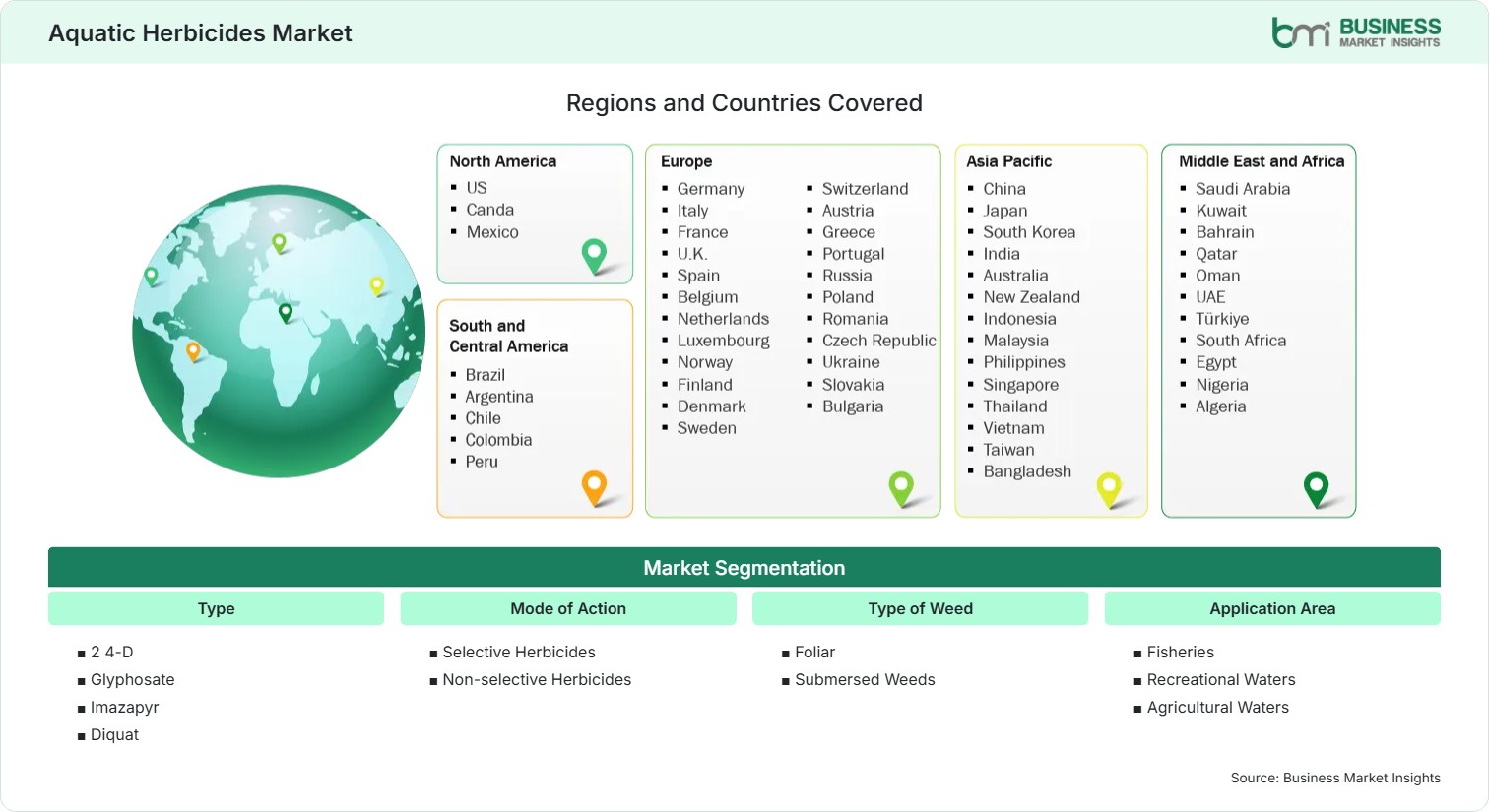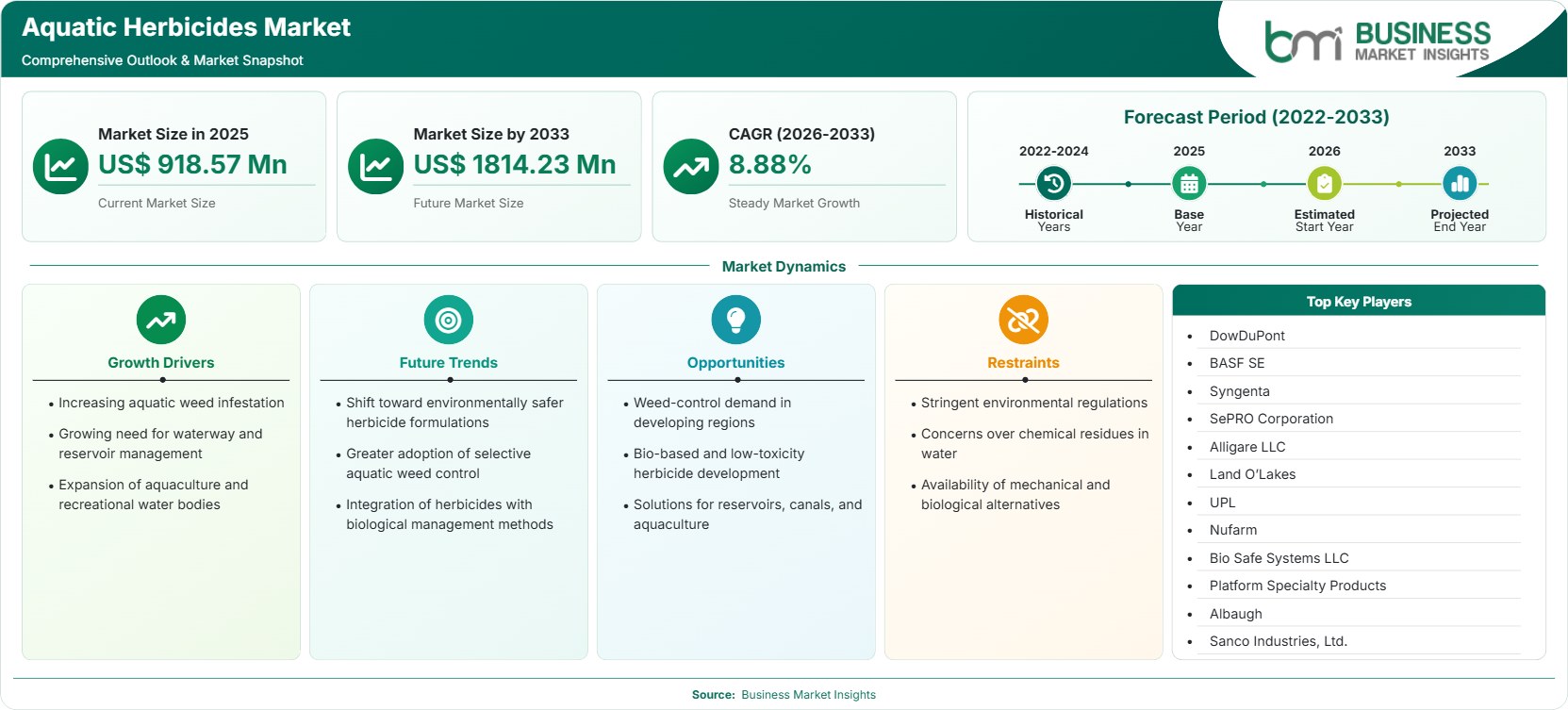
Aquatic Herbicides Market Regional Highlights
North America Aquatic Herbicides Market
North America accounted for a share of 35%–38% in 2025, expanding at a CAGR of 8.2%–8.8% during 2026–2033. The region maintains leadership due to extensive freshwater bodies, advanced lake management practices, and regulatory support for controlled aquatic weed removal. The Market share in North America benefits from demand across fisheries, municipal water bodies, and recreational lakes. The Aquatic Herbicides Market growth is supported by increasing adoption of selective formulations and integrated aquatic ecosystem management strategies across the United States and Canada.
- The United States represents the dominant contributor within North America due to extensive freshwater resources, large recreational water networks, and advanced aquatic vegetation control programs supporting continuous herbicide adoption.
- Canada demonstrates increasing demand through lake restoration initiatives, fisheries management programs, and environmental monitoring activities focused on controlling invasive aquatic plant species while maintaining ecological balance.
- Regulatory approval processes from agencies including the U.S. Environmental Protection Agency encourage development and commercialization of safer aquatic herbicide formulations with improved environmental compatibility.
- Growing investments from municipal authorities and water management organizations are strengthening demand for specialized aquatic weed control solutions across reservoirs, ponds, and conservation areas.
US Aquatic Herbicides Market
The US accounted for a share of 28%–31% within the global Aquatic Herbicides Market in 2025, growing at a CAGR of 8.3%–8.7% between 2026–2033. Strong adoption is supported by widespread use in fisheries, agricultural water systems, and recreational lakes. The country’s mature water management infrastructure and focus on invasive species control continue to create stable demand. Increased preference for selective herbicides and improved application technologies is shaping future market expansion.
- The US market benefits from extensive freshwater resources and increasing management requirements for invasive weeds such as hydrilla, Eurasian watermilfoil, and other aggressive aquatic vegetation.
- Agricultural regions are adopting aquatic herbicide solutions to maintain irrigation efficiency, improve water availability, and reduce weed-related productivity losses in farming operations.
- Recreational water operators are investing in advanced treatment programs to maintain lake quality, improve visitor experiences, and comply with environmental management standards.
Europe Aquatic Herbicides Market
Europe represented a share of 22%–25% in 2025, developing at a CAGR of 7.8%–8.4% during 2026–2033. The region focuses on sustainable aquatic management, biodiversity protection, and controlled use of chemical solutions. Germany, France, the United Kingdom, and Nordic countries are key markets, with Germany and France showing comparatively stronger growth rates of 8.0%–8.5%. The Aquatic Herbicides Market in Europe is influenced by environmental regulations, restoration projects, and increasing efforts to manage invasive aquatic plants.
- Germany is strengthening adoption through advanced water conservation programs, research-driven aquatic management practices, and demand for environmentally compliant vegetation control solutions.
- France is witnessing rising usage across agricultural waterways and recreational water bodies as authorities focus on maintaining aquatic ecosystem health.
- The United Kingdom is emphasizing invasive species management programs, supporting demand for targeted herbicides and integrated aquatic vegetation control approaches.
- European manufacturers are investing in formulation improvements to meet stringent environmental standards while maintaining effective weed management performance.
Asia Pacific Aquatic Herbicides Market
Asia Pacific held a share of 25%–28% in 2025 and is projected to expand at a CAGR of 9.5%–10.2% from 2026–2033, making it the fastest-growing regional market. Rising aquaculture production, agricultural water demand, and government-led water restoration initiatives are accelerating adoption. China, India, Japan, and Southeast Asian countries are major contributors, with China and India experiencing higher growth rates of 9.8%–10.5% due to expanding water-intensive activities.
- China is increasing aquatic herbicide adoption through large-scale aquaculture operations, reservoir management programs, and efforts to control invasive aquatic vegetation in freshwater systems.
- India is emerging as a high-potential market due to expanding fisheries activities, irrigation development, and increasing awareness regarding efficient aquatic weed management.
- Southeast Asian countries are adopting advanced aquatic treatment solutions to support aquaculture productivity and improve water quality management practices.
- Japan demonstrates stable demand through technologically advanced water management systems, environmental conservation initiatives, and precision application methods.
Rest of World Aquatic Herbicides Market
Rest of World accounted for a share of 10%–13% in 2025, expanding at a CAGR of 7.5%–8.2% during 2026–2033. South and Central America are witnessing adoption through agricultural expansion, fisheries development, and reservoir management programs. Brazil and Argentina are leading markets, with growth rates ranging between 8.0%–8.5%. Middle East and Africa demand is supported by water conservation projects, irrigation development, and increasing focus on sustainable aquatic resource utilization.
- Brazil is experiencing rising demand due to extensive agricultural waterways, aquaculture growth, and increased management of aquatic weeds affecting water infrastructure.
- Argentina is adopting aquatic herbicide solutions across agricultural and fisheries applications to improve water resource productivity and operational efficiency.
- Middle Eastern countries are exploring advanced aquatic management approaches to support irrigation systems and water preservation initiatives.
- African markets are gradually expanding through fisheries development projects and improved awareness of invasive aquatic plant management practices.