
Aquaponics Market Outlook: Size, Share, Trends, Growth Analysis, Competitive Landscape & Forecast, 2026-2033

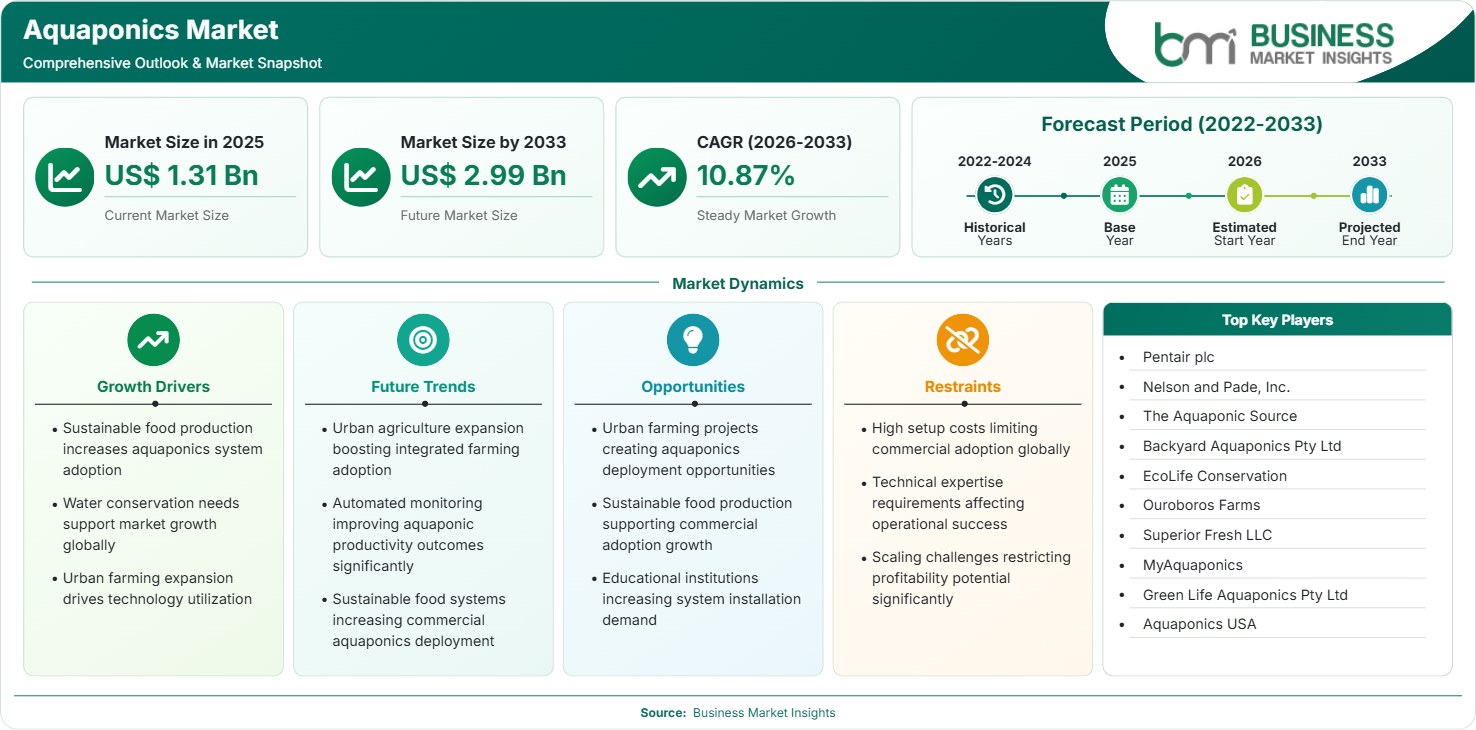
The Aquaponics Market size was valued at US$ 1.31 Billion in 2025 and is projected to reach US$ 2.99 Billion by 2033, growing at a CAGR of 10.87% during 2026–2033. Key growth drivers include rising adoption of sustainable agriculture, water-efficient cultivation methods, urban farming expansion, and demand for local food production, while opportunities emerge from controlled-environment agriculture and smart farming integration.

Report Coverage
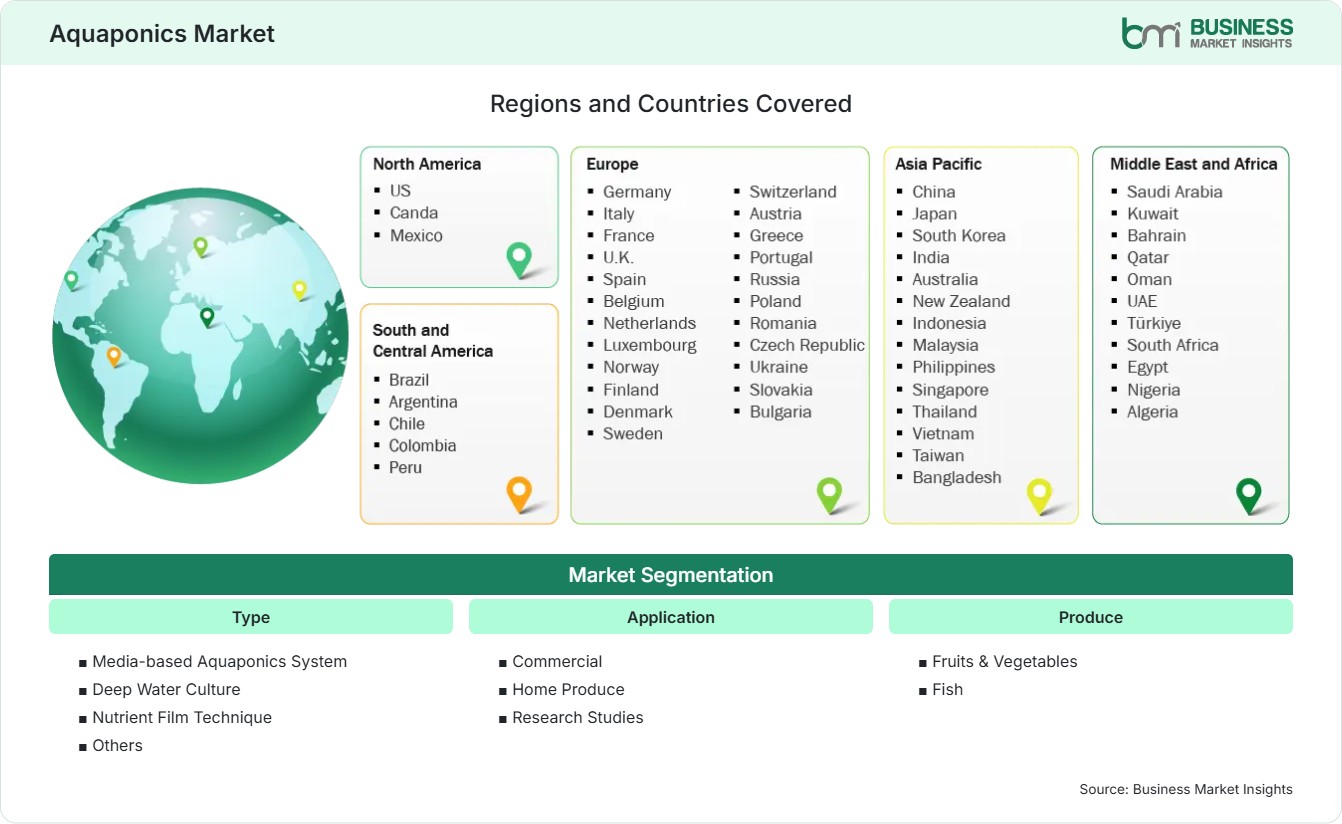
  • Type: Media-based Aquaponics System, Deep Water Culture , Nutrient Film Technique , Others
  • Application: Commercial, Home Produce, Research Studies
  • Produce: Fruits & Vegetables, Fish
US$ 1.31 Bn Market size in 2025
US$ 2.99 Bn Market Size by 2033
10.87% CAGR, 2026 - 2033
2026-2033 Forecast Period

AI Overview

Aquaponics Market Summary

  • North America Region: North America holds a market share of 34%–37% in 2025, growing at a CAGR of 9.8%–10.4% during 2026–2033. Growth is supported by commercial greenhouse investments, food security initiatives, controlled-environment farming adoption, water conservation requirements, technology innovation, premium produce demand, and expanding urban agriculture ecosystems. The U.S. maintains regional leadership through large-scale greenhouse deployment and commercial aquaponic investments, advancing at a CAGR of 10.0%–10.6%.
  • Fastest Growing Region: Asia Pacific accounts for a 25%–28% share in 2025 and is projected to expand at a CAGR of 12.4%–13.2% during 2026–2033. Rapid urbanization, increasing food demand, government-backed sustainable agriculture programs, protected cultivation expansion, resource-efficiency requirements, and growing investment in agritech startups accelerate adoption across major economies.
  • Leading Segment: Commercial represents a 52%–56% share in 2025 and is expected to record a CAGR of 10.4%–11.1% during 2026–2033. Aquaponics Market Demand stems from year-round production, premium crop cultivation, marketable fish output, retail supply contracts, resource optimization, sustainable branding initiatives, and technological scalability enhancing operational economics.
  • High Growth Segment: Deep Water Culture (DWC) represents a 29%–33% share in 2025 and is forecast to grow at a CAGR of 11.8%–12.6% during 2026–2033. Adoption increases because of higher productivity, simplified nutrient circulation, compatibility with leafy greens, commercial scalability, operational efficiency improvements, and increasing greenhouse integration globally.
  • Key Market Opportunity: Expansion of climate-resilient food production systems creates opportunities for integrated fish and vegetable cultivation near urban centers, enabling efficient water use, reduced transportation costs, year-round output, and improved supply-chain resilience.
  • Major Market Players: Pentair plc, Nelson and Pade, Inc., The Aquaponic Source, Backyard Aquaponics Pty Ltd, EcoLife Conservation, Ouroboros Farms, Superior Fresh LLC, MyAquaponics, Green Life Aquaponics Pty Ltd, Aquaponics USA.
Strategic Insights

Aquaponics Market: Strategic Insights

Aquaponics Market Strategic Framework
FREE PDF
Request your free sample
Request free sample
Stakeholder View

Key Takeaways

  • The value chain is moving towards integrated ecosystems with equipment suppliers, fish hatcheries, greenhouse operators, software providers and produce distributors all working together to improve productivity and reliability of operations.
  • Commercial cultivation facilities represent the strongest revenue opportunity because operators can monetize both fish and vegetable production while benefiting from premium pricing for sustainably grown food products.
  • Sensor-enabled monitoring, automated feeding systems, AI-assisted water management, and predictive crop analytics are all becoming key differentiators for high-performance production facilities.
  • Asia Pacific provides a very attractive investment environment given the size of the urban population base, the pressure on arable land and the increasing levels of government support for advanced agricultural technologies.
  • VC participation and strategic funding in the CEA space continue to be focused on businesses developing scalable food production systems with a strong sustainability profile.
  • Educational bodies and research organizations are increasingly using integrated farming systems as living laboratories, and this is generating further demand for the associated installations and technical support.
Geographic Outlook

Aquaponics Market Regional Highlights

North America Aquaponics Market

North America accounted for 34%–37% of global Aquaponics Market revenue in 2025 and is projected to grow at a CAGR of 9.8%–10.4% during 2026–2033. The region benefits from strong controlled-environment agriculture adoption, advanced greenhouse infrastructure, and increasing demand for locally produced food.

  • Commercial greenhouse operators are increasingly incorporating aquaponics as a way of reducing their water usage and at the same time supplying their retail and foodservice customers with premium vegetables and fish as part of a locally sourced, traceable food supply.
  • Rising labor costs are driving the uptake of automation technologies (remote monitoring, predictive maintenance, intelligent feeding, etc.) which in turn are delivering increased productivity and improved consistency of operation across the large sites.
  • Institutional support schemes for sustainable agriculture are geared towards promoting investment in advanced cultivation systems, thereby fostering entrepreneurial activity and commercialization opportunities across the agricultural technology ecosystem.
  • Food retailers are all about year-round local sourcing, and that creates an opportunity for the CEA growers to provide a consistent supply irrespective of the vagaries of the weather or the potential for transport disruption.

US Aquaponics Market

The United States represents approximately 72%–76% of regional Aquaponics Market revenue in 2025 and advances at a CAGR of 10.0%–10.6% through 2033. Large-scale greenhouse operators, university research programs, and sustainable food enterprises continue driving adoption.

  • Universities and agricultural research organizations are increasingly working with technology providers to develop optimized production systems and more resource-efficient cultivation practices for commercial deployment.
  • The demand for premium lettuce, herbs, microgreens and other specialist vegetables provides a number of very profitable opportunities for those who can consistently produce quality product all year round.
  • Smart agriculture tech improves the efficiency of monitoring by allowing for real-time analysis of water quality, fish health, and crop performance throughout the growing cycle.
  • Sustainability commitments from retailers and the hospitality sector provide procurement opportunities for operators focusing on reduced transport distances and lower environmental footprints.

Europe Aquaponics Market

Europe captures approximately 25%–28% of global Aquaponics Market revenue in 2025 and is expected to record a CAGR of 10.2%–10.9% through 2033. The region benefits from strict sustainability targets, increasing controlled-environment agriculture deployment, and strong consumer demand for traceable food products.

  • Circular food production fits in very nicely with integrated production systems which aim to minimize waste and maximize the productive use of water and nutrients.
  • The Netherlands remains a technology hub due to its world-class greenhouse know-how and its advanced agricultural engineering capability, which enables very large-scale deployments.
  • Germany is in a strong position through research partnerships, commercial farming projects and the demand from the German consumer for food that is produced in an environmentally responsible manner.
  • Southern European countries are increasingly investing in water-efficient agricultural infrastructure in response to the climate pressures which are having an impact on the productivity of conventional farming.
  • Retailers and distributors are all about transparency and traceability and are promoting the use of cultivation methods which deliver tangible sustainability benefits throughout the agricultural value chain.

Asia Pacific Aquaponics Market

Asia Pacific accounted for 25%–28% of global Aquaponics Market revenue in 2025 and is forecast to expand at a CAGR of 12.4%–13.2% during 2026–2033, making it the fastest-growing regional market. Rapid urbanization, food security concerns, and limited arable land availability encourage adoption of advanced production methods.

  • Expanding urban populations are driving the need for local food production systems, which will reduce the need for transport and improve access to fresh food.
  • Government-backed agricultural modernization schemes promote the adoption of new forms of cultivation with a focus on water conservation and increased productivity.
  • Australia is the regional innovation hub via its commercial projects, training, and technology development in sustainable agriculture practices.
  • India has huge growth potential as awareness of protected cultivation continues to grow and investment in the agricultural technology infrastructure continues to increase.
  • Agritech startups are still coming in with affordable monitoring and automation tools, which is helping to make these sorts of technologies more accessible to the smaller and medium-sized farming operations.

Rest of World Aquaponics Market

Rest of World contributes approximately 11%–14% of global Aquaponics Market revenue in 2025 and is anticipated to register a CAGR of 10.8%–11.6% through 2033. South and Central America benefit from growing interest in sustainable farming methods and year-round crop production capabilities.

  • Water conservation requirements are a major driver for the adoption of recirculating production systems, which are capable of achieving a far greater degree of resource efficiency than conventional cultivation methods.
  • Gulf countries are still investing in food self-sufficiency programs, which in turn are creating the right conditions for the introduction of more advanced production technologies and for the expansion of commercial greenhouses.
  • Brazil has the benefit of expanding sustainable agriculture and growing awareness amongst the commercial farming sector of the value of integrated cultivation systems.
  • International development programs support technology transfer and training activities which in turn enhance the dissemination of knowledge and the ability to implement it in practice.
  • Increasing climate variability is fuelling interest in resilient production systems that can deliver stable output irrespective of the changing climate.
Global Market Geography
FREE PDF
Request your free sample
Request free sample
Segment Analysis

Aquaponics Market Segmentation

Type

The Type segment represents a critical component of industry development. Media-based systems maintained the largest Aquaponics Market share at approximately 38%–42% in 2025, while the overall segment is projected to advance at a CAGR of 10.6%–11.3% through 2033.

  • Media-based Aquaponics System: Widely adopted across commercial and educational facilities because of biological filtration capability, operational simplicity, effective nutrient retention, and compatibility with diverse plant varieties and production scales.
  • Deep Water Culture (DWC): Increasingly preferred for leafy greens and herbs due to stable root-zone conditions, strong scalability, efficient nutrient delivery, and compatibility with high-density commercial greenhouse production.
  • Nutrient Film Technique (NFT): Gains traction in space-constrained environments where continuous nutrient circulation, lower water volumes, and efficient crop management support profitable cultivation of lightweight crops.

Application

Application patterns are shifting toward commercial-scale deployment as producers seek year-round cultivation and diversified revenue generation. Commercial operations accounted for 52%–56% of revenue in 2025 and are forecast to achieve a CAGR of 10.4%–11.1% through 2033.

  • Commercial: Revenue generation from fish and vegetable production supports strong adoption among greenhouse operators seeking operational diversification, sustainability advantages, and premium product positioning.
  • Home Produce: Consumer interest in self-sufficiency, urban gardening, and fresh food access encourages adoption of compact systems designed for residential cultivation environments.
  • Research Studies: Universities and agricultural institutes utilize integrated systems to evaluate nutrient cycling, fish health, crop performance, and resource optimization methodologies.

Produce

Produce segmentation reflects the dual-output structure unique to integrated cultivation systems. Fruits & Vegetables accounted for 63%–67% of the Aquaponics Market in 2025 and are projected to expand at a CAGR of 10.3%–11.0% through 2033.

  • Fruits & Vegetables: High consumer demand for fresh, pesticide-free produce encourages cultivation of lettuce, herbs, tomatoes, cucumbers, peppers, and specialty vegetables across commercial facilities.
  • Fish: Tilapia, trout, catfish, and other species provide additional revenue streams while contributing nutrients required for plant growth within recirculating production ecosystems.
Market Forces

Aquaponics Market Dynamics

Key Market Drivers

Rising Demand for Sustainable Food Production Systems

There's increasing pressure on the global food system, which is driving the uptake of integrated aquaculture and hydroponics. Agriculture as a whole accounts for around 70% of the world's freshwater abstraction, so there's a strong incentive for producers to move towards more water-efficient technologies. Aquaponics can use significantly less water than conventional agriculture and provide year-round production. All of this supports the long-term development of the sector in terms of resource productivity and environmental sustainability. The growing number of sustainability mandates from both government and retailers is also providing a significant boost to commercial deployment.

Expansion of Controlled-Environment Agriculture Infrastructure

Greenhouses, indoor farms, and climate-controlled cultivation facilities are increasingly incorporating integrated production models to improve operational efficiency. Advanced environmental controls enable stable production regardless of external weather conditions, reducing crop risks and improving harvest predictability. Aquaponics Market trends indicate rising integration of artificial intelligence and sensor technologies to optimize nutrient levels and water quality. As controlled-environment agriculture investments expand globally, demand for integrated systems is expected to strengthen substantially across commercial applications and research facilities.

Growing Food Security and Resource Efficiency Priorities

Governments and private stakeholders increasingly prioritize resilient food systems capable of maintaining production under changing environmental conditions. Water scarcity, declining arable land availability, and climate-related disruptions challenge conventional agriculture. Integrated cultivation systems address these concerns through efficient nutrient recycling and reduced land requirements. Aquaponics Market growth is further supported by urban agriculture initiatives that encourage localized food production and shorter supply chains.

Key Market Opportunities

Commercial Greenhouse Expansion Across Emerging Economies

Emerging economies are investing heavily in greenhouse cultivation to improve food security and agricultural productivity. Commercial growers increasingly seek technologies capable of maximizing output while minimizing water and land use. Integrated fish and vegetable production systems align well with these objectives, creating substantial opportunities for technology providers and farm developers. Aquaponics Market Forecasts remain favorable as operators explore scalable business models supporting year-round food production.

Integration of Smart Farming and Automation Platforms

Digital agriculture offers the potential to increase productivity, consistency and profitability. The use of smart sensors, automated feeding, predictive analytics and cloud-based monitoring systems allows for real-time management of water quality and crop performance. This leads to reduced labor requirements and better decision-making. Vendors have an opportunity to capitalize on the growing demand for integrated solutions that bring together the cultivation infrastructure with the software. The increasing affordability of the technology also means it is becoming accessible to a much wider range of medium-scale producers.

Urban Food Production and Distributed Farming Networks

Rapid urbanization is creating a demand for food production facilities located closer to the consumer. The benefits of urban cultivation include reduced transport requirements, improved product freshness, and greater resilience in the local supply chain. Aquaponics are ideally suited to the urban environment as they use significantly less water and can be operated in a contained environment. Developers, local authorities and institutional investors are increasingly looking at distributed farming models as a way of meeting food access objectives.

Market Restraints and Challenges

High Capital Investment Requirements

Factor: The establishment of commercial operations will require an investment in tanks, filtration, greenhouses, monitoring and environmental control systems, etc. Impact: The high level of upfront capital required can be a significant barrier to entry for small and medium producers, especially in areas with limited access to finance. Whilst improved operating efficiencies over the longer term can go some way to improving the economics of the project, the hurdle of securing the initial capital is one which many potential operators will find difficult to overcome.

Technical Complexity and Operational Knowledge Gaps

Factor: Successful operation is predicated on the ongoing management of fish health, plant nutrition, water chemistry, biofiltration, and the environment. Impact: A lack of appropriate expertise will lead to reduced productivity and increased risk. Many of those moving into integrated cultivation from conventional agriculture have no specific background in this area. Training and technical support are key in overcoming this, but the need for a skilled workforce is a real one in many parts of the world.

Company Analysis

Competitive Landscape

The competitive environment remains moderately fragmented, with established technology suppliers, commercial farm operators, and specialized solution providers competing through innovation, training, and turnkey services. Aquaponics Market analysis indicates increasing emphasis on automation, greenhouse integration, and scalable commercial production models.

Company Name

Overview

Products and Services relevant to this market

Pentair plc

Global water treatment and aquaculture technology provider with extensive expertise in integrated production infrastructure.

Filtration systems, water management equipment, aquaculture technologies, environmental monitoring solutions, and commercial farm support services.

Nelson and Pade, Inc.

Specialized aquaponics company providing training, consulting, and commercial system development worldwide.

Aquaponic systems, educational programs, greenhouse packages, consulting services, operational support, and production methodologies.

The Aquaponic Source

Well-known supplier supporting commercial and residential integrated farming projects.

Aquaponic equipment, grow beds, pumps, educational resources, system design support, and cultivation accessories.

Backyard Aquaponics Pty Ltd

Australia-based specialist focused on practical integrated cultivation adoption and knowledge dissemination.

Home systems, educational materials, equipment kits, training resources, and technical guidance services.

EcoLife Conservation

Sustainable agriculture technology provider emphasizing resource-efficient food production methods.

Educational systems, community projects, aquaponic technologies, sustainability solutions, and implementation support.

Ouroboros Farms

Commercial producer and technology developer operating integrated food production facilities.

Commercial farming solutions, produce cultivation, fish production systems, consulting, and operational expertise.

Superior Fresh LLC

Large-scale controlled-environment agriculture company integrating fish and vegetable production.

Premium vegetables, fish products, greenhouse cultivation technologies, and integrated production solutions.

MyAquaponics

Specialized provider serving hobbyist and commercial market requirements.

System components, training services, cultivation guidance, equipment packages, and support resources.

Green Life Aquaponics Pty Ltd

Australian participant focused on sustainable food production technologies.

Aquaponic systems, commercial installations, consulting services, training, and productivity optimization tools.

Aquaponics USA

Supplier supporting growers through customized production solutions and equipment offerings.

Aquaponic systems, nutrient management technologies, farm equipment, technical support, and design services.

Trust & Transparency

Research Methodology

The market analysis combines proprietary research with secondary data from government agencies, company disclosures, regulatory filings, industry databases and expert interviews. Market estimates are validated through data triangulation, cross-market benchmarking and analyst review.

View Full Research Methodology

Questions Answered

Frequently Asked Questions

What does the Aquaponics Market Report provide to stakeholders?

The Aquaponics Market Report provides insights into industry structure, regional trends, competitive developments, segment performance, growth drivers, investment opportunities, and strategic considerations influencing future market expansion.

Which region offers the strongest expansion opportunities?

Asia Pacific presents substantial opportunities due to rapid urbanization, food security priorities, government support for agricultural modernization, and increasing investment in sustainable cultivation technologies.

How does climate change influence industry adoption?

Climate variability increases interest in resilient production systems capable of reducing dependence on weather conditions, improving water efficiency, and supporting year-round food availability in diverse locations.

Which produce categories generate the highest revenue potential?

Leafy greens, herbs, specialty vegetables, and premium fresh produce typically generate strong returns due to consistent demand, shorter production cycles, and compatibility with controlled-environment cultivation systems.

What makes aquaponics different from conventional hydroponics?

Aquaponics integrates fish cultivation with plant production, allowing fish waste to provide nutrients for crops. Hydroponics relies on externally supplied nutrient solutions rather than a biological fish-based nutrient cycle.

Access the Full Aquaponics Market Report

Get segment-level forecasts, regional estimates, competitive benchmarking, company profiles and downloadable Excel datasets.

Access the full Aquaponics Market Report
350 pages PDF & Excel | 2026-11-10
Similar Research

Related Market Reports