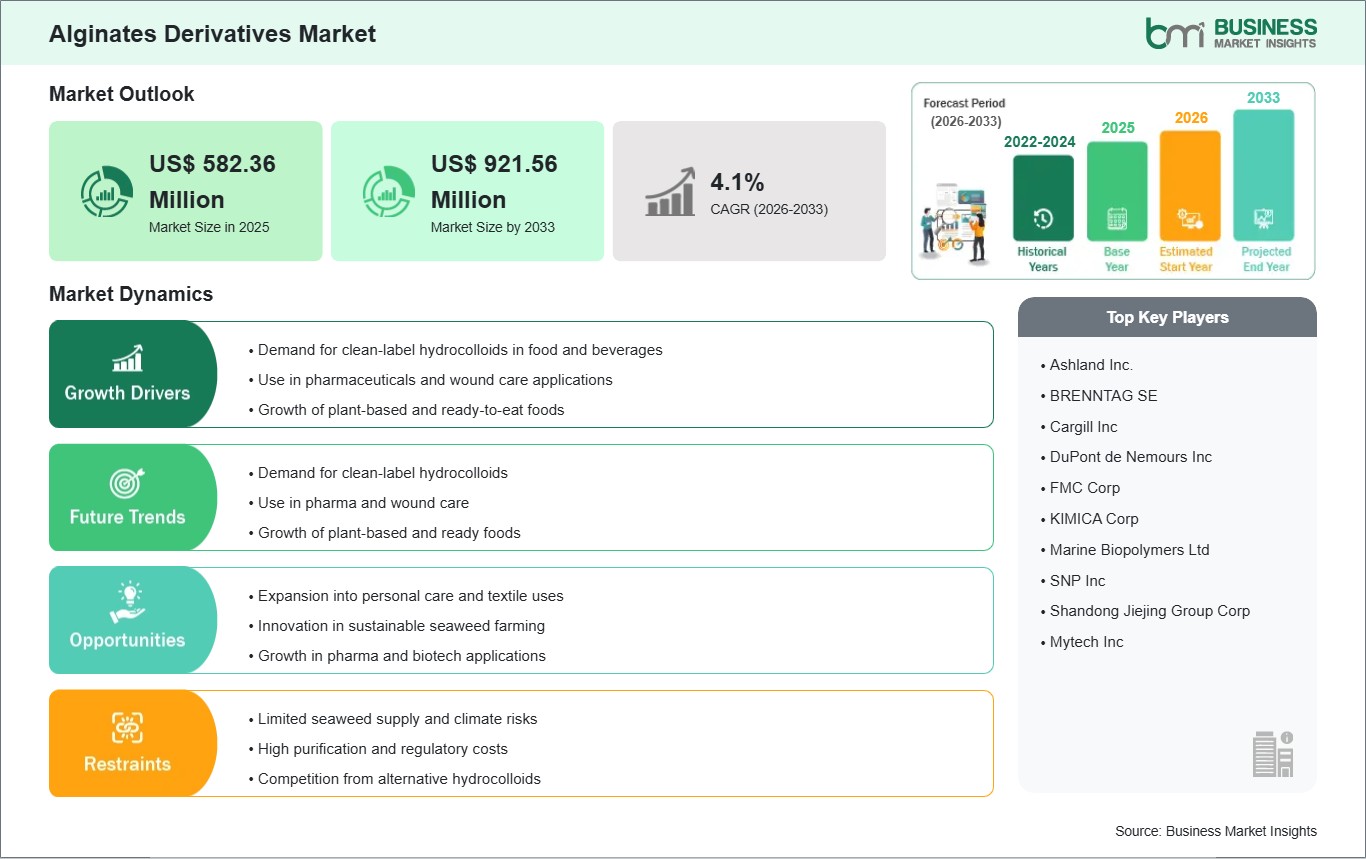
The alginates derivatives market size is expected to reach US$ 921.56 Million by 2033 from US$ 582.36 Million in 2025. The market is estimated to record a CAGR of 4.1% from 2026 to 2033.
Alginate derivatives are versatile, naturally sourced polysaccharides that are essential hydrocolloids in biomedical, pharmaceutical, and industrial applications. They are primarily extracted from brown seaweed and are known for their unique properties of gelation, viscosity control, and biocompatibility. Alginates are a key component in modern wound care, drug delivery systems, and food science. The market for alginate derivatives is growing steadily. This growth is fueled by the increasing focus on sustainable and natural materials, stricter standards for healthcare products, and a rising demand for nutraceuticals, tissue engineering, and textile printing. Ongoing improvements in chemical modification, purification, and functionalization are further boosting performance, enhancing gel strength, stability, controlled release, and purity. As a result, these derivatives are becoming vital for innovation in specific, high-value formulations.
However, the market faces significant challenges. Variability in seaweed sourcing, along with energy-intensive extraction and modification processes, can affect cost and consistency. The existence of alternative synthetic polymers, regulatory barriers for medical-grade approval, and performance issues in certain physiological or processing conditions also present obstacles. Nonetheless, there are many opportunities. Advances in biomaterial science and hybrid polymer systems are leading to the creation of smarter, more functional, and targeted alginate-based products. These innovations are paving the way for integrating alginate derivatives into regenerative medicine, 3D bioprinting, eco-friendly agrochemicals, and advanced encapsulation technologies. Ultimately, the future of the alginates derivatives market will be influenced by the global shift toward bio-based, non-toxic materials and the growing connection between material science and life sciences.

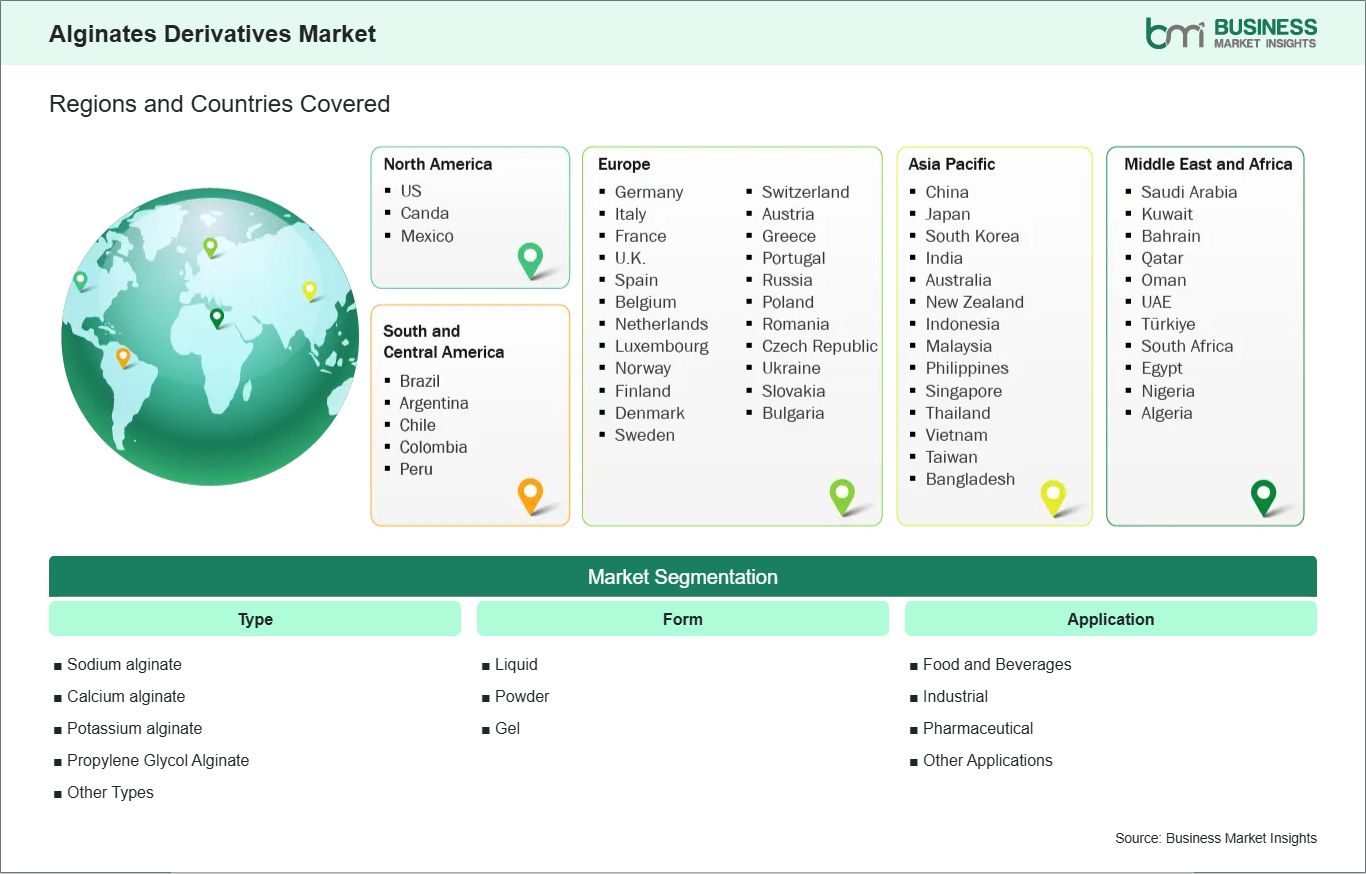
Key segments that contributed to the derivation of the alginates derivatives market analysis are type, form, and application.
The global shift toward better wound care, regenerative medicine, and targeted drug delivery is increasing the demand for high-purity, customized alginate derivatives in the biomedical sector. As populations age and the rates of chronic wounds, diabetes, and musculoskeletal disorders rise, healthcare systems are using more advanced biomaterial solutions that promote healing, lower infection rates, and improve patient outcomes. Alginate-based hydrogels, fibers, and scaffolds are key to this change. They are valued for their natural biocompatibility, ability to create gentle yet effective gels, and capacity for controlled ionic release. At the same time, the pharmaceutical and nutraceutical markets, which are important for developing packaging systems, controlled-release formulations, and functional food ingredients, need derivatives that provide specific gelation timing, better stability, and customized degradation profiles. This combined demand from both medical and life science fields is pushing manufacturers to innovate in purification and chemical modification. They are creating solutions tailored for specific applications that meet strict regulatory standards. By improving therapeutic effectiveness, enhancing patient comfort, and allowing for less invasive treatments, these alginate advancements are not only adding clinical value but also boosting the growth and complexity of the alginate derivatives market.
Traditional alginate applications often face limits in mechanical strength, consistency from batch to batch, and functionality in different environmental conditions. These issues can hold back performance in high-end applications. In response, significant progress in chemical modification, composite material development, and nano-engineering is greatly expanding the capabilities of alginate derivatives. New techniques like oxidation, sulfation, and covalent cross-linking with other polymers are enabling the creation of next-generation materials with specific properties. These include improved elasticity, better adhesive strength, increased stability in physiological fluids, and the addition of new bioactive functions. Such innovations are crucial for the commercialization of complex 3D bioprinting structures, smart wound dressings with integrated sensors, and more efficient agricultural seed coatings.
Additionally, the growing focus on a circular economy and sustainable sourcing is creating new opportunities for derivatives from verified, eco-friendly seaweed cultivation and processing. Companies that invest in these advanced material platforms are well-positioned to target premium markets in green packaging, water-treatment biocapsules, and eco-friendly textile printing. They will meet strict environmental regulations and consumer demand for natural ingredients. This focus on innovation and sustainability not only helps maintain long-term market competitiveness but also encourages the wider use of renewable, multifunctional biomaterials in the global economy.

The Alginates Derivatives market demonstrates steady growth, with size and share analysis revealing evolving trends and competitive positioning among key players. The report examines subsegments categorized within type, form, and application, offering insights into their contribution to overall market performance.
Based on type, the sodium alginate segment dominates the alginates derivatives market. Sodium alginate provides great versatility, biocompatibility, and cost-effectiveness in forming stable gels and thickening solutions. This makes it important for creating wound dressings, pharmaceutical coatings, and food stabilizers. Its reliable gelation behavior, strong compatibility with active ingredients, and recognition as a GRAS (Generally Recognized As Safe) material for large-scale production have made it a top choice for manufacturers in the medical, food, and industrial fields.
| Report Attribute | Details |
|---|---|
| Market size in 2025 | US$ 582.36 Million |
| Market Size by 2033 | US$ 921.56 Million |
| Global CAGR (2026 - 2033) | 4.1% |
| Historical Data | 2022-2024 |
| Forecast period | 2026-2033 |
| Segments Covered | By Type
|
|
Regions and Countries Covered
| |
| North America | US, Canada, Mexico |
| Europe | Belgium, Austria, Finland, Denmark, Greece, Poland, Romania, Russia, Ukraine, Czech Republic, Slovakia, Bulgaria, Italy, Luxembourg, Germany, Switzerland, France, Netherlands, Norway, Portugal, Spain, Sweden, United Kingdom |
| Asia-Pacific | Australia, China, India, Japan, South Korea, Indonesia, Malaysia, Philippines, Singapore, Thailand, Vietnam, Bangladesh, New Zealand, Taiwan |
| South and Central America | Brazil, Argentina, Peru, Chile, Colombia |
| Middle East and Africa | Bahrain, Kuwait, Oman, Qatar, Saudi Arabia, United Arab Emirates, Turkiye, South Africa, Egypt, Algeria, Nigeria |
| Market leaders and key company profiles |
|
The " Alginates Derivatives Market Size and Forecast (2022–2033)" report provides a detailed analysis of the market covering below areas:
The geographical scope of the Alginates Derivatives market report is divided into five regions: North America, Asia Pacific, Europe, the Middle East & Africa, and South & Central America. The Asia Pacific Alginates Derivatives Market is segmented into China, Japan, South Korea, India, Australia, New Zealand, Indonesia, Malaysia, the Philippines, Singapore, Thailand, Vietnam, Taiwan, Bangladesh, and the Rest of Asia Pacific. Asia Pacific is a vibrant center for growth and supply in the global alginates derivatives market. This position is driven by the region's strength in sourcing raw materials. Its extensive coastlines support large-scale seaweed farming, especially for brown algae species. With a strong and cost-effective manufacturing base, the region has built a solid and integrated supply chain. Rapidly growing economies are also fueling significant domestic demand in key sectors like pharmaceuticals, food and beverage, and textiles. This growth is supported by increased healthcare spending, an aging population that needs better wound care solutions, and a rising middle class that is turning to processed and functional foods that use alginates as stabilizers and texturizers.
At the same time, a growing focus from governments and industries on sustainable, bio-based materials is boosting investment and innovation in high-value applications. The presence of both major global exporters and flexible local manufacturers, along with significant research into alginate refinement and application development, strengthens Asia Pacific's position not just as a production center but also as a key player in shaping future market trends, scalability, and cost structures for alginate derivatives globally.

The Alginates Derivatives market is evaluated by gathering qualitative and quantitative data post-primary and secondary research, which includes important corporate publications, association data, and databases. A few of the key developments in the alginates derivatives market are:
The Alginates Derivatives Market is valued at US$ 582.36 Million in 2025, it is projected to reach US$ 921.56 Million by 2033.
As per our report Alginates Derivatives Market, the market size is valued at US$ 582.36 Million in 2025, projecting it to reach US$ 921.56 Million by 2033. This translates to a CAGR of approximately 4.1% during the forecast period.
The Alginates Derivatives Market report typically cover these key segments-
The historic period, base year, and forecast period can vary slightly depending on the specific market research report. However, for the Alginates Derivatives Market report:
The Alginates Derivatives Market is populated by several key players, each contributing to its growth and innovation. Some of the major players include:
The Alginates Derivatives Market report is valuable for diverse stakeholders, including:
Essentially, anyone involved in or considering involvement in the Alginates Derivatives Market value chain can benefit from the information contained in a comprehensive market report.
Please tell us your area of interest
(Market Segments/ Regions and Countries/ Companies)