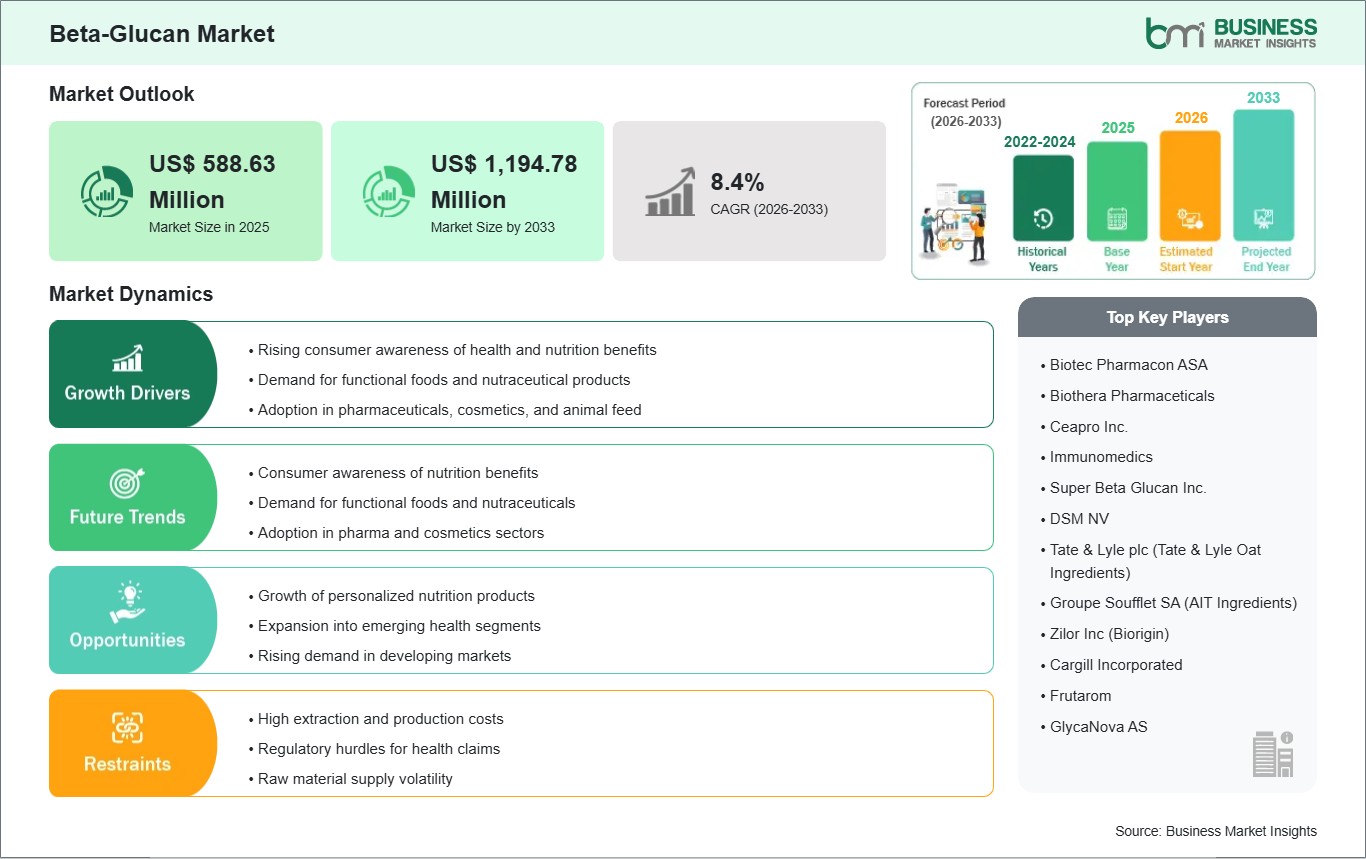
Market Summary
Executive Summary and Global Market Analysis
Beta-glucan is a natural polysaccharide found in the cell walls of cereals like oats and barley, as well as in yeast, fungi, and some bacteria. It is commonly used in food and beverages, dietary supplements, pharmaceuticals, and personal care products because of its ability to modulate the immune system, lower cholesterol, and support gut health. Beta-glucan is frequently added to functional foods, nutraceuticals, and cosmetics, where it is appreciated for improving immunity, heart health, regulating blood sugar levels, and promoting skin hydration and repair.
Market growth is driven by rising consumer awareness of preventive healthcare, increased demand for functional foods and dietary supplements, and a preference for natural, plant-based ingredients. The growth of the nutraceutical and pharmaceutical industries, coupled with greater interest in immune health due to global health challenges, also supports demand. Furthermore, the increasing popularity of clean-label products and fortified food and beverage options in both developed and emerging markets is speeding up the use of beta-glucan in various applications.
Segment Analysis
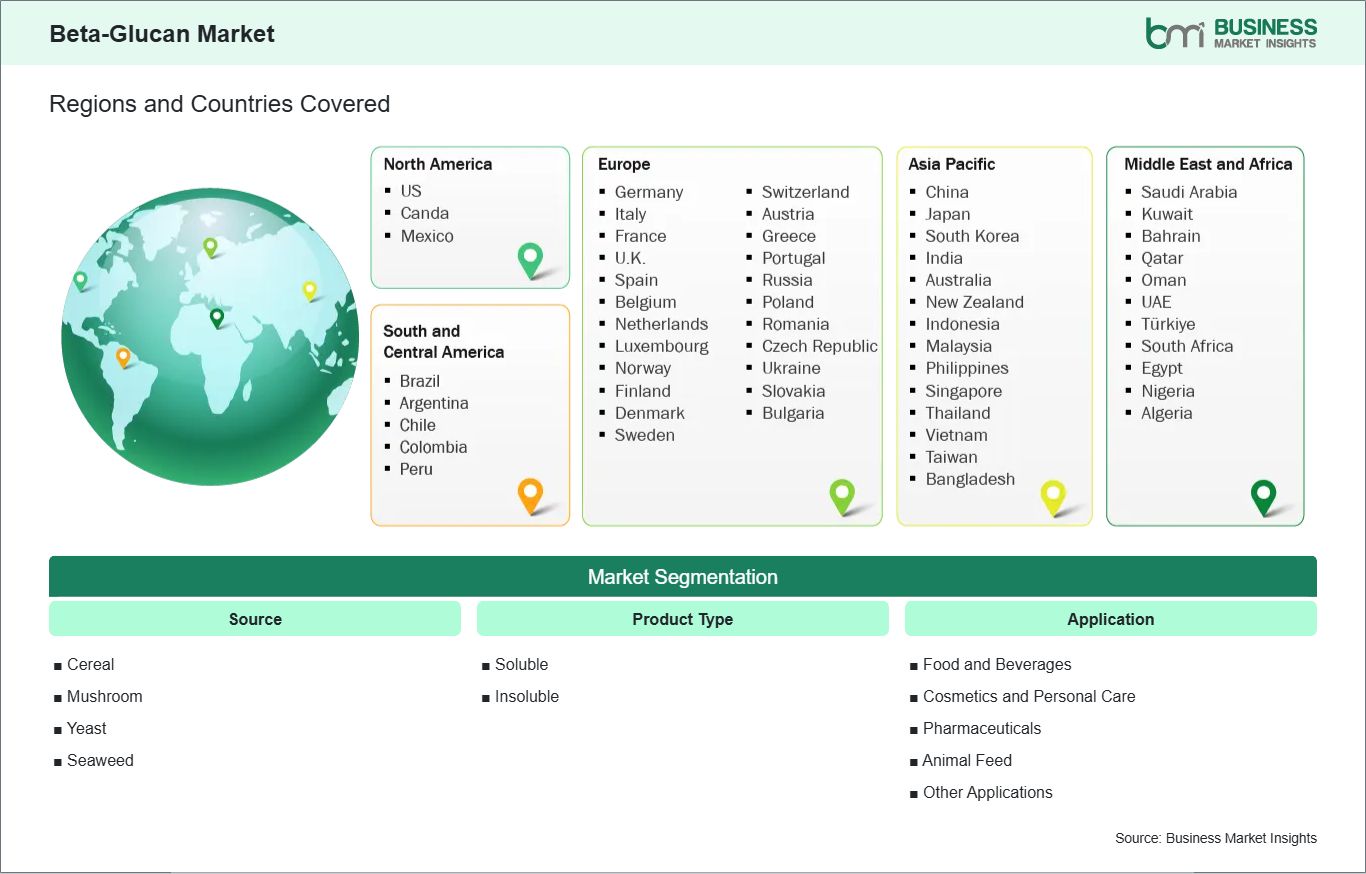
Beta-Glucan Market Segmentation
Key segments that contributed to the derivation of the beta-glucan market analysis are source, product type, and application.
- By source, the beta-glucan market is segmented into cereal, mushroom, yeast, and seaweed. The cereal segment held the largest market share in 2025.
- By product type, the market is segmented into soluble and insoluble. The soluble segment held the largest market share in 2025.
- By application, the beta-glucan market is segmented into food and beverages, cosmetics and personal care, pharmaceuticals, animal feed, and others. The food and beverages segment held the largest market share in 2025.
Market Forces
Beta-Glucan Market Drivers and Opportunities
Rising Consumer Focus on Preventive Healthcare and Immune Support
One of the primary growth factors of the beta-glucan market is the increasing consumer interest in preventive healthcare and immune system support. More people are aware of how nutrition affects overall health. This awareness has led to a preference for functional foods and dietary supplements with scientifically backed ingredients. Beta-glucan, known for improving immunity and reducing cholesterol, has caught the attention of health-conscious consumers looking for natural ways to support heart health, control blood sugar, and enhance gut health.
The global rise in lifestyle-related diseases such as cardiovascular issues, diabetes, and obesity has increased the demand for ingredients that provide proven benefits. Moreover, the recent focus on immunity due to global health concerns has sped up the use of beta-glucan in fortified foods, nutraceuticals, and pharmaceuticals. Supportive regulatory approvals for specific health claims in various regions have also boosted consumer confidence and product integrity. As disposable incomes rise and awareness of functional nutrition grows in developing economies, the demand for beta-glucan-based products is likely to keep increasing steadily.
Expansion in Functional Food and Clean-Label Product Innovation
A significant growth opportunity in the beta-glucan market comes from the rapid rise of functional foods and clean-label product innovation. Consumers are paying more attention to product labels and prefer natural, lightly processed ingredients that offer clear health benefits. This change creates a strong chance for manufacturers to add beta-glucan to a wider variety of everyday food and drink products. These include bakery items, dairy alternatives, snacks, and ready-to-drink beverages. The increasing popularity of plant-based diets also boosts opportunities for cereal- and yeast-derived beta-glucan as sustainable and vegan-friendly functional ingredients.
Furthermore, improvements in extraction and formulation technologies are increasing the solubility, stability, and compatibility of beta-glucan, allowing its use without affecting taste or texture. Emerging markets in Asia-Pacific and Latin America offer untapped potential thanks to rising urbanization, growing middle-class populations, and greater health awareness. Partnerships between ingredient suppliers and food manufacturers can speed up product innovation, making beta-glucan a key part of next-generation functional nutrition solutions.
Size and Share Analysis
Beta-Glucan Market Size and Share Analysis
The beta-glucan market demonstrates steady growth, with size and share analysis revealing evolving trends and competitive positioning among key players. The report examines subsegments categorized within source, product type, and application, offering insights into their contribution to overall market performance. By source, the cereal segment holds the largest market share. This dominance stems from its common use in functional foods, drinks, and dietary supplements. Oat- and barley-derived beta-glucan are highly valued for their cholesterol-lowering and heart health benefits. Cereal-based beta-glucan is preferred because of strong clinical support, regulatory approvals for health claims in several regions, and high consumer awareness. The growth of this segment is driven by rising demand for clean-label, plant-based ingredients and increased consumption of fortified food products. Ongoing product innovation in ready-to-eat cereals, baked goods, and nutritional supplements is also encouraging broader use. Together, these factors make the cereal segment a vital part of the beta-glucan market, with steady demand expected in the coming years.
Report Coverage
Beta-Glucan Market Report Coverage and Deliverables
The " Beta-Glucan Market Size and Forecast (2022–2033)" report provides a detailed analysis of the market covering below areas:
- Beta-glucan market size and forecast at global, regional, and country levels for all the key market segments covered under the scope
- Beta-glucan market trends, as well as market dynamics such as drivers, restraints, and key opportunities
- Beta-glucan market analysis covering key market trends, global and regional framework, major players, regulations, and recent market developments
- Industry landscape and competition analysis covering market concentration, heat map analysis, prominent players, and recent developments for the beta-glucan market
- Detailed company profiles, including SWOT analysis
Geographic Insights
Beta-Glucan Market Geographic Insights
The geographical scope of the beta-glucan market report is divided into five regions: North America, Asia Pacific, Europe, the Middle East & Africa, and South & Central America. North America holds a significant share of the beta-glucan market. This is due to strong consumer awareness, a well-established nutraceutical industry, and supportive regulations for functional ingredients. The region has a high occurrence of lifestyle-related health issues like cardiovascular disease, obesity, and diabetes. These conditions have greatly increased the demand for heart health and immune support products. Consumers in the United States and Canada prefer functional foods, dietary supplements, and clean-label products. This creates ongoing demand for beta-glucan derived from oats and yeast.
Additionally, the presence of major food processing companies, supplement makers, and research institutions boosts product development and commercialization. Approvals for specific health claims about lowering cholesterol have also increased consumer confidence and market presence. The region enjoys advanced distribution networks, including retail chains and online shopping platforms, which help provide wide product access. Ongoing innovation in fortified foods, drinks, and nutraceutical formulations is likely to keep North America in the lead in the beta-glucan market throughout the forecast period.
Industry Activity
Recent Developments
The beta-glucan market is evaluated by gathering qualitative and quantitative data post-primary and secondary research, which includes important corporate publications, association data, and databases. A few of the key developments in the beta-glucan market are:
- In February 2025, Layn Natural Ingredients announced the launch of its new beta-glucan ingredient, Galacan. At the same time, the company unveiled an expanded biotechnology facility to support large-scale production of sustainable bioactive ingredients. The company highlighted the ingredient's potential uses in supplements, functional foods, beverages, personal care, and animal nutrition.
- In October 2022, Sawubona Mycelium (Pty) Ltd, a South African biotechnology company, launched two beta-glucan-based skin-care products. These are a hydrating serum and an anti-aging serum. They were introduced under the brand Blu Beryl at the Technology Innovation Agency (TIA) Bioprocessing Platform in Umbogintwini, Durban.
Trust & Transparency
Research Methodology
The market analysis combines proprietary research with secondary data from government agencies, company disclosures, regulatory filings, industry databases and expert interviews. Market estimates are validated through data triangulation, cross-market benchmarking and analyst
review.
View Full Research Methodology
Key Sources Referred:
World Bank – Global Trade IndicatorsWorld Trade Organization (WTO)International Monetary Fund (IMF)International Trade Administration (ITA)Company WebsitesCompany Annual ReportsCompany Investor PresentationsInstitute of Food Technologists (IFT)International Life Sciences Institute (ILSI)Natural Products Association (NPA)S. Food and Drug Administration (FDA)