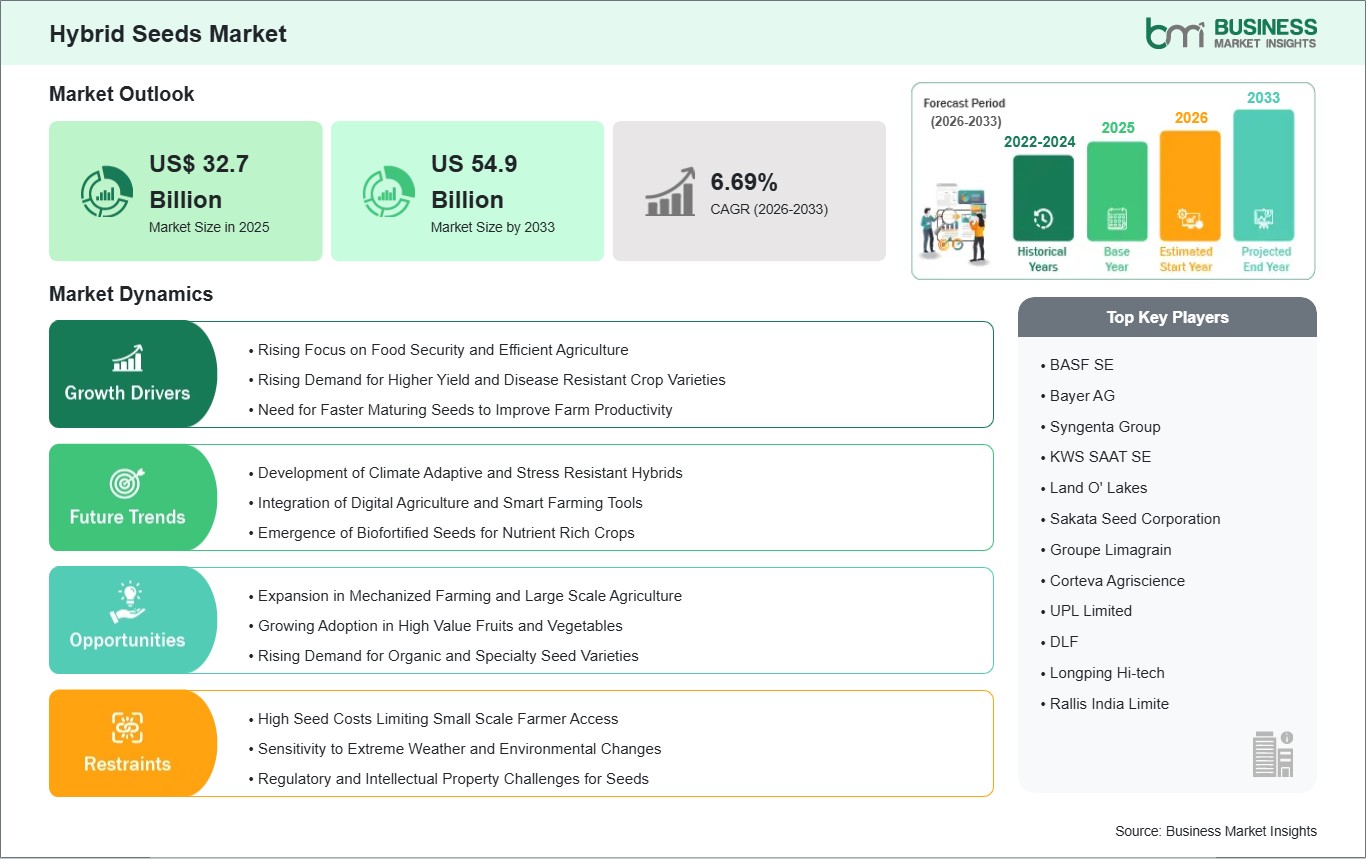
The Hybrid Seeds Market size is expected to reach US$ 54.9 Billion by 2033 from US$ 32.7 Billion in 2025. The market is estimated to record a CAGR of 6.69% from 2026 to 2033.
The global market for hybrid seeds is a vital segment of modern agriculture that primarily deals with the development and marketing of seeds that have the best characteristics of the parent plant. This means that the seeds have been engineered using controlled crossbreeding techniques to ensure that the output is maximized and that the plant can withstand different conditions. This has seen the adoption of hybrid seeds for different crops such as corn, rice, and wheat. In addition, the seeds have been used in horticulture and for other crops. This has seen the adoption of hybrid seeds for different crops due to the need for sustainability in food production and the ability to withstand climate change. The major drivers of the market include the need to enhance agricultural efficiency while reducing the effects of environmental factors, including pests, diseases, and unfavorable climatic changes. The farmers reap the rewards of the increased rate of growth, uniformity, and nutritional value of the plants, which are essential for food security and commercial viability of the crops.
However, some challenges are associated with the use of hybrid seeds, including the fact that the seeds are more expensive than the conventional open-pollinated seeds, as well as the fact that farming practices must be controlled to obtain the best results from the seeds. Furthermore, the fact that only a few varieties of the seeds are commercially available raises some concerns about biodiversity, which might affect the sustainability of the seeds in the long run. However, the fact that research is continually being done to enhance the genetic, biotechnology, and precision capabilities of the seeds ensures that the seeds play a crucial role in the agricultural sector, considering the high performance and adaptability of the seeds to the increasing global population.

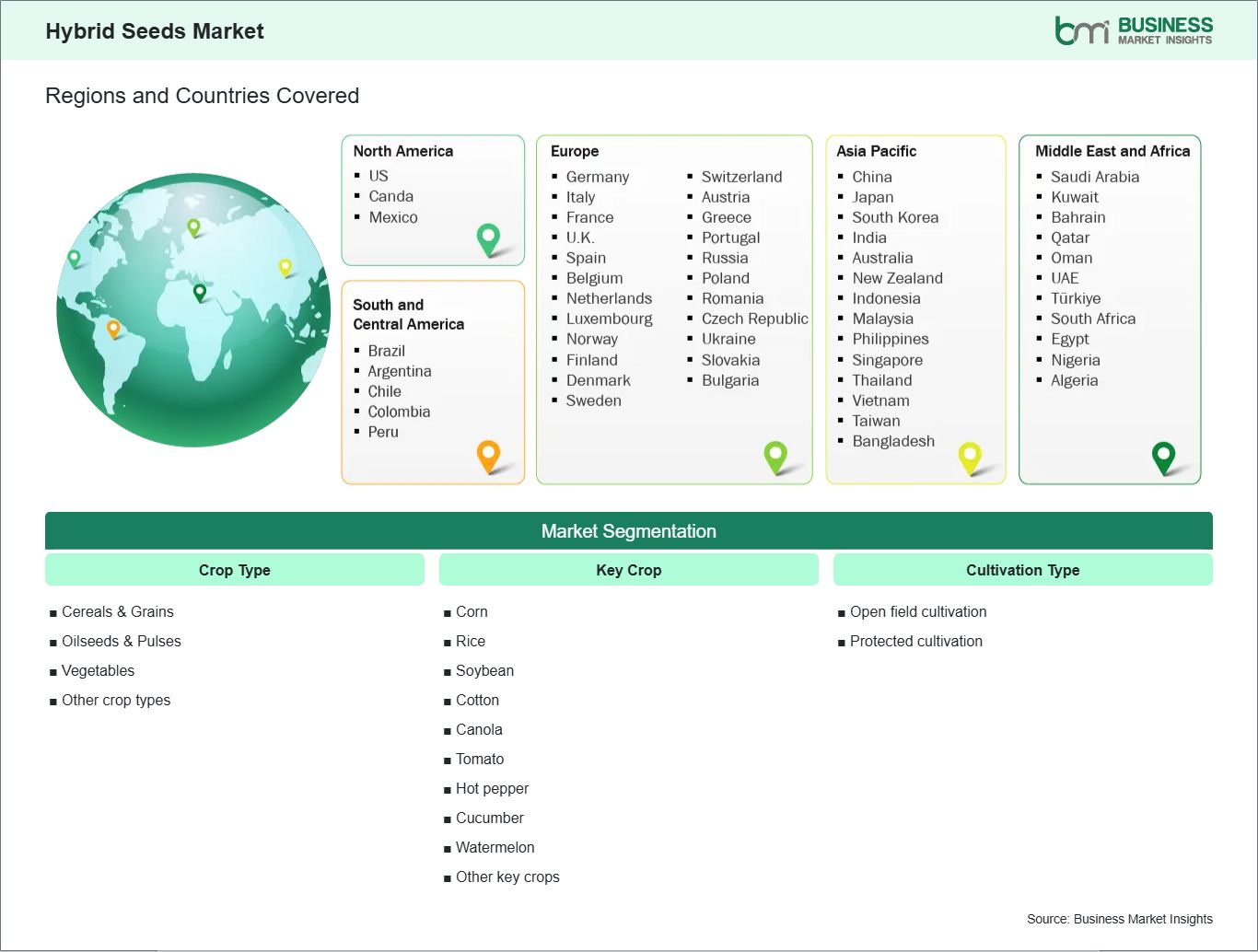
Key segments that contributed to the derivation of the hybrid seeds market analysis are crop type, key crop, and cultivation type.
The main driver of the demand for hybrid seeds in the global market has been the increasing trend in the focus on food security and the need for efficient agricultural practices. This is because the population of the world is continuously growing. This has led to food security being a priority for governments and organizations. This is due to the fact that food is essential for the sustenance of life. The main aim of developing hybrid seeds has been to ensure that farmers can produce consistent yields in different environmental conditions. This has been essential in ensuring that the crops have resistance to pests and diseases.
In addition to yield improvements, hybrid seeds support sustainable and efficient agriculture by optimizing resource utilization. These seeds often require less water, fertilizers, and pesticides due to their improved vigor and resilience, which reduces input costs for farmers while minimizing environmental impact. Crops such as maize, rice, wheat, and various vegetables benefit from hybridization techniques that enhance uniformity and growth performance. Globally, the adoption of hybrid seeds is being promoted through initiatives that emphasize agricultural modernization, climate-smart farming, and supply chain resilience, reflecting the critical role of these seeds in meeting rising food demands sustainably.
Furthermore, hybrid seeds are also playing an essential role in empowering smallholder farmers in regions prone to climatic variability. By providing seeds that consistently deliver higher yields and resist local pest pressures, hybrid varieties contribute to improved food availability and economic stability. Agricultural research institutions and seed companies are actively developing region-specific hybrids that cater to local soil, climate, and cropping practices, supporting food security goals globally. As governments and international organizations continue to focus on reducing hunger and improving agricultural efficiency, hybrid seeds are increasingly seen as a strategic tool to safeguard the world’s food supply.
The adoption of hybrid seeds is being further accelerated by the global expansion of mechanized and large-scale agriculture. Mechanized farming systems, which rely on advanced machinery for planting, harvesting, and crop management, benefit from hybrid seeds’ uniformity and predictability. The consistent growth patterns of hybrid crops facilitate precision agriculture techniques, allowing farmers to optimize planting density, irrigation schedules, and nutrient management. This synergy between mechanization and hybrid seeds enhances productivity and operational efficiency, which is increasingly important as farming shifts toward large-scale, commercially oriented models worldwide.
Large-scale agriculture practices, including commercial farming and contract farming, are also utilizing hybrid seeds to enhance crop yield while keeping costs at manageable levels. Commercial farming is benefiting from hybrid seeds' improved germination capacity, maturity, and resistance to disease, allowing for easier harvesting and reduced labor requirements. The role of hybrid seeds in large-scale agriculture is improving the efficiency of the supply chain and catering to the increasing demand for basic crops and commercial products. Across the world, this has created partnerships between seed and agriculture companies to ensure that farmers have access to quality seeds for large-scale cultivation.
Furthermore, the use of hybrid seeds enables the application of advanced farming technologies. This includes precision irrigation, automated planting, and data-based management. The reliability of hybrid seeds helps the farmer to adopt innovative technologies that enhance efficiency and reduce costs. In areas where large-scale farming is being adopted, the use of hybrid seeds plays a crucial role in increasing productivity per hectare. This helps to make farming economically viable. With the global adoption of automated farming and large-scale farming, hybrid seeds are becoming essential for modern agriculture.

The hybrid seeds market is experiencing steady growth, with market size and share analysis reflecting evolving treatment preferences and competitive dynamics among key players. The report evaluates important subsegments categorized within are crop type, key crop, and cultivation type, highlighting their respective contributions to overall market performance.
By crop type, the Cereals & Grains subsegment dominated the Hybrid Seeds market in 2025. Cereals and grains offer high yield potential, adaptability, and strong demand as staple foods, driving their widespread adoption among farmers.
Based on key crop, the Corn subsegment dominated the Hybrid Seeds market in 2025. Corn is a major staple with extensive industrial and food applications, supporting strong demand for high-yield and resilient hybrid varieties.
In terms of cultivation type, the Open Field Cultivation subsegment dominated the Hybrid Seeds market in 2025. Open field cultivation provides cost-effective and scalable production methods, reinforcing the dominance of this segment in global agriculture.
| Report Attribute | Details |
|---|---|
| Market size in 2025 | US$ 32.7 Billion |
| Market Size by 2033 | US 54.9 Billion |
| Global CAGR (2026 - 2033) | 6.69% |
| Historical Data | 2022-2024 |
| Forecast period | 2026-2033 |
| Segments Covered | By Crop Type
|
|
Regions and Countries Covered
| |
| North America | US, Canada, Mexico |
| Europe | Belgium, Austria, Finland, Denmark, Greece, Poland, Romania, Russia, Ukraine, Czech Republic, Slovakia, Bulgaria, Italy, Luxembourg, Germany, Switzerland, France, Netherlands, Norway, Portugal, Spain, Sweden, United Kingdom |
| Asia-Pacific | Australia, China, India, Japan, South Korea, Indonesia, Malaysia, Philippines, Singapore, Thailand, Vietnam, Bangladesh, New Zealand, Taiwan |
| South and Central America | Brazil, Argentina, Peru, Chile, Colombia |
| Middle East and Africa | Bahrain, Kuwait, Oman, Qatar, Saudi Arabia, United Arab Emirates, Turkiye, South Africa, Egypt, Algeria, Nigeria |
| Market leaders and key company profiles |
|
The "Hybrid Seeds Market Size and Forecast (2022 - 2033)" report provides a detailed analysis of the market covering below areas:
The geographical scope of the Hybrid Seeds market report is divided into five regions: North America, Asia Pacific, Europe, Middle East & Africa, and South & Central America. The Hybrid Seeds market in North America is expected to grow during the forecast period.
North America holds a dominant position in the hybrid seeds market, backed by a mix of favorable agricultural infrastructure, R&D activities, and the practice of modern farming techniques. The United States and Canada have been at the forefront in cultivating crops such as corn, soybeans, and vegetables, for which hybrid seeds have been widely used to enhance crop yield, pest resistance, and adaptability to environmental conditions. Farmers in North America are adopting hybrid seeds to guarantee crop growth and maintain profitability in large-scale farming activities. The adoption of precise farming practices like the use of GPS technology in planting crops, crop growth monitoring, and the installation of automatic irrigation systems is further enhancing the advantages of hybrid seeds.
The North American seed market is also benefiting from the strong association of seed companies, research organizations, and agritech innovators in the region, which are continually introducing new hybrid seeds with improved characteristics like drought resistance, disease resistance, and nutrient efficiency. Sustainability aspects are also being considered in the development of hybrid seeds, which are being designed to have low chemical requirements and to have improved soil health. Regulations and IP laws are in place to support the adoption of advanced hybrid seeds by manufacturers and users. While the higher cost of hybrid seeds and dependence on specific cultivation practices remain challenges, North America’s combination of technological innovation, scientific expertise, and large-scale commercial farming ensures that it continues to lead the global hybrid seeds market in adoption, research, and application.

The hybrid seeds market is evaluated by gathering qualitative and quantitative data post primary and secondary research, which includes important corporate publications, association data, and databases. A few of the key developments in the hybrid seeds market are:
The Hybrid Seeds Market is valued at US$ 32.7 Billion in 2025, it is projected to reach US 54.9 Billion by 2033.
As per our report Hybrid Seeds Market, the market size is valued at US$ 32.7 Billion in 2025, projecting it to reach US 54.9 Billion by 2033. This translates to a CAGR of approximately 6.69% during the forecast period.
The Hybrid Seeds Market report typically cover these key segments-
The historic period, base year, and forecast period can vary slightly depending on the specific market research report. However, for the Hybrid Seeds Market report:
The Hybrid Seeds Market is populated by several key players, each contributing to its growth and innovation. Some of the major players include:
The Hybrid Seeds Market report is valuable for diverse stakeholders, including:
Essentially, anyone involved in or considering involvement in the Hybrid Seeds Market value chain can benefit from the information contained in a comprehensive market report.
Please tell us your area of interest
(Market Segments/ Regions and Countries/ Companies)