Anti-Microbial Nano Coatings Market Outlook: Size, Share, Trends, Growth Analysis, Competitive Landscape & Forecast, 2026–2033

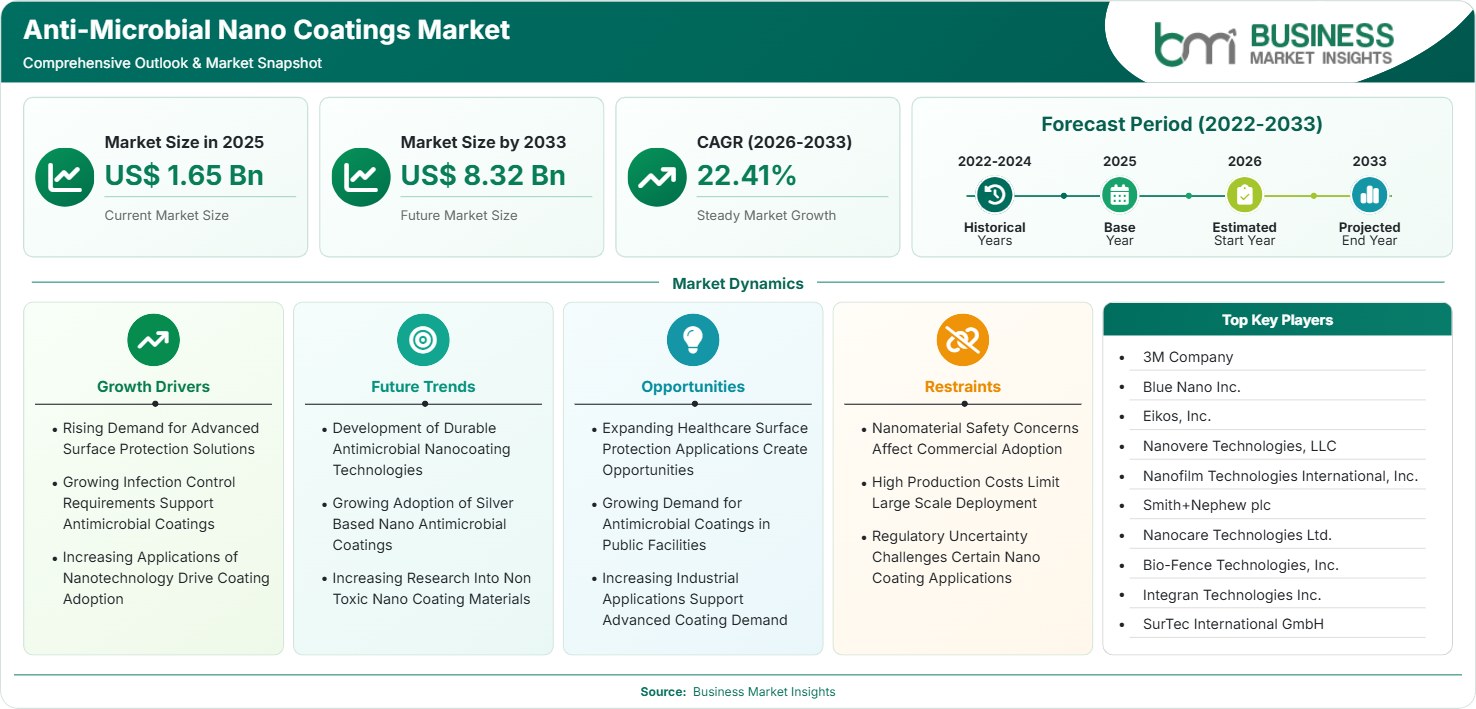
The Anti-Microbial Nano Coatings Market size was valued at US$ 1.65 Billion in 2025 and is projected to reach US$ 8.32 Billion by 2033, expanding at a CAGR of 22.41% from 2026 to 2033. Demand is supported by increasing infection-control requirements, advanced surface protection needs, nanotechnology adoption, and expanding applications across healthcare, medical, food and beverage, water treatment equipment, marine, and industrial environments.

Report Coverage
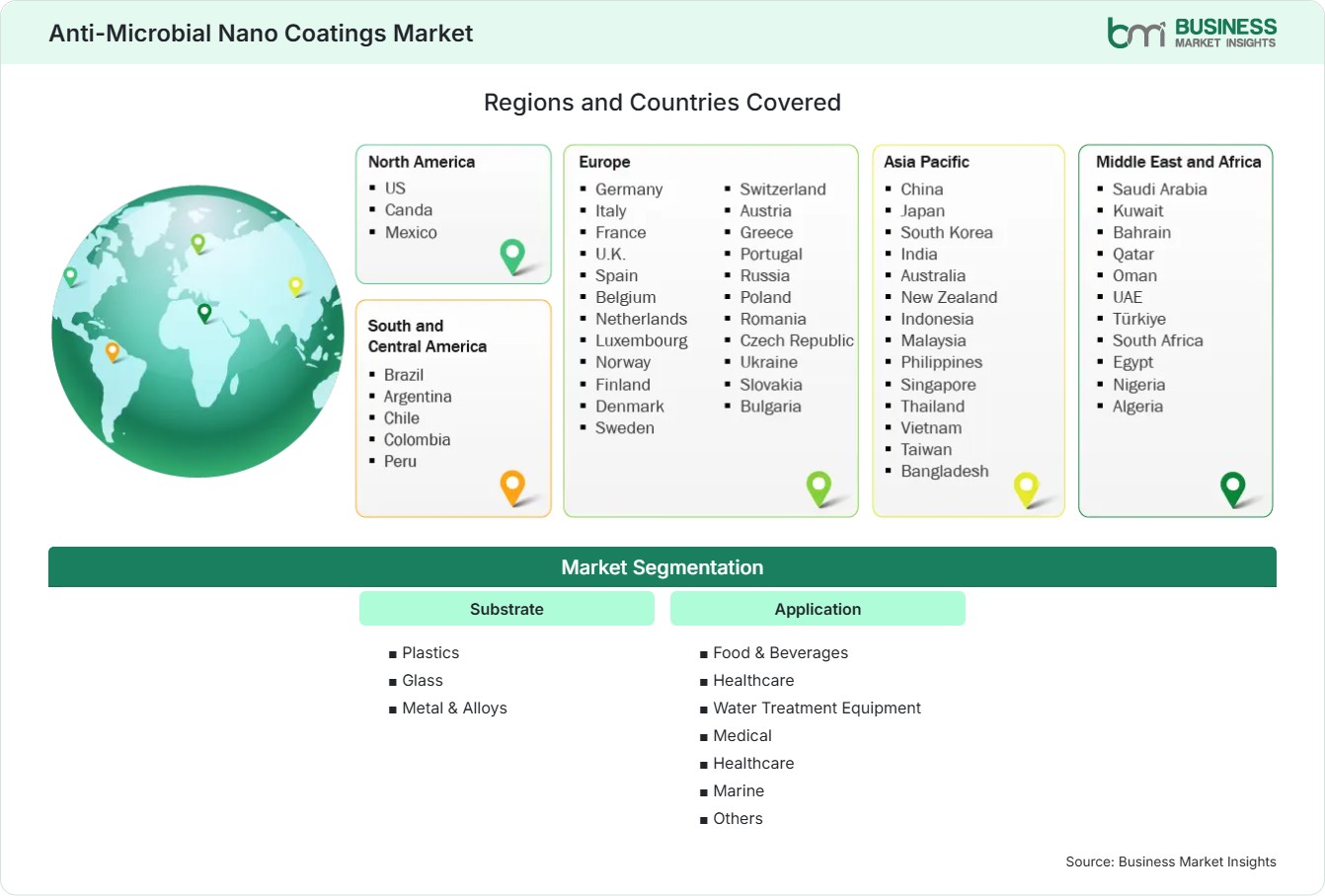
  • Substrate: Plastics, Glass, Metal & Alloys
  • Application: Food & Beverages, Healthcare, Water Treatment Equipment, Medical, Healthcare, Marine, Others
US$ 1.65 Bn Market size in 2025
US$ 8.32 Bn Market Size by 2033
22.41% CAGR, 2026 - 2033
2026-2033 Forecast Period

AI Overview

Anti-Microbial Nano Coatings Market Summary

  • North America: North America represents a 28%–32% share in 2025 and is advancing at a 20.5%–22.5% CAGR through 2033, supported by sophisticated healthcare infrastructure, nanotechnology capabilities, medical applications, and demand for specialized antimicrobial surface protection.
  • Fastest Growing Region: Asia Pacific holds a 30%–34% share in 2025 and is projected to record a 24.0%–27.0% CAGR through 2033, supported by industrialization, healthcare infrastructure expansion, advanced materials adoption, and increasing manufacturing activity.
  • Leading Segment: Metal & Alloys represent a 38%–42% share in 2025 and are expanding at a 21.0%–23.5% CAGR through 2033, supported by applications across medical equipment, industrial components, marine structures, and high-contact surfaces.
  • High Growth Segment: Healthcare applications account for a 22%–26% share in 2025 and are advancing at a 24.0%–27.0% CAGR through 2033, supported by infection-control priorities and demand for antimicrobial protection across facilities and equipment.
  • Key Market Opportunity: Expanding healthcare, food processing, public facilities, water treatment equipment, and marine applications create opportunities for durable nano-enabled coatings offering antimicrobial functionality alongside substrate compatibility and surface protection.
  • Major Market Players: 3M Company, Blue Nano Inc., Eikos, Inc., Nanovere Technologies, LLC, Nanofilm Technologies International, Inc., Smith+Nephew plc, Nanocare Technologies Ltd., Bio-Fence Technologies, Inc., Integran Technologies Inc., SurTec International GmbH.
Strategic Insights

Anti-Microbial Nano Coatings Market: Strategic Insights

Anti-Microbial Nano Coatings Market Strategic Framework
FREE PDF
Request your free sample
Request free sample
Stakeholder View

Key Takeaways

  • Healthcare and medical applications remain important demand areas because infection-control requirements encourage the use of antimicrobial surface technologies.
  • Metal, glass, and plastic substrates create diverse opportunities as manufacturers seek coatings compatible with different material properties and operating conditions.
  • Product differentiation increasingly depends on antimicrobial effectiveness, coating durability, adhesion, substrate compatibility, and application efficiency.
  • Asia Pacific offers attractive expansion potential as healthcare infrastructure, manufacturing capacity, and industrial surface-protection requirements continue to develop.
  • Public facilities, food-processing environments, water-treatment equipment, and marine applications provide additional avenues for expansion beyond healthcare.
  • Long-term adoption will depend on balancing antimicrobial performance with safety considerations, regulatory requirements, production economics, durability, and practical application requirements.
Geographic Outlook

Anti-Microbial Nano Coatings Market Regional Highlights

North America Anti-Microbial Nano Coatings Market

North America holds a 28%–32% share in 2025 and is projected to grow at a 20.5%–22.5% CAGR through 2033. Advanced healthcare infrastructure, research capabilities, and demand for specialized surface technologies support regional adoption across medical and industrial applications.

  • Healthcare facilities are evaluating antimicrobial surfaces to support infection-control practices and hygiene management.
  • Medical-device applications create demand for coatings compatible with complex equipment and specialized materials.
  • Food and beverage processors can use protected surfaces where hygiene and contamination control are important.
  • Advanced nanotechnology capabilities support continued development of higher-performance coating formulations.

U.S. Anti-Microbial Nano Coatings Market

The U.S. accounted for approximately 29%–33% of the North American market share in 2025 and represents the region's principal country-level demand center. The market benefits from a developed health care sector, an active nanotech research program, food processing activities, and demand for surface technology advancements.

  • The healthcare sector has immense potential for the use of antimicrobial surface coatings and functional medical applications.
  • Food processing and packaging industries have requirements for the application of coatings that will enhance the effectiveness of current hygiene control systems.
  • State-of-the-art research facilities allow for the development of nano-based products that are more durable and compatible with the substrates.
  • Other industrial/commercial sites present further possibilities as users seek out long-term surface protection solutions.

Europe Anti-Microbial Nano Coatings Market

Europe represents a 24%–28% share in 2025 and is advancing at a 19.0%–21.5% CAGR through 2033. Developed healthcare infrastructures, advanced manufacturing processes, and focus on material safety increase the demand for specific surface treatment techniques.

  • Healthcare environments provide opportunities for antimicrobial coatings on frequently contacted surfaces and equipment.
  • Industrial manufacturers are assessing coatings that combine antimicrobial properties with corrosion and wear resistance.
  • Hygiene management benefits from food processing applications where there is a need for proper surface technologies.
  • Sustainable development motivates efforts towards efficient and safe nanomaterials usage.

Asia Pacific Anti-Microbial Nano Coatings Market

Asia Pacific represents a 30%–34% share in 2025 and records the fastest growth at a 24.0%–27.0% CAGR. Growth in manufacturing, development of healthcare facilities, and utilization of high-tech materials provide wide-ranging opportunities within the region.

  • In China, there are opportunities due to manufacturing and advanced materials.
  • In India, there are possibilities in healthcare, the food processing industry, factories, and infrastructure.
  • In Japan and South Korea, there are opportunities for advanced coatings by means of advanced materials and technologies.
  • The markets in Southeast Asia have emerging opportunities as a result of expanding infrastructures in healthcare and manufacturing.

Rest of World Anti-Microbial Nano Coatings Market

Rest of World holds a 14%–18% share in 2025 and is projected to grow at a 20.0%–23.0% CAGR through 2033. Latin America, the Middle East, and Africa offer developing opportunities linked to healthcare expansion and industrial modernization.

Surface protection needs are emerging in healthcare facilities, food processing plants, machinery, the maritime sector, and infrastructure. The use of advanced coatings would depend on the development of infrastructure, the economics of application, and technological know-how.

  • Markets in Latin America exist in the sectors of health care, food processing, manufacturing, and water treatment.
  • Middle East countries have demand from hospitals, industries, infrastructure for water, and the marine environment.
  • Africa offers future possibilities as health care and industrial infrastructure grow.
  • Technical assistance and proper distribution can help in areas where coating expertise is lacking.
Global Market Geography
FREE PDF
Request your free sample
Request free sample
Segment Analysis

Anti-Microbial Nano Coatings Market Segmentation

Substrate

Plastics accounted for approximately 40%-44% share in 2025 and continue to be one of the major substrates due to extensive usage in the healthcare industry, packaging, consumer goods, and manufacturing industries. Compatibility, adhesion, corrosion protection, and surface performance affect purchasing decisions in all of these applications.

  • Plastics: Supports antimicrobial protection for medical products, equipment components, packaging, and frequently handled surfaces.
  • Glass: Enables protected surfaces across healthcare equipment, food environments, laboratory applications, and public facilities.
  • Metal & Alloys: Serves medical equipment, industrial components, marine applications, and high-contact surfaces requiring durable protection.

Application

Healthcare represents a leading application area, accounting for approximately 19%-23% Anti-Microbial Nano Coatings Market share in 2025, on the basis of growing demand of anti-microbial coatings in hospitals and healthcare equipment. The industrial, food processing, water treatment, marine, and public sectors add to the demand.

  • Food & Beverages: Supports hygienic surfaces across processing equipment, production environments, and food-handling applications.
  • Healthcare: Addresses antimicrobial surface protection requirements across facilities and frequently contacted equipment.
  • Water Treatment Equipment: Supports protected equipment surfaces exposed to moisture and demanding operating conditions.
  • Medical: Provides opportunities for specialized coatings on devices, instruments, and healthcare-related equipment.
  • Marine: Addresses surface-protection requirements in moisture-intensive marine operating environments.
  • Others: Includes industrial and public applications requiring specialized antimicrobial surface protection.
Market Forces

Anti-Microbial Nano Coatings Market Dynamics

Key Market Drivers

Rising Demand for Advanced Surface Protection Solutions

There is a demand for surface coating that should be highly resistant and durable since it would allow providing effective protection. In this regard, there is a tendency towards more careful selection of antimicrobial nano coatings, considering the environment where the contamination, degradation, and cleaning can influence the coating quality. Nano-based formulas allow adding surface characteristics and ensuring protection at the same time when dealing with surfaces that have high contact and require certain conditions. There is an increasing number of users who analyze their options for surface coatings in accordance with such aspects as adhesion, durability, chemical resistance, surface compatibility, and maintenance rather than antimicrobial performance only. Thus, the Anti-Microbial Nano Coatings Market growth is driven by the need for versatile coatings that can enhance the functionality of materials and also meet the needs related to hygiene. The focus on durability will give an additional boost to the market.

Growing Infection Control Requirements Support Antimicrobial Coatings

The rise in the focus on preventing infections is increasing the requirement for surfaces that will aid in controlling the spread of microbes in areas that require frequent touch or cleaning. Antimicrobial surfaces are being considered in healthcare facilities, public buildings, transportation, food industries, and other high-touch settings as an approach within their hygiene plans. Anti-microbial nano-coating can serve as a layer on selective surfaces and be compatible with varied materials when formulated correctly. Consumers are increasingly considering how well the coating performs in addition to its compatibility with cleaning processes, longevity, application method, and maintenance. This is affecting the Anti-Microbial Nano Coatings Market trend in terms of improving surface hygiene without depending only on repetitive cleaning actions. Manufacturers with the ability to prove their performance under practical conditions will find more acceptance with institutional and commercial customers.

Increasing Applications of Nanotechnology Drive Coating Adoption

Improvements in nanotechnology have created new options for antimicrobial coating designers. Nanostructured coatings may be tailored to exhibit certain surface properties, specific levels of antimicrobial action, better dispersability, and increased interaction with certain substrates. The above features are enabling researchers to experiment with new applications such as healthcare devices, packaging surfaces, industrial parts, and water purification equipment, among others. Research in this area is also geared towards improving adhesion, durability, visibility, and integration with current manufacturing processes. With increased technological capability, coating producers will be able to customize their coating formulations based on specific application needs and not general coating solutions. The progress made in this area provides an avenue for further development and implementation of more robust nano-enhanced surface protection technologies.

Key Market Opportunities

Expanding Healthcare Surface Protection Applications Create Opportunities

The healthcare industry is an area that presents abundant potential for development and use of antimicrobial nano coatings due to its presence of many surface materials and pieces of equipment that need constant sanitation. Possible areas of application include such materials as medical equipment, fixtures, protective surfaces, hospital furniture, and other components where the antimicrobial property will add value to the existing sanitation practices. It is anticipated that consumers would favor those products that retain their efficacy even after going through several rounds of sanitization, have a good binding capacity to the surface material without altering its appearance and functionality. Further, there can be development of formulations specifically for use in particular applications, depending on the nature of surface materials like plastic, metals, glass, and others that are common in the health sector. It therefore follows that the Anti-Microbial Nano Coatings Market forecasts will be affected by the ability of firms to exploit nanotechnology.

Growing Demand for Antimicrobial Coatings in Public Facilities

There are other opportunities within the public facilities where the facility operators can apply the practical approach to deal with microbial contamination on surfaces regularly utilized by people. Public facilities, such as airports, schools, transportation systems, hospitality centers, business centers, and recreation centers, can have several surfaces that are regularly being utilized by people. Antimicrobial coatings could serve as one of the methods of providing an additional protection layer, together with the existing ones. The decisions regarding the application will largely be influenced by factors such as cost of application, expected lifespan, ability to resist cleaning, the process of installation, and compatibility with current maintenance practices. Manufacturers can improve their business opportunities by designing coatings specifically suited to the environments within the facilities, rather than providing one coating for all. The demand for such coatings might also be boosted by more knowledge of preventive hygienic practices, especially among those who would like long-lasting surfaces to clean.

Increasing Industrial Applications Support Advanced Coating Demand

Industrial applications are creating opportunities for antimicrobial nano coatings where surface hygiene, material protection, and operational reliability intersect. Manufacturing facilities, processing environments, water-treatment equipment, marine applications, and other industrial settings can require surfaces that withstand demanding conditions while limiting microbial growth. Coating developers can target requirements such as chemical exposure, moisture, abrasion, temperature variation, and repeated cleaning when designing specialized formulations. Application-specific solutions can help manufacturers address different substrate characteristics and operating environments while improving the practical value of antimicrobial technologies. The opportunity extends beyond hygiene because advanced coatings may also contribute to surface durability and maintenance efficiency when properly engineered. Wider industrial adoption will depend on demonstrating dependable performance, straightforward application, compatibility with production processes, and commercially viable lifecycle economics.

Market Restraints and Challenges

Nanomaterial Safety Concerns Affect Commercial Adoption

Factor: Concerns surrounding the safety of nanomaterials can influence the development, approval, and commercial use of antimicrobial nano coatings. Questions regarding nanoparticle toxicity, environmental release, worker exposure, and long-term behavior may require additional testing and risk assessment before products can be widely adopted. Impact: Safety-related uncertainty can extend development timelines, increase compliance requirements, and make buyers more cautious when evaluating nano-enabled coatings. Manufacturers may need to provide detailed material characterization, exposure assessments, handling guidance, and performance validation to establish confidence. These requirements can increase development costs and create additional barriers for newer coating technologies, particularly in applications involving healthcare, food-contact surfaces, or public environments. Demonstrating stable integration of nanomaterials within the coating matrix can therefore become important for commercial acceptance and long-term customer confidence.

High Production Costs Limit Large Scale Deployment

Factor: Production costs can remain high because antimicrobial nano coatings may require specialized nanomaterials, controlled formulation processes, advanced dispersion techniques, application equipment, testing, and quality-control procedures. Large surface areas may further increase material consumption and installation expenses. Impact: Higher costs can discourage adoption when customers compare nano-enabled coatings with conventional antimicrobial or protective surface treatments. Price sensitivity may be particularly relevant for large facilities, infrastructure projects, and applications requiring extensive surface coverage or periodic recoating. Manufacturers may need to demonstrate value through longer coating life, reduced maintenance, improved surface performance, or additional protective functions. Process optimization, efficient material utilization, scalable manufacturing, and improved formulation techniques can gradually reduce production costs. However, the initial investment and uncertainty regarding long-term economic benefits can continue to delay large-scale deployment across cost-sensitive applications.

Company Analysis

Competitive Landscape

The Anti-Microbial Nano Coatings Market analysis indicates competition among diversified materials companies, nanotechnology specialists, healthcare manufacturers, and surface-treatment providers. Competitive positioning depends on coating performance, substrate compatibility, antimicrobial effectiveness, durability, application technology, product development capabilities, and the ability to address industry-specific requirements.

Company Name

Overview

Products and Services relevant to this market

3M Company

Diversified technology company with broad materials and healthcare capabilities.

Surface protection technologies, antimicrobial solutions, specialty materials, and healthcare-related products.

Blue Nano Inc.

Nanotechnology company focused on advanced nanomaterial solutions.

Nano-enabled materials and antimicrobial nanotechnology solutions.

Eikos, Inc.

Advanced materials company focused on nanotechnology applications.

Nanomaterial-based coatings and advanced surface technologies.

Nanovere Technologies, LLC

Nanotechnology-focused company serving surface-protection applications.

Nano-enabled protective coatings and specialty surface treatments.

Nanofilm Technologies International, Inc.

Advanced coatings company serving specialized industrial and commercial applications.

Thin-film coatings, surface treatments, and antimicrobial coating technologies.

Smith+Nephew plc

Medical technology company serving healthcare applications.

Medical devices, wound-care solutions, antimicrobial technologies, and healthcare products.

Nanocare Technologies Ltd.

Nanotechnology-focused company developing specialized surface solutions.

Antimicrobial nano coatings and surface-protection technologies.

Bio-Fence Technologies, Inc.

Antimicrobial technology company focused on surface protection.

Antimicrobial coatings and treated surface technologies.

Integran Technologies Inc.

Advanced materials company specializing in nanostructured technologies.

Nanostructured coatings, surface treatments, and engineered material solutions.

SurTec International GmbH

Surface technology company serving industrial finishing applications.

Surface treatment chemicals, coatings, finishing technologies, and specialty surface solutions.

Trust & Transparency

Research Methodology

The market analysis combines proprietary research with secondary data from government agencies, company disclosures, regulatory filings, industry databases and expert interviews. Market estimates are validated through data triangulation, cross-market benchmarking and analyst review.

View Full Research Methodology

Questions Answered

Frequently Asked Questions

What does the Anti-Microbial Nano Coatings Market report indicate about future competition?

The report indicates that competition will increasingly focus on antimicrobial performance, coating durability, substrate compatibility, nanomaterial safety, application efficiency, and industry-specific product development. Companies capable of combining effective surface protection with practical manufacturing economics and reliable performance should strengthen their competitive positioning.

Why are healthcare and medical applications creating new opportunities for antimicrobial nano coatings?

Healthcare environments contain numerous high-contact surfaces and specialized devices where hygiene management is important. Antimicrobial coatings can complement established cleaning procedures by adding protective functionality to suitable surfaces. Adoption will depend on safety, regulatory acceptance, durability, cleaning compatibility, and demonstrated performance.

How are nanotechnology advancements influencing antimicrobial coating adoption?

Nanotechnology is enabling manufacturers to develop coatings with more controlled surface properties and specialized antimicrobial functionality. Improvements in formulation, particle dispersion, adhesion, durability, and substrate compatibility can expand applications across healthcare, industrial, food-processing, and other environments requiring enhanced surface protection.

Which applications present the strongest opportunity in the market?

Healthcare, medical, food and beverage, water-treatment equipment, marine, and public facilities represent attractive application areas. These environments require surface technologies that can combine antimicrobial functionality with durability, material compatibility, resistance to operating conditions, and practical maintenance requirements.

What factors are improving Anti-Microbial Nano Coatings Market return on investment?

Increasing infection-control requirements, demand for advanced surface protection, healthcare applications, industrial hygiene needs, and expanding nanotechnology adoption are supporting commercial opportunities. Durable coatings can also provide value by extending surface functionality, reducing contamination concerns, and supporting specialized applications where conventional protection may be insufficient.

Access the Full Anti-Microbial Nano Coatings Market Report

Get segment-level forecasts, regional estimates, competitive benchmarking, company profiles and downloadable Excel datasets.

Access the full Anti-Microbial Nano Coatings Market Report
350 pages PDF & Excel | 2026-09-22
Similar Research

Related Market Reports