
Powder Coatings Market Outlook: Size, Share, Trends, Growth Analysis, Competitive Landscape & Forecast, 2026-2033

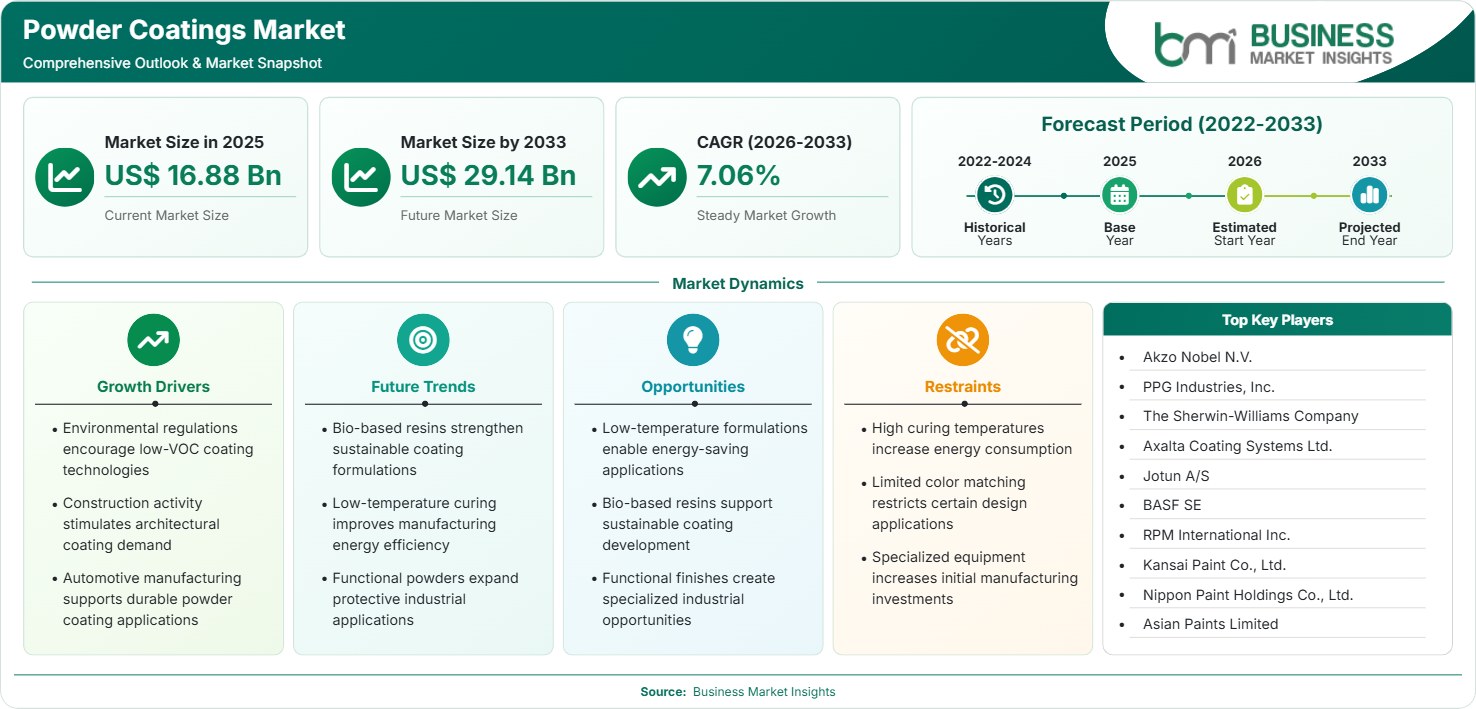
The Powder Coatings Market size was valued at US$ 16.88 Billion in 2025 and is projected to reach US$ 29.14 Billion by 2033, registering a CAGR of 7.06% during 2026–2033. Market expansion is being shaped by higher automotive production, wider architectural use, sustainability requirements, and continued industrial manufacturing activity. At the same time, electric vehicles, smart infrastructure, and low-temperature curing technologies are opening new areas of demand.

Report Coverage
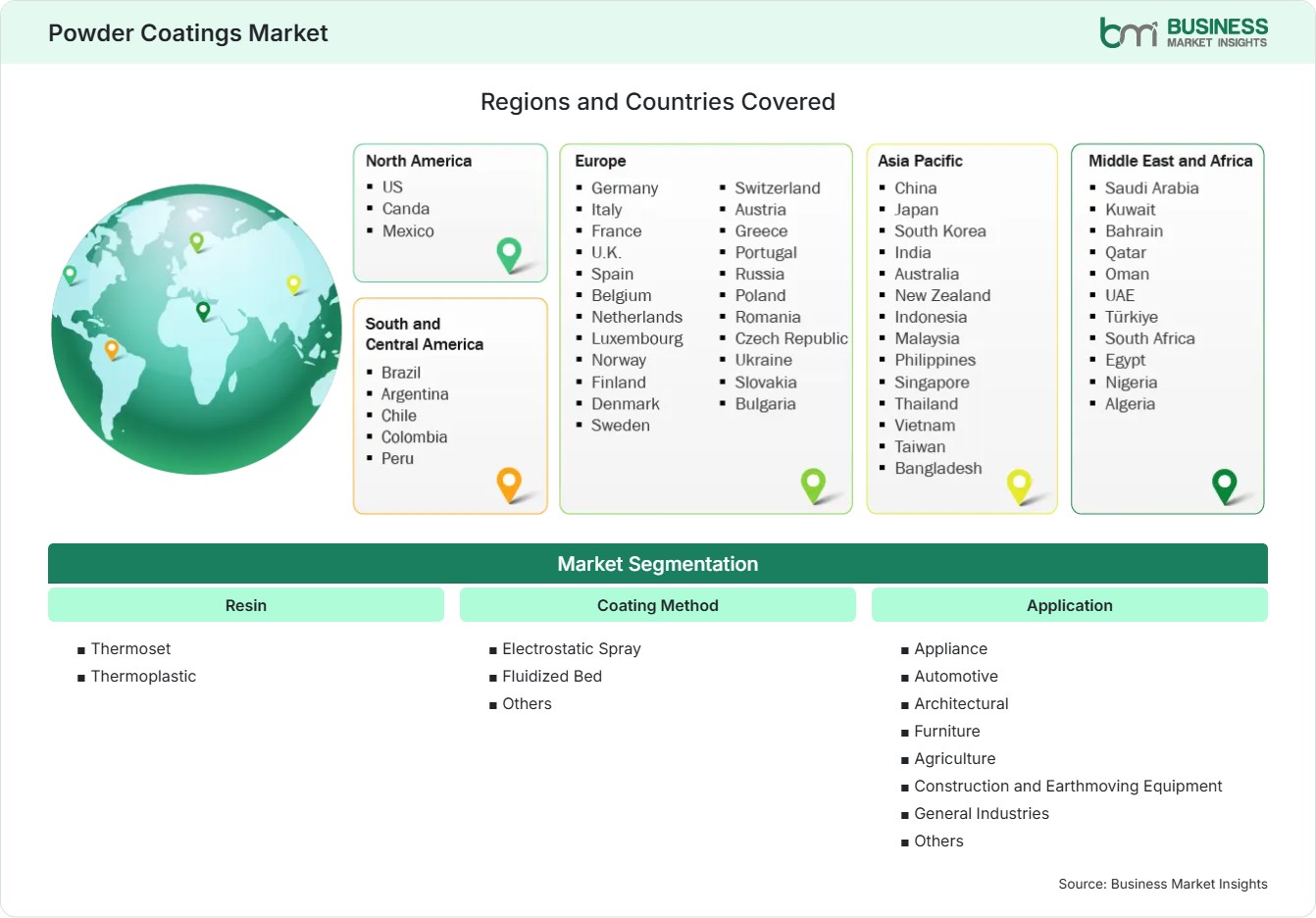
  • Resin: Thermoset, Thermoplastic
  • Coating Method: Electrostatic Spray, Fluidized Bed, Others
  • Application: Appliance, Automotive, Architectural, Furniture, Agriculture, Construction and Earthmoving Equipment, General Industries, Others
US$ 16.88 Bn Market size in 2025
US$ 29.14 Bn Market Size by 2033
7.06% CAGR, 2026 - 2033
2026-2033 Forecast Period

AI Overview

Powder Coatings Market Summary

  • North America Region: North America accounted for a 24%–27% market share in 2025 and is expected to expand at a 6.3%–6.8% CAGR during 2026–2033. Modernization of automotive manufacturing, appliance production, infrastructure refurbishment, and greater use of environmentally compliant coating systems are supporting demand. The U.S. remains the regional leader, helped by reshoring initiatives and advanced manufacturing investments, with growth estimated at a 6.4%–6.9% CAGR.
  • Fastest Growing Region: Asia Pacific held a 42%–45% market share in 2025 and is projected to grow at an 8.0%–8.5% CAGR during 2026–2033. Industrialization, construction activity, automotive production, export-oriented manufacturing, infrastructure investment, urban development, and rising appliance consumption are contributing to the region's strong position.
  • Leading Segment: Thermoset resin represented 72%–76% market share in 2025 and is forecast to grow at a 6.8%–7.3% CAGR during 2026–2033. Its durability, corrosion resistance, established industrial use, processing flexibility, and suitability for automotive and architectural applications continue to support its leading position.
  • High Growth Segment: Automotive application accounted for 18%–22% market share in 2025 and is expected to record an 8.2%–8.8% CAGR during 2026–2033. Electric vehicle production, lightweight components, durability requirements, sustainability objectives, localized supply chains, and demand for high-quality finishes are contributing to this momentum.
  • Key Market Opportunity: Low-temperature curing formulations can extend powder coating use to heat-sensitive substrates. This creates room for applications in electronics, engineered plastics, modular construction components, energy-efficient appliances, and lightweight transportation equipment.
  • Major Market Players: Akzo Nobel N.V., PPG Industries, Inc., The Sherwin-Williams Company, Axalta Coating Systems Ltd., Jotun A/S, BASF SE, RPM International Inc., Kansai Paint Co., Ltd., Nippon Paint Holdings Co., Ltd., Asian Paints Limited.
Strategic Insights

Powder Coatings Market: Strategic Insights

Powder Coatings Market Strategic Framework
FREE PDF
Request your free sample
Request free sample
Stakeholder View

Key Takeaways

  • The industry value chain brings together resin producers, pigment suppliers, equipment manufacturers, applicators, and OEMs. Closer coordination among these participants can improve product development and supply-chain efficiency.
  • Automotive, architectural, and ACE applications offer strong medium-term potential as customers place greater emphasis on durability, sustainability, and long-term performance.
  • Product innovation is moving toward low-temperature curing, thin-film systems, antimicrobial formulations, improved weatherability, and digital process controls.
  • Asia Pacific remains an important investment region because of manufacturing expansion, infrastructure development, urbanization, and the rapid build-out of EV production ecosystems.
  • Strategic acquisitions can help established participants broaden their product portfolios, enter new geographic markets, strengthen specialty technology capabilities, and deepen customer relationships.
  • Sustainability is becoming an important point of differentiation. Customers are increasingly evaluating coating solutions based on emissions, material efficiency, durability, and compliance with environmental requirements.
Geographic Outlook

Powder Coatings Market Regional Highlights

North America Powder Coatings Market

North America represented approximately 24%–27% Powder Coatings Market share in 2025 and is expected to grow at a 6.3%–6.8% CAGR through 2033. Industrial manufacturing, appliance production, transportation equipment, and infrastructure renovation remain the main demand foundations. Sustainability requirements are also encouraging manufacturers to move away from solvent-based systems.

  • U.S. and Canadian manufacturers are increasingly adopting automated electrostatic spray systems. These systems can improve transfer efficiency, limit material waste, and make large-scale finishing operations more economical.
  • Appliance manufacturers continue to use environmentally compliant coating technologies for refrigerators, washing machines, cooking equipment, and other consumer durables where appearance and durability are important.
  • Infrastructure modernization is creating demand for coated metal structures, transportation systems, utility equipment, and public assets that require reliable corrosion protection.
  • Expansion of electric vehicle assembly and battery manufacturing facilities is creating additional requirements for coatings used on structural components, enclosures, and related industrial equipment.

US Powder Coatings Market

The United States accounts for approximately 78%–82% of regional demand and is anticipated to expand at a 6.4%–6.9% CAGR through 2033. The presence of a good manufacturing base, automation, and transportation machinery production continues to provide impetus to demand. Government incentives to promote manufacturing and infrastructural development activities are contributing towards the sustenance of the industry. The nation is a key hub for innovations in coating applications. Manufacturers are focusing more on innovative formulations that can cure at lower temperatures and are sustainable in nature.

  • Domestic appliance manufacturing supports demand for coating systems that combine attractive finishes with scratch resistance, durability, and environmental compliance.
  • Expansion of logistics infrastructure and warehouse construction is increasing the use of coated shelving, steel structures, and material-handling equipment.
  • Industrial equipment manufacturers are looking for surface protection systems that can reduce maintenance needs and extend equipment service life.
  • Renewable energy investments are opening opportunities for coatings used on transmission equipment, mounting structures, and related engineered components.

Europe Powder Coatings Market

Europe accounted for approximately 22%–25% of global demand in 2025 and is projected to grow at a 6.5%–7.0% CAGR during 2026–2033. The stringent environmental regulations, the advanced manufacturing techniques and processes, and the presence of the auto and building industries create an adequate demand base. The powder coating technologies align with the objectives of emission reduction and resource efficiency in the region. The German market is the largest in the country, and manufacturing industries in Eastern Europe are receiving further investments.

  • Germany remains the leading European market, backed by automotive manufacturing, industrial machinery exports, advanced production capabilities, and coating technology development. The country is estimated to grow at approximately 6.4%–6.9% CAGR through 2033.
  • France benefits from infrastructure renovation and energy-efficient building programs, which support demand for coatings used on architectural aluminum systems, public infrastructure, and commercial construction.
  • Italy's furniture and appliance industries continue to require decorative and durable finishes, supporting demand from both domestic producers and export-oriented manufacturers.
  • Poland and neighboring Eastern European markets are among the faster-growing manufacturing centers. Industrial expansion and foreign investment are supporting coating consumption growth of approximately 7.5%–8.0%.
  • Sustainability regulations are encouraging wider use of low-emission alternatives across industrial and commercial applications.

Asia Pacific Powder Coatings Market

Asia Pacific represented approximately 42%–45% of global Powder Coatings Market demand in 2025 and is expected to record an 8.0%–8.5% CAGR through 2033, making it the fastest-growing regional market. Industrialization, construction activity, appliance production, and automotive manufacturing are central to this performance. China remains the largest national market, while India is showing particularly strong expansion. Urbanization and infrastructure development are adding demand across architectural products, transportation equipment, industrial machinery, and consumer durables.

  • China maintains its regional lead through extensive manufacturing activity, appliance production, infrastructure construction, and automotive output.
  • India is the fastest-growing major market, with an estimated 8.8%–9.3% CAGR, supported by industrial investment, infrastructure development, and expansion of domestic manufacturing capabilities.
  • Southeast Asian economies are attracting production relocation, which is increasing demand for coatings used in furniture, building products, appliances, and general industrial applications.
  • Growing EV production in China, India, South Korea, and Japan is creating additional requirements for component protection and premium finishing.
  • Rising middle-class consumption is supporting appliance and consumer durable manufacturing, adding another source of long-term demand.

Rest of World Powder Coatings Market

Rest of World represented approximately 9%–12% of global Powder Coatings Market demand in 2025 and is projected to grow at a 6.9%–7.4% CAGR through 2033. South and Central America are benefiting from gradual industrial development and construction investment, with Brazil remaining the leading market. Across the Middle East and Africa, infrastructure projects, industrial diversification, and manufacturing activity are creating additional opportunities. Saudi Arabia and the UAE are particularly notable because of their ongoing investments in industrial and construction projects.

  • Brazil leads regional demand through construction, appliance manufacturing, industrial production, and transportation development.
  • Mexico is benefiting from nearshoring and manufacturing expansion, particularly across automotive and industrial equipment supply chains serving international customers.
  • Saudi Arabia's industrial diversification programs are creating opportunities in infrastructure, architectural projects, and industrial facilities that require durable surface protection.
  • The United Arab Emirates is seeing demand from commercial construction, transportation infrastructure, and industrial development supported by government investment programs.
  • Mining, energy, and agricultural equipment manufacturing across emerging economies continues to support demand for corrosion-resistant coating technologies.
Global Market Geography
FREE PDF
Request your free sample
Request free sample
Segment Analysis

Powder Coatings Market Segmentation

Resin

The resin segment generated the largest industry revenue contribution, with thermoset materials accounting for a substantial portion of coating consumption. The segment held approximately 72%–76% market share in 2025 and is expected to expand at a 6.8%–7.3% CAGR through 2033. The Powder Coatings Market scope is widening as manufacturers prioritize durability, corrosion resistance, weatherability, and efficient processing.

  • Epoxy Polyester: Commonly used for indoor industrial products because it balances durability, appearance, and cost. Appliances, office furniture, electrical equipment, and general industrial products remain important application areas.
  • Polyester: Well suited to exterior applications where weather resistance and color retention are important. Architectural systems, outdoor furniture, infrastructure assets, and transportation components support demand.
  • Epoxy: Known for strong adhesion, chemical resistance, and corrosion protection, making it suitable for pipelines, valves, machinery, industrial equipment, and other demanding applications.
  • Polyurethane: Offers a combination of attractive appearance and mechanical performance. It is gaining attention in premium automotive components, architectural products, and specialized industrial applications.
  • Acrylic: Used where smooth surfaces, weather performance, and appearance are priorities, particularly in architectural products, automotive trim, and specialty finishes.
  • Polyvinyl chloride (PVC): Valued for chemical resistance and electrical insulation, with applications across wire goods, protective coatings, and selected industrial products.
  • Nylon: Its wear resistance and low-friction properties support use in machinery components, consumer products, and specialized engineering applications.
  • Polyolefin: Used where flexibility, impact resistance, and chemical durability are required, making it suitable for selected protective coating applications.
  • Polyvinyl Fluoride (PVF): Provides strong weatherability and ultraviolet resistance and is therefore suited to premium architectural systems and demanding outdoor environments.

Coating Method

Coating methods have a direct effect on material usage, finish quality, and production costs. Automation and process optimization are reshaping this segment, with electrostatic application remaining the dominant approach. It accounted for approximately 68%–72% Powder Coatings Market share in 2025 and is forecast to grow at a 7.1%–7.6% CAGR during the assessment period.

  • Electrostatic Spray: The most widely used method because it offers high transfer efficiency, consistent finishes, operational flexibility, and compatibility with automated production lines.
  • Fluidized Bed: Generally selected for thicker protective coatings where durability and corrosion resistance are priorities, particularly for industrial components, wire products, functional coatings, and engineered equipment.

Application

Application industries play a major role in shaping demand and product development. Automotive represents the fastest-growing area, supported by vehicle production and higher performance expectations. The segment accounted for 18%–22% Powder Coatings Market share in 2025 and is projected to grow at an 8.2%–8.8% CAGR. Construction activity, durable consumer goods, and industrial manufacturing provide additional support.

  • Appliance: Demand is linked to the need for attractive, scratch-resistant finishes on refrigerators, washing machines, ovens, and other household products.
  • Automotive: Growth is supported by electric vehicle manufacturing, lightweight components, sustainability requirements, and wider use of durable finishes on structural and decorative parts.
  • Architectural: Commercial construction, aluminum extrusion systems, curtain walls, façades, and infrastructure projects require coatings that can withstand prolonged outdoor exposure.
  • Furniture: Powder coatings are increasingly used on metal furniture because they combine durability, decorative flexibility, and cost-efficient finishing.
  • Agriculture: Agricultural equipment requires coatings that can withstand corrosion, abrasion, moisture, and demanding field conditions.
  • Construction and Earthmoving Equipment (ACE): Infrastructure investment and heavy equipment production support demand for highly durable protective finishes.
  • General Industries: Applications include industrial machinery, storage systems, material-handling equipment, electrical enclosures, and fabricated metal products.
Market Forces

Powder Coatings Market Dynamics

Key Market Drivers

Stringent Environmental Regulations Accelerating Adoption

With increased environmental regulations on solvents used in North America, Europe, and Asia, manufacturers have been encouraged to consider powder coating systems rather than solvent-based coating systems. Powder coating systems are low in VOC content and have good material efficiency, thereby attracting manufacturers with environmental goals. Customer expectations are changing as well, with sustainability becoming part of purchasing decisions. Powder Coatings Market growth is consequently becoming more closely connected with environmental compliance and corporate sustainability programs.

Expansion of Automotive and Electric Vehicle Manufacturing

Automobile manufacturing and investments in electric mobility are contributing to consistent demand for durable protective surfaces. Vehicle components should be able to withstand wear and tear, corrosion, impacts, temperature variations, and repetitive use, while also looking good. Powder coatings are able to satisfy a majority of these criteria while at the same time aligning with the sustainability goals of auto manufacturers. As automotive supply chains become more localized, particularly in the Asia Pacific and North America, Powder Coatings Market trends are increasingly reflecting the needs of mobility manufacturers.

Infrastructure Development and Industrial Manufacturing Investments

Infrastructure projects and industrial capacity additions are broadening the customer base for durable coating systems. Construction, transportation infrastructure, renewable energy installations, and factory upgrades all require protection against corrosion and environmental exposure. Powder coatings are well positioned for applications where long service life and lower maintenance requirements matter. Investment in factories, logistics facilities, public infrastructure, machinery, and structural assets is creating demand across multiple end-use industries, giving suppliers opportunities to expand beyond traditional applications.

Key Market Opportunities

Low-Temperature Curing Technologies for New Substrates

Low-temperature curing is one of the more promising areas for product development. Conventional powder coating processes can require elevated temperatures, which restrict their use on heat-sensitive materials. Improvements in resin chemistry and curing technology are helping overcome this limitation. The ability to coat engineered plastics, composites, and lightweight materials can expand applications across electronics, furniture, transportation, and modular construction. Powder Coatings Market Forecasts increasingly recognize the potential of these technologies because they can lower energy consumption while broadening substrate compatibility. Suppliers with specialized formulations may also gain access to higher-value applications.

Growing Demand from Renewable Energy Infrastructure

The expansion of renewable energy is creating another demand channel. Solar, wind, transmission, and energy storage installations require coatings that can tolerate ultraviolet exposure, moisture, corrosion, and temperature variation. Powder coatings can provide the durability needed for long-life infrastructure assets. Utility-scale solar projects, battery storage systems, transmission equipment, and wind installations therefore offer opportunities for suppliers that can tailor formulations to demanding outdoor environments.

Industrial Automation and Smart Manufacturing Integration

The shift toward smart manufacturing is changing coating operations as well. Automated application equipment, AI-driven inspection, predictive maintenance, and real-time process monitoring can improve consistency while reducing defects and material losses. Equipment manufacturers and coating suppliers are increasingly looking for ways to integrate these technologies into complete production systems. As industrial customers upgrade their facilities, advanced application systems and performance-oriented coatings should gain greater attention, particularly where throughput, repeatability, and resource efficiency are key priorities.

Market Restraints and Challenges

Raw Material Volatility and Margin Pressure

Factor: Prices for resins, pigments, additives, and specialty chemicals can fluctuate considerably. Energy costs, feedstock availability, supply-chain disruptions, and geopolitical developments can all affect procurement conditions.

Impact: Cost volatility can put pressure on margins, make long-term pricing more difficult, and increase purchasing risks. Smaller manufacturers may feel this effect more strongly because they often have less negotiating power. Sudden increases in input costs can also cause customers to delay purchases or reconsider planned investments. Managing procurement while maintaining competitive pricing remains a significant challenge.

High Initial Equipment Costs and Adoption Barriers

Factor: Moving to powder coating can require investment in application equipment, curing ovens, material recovery systems, and process controls. For some manufacturers, particularly smaller businesses, the initial capital requirement can be difficult to justify even when operating efficiencies are attractive over the longer term.

Impact: High upfront costs can slow adoption and encourage some customers to continue using established liquid coating systems. Facility modifications and workforce training may add to the transition burden. Suppliers therefore need to demonstrate clear economic benefits, including material savings, lower operating costs, and improved productivity, to encourage customers to make the switch.

Company Analysis

Competitive Landscape

The competitive environment is shaped by product development, sustainability initiatives, capacity expansion, and strategic partnerships. Current Powder Coatings Market analysis indicates that leading participants are strengthening regional manufacturing networks while developing specialty formulations for automotive, architectural, appliance, and industrial applications.

Company Name

Overview

Products and Services relevant to this market

Akzo Nobel N.V.

Global coatings leader with an extensive manufacturing footprint and a strong sustainability-oriented portfolio.

Thermoset and specialty powder coatings, architectural coatings, industrial finishing solutions, technical support, and application services.

PPG Industries, Inc.

Major coatings supplier serving transportation, industrial, aerospace, and building markets.

Powder coatings, protective coatings, automotive finishes, industrial coatings, color technologies, and performance coating solutions.

The Sherwin-Williams Company

Leading paint and coatings company with broad global operations and industrial finishing expertise.

Industrial powder coatings, protective solutions, architectural finishes, coating systems, and technical consulting services.

Axalta Coating Systems Ltd.

Specialized coatings manufacturer focused on transportation, industrial, and refinish markets.

Powder coatings, automotive coatings, industrial finishing products, corrosion protection systems, and color management technologies.

Jotun A/S

International coatings company with established marine, industrial, decorative, and protective coating capabilities.

Powder coatings, architectural finishing products, industrial protection solutions, and infrastructure coating technologies.

BASF SE

Diversified chemical company applying materials expertise to coating technologies and formulations.

Resin technologies, powder coating materials, performance additives, specialty chemicals, and industrial coating solutions.

RPM International Inc.

Global supplier of specialty coatings and construction products serving industrial and infrastructure customers.

Protective coatings, industrial finishes, specialty coating systems, sealants, and maintenance solutions.

Kansai Paint Co., Ltd.

Major Asian coatings manufacturer with a strong presence in automotive and industrial markets.

Powder coatings, automotive coatings, industrial coating systems, decorative coatings, and performance finishes.

Nippon Paint Holdings Co., Ltd.

Global coatings company expanding across industrial, infrastructure, and architectural applications.

Powder coating solutions, industrial finishes, corrosion-resistant technologies, and architectural coating products.

Asian Paints Limited

Prominent coatings manufacturer expanding industrial and specialty coating capabilities across growth markets.

Powder coatings, industrial finishing systems, decorative products, protective coatings, and related technical services.

Trust & Transparency

Research Methodology

The market analysis combines proprietary research with secondary data from government agencies, company disclosures, regulatory filings, industry databases and expert interviews. Market estimates are validated through data triangulation, cross-market benchmarking and analyst review.

View Full Research Methodology

Questions Answered

Frequently Asked Questions

Why do buyers invest in a Powder Coatings Market Report?

A Powder Coatings Market Report provides stakeholders with a structured view of competitive positioning, technology developments, application trends, regional opportunities, investment areas, and strategic risks. Such information can support business planning, market-entry decisions, product development, and longer-term strategy.

What factors will shape future market expansion?

Electric vehicle production, renewable energy infrastructure, industrial automation, low-temperature curing, and construction activity are expected to influence future demand. The ability to develop formulations for new substrates will also determine how far powder coatings can expand into applications that have traditionally relied on other coating technologies.

How are sustainability regulations influencing industry adoption?

Regulations aimed at reducing volatile organic compound emissions are encouraging manufacturers to consider powder-based technologies. Companies are also adopting these systems to improve material efficiency and support internal sustainability targets. As environmental standards develop across major markets, the transition away from conventional liquid systems is likely to remain an important theme.

What industries generate the highest demand for powder coatings?

Automotive, architectural, appliance, furniture, industrial machinery, and construction equipment are among the largest demand-generating sectors. These industries value powder coatings for their combination of durability, appearance, environmental performance, and long-term protection.

What makes powder coatings different from conventional liquid coatings?

Powder coatings are applied as dry particles and then cured to form a durable finish. Unlike many conventional liquid systems, they do not rely on traditional solvent-based application. Their material efficiency, lower emissions, corrosion resistance, and reduced waste make them attractive for a range of industrial applications.

Access the Full Powder Coatings Market Report

Get segment-level forecasts, regional estimates, competitive benchmarking, company profiles and downloadable Excel datasets.

Access the full Powder Coatings Market Report
350 pages PDF & Excel | 2026-09-16
Similar Research

Related Market Reports