Market Summary
Executive Summary and Global Market Analysis
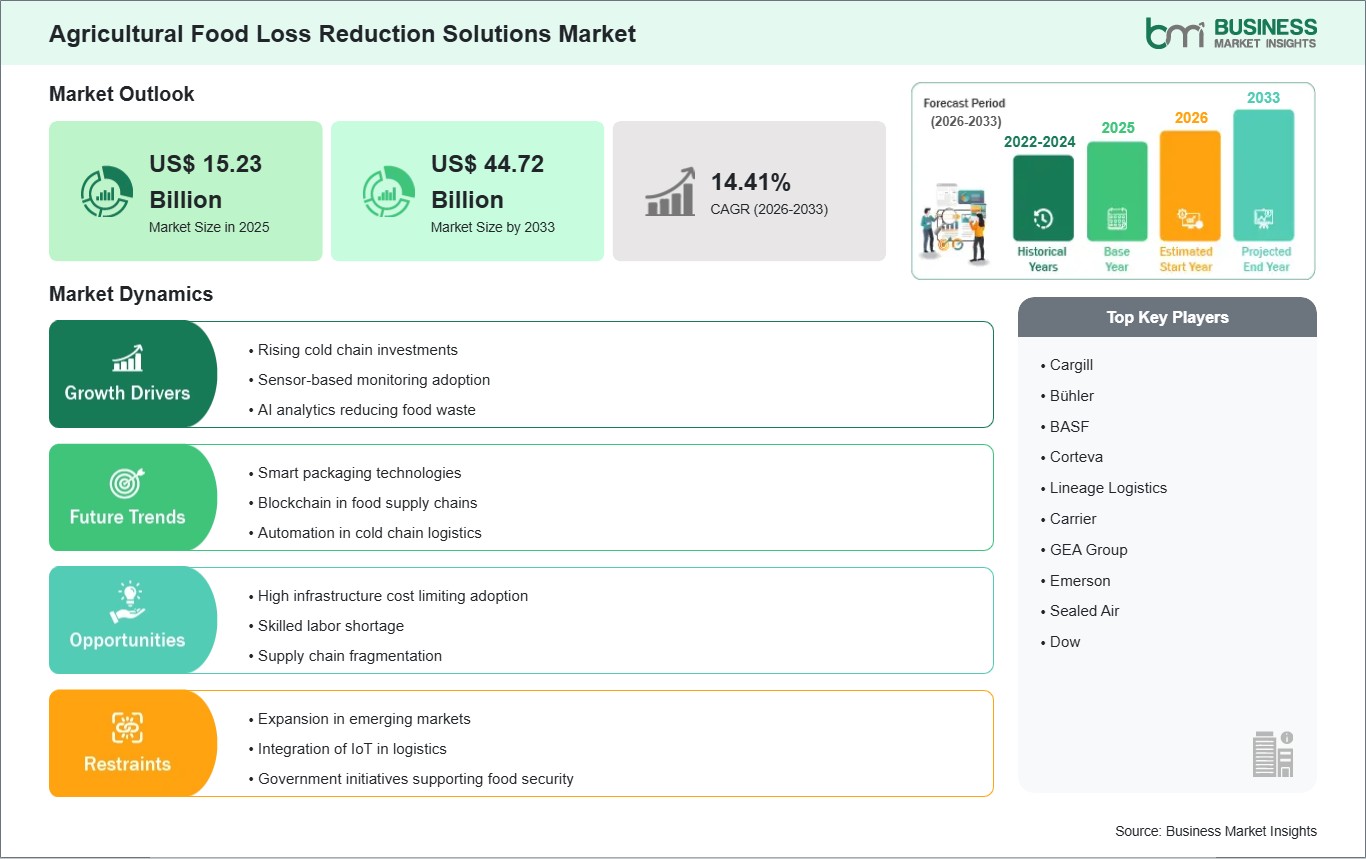
Agricultural food loss reduction solutions include technologies, systems, and operational processes designed to minimize food wastage across harvesting, storage, transportation, processing, and distribution stages. These solutions help improve food quality, extend shelf life, reduce spoilage, and strengthen supply chain efficiency. Cold chain systems, smart monitoring technologies, and AI-based analytics platforms are increasingly being adopted to address rising concerns related to food security, sustainability, and supply chain management. Governments, agricultural organizations, and food producers are focusing on reducing post-harvest losses and improving resource utilization through digital technologies and infrastructure investments.
Several operational and infrastructure-related challenges continue to affect the Agricultural Food Loss Reduction Solutions market. High initial investment requirements for cold storage facilities, refrigerated transportation systems, and digital monitoring technologies can limit adoption among small-scale farmers and local distributors. In many developing regions, inadequate transportation networks, unreliable electricity supply, and limited access to modern storage infrastructure create barriers to efficient food preservation. Integration of AI analytics and sensor-based technologies also requires technical expertise and data management capabilities, which may not be readily available across all agricultural operations.
Despite these challenges, the market continues to benefit from increasing investments in sustainable agriculture and food supply chain modernization. Cold chain technologies remain widely adopted due to growing demand for temperature-sensitive food transportation and storage. Sensor-based monitoring systems and AI analytics solutions are also gaining importance as food manufacturers and logistics providers seek real-time visibility and predictive insights for inventory management and spoilage prevention. Competitive activity in the market is focused on automation capabilities, energy-efficient systems, data integration technologies, and scalable infrastructure solutions that support long-term food preservation and supply chain optimization.
Segment Analysis
Agricultural Food Loss Reduction Solutions Market Segmentation
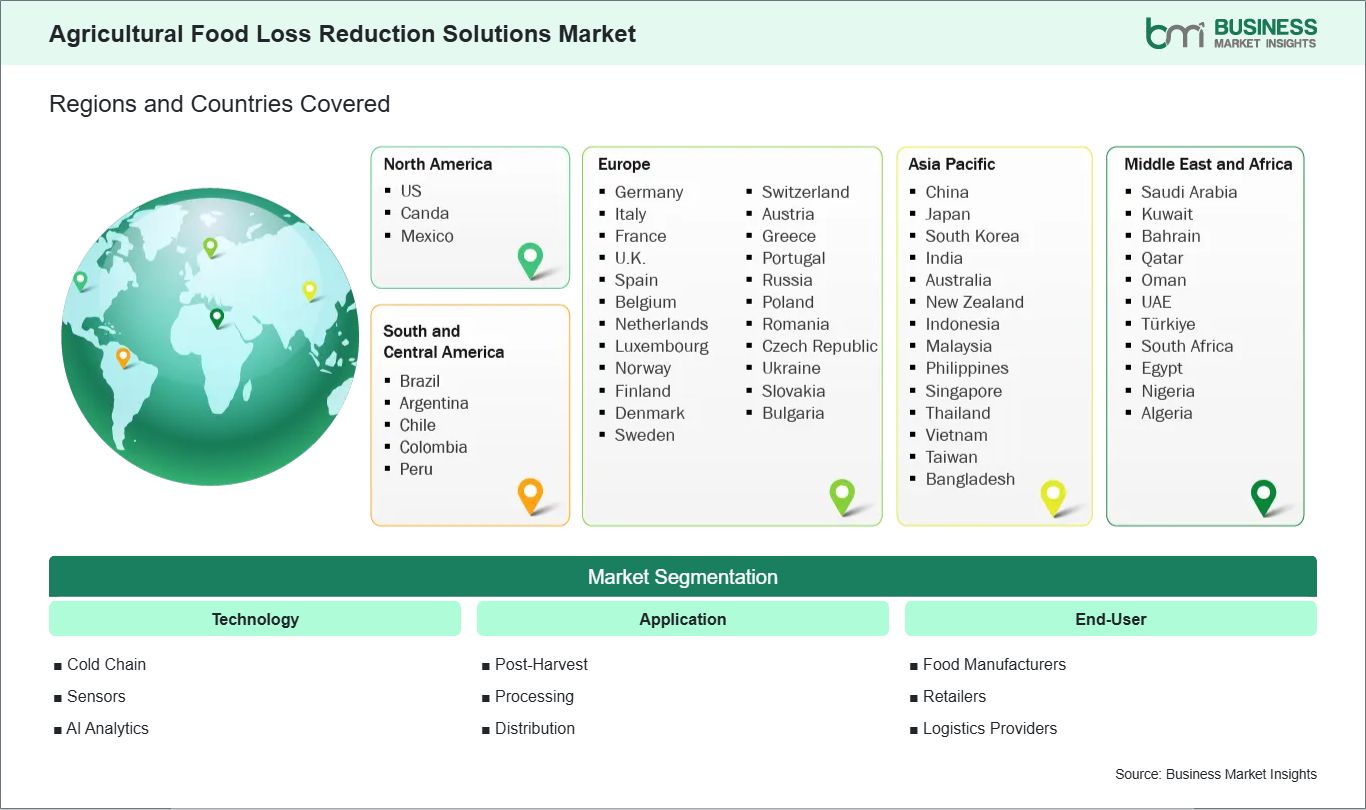
The Agricultural Food Loss Reduction Solutions market is segmented based on technology, application, and end-user. Increasing focus on reducing post-harvest losses and improving supply chain efficiency continues to influence demand across multiple agricultural and food processing sectors.
By Technology
- Cold Chain: Widely adopted for preserving perishable food products through temperature-controlled storage and transportation systems.
- Sensors: Used for monitoring humidity, temperature, storage conditions, and product quality throughout the supply chain.
- AI Analytics: Supports predictive maintenance, inventory optimization, demand forecasting, and spoilage reduction through data-driven insights.
By Application
- Post-Harvest: Focuses on reducing crop losses during handling, storage, and transportation after harvesting.
- Processing: Helps improve operational efficiency and minimize wastage during food manufacturing activities.
- Distribution: Supports efficient logistics, inventory tracking, and product quality management across supply chains.
By End-User
- Food Manufacturers: Utilize advanced monitoring and storage technologies to improve production efficiency and reduce spoilage.
- Retailers: Adopt food preservation and inventory management solutions to maintain product freshness and minimize waste.
- Logistics Providers: Increasingly integrate cold chain and tracking systems to improve transportation efficiency and supply chain visibility.
Market Forces
Agricultural Food Loss Reduction Solutions Market Drivers and Opportunities
Rising Focus on Food Security and Supply Chain Efficiency
Growing concerns regarding food security, agricultural sustainability, and supply chain efficiency are driving the adoption of Agricultural Food Loss Reduction Solutions across global markets. Increasing population growth and rising food demand are encouraging governments and agricultural organizations to improve food preservation and minimize losses throughout the supply chain. Cold storage systems, sensor technologies, and AI-based monitoring platforms are becoming important for maintaining food quality during harvesting, transportation, and storage activities.
The expansion of international food trade and growing demand for perishable agricultural products are also supporting investment in modern logistics and preservation technologies. Regulatory authorities are implementing stricter food safety and traceability requirements, encouraging food manufacturers and distributors to adopt advanced monitoring systems. In addition, increasing awareness regarding environmental sustainability and resource optimization is encouraging companies to reduce food waste and improve operational efficiency. These factors continue to strengthen long-term demand for integrated food loss reduction solutions across agricultural and food processing industries.
Expansion of Smart Agriculture and Digital Food Monitoring Systems
The increasing adoption of smart agriculture technologies and digital supply chain management systems is creating new opportunities for the Agricultural Food Loss Reduction Solutions market. AI-driven analytics, IoT-enabled sensors, and automated monitoring platforms are helping agricultural businesses improve inventory visibility, detect spoilage risks, and optimize storage conditions in real time. These technologies are supporting better decision-making and improving operational efficiency across food production and distribution networks.
Growing investments in sustainable farming practices and digital infrastructure development are also encouraging the deployment of connected cold chain systems and intelligent logistics platforms. Emerging economies are witnessing rising demand for modern storage facilities and transportation systems to support agricultural exports and domestic food supply chains. In addition, advancements in predictive analytics and cloud-based monitoring technologies are enabling companies to improve traceability and reduce operational losses. Increasing collaboration between agricultural producers, food manufacturers, and logistics providers is expected to accelerate innovation and support future market expansion.
Size and Share Analysis
Agricultural Food Loss Reduction Solutions Market Size and Share Analysis
The Agricultural Food Loss Reduction Solutions Market is projected to grow from US$ 15.23 Billion in 2025 to US$ 44.72 Billion by 2033 , registering a CAGR of 14.41% from 2026 to 2033.
By technology, cold chain solutions hold a significant share due to their critical role in preserving temperature-sensitive food products during transportation and storage. Sensors and AI analytics are gaining increasing attention as companies seek real-time monitoring, predictive maintenance, and data-driven inventory management capabilities. By application, post-harvest activities account for a major share of the market due to increasing efforts to minimize crop losses immediately after harvesting. Processing and distribution applications are also witnessing steady growth with rising demand for efficient food handling and logistics systems.
By end-user, food manufacturers remain major adopters of Agricultural Food Loss Reduction Solutions due to increasing focus on operational efficiency, product quality, and regulatory compliance. Retailers and logistics providers are also expanding investments in intelligent monitoring systems and cold chain infrastructure to improve supply chain visibility and minimize spoilage risks. Continuous advancements in smart agriculture technologies and connected logistics platforms are expected to support long-term market growth.
Report Coverage
Agricultural Food Loss Reduction Solutions Market Report Coverage and Deliverables
The "Agricultural Food Loss Reduction Solutions Size and Forecast (2022-2033)" report provides a detailed analysis of the market covering below areas:
- Market size and forecast at global, regional, and country levels for all the key market segments covered under the scope
- Market trends, as well as market dynamics such as drivers, restraints, and key opportunities
- Market analysis covering key market trends, global and regional framework, major players, regulations, and recent market developments
- Industry landscape and competition analysis covering market concentration, heat map analysis, prominent players, and recent developments for the market
- Detailed company profiles, including SWOT analysis
Geographic Insights
Agricultural Food Loss Reduction Solutions Market Geographic Insights
The Agricultural Food Loss Reduction Solutions market shows diverse regional adoption patterns influenced by agricultural infrastructure development, food supply chain modernization, sustainability initiatives, and increasing focus on reducing post-harvest losses.
North America continues to witness strong adoption of Agricultural Food Loss Reduction Solutions due to advanced food processing infrastructure, widespread cold chain networks, and increasing implementation of digital agriculture technologies. The United States remains a key market with growing deployment of AI analytics, automated monitoring systems, and smart storage technologies across food manufacturing and logistics operations. Canada is also expanding investments in sustainable agricultural practices and refrigerated transportation systems to improve food quality management and supply chain efficiency. Increasing regulatory focus on food safety and traceability is encouraging the use of connected monitoring platforms and intelligent inventory management systems across the region.
Asia Pacific is experiencing rapid growth in the Agricultural Food Loss Reduction Solutions market due to expanding agricultural production, rising food demand, and increasing investments in cold storage infrastructure. Countries such as China and India are focusing on reducing post-harvest losses through modernization of transportation systems, warehousing facilities, and digital monitoring technologies. Japan and South Korea are emphasizing automation, sensor integration, and smart logistics systems to strengthen food distribution efficiency. Growing government support for food security initiatives and sustainable agriculture programs is also supporting regional market development. Increasing urbanization and expansion of organized retail sectors are further encouraging the adoption of advanced food preservation technologies across Asia Pacific.
Industry Activity
Recent Developments
The Agricultural Food Loss Reduction Solutions market is analyzed using a mix of primary and secondary research sources, including corporate publications, industry associations, and verified databases. This approach ensures accurate tracking of innovation trends and strategic developments influencing the market.
- In February 2024, Lineage announced the expansion of its cold storage and food logistics infrastructure to strengthen temperature-controlled supply chain operations for perishable food products. The development focused on improving food preservation efficiency and reducing spoilage risks during transportation and storage activities.
- In September 2023, Carrier introduced advanced digital cold chain monitoring solutions designed to improve temperature visibility and real-time tracking for food transportation systems. The platform supports operational efficiency and helps reduce food losses across distribution networks.
Trust & Transparency
Research Methodology
The market analysis combines proprietary research with secondary data from government agencies, company disclosures, regulatory filings, industry databases and expert interviews. Market estimates are validated through data triangulation, cross-market benchmarking and analyst
review.
View Full Research Methodology
Key Sources Referred:
World Bank - Global Trade Indicators World Trade Organization (WTO) International Monetary Fund (IMF) International Trade Administration (ITA) Company Websites Company Annual Reports Company Investor Presentations