
Aero Engine Composite Material Market Outlook: Size, Share, Trends, Growth Analysis, Competitive Landscape & Forecast, 2026-2033

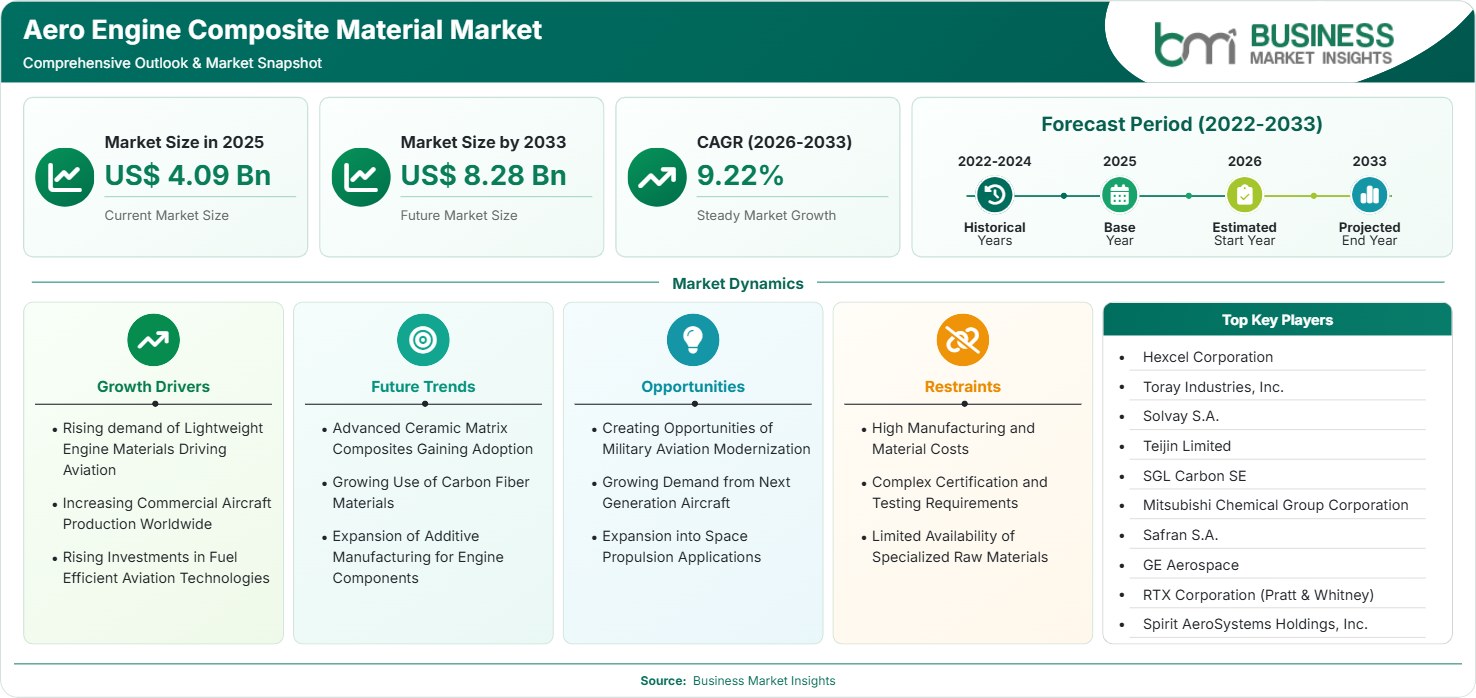
The Aero Engine Composite Material Market size was valued at US$ 4.09 Billion in 2025 and is projected to reach US$ 8.28 Billion by 2033, growing at a CAGR of 40.08% during 2026–2033, driven by lightweight aerospace component demand, fuel efficiency initiatives, advanced composite adoption, and expanding opportunities in next-generation aircraft manufacturing.

Report Coverage
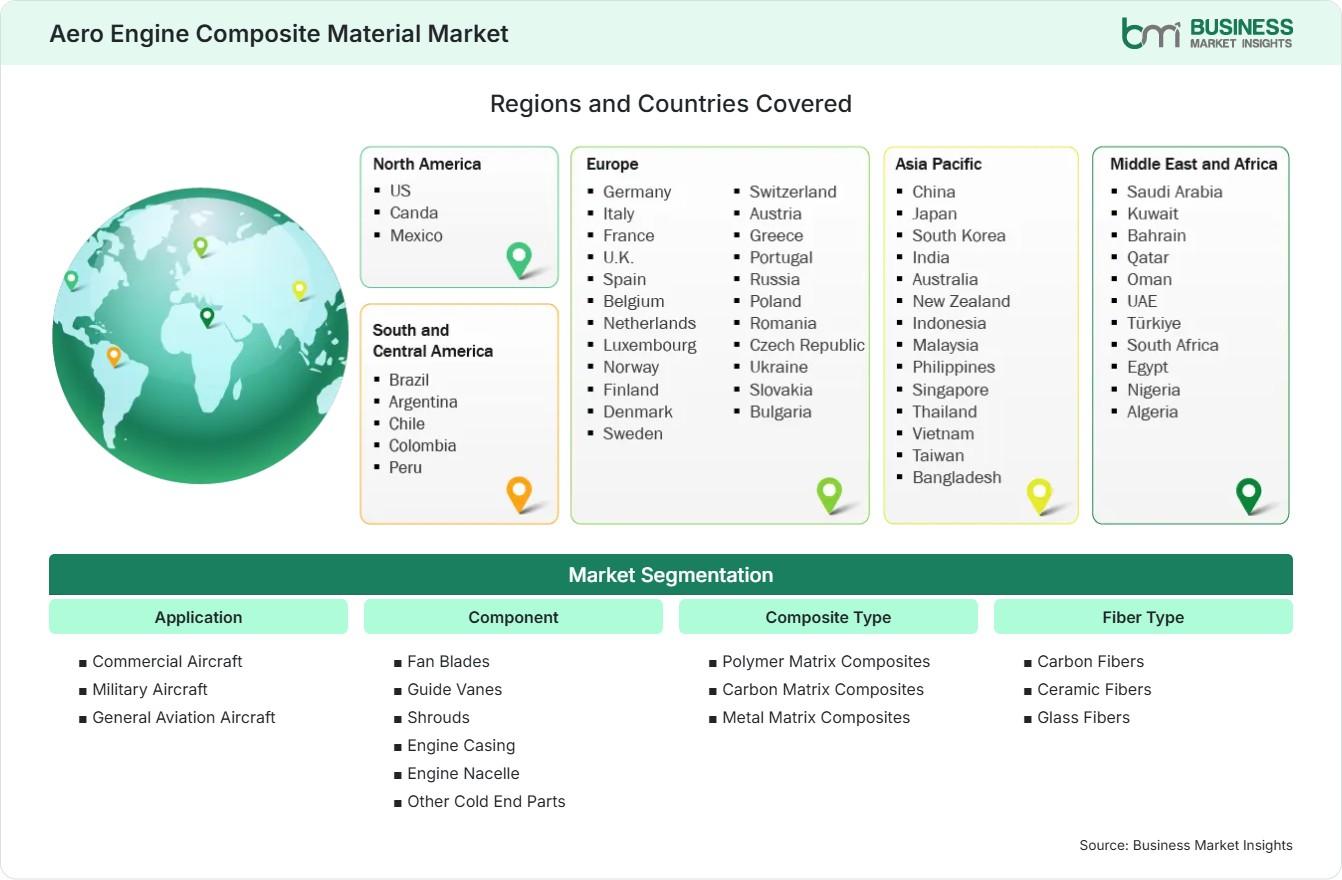
  • Application: Commercial Aircraft, Military Aircraft, General Aviation Aircraft
  • Component: Fan Blades, Guide Vanes, Shrouds, Engine Casing, Engine Nacelle, Other Cold End Parts
  • Composite Type: Polymer Matrix Composites, Carbon Matrix Composites, Metal Matrix Composites
  • Fiber Type: Carbon Fibers, Ceramic Fibers, Glass Fibers
US$ 4.09 Bn Market size in 2025
US$ 8.28 Bn Market Size by 2033
9.22% CAGR, 2026 - 2033
2026-2033 Forecast Period

AI Overview

Aero Engine Composite Material Market Summary

  • North America Region: North America holds approximately 38%–42% share in 2025, growing at a CAGR of 39%–41% during 2026–2033, supported by aerospace innovation, aircraft production expansion, defense modernization programs, and composite manufacturing investments. The US market analysis indicates strong adoption with a CAGR of 40%–42% due to commercial aviation recovery, military aircraft programs, and advanced engine development.
  • Fastest Growing Region: Asia Pacific accounts for approximately 27%–31% share in 2025, expanding at a CAGR of 42%–44% during 2026–2033, driven by aircraft fleet expansion, regional aviation growth, aerospace manufacturing investments, and increasing composite material capabilities across emerging economies.
  • Leading Segment: Commercial Aircraft represents approximately 55%–59% share in 2025, growing at a CAGR of 40%–42% during 2026–2033, supported by airline fleet modernization, lightweight engine component requirements, fuel savings targets, and increasing aircraft deliveries worldwide.
  • High Growth Segment: Carbon Fibers represent approximately 46%–50% share in 2025, advancing at a CAGR of 43%–45% during 2026–2033, driven by superior strength-to-weight ratio, thermal resistance, engine efficiency requirements, and adoption in advanced propulsion systems.
  • Key Market Opportunity: Increasing aircraft production, sustainable aviation initiatives, and demand for lightweight propulsion components create opportunities through advanced composite technologies, improved manufacturing processes, and expanded aerospace supply chain partnerships.
  • Major Market Players: Hexcel Corporation, Toray Industries, Inc., Solvay S.A., Teijin Limited, SGL Carbon SE, Mitsubishi Chemical Group Corporation, Safran S.A., GE Aerospace, RTX Corporation, and Spirit AeroSystems Holdings, Inc.
Strategic Insights

Aero Engine Composite Material Market: Strategic Insights

Aero Engine Composite Material Market Strategic Framework
FREE PDF
Request your free sample
Request free sample
Stakeholder View

Key Takeaways

  • The composite supply chain for the aerospace industry is evolving, with the collaboration of raw material suppliers, engine makers, aircraft makers and technology providers helping to enhance production scalability and manufacture high performance components for today's propulsion engines.
  • Commercial airlines form the main driver of demand, while military aircraft and general aviation segments will also offer growth potential with modernization initiatives, upgrades and the use of lightweight structures in aircraft engines.
  • Innovations will be fueled by carbon fiber reinforced materials, ceramic matrix composites and advanced polymers, providing enhanced thermal resistance, durability and weight savings in key engine parts.
  • The APAC region represents the area with strong investment potential due to the expansion of aircraft fleets, development of aerospace production capacities, and participation of countries like China, India, and Japan in aviation supply chains.
  • Sustainability issues encourage aerospace companies to search for recyclable composite solutions, production technologies, and materials for development of low-emission aircraft programs.
Geographic Outlook

Aero Engine Composite Material Market Regional Highlights

North America Aero Engine Composite Material Market

North America represents approximately 38%–42% share in 2025 and is projected to expand at a CAGR of 39%–41% during 2026–2033. The region benefits from established aerospace manufacturing infrastructure, strong defense aviation spending, and advanced composite research capabilities. The Aero Engine Composite Material Market share in North America is supported by aircraft engine programs, supplier networks, and investments from major aerospace companies.

  • The United States dominates regional demand through major aircraft engine manufacturers, defense programs, and commercial aircraft production activities requiring advanced composite components for improved efficiency.
  • Aerospace companies are increasing investments in carbon fiber materials and ceramic matrix composites to support high-temperature engine applications and reduce aircraft operating costs.
  • Government aerospace initiatives and defense modernization programs continue supporting composite material adoption across military aircraft engine platforms and propulsion technologies.
  • Research partnerships between universities, material suppliers, and aerospace manufacturers are accelerating development of advanced composite manufacturing processes for future aviation systems.

US Aero Engine Composite Material Market

The United States accounts for approximately 31%–35% share of the global market in 2025 and is expected to grow at a CAGR of 40%–42% during 2026–2033. Strong aerospace manufacturing capabilities, commercial aircraft programs, and defense investments support market expansion. The country remains a major innovation center for advanced propulsion materials due to extensive research activities and established supplier ecosystems. Increasing adoption of lightweight engine components is strengthening demand among aircraft manufacturers and engine producers.

  • The US aerospace sector benefits from strong collaboration between composite manufacturers and engine developers focused on improving propulsion efficiency and reducing emissions.
  • Defense aviation programs are creating demand for durable composite materials capable of operating under extreme temperatures and high mechanical stress conditions.
  • Commercial aircraft production growth is encouraging suppliers to expand composite manufacturing capacity and develop scalable aerospace-grade material solutions.

Europe Aero Engine Composite Material Market

Europe holds approximately 25%–29% share in 2025 and is projected to grow at a CAGR of 38%–40% during 2026–2033. The region benefits from advanced aerospace engineering capabilities, sustainability regulations, and strong aircraft manufacturing activities. Countries including France, Germany, the United Kingdom, and Italy are supporting composite adoption through aviation innovation programs. The Aero Engine Composite Material Market share in Europe reflects demand from commercial aircraft production and defense aerospace applications. Manufacturers are focusing on efficient production methods and advanced materials.

  • France leads regional adoption through strong aerospace capabilities and extensive participation in aircraft engine development programs requiring composite technologies.
  • Germany is expanding composite research through aerospace engineering initiatives focused on lightweight structures, manufacturing efficiency, and sustainable aviation solutions.
  • The United Kingdom is supporting material innovation through aerospace research programs targeting advanced propulsion systems and next-generation aircraft technologies.
  • European aerospace companies are investing in recyclable composites and improved manufacturing processes to meet environmental sustainability targets.

Asia Pacific Aero Engine Composite Material Market

Asia Pacific represents approximately 27%–31% share in 2025 and is expected to register a CAGR of 42%–44% during 2026–2033, making it the fastest-growing regional market. Expanding aircraft fleets, increasing air passenger traffic, and growing aerospace manufacturing investments are driving adoption. China, India, and Japan are strengthening aerospace capabilities through domestic production initiatives and technology partnerships. The Aero Engine Composite Material Market share in Asia Pacific is rising due to increasing aircraft manufacturing activities and defense aviation modernization.

  • China is expanding aerospace composite capabilities through commercial aircraft development programs and investments in domestic aviation supply chains.
  • India is increasing demand through aviation infrastructure expansion, defense aircraft modernization, and participation in global aerospace manufacturing networks.
  • Japan continues advancing composite technology through material science expertise and collaboration with aerospace manufacturers for high-performance applications.
  • Regional aerospace companies are investing in advanced manufacturing facilities to support growing aircraft production and composite component requirements.

Rest of World Aero Engine Composite Material Market

Rest of World accounts for approximately 8%–12% share in 2025 and is expected to grow at a CAGR of 35%–38% during 2026–2033. South America and the Middle East are gradually expanding aerospace capabilities through fleet modernization and aviation infrastructure investments. Countries including Brazil, United Arab Emirates, and Saudi Arabia are increasing participation in aerospace supply chains. Composite adoption is supported by airline expansion, defense procurement programs, and growing interest in efficient aircraft technologies.

  • Brazil benefits from established aircraft manufacturing expertise and increasing demand for lightweight aerospace materials across commercial aviation programs.
  • Middle Eastern countries are investing in aviation hubs, fleet expansion, and defense aerospace modernization, supporting future composite material demand.
  • Saudi Arabia and the United Arab Emirates are strengthening aerospace ecosystems through strategic investments in aviation manufacturing and maintenance capabilities.
  • Latin American aviation markets are adopting advanced aircraft technologies, creating additional opportunities for composite suppliers and aerospace material manufacturers.
Global Market Geography
FREE PDF
Request your free sample
Request free sample
Segment Analysis

Aero Engine Composite Material Market Segmentation

Application

Commercial Aircraft represents approximately 55%–59% share in 2025 and is projected to grow at a CAGR of 40%–42% between 2026–2033. Increasing aircraft deliveries, airline fleet renewal, and fuel efficiency requirements are supporting composite adoption. The Aero Engine Composite Material Market scope expands through demand for lightweight engine components, reduced emissions, and improved aircraft performance across global commercial aviation platforms.

  • Commercial Aircraft: Demand is driven by new aircraft programs, airline modernization strategies, and engine efficiency improvements requiring advanced composite components.
  • Military Aircraft: Adoption is supported by defense modernization programs, advanced fighter aircraft development, and requirements for durable high-performance propulsion materials.
  • General Aviation Aircraft: Growth is influenced by increasing private aviation demand, lightweight aircraft designs, and improved fuel efficiency requirements.

Component

Fan Blades represent approximately 32%–36% share in 2025 and are expected to grow at a CAGR of 42%–44% between 2026–2033. Composite components are increasingly used in engine structures due to weight reduction benefits, enhanced durability, and improved aerodynamic performance. Advanced component applications continue expanding with next-generation engine development programs.

  • Fan Blades: Composite fan blades provide weight reduction, corrosion resistance, and improved efficiency in modern aircraft engine systems.
  • Guide Vanes: These components support airflow optimization and improved engine performance through advanced composite manufacturing technologies.
  • Shrouds: Composite shrouds enhance thermal resistance and structural performance in demanding propulsion environments.
  • Engine Casing: Lightweight composite casings improve engine efficiency while maintaining required mechanical strength and durability.
  • Engine Nacelle: Composite nacelles support aerodynamic improvements, noise reduction, and weight optimization in aircraft propulsion systems.

Aero Engine Composite Material Market: Segmentation Size and Share Analysis

Composite Type

Polymer Matrix Composites represent approximately 48%–52% share in 2025 and are projected to grow at a CAGR of 39%–41% between 2026–2033. These materials dominate aerospace applications due to lightweight properties, manufacturing flexibility, and established production processes. The market trends indicate increasing adoption of advanced polymer systems for engine components requiring strength, durability, and cost efficiency.

  • Polymer Matrix Composites: These composites are widely adopted due to high strength-to-weight ratios, production scalability, and compatibility with commercial aircraft engine applications.
  • Carbon Matrix Composites: Carbon-based composites support high-temperature applications by providing thermal stability, durability, and performance advantages in advanced propulsion systems.
  • Metal Matrix Composites: These materials offer enhanced mechanical properties, thermal conductivity, and resistance for specialized aerospace engine applications.

Fiber Type

Carbon Fibers represent approximately 46%–50% share in 2025 and are expected to grow at a CAGR of 43%–45% between 2026–2033. Their adoption is increasing due to exceptional strength, low weight, and suitability for high-performance aerospace applications. The Aero Engine Composite Material Market trends reflect rising demand for carbon fiber solutions in lightweight propulsion systems and next-generation aircraft engines.

  • Carbon Fibers: Carbon fibers enable superior mechanical performance, reduced component weight, and improved efficiency in commercial and military aircraft engines.
  • Ceramic Fibers: Ceramic fibers support high-temperature applications by maintaining performance under extreme thermal conditions in advanced propulsion environments.
  • Glass Fibers: Glass fibers provide cost-effective reinforcement solutions for selected aerospace components requiring durability and structural reliability.
Market Forces

Aero Engine Composite Material Market Dynamics

Key Market Drivers

Rising Demand of Lightweight Engine Materials Driving Aviation

Aerospace manufacturers are increasingly adopting lightweight composite materials to improve aircraft efficiency, reduce fuel consumption, and support emission reduction targets. The Aero Engine Composite Material Market growth is driven by the requirement for high-performance and low-weight composite materials for propulsion components. The global aviation industry, represented by organizations such as the International Air Transport Association, continues to stress efficiency enhancement in the performance of aircraft. There are trends indicating more usage of carbon and ceramic matrix composites in fan blades and other engine components.

Increasing Commercial Aircraft Production Worldwide

Rising aircraft production activities are creating strong demand for composite engine materials as manufacturers seek efficient propulsion solutions for expanding global fleets. Commercial aviation recovery, airline fleet modernization, and increasing passenger traffic are encouraging aircraft producers to adopt lightweight components. The development of next generation engines that incorporate composites for fuel efficiency and improved performance is being undertaken by major aerospace companies. This will create new opportunities for the supply of composite materials for narrow body and wide body aircraft programs. Advanced manufacturing methods such as fiber placement and improved resins have enabled manufacturers to mass produce while meeting quality requirements.

Rising Investments in Fuel Efficient Aviation Technologies

Increasing investment in sustainable aviation technologies is accelerating research and development of advanced composite materials for aircraft engines. Aerospace companies are focusing on technologies that reduce fuel consumption, improve thermal performance, and support lower carbon emissions. The use of composite materials allows for the design of efficient propulsion systems, ensuring structural reliability at the same time. Programs for the development of hybrid electric planes, advanced engines, and sustainable aviation concepts are generating higher demand for new materials. The partnership between aerospace OEMs, composite manufacturers, and research centers is facilitating technological advancements.

Key Market Opportunities

Creating Opportunities of Military Aviation Modernization

Development of next-generation aircraft creates significant opportunities for advanced composite materials through requirements for improved efficiency, reduced weight, and enhanced propulsion performance. The manufacturers of aircraft are exploring innovative designs for engines, which would require materials resistant to elevated temperatures and stresses. The Aero Engine Composite Material Market trends reveal a rising trend due to emerging aircraft programs that use advanced composite construction and sustainable propulsion systems. The innovations in engine platforms, production processes, and aerospace materials are forecasted to lead to expanded applications.

Growing Demand from Next Generation Aircraft

Development of next-generation aircraft creates significant opportunities for advanced composite materials through requirements for improved efficiency, reduced weight, and enhanced propulsion performance. Aircraft manufacturers are exploring innovative engine architectures that require materials capable of withstanding higher temperatures and mechanical stress. The Aero Engine Composite Material Market Forecasts indicate increasing potential from future aircraft programs incorporating advanced composite structures and sustainable propulsion technologies. Investments in new engine platforms, improved manufacturing methods, and aerospace material research are expected to expand application areas.

Expansion into Space Propulsion Applications

Growing space exploration activities and commercial space programs are creating emerging opportunities for composite materials beyond traditional aviation applications. Aerospace propulsion systems will need to use lightweight materials with high strength and thermal and physical resistance. Composite technology is being considered for applications in rockets, propulsion systems, and other aerospace applications. The increasing amount of investment by space private firms and government space organizations will encourage advancements in aerospace materials. Suppliers who can use their knowledge of composites in aviation for aerospace applications could be rewarded by increased demand.

Market Restraints and Challenges

High Manufacturing and Material Costs

Factor: Advanced composite materials require expensive raw materials, specialized equipment, and complex manufacturing processes, increasing production costs compared with conventional metallic alternatives. Impact: Higher costs can limit adoption among price-sensitive aerospace programs and smaller manufacturers requiring cost-efficient solutions. Composite production involves significant investments in tooling, quality control, and skilled workforce development. Cost reduction through automation, improved recycling methods, and manufacturing innovation will remain essential for broader adoption across aerospace applications.

Complex Certification and Testing Requirements

Factor: Aerospace composite components require extensive testing, validation, and certification procedures to meet strict aviation safety standards. Impact: Lengthy qualification timelines can delay commercialization and increase development expenses for new composite technologies. Aviation authorities require detailed assessments of structural performance, durability, thermal behavior, and failure characteristics before approval. Development of standardized testing methods and improved simulation technologies may help reduce certification complexity while maintaining aerospace safety expectations.

Company Analysis

Competitive Landscape

The Aero Engine Composite Material Market analysis highlights a competitive ecosystem shaped by aerospace composite manufacturers, aircraft engine producers, and technology companies developing advanced lightweight materials. Market participants are focusing on material innovation, strategic partnerships, manufacturing expansion, and high-performance composite solutions to support commercial, military, and next-generation aircraft propulsion requirements.

Company Name

Overview

Products and Services relevant to this market

Hexcel Corporation

Hexcel is a global advanced composites manufacturer serving aerospace and industrial sectors with specialized lightweight material technologies.

Provides carbon fibers, composite structures, prepregs, and engineered materials used in aircraft engine components and propulsion applications.

Toray Industries, Inc.

Toray Industries develops advanced materials and composite technologies for aerospace manufacturers worldwide through extensive research capabilities.

Supplies carbon fiber reinforced composites, prepreg materials, and high-performance solutions for aircraft engine applications.

Solvay S.A.

Solvay provides advanced specialty materials supporting aerospace innovation through lightweight and high-temperature composite technologies.

Offers aerospace-grade composite materials, resin systems, prepregs, and structural solutions for engine manufacturing programs.

Teijin Limited

Teijin is a diversified materials company specializing in advanced fibers and composite technologies for aerospace applications.

Provides carbon fibers, thermoplastic composites, and lightweight material solutions for aerospace propulsion components.

SGL Carbon SE

SGL Carbon develops carbon-based materials and composite solutions for demanding industrial and aerospace applications.

Manufactures carbon fibers, carbon composites, and thermal management materials used in aerospace engine systems.

Mitsubishi Chemical Group Corporation

Mitsubishi Chemical Group focuses on advanced materials development with applications across aerospace and high-performance industries.

Supplies carbon fiber composites, thermoset materials, and specialty resin technologies for aircraft components.

Safran S.A.

Safran is a leading aerospace company involved in aircraft engines, propulsion systems, and advanced aerospace technologies.

Develops engine components, propulsion systems, and composite-integrated solutions for commercial and defense aircraft.

GE Aerospace

GE Aerospace designs and manufactures advanced aircraft engines incorporating innovative materials and manufacturing technologies.

Utilizes composite materials in engine components, fan systems, and next-generation propulsion technologies.

RTX Corporation

RTX develops aerospace propulsion systems and advanced engine technologies through its Pratt & Whitney business.

Provides aircraft engines and propulsion solutions integrating lightweight composite components and advanced materials.

Spirit AeroSystems Holdings, Inc.

Spirit AeroSystems specializes in aerospace structures and manufacturing solutions for global aircraft programs.

Produces composite aerostructures and advanced manufacturing solutions supporting aerospace OEM and engine applications.

Trust & Transparency

Research Methodology

The market analysis combines proprietary research with secondary data from government agencies, company disclosures, regulatory filings, industry databases and expert interviews. Market estimates are validated through data triangulation, cross-market benchmarking and analyst review.

View Full Research Methodology

Questions Answered

Frequently Asked Questions

What information is covered in the Aero Engine Composite Material Market Report?

The report provides insights into market size, segmentation, competitive developments, technology trends, regional analysis, growth drivers, opportunities, and industry challenges affecting future aerospace composite adoption.

What role do ceramic matrix composites play in future aviation?

Ceramic matrix composites enable engine operation at higher temperatures while improving efficiency and durability, making them important for advanced propulsion systems and next-generation aircraft engines.

Which aircraft segment creates the highest demand for composite engine materials?

Commercial aircraft generate the largest demand due to fleet expansion, airline modernization programs, and increasing requirements for fuel-efficient engines incorporating lightweight composite components.

How do carbon fiber composites support aerospace engine development?

Carbon fiber composites reduce component weight while maintaining structural strength, enabling improved engine efficiency, enhanced aircraft performance, and lower operational costs across commercial and military aviation applications.

What factors are increasing adoption of composite materials in aircraft engines?

Increasing demand for fuel-efficient aircraft, emission reduction targets, and lightweight propulsion technologies are encouraging manufacturers to replace traditional materials with advanced composites offering improved strength, durability, and thermal performance.

Access the Full Aero Engine Composite Material Market Report

Get segment-level forecasts, regional estimates, competitive benchmarking, company profiles and downloadable Excel datasets.

Access the full Aero Engine Composite Material Market Report
350 pages PDF & Excel | 2026-08-21
Similar Research

Related Market Reports