
ADAS Simulation Market Outlook: Size, Share, Trends, Growth Analysis, Competitive Landscape & Forecast, 2026-2033

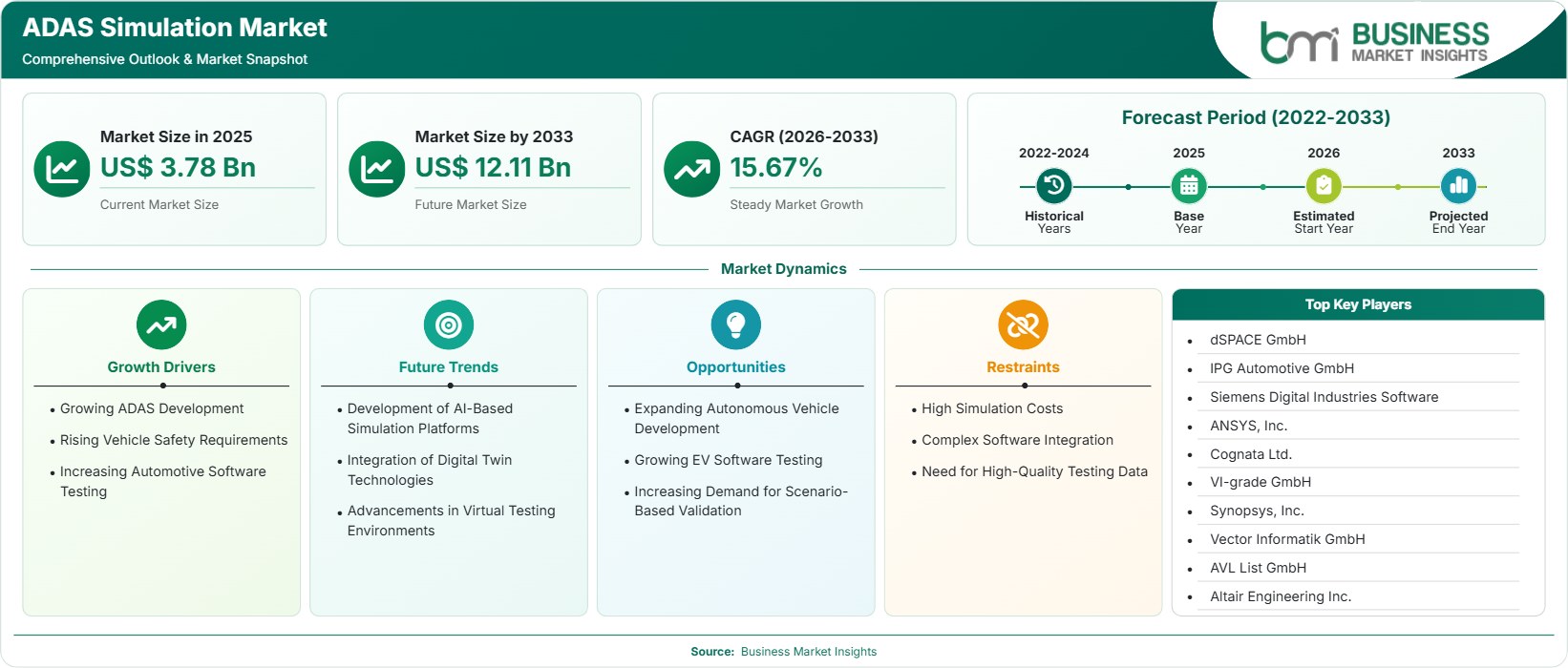
The ADAS Simulation Market size was valued at US$ 3.78 Billion in 2025 and is projected to reach US$ 12.11 Billion by 2033, growing at a CAGR of 15.67% during 2026–2033, driven by autonomous vehicle validation demand, software-defined vehicles, virtual testing efficiency, regulatory safety requirements, and expanding cloud-based simulation ecosystems.

Report Coverage
  • Simulation Type: Software-in-the-Loop, Hardware-in-the-Loop, Model-in-the-Loop, Driver-in-the-Loop
  • Component: Software, Hardware, Services
  • Application: Autonomous Driving Testing, ADAS Function Validation, Sensor Fusion Testing, Scenario & Environment Simulation
  • Vehicle Type: Passenger Cars, Commercial Vehicles
  • End User: Automotive OEMs, Tier 1 Suppliers, Technology Providers, Research & Testing Institutions
US$ 3.78 Bn Market size in 2025
US$ 12.11 Bn Market Size by 2033
15.67% CAGR, 2026 - 2033
2026-2033 Forecast Period

01 AI Overview

ADAS Simulation Market Summary

  • North America Region: Holds a market share of 35%–38% in 2025, growing at a CAGR of 14.5%–15.5% during 2026–2033. Strong autonomous mobility investments, regulatory compliance requirements, digital engineering adoption, and partnerships between OEMs and software providers continue creating commercialization opportunities across testing ecosystems. US market remains the regional anchor, supported by advanced vehicle software programs and estimated CAGR of 14.8%–15.8%.
  • Fastest Growing Region: Asia Pacific accounts for 29%–32% share in 2025 and advances at 17.5%–18.5% CAGR. Expanding EV production, autonomous driving programs, semiconductor investments, and vehicle software localization initiatives stimulate adoption of advanced simulation environments across major automotive markets.
  • Leading Segment: Software commands 46%–49% share in 2025 and expands at 15.5%–16.5% CAGR. Demand for scalable virtual testing, digital twins, sensor modeling, cloud deployment, and automated scenario generation strengthens software platform utilization across vehicle development workflows.
  • High Growth Segment: Autonomous Driving Testing represents 28%–31% share in 2025 and grows at 17.5%–18.5% CAGR. Increasing validation complexity, large-scale virtual mileage requirements, AI-based perception testing, and safety certification needs accelerate investment throughout mobility development pipelines.
  • Key Market Opportunity: Integration of AI-generated scenarios, synthetic sensor datasets, cloud-native validation platforms, and digital twins enables cost-efficient large-scale testing, supporting faster deployment of higher-level vehicle automation technologies globally.
  • Major Market Players: dSPACE GmbH, IPG Automotive GmbH, Siemens Digital Industries Software, ANSYS, Inc., Cognata Ltd., VI-grade GmbH, Synopsys, Inc., Vector Informatik GmbH, AVL List GmbH, Altair Engineering Inc.
02 Strategic Insights

ADAS Simulation Market: Strategic Insights

ADAS Simulation Market Strategic Framework
FREE PDF
Request your free sample
Request free sample
03 Stakeholder View

Key Takeaways

  • The industry value chain is evolving from standalone testing tools toward integrated ecosystems combining sensor modeling, digital twins, software validation, scenario generation, and cloud-based orchestration.
  • Autonomous driving testing and scenario-based environment simulation offer the highest long-term revenue opportunities as vehicle automation levels and software complexity increase.
  • Innovation is shifting toward AI-assisted scenario generation, synthetic data development, virtual ECUs, and real-time validation environments supporting continuous software updates.
  • Asia Pacific presents the strongest investment outlook due to rapid EV expansion, growing semiconductor capabilities, and increasing autonomous mobility research programs.
  • Strategic collaborations between simulation vendors, cloud providers, semiconductor firms, and OEMs are accelerating acquisitions, joint development programs, and platform integration initiatives.
  • Competitive advantage increasingly depends on sensor-fusion realism, cloud scalability, and regulatory-compliant validation frameworks capable of supporting global deployment programs.
04 Geographic Outlook

ADAS Simulation Market Regional Highlights

North America ADAS Simulation Market

North America accounts for 35%–38% of global revenue in 2025 and is expected to expand at a CAGR of 14.5%–15.5% through 2033. The region benefits from strong autonomous driving investments, advanced software engineering capabilities, and regulatory emphasis on safety validation. ADAS Simulation Market share leadership is supported by major technology firms, testing infrastructure, and extensive R&D spending. Demand remains concentrated among OEMs, mobility innovators, and software suppliers adopting large-scale virtual validation strategies.

  • High adoption of cloud-native testing platforms supports efficient validation of perception and sensor-fusion functions.
  • Technology partnerships strengthen virtual mileage generation and automated scenario validation capabilities.
  • Strong semiconductor and AI ecosystems improve simulation accuracy and computational performance.
  • Commercial vehicle automation initiatives enhance enterprise adoption across logistics applications.

US ADAS Simulation Market

The United States represents 78%–82% of regional demand and advances at a CAGR of 14.8%–15.8%. The country hosts leading automotive software developers, autonomous mobility programs, and validation technology providers. Government-supported testing corridors and private investments encourage widespread deployment of simulation tools. ADAS Simulation Market growth remains linked to software-defined vehicle programs and increasingly complex safety validation requirements.

  • Autonomous vehicle developers use large-scale scenario libraries to accelerate software verification.
  • AI-driven sensor-testing platforms gain traction across both passenger and commercial vehicle programs.
  • Cloud infrastructure supports distributed engineering and scalable validation workflows.
  • Strong venture funding activity promotes next-generation mobility innovation.

Europe ADAS Simulation Market

Europe captures 27%–30% market share in 2025 and records CAGR of 14.8%–15.8% through 2033. The region benefits from stringent safety regulations, established automotive manufacturing, and strong engineering expertise. Germany leads regional demand, while Eastern European innovation centers contribute accelerating adoption. Increasing software content in vehicles is encouraging simulation-first validation approaches. Germany remains the largest market, while Spain and Poland demonstrate comparatively stronger growth trajectories.

  • Euro NCAP evolution encourages extensive virtual validation before physical testing.
  • Premium vehicle manufacturers invest heavily in digital engineering environments.
  • Germany maintains leadership with advanced automotive software infrastructure.
  • Spain and Poland emerge as high-growth locations supported by technology investments.
  • Collaboration among OEMs, suppliers, and research institutes strengthens innovation.

Asia Pacific ADAS Simulation Market

Asia Pacific holds 29%–32% share in 2025 and remains the fastest expanding region with CAGR of 17.5%–18.5%. China dominates regional demand due to EV leadership, autonomous mobility investment, and semiconductor expansion. India, South Korea, and Japan continue strengthening simulation capabilities for next-generation vehicle programs. Large-scale vehicle production and localization of software development create substantial requirements for virtual testing platforms.

  • China leads adoption through aggressive intelligent transportation and autonomous driving initiatives.
  • India demonstrates rapid growth from automotive software engineering expansion.
  • Japanese OEMs increasingly integrate simulation across product development lifecycles.
  • South Korea benefits from strong electronics and sensor ecosystems.
  • EV innovation creates additional demand for software validation environments.

Rest of World ADAS Simulation Market

Rest of World contributes 8%–10% share in 2025 and advances at CAGR of 15.0%–16.0%. South and Central America increasingly utilize virtual testing to modernize vehicle development processes. Middle East and Africa adoption is supported by smart mobility programs, digital infrastructure spending, and transportation innovation initiatives. Brazil leads regional demand while Saudi Arabia demonstrates one of the fastest adoption trajectories.

  • Brazil benefits from expanding automotive engineering activities and digital transformation projects.
  • Mexico supports adoption through integration with global automotive supply chains.
  • Saudi Arabia promotes simulation investments through advanced mobility initiatives.
  • UAE focuses on connected and autonomous transportation innovation programs.
  • Research institutions expand collaboration with technology providers across emerging markets.
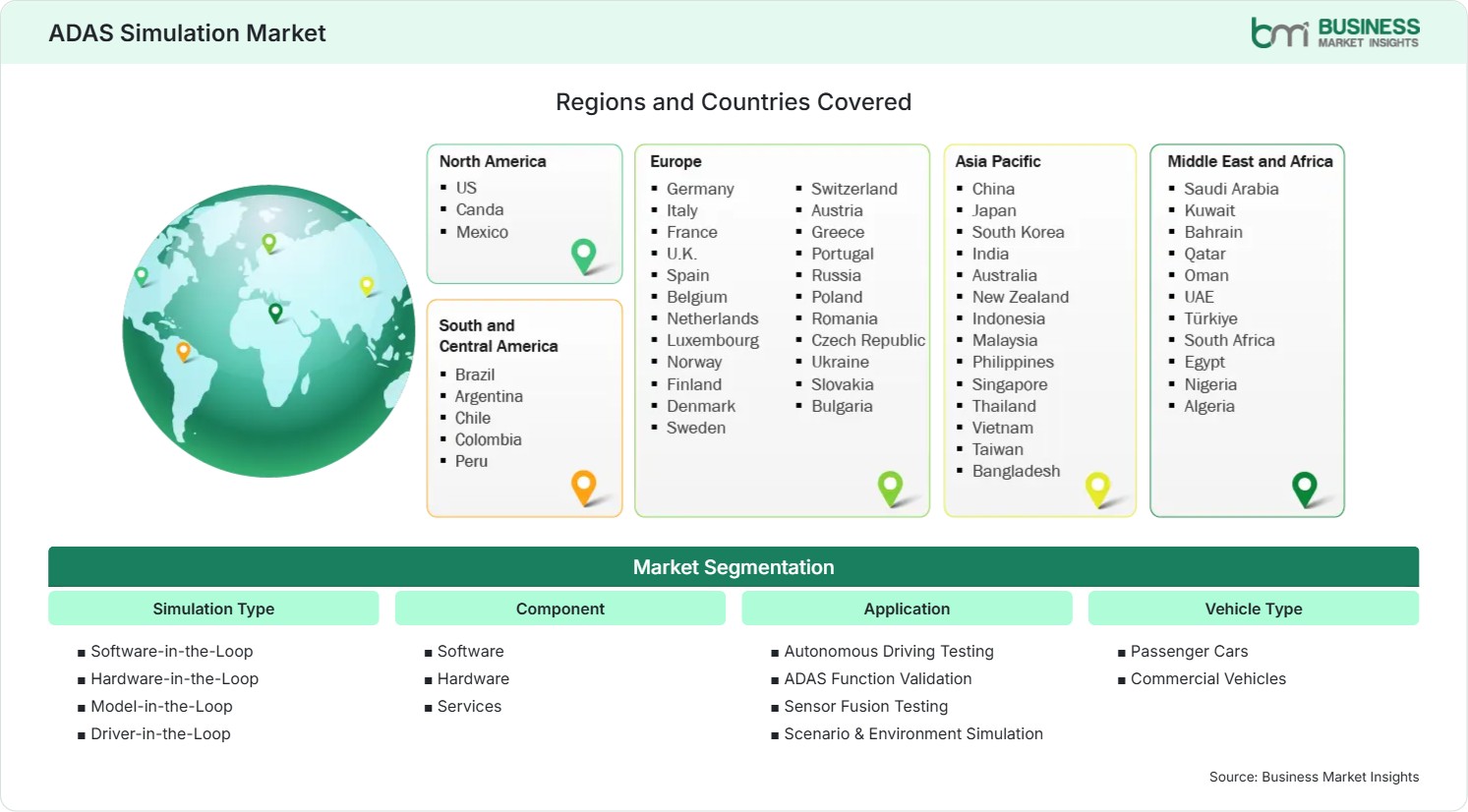
Global Market Geography
FREE PDF
Request your free sample
Request free sample
05 Segment Analysis

ADAS Simulation Market Segmentation

Simulation Type

This segment represents approximately 32%–35% ADAS Simulation Market scope in 2025 and is expected to expand at 15.8%–16.8% CAGR. Growth is driven by increasing validation complexity, software-centric vehicle architectures, and industry migration toward virtual development environments reducing physical testing dependencies.

  • Software-in-the-Loop (SiL): Supports early-stage software validation, enabling scalable testing of algorithms, perception systems, and control logic before hardware integration.
  • Hardware-in-the-Loop (HiL): Widely used for real-time ECU validation and safety-critical functional verification under realistic operational conditions.
  • Model-in-the-Loop (MiL): Facilitates conceptual design validation and algorithm optimization during initial development stages through controlled virtual environments.
  • Driver-in-the-Loop (DiL): Enhances human-machine interaction testing and behavioral assessments under dynamic traffic scenarios and complex road conditions.

Component

Component solutions account for 46%–49% share in 2025 and grow at 15.5%–16.5% CAGR. Increased adoption of cloud platforms, AI-enabled validation tools, and scalable testing frameworks continues supporting deployment across automotive development programs.

  • Software: Delivers scenario generation, sensor modeling, virtual validation, and analytics capabilities that support efficient development cycles.
  • Hardware: Provides computing infrastructure, real-time testing systems, and specialized processing environments for advanced simulations.
  • Services: Includes consulting, deployment, integration, training, and customized engineering support aligned with project requirements.

Application

Applications account for about 27%–30% ADAS Simulation Market share in 2025 and advance at 16.5%–17.5% CAGR. Market expansion reflects growing emphasis on safety, automation, and software reliability across next-generation vehicle platforms.

  • Autonomous Driving Testing: Enables validation of perception, planning, and vehicle-control systems across extensive virtual driving conditions.
  • ADAS Function Validation: Supports verification of braking, lane-keeping, adaptive cruise control, and driver assistance functionalities.
  • Sensor Fusion Testing: Evaluates integration accuracy among cameras, radar, lidar, and ultrasonic sensing technologies.
  • Scenario & Environment Simulation: Creates realistic traffic, weather, and road environments for repeatable performance assessments.

Vehicle Type

Vehicle-type demand maintains 68%–72% concentration within passenger-car programs and expands at 15.2%–16.2% CAGR. Growing software content and regulatory expectations remain major adoption catalysts.

  • Passenger Cars: Drive volume demand as manufacturers accelerate deployment of advanced safety and automation technologies.
  • Commercial Vehicles: Adoption increases through autonomous logistics, fleet safety enhancement, and operational efficiency initiatives.

End User

End-user adoption remains broad, supported by multi-stakeholder development ecosystems. The segment records CAGR of 15.5%–16.5% through the forecast period.

  • Automotive OEMs: Invest heavily in integrated virtual validation environments to reduce development costs and timelines.
  • Tier 1 Suppliers: Use simulation tools to verify component interoperability and compliance before deployment.
  • Technology Providers: Develop advanced software frameworks supporting autonomous and connected mobility functions.
  • Research & Testing Institutions: Conduct safety studies, regulatory assessments, and collaborative innovation programs.
06 Market Forces

ADAS Simulation Market Dynamics

Key Market Drivers

Growing ADAS Development

Automotive manufacturers are accelerating the deployment of advanced driver assistance functions across passenger and commercial vehicles, creating a greater need for sophisticated virtual validation environments. The incorporation of features such as braking assistance, adaptive cruise control, lane-centering, parking assistance, and driver monitoring into vehicles has made the development process more complex. The above-mentioned factors have been playing an important role in fueling the ADAS Simulation Market growth, because manufacturers have started using simulation to test their vehicles' performance in various driving scenarios. Through simulation, it is possible to conduct tests in virtual settings.

Rising Vehicle Safety Requirements

Stricter vehicle safety expectations from regulatory agencies, consumers, and certification bodies are reshaping automotive testing strategies. One of the important ADAS Simulation Market trends is the increasing move towards virtual verification platforms through which manufacturers are able to validate their safety-critical functions in all sorts of operational scenarios. It is not always possible to test some specific situations physically because of either their rare nature or high level of danger. The use of simulation technology allows for repeatable and scalable evaluations of how the systems operate, optimize the performance of software and detect problems beforehand.

Increasing Automotive Software Testing

The emergence of software-defined vehicles is transforming how automotive companies design, validate, and maintain vehicle systems. Contemporary automobiles have sophisticated software architecture in place that helps them function in terms of perception, connectivity, decision-making, and automation. Updates of software and improvements are constant throughout the lifetime of the product and not just during the initial stages of its development. Such systems facilitate this approach by offering opportunities for early-stage testing, ECU verification in virtual form and verification of software interactions without physical hardware implementation. This increases efficiency in engineering process while decreasing risks and costs associated with the development process.

Key Market Opportunities

Expanding Autonomous Vehicle Development

The pursuit of higher levels of vehicle autonomy is generating substantial opportunities for simulation solution providers. As per the predictions provided by ADAS Simulation Market Forecasts, the need for scalable virtual testing environments is on the rise since developers require effective ways to test their perception systems, path planning algorithms, decision making abilities, and safety mechanisms. The programs associated with autonomous driving require massive amounts of testing in numerous real-life situations as well as theoretical conditions that cannot be achieved by using only physical means. The high-fidelity simulations can help to meet this need by validating the software in a controlled environment.

Growing EV Software Testing

The rapid evolution of electric vehicles is increasing demand for comprehensive software validation solutions. Battery management, energy optimization, connectivity features, safety, and driver assistance are some of the key areas where modern EV platforms are heavily dependent on software. With the increase in intelligence and connectivity of such vehicles, testing becomes significantly more demanding at all stages of development. Simulation tools enable car manufacturers to test the interaction of their software and system performance without having to build physical prototypes. The convergence of electrified cars with digital architecture is prompting the use of validation ecosystems, thus presenting an opportunity for simulation providers.

Increasing Demand for Scenario-Based Validation

Automotive developers are increasingly prioritizing scenario-based validation approaches to improve testing coverage and accelerate product development. Advanced vehicles must operate reliably across a broad spectrum of driving environments, traffic conditions, weather patterns, and unpredictable road events. Simulation platforms enable engineers to create and execute thousands of customized scenarios within controlled digital environments, allowing more efficient evaluation of system performance. Growing demand for automated scenario generation, intelligent analytics, and large-scale validation workflows is encouraging investments in next-generation testing platforms. As automation capabilities become more sophisticated, scenario-based validation is expected to play an increasingly important role in ensuring vehicle safety and reliability.

Market Restraints and Challenges

High Simulation Costs

Factor: The deployment of advanced simulation ecosystems often requires substantial investments in software licenses, specialized computing infrastructure, cloud resources, and highly skilled engineering teams. Organizations seeking high-fidelity validation capabilities frequently need to allocate significant resources toward implementation, maintenance, and platform upgrades. Impact: These financial constraints can result in barriers to adoption by smaller suppliers, innovative tech companies, and research organizations working on a limited budget. Even though the process of simulating is efficient and helps save on costs associated with the testing process, the financial constraint at the beginning of the process may slow down purchases.

Complex Software Integration

Factor: Automotive development programs depend on numerous software tools, engineering platforms, communication protocols, and data ecosystems that must function cohesively throughout the validation process. Integrating simulation solutions into existing workflows often requires customization, interoperability management, and extensive technical coordination. Impact: Integration challenges can lengthen implementation timelines, increase operational complexity, and require additional engineering resources to maintain consistency across development activities. Organizations may also encounter difficulties aligning virtual testing outputs with hardware validation processes. These challenges can reduce deployment efficiency and increase project costs, particularly in large-scale development environments involving multiple stakeholders and technology platforms.

07 Company Analysis

Competitive Landscape

ADAS Simulation Market analysis indicates competition is centered on simulation fidelity, sensor realism, cloud scalability, digital twin capabilities, and integrated validation workflows.

Company Name

Overview

Products and Services relevant to this market

dSPACE GmbH

German provider specializing in simulation, validation, and testing solutions for automotive software development.

AURELION, SCALEXIO, VEOS, sensor simulation, HiL platforms, validation and testing services.

IPG Automotive GmbH

Automotive simulation specialist focused on virtual vehicle development and testing environments.

CarMaker, TruckMaker, MotorcycleMaker, virtual testing, validation software, HiL solutions.

Siemens Digital Industries Software

Global engineering software company serving digital transformation across automotive development.

Simcenter Prescan, PAVE360, digital twins, system simulation, validation platforms.

ANSYS, Inc.

Engineering simulation leader offering multiphysics and sensor modeling capabilities.

AVxcelerate Sensors, radar simulation, digital engineering, validation software.

Cognata Ltd.

Provider of AI-driven simulation and synthetic data solutions for mobility applications.

OneSim, DriveMatriX, synthetic data generation, perception validation platforms.

VI-grade GmbH

Specialist in driver-in-the-loop and dynamic vehicle simulation technologies.

Driving simulators, DiL platforms, vehicle dynamics testing solutions.

Synopsys, Inc.

Software and semiconductor technology provider supporting virtual development workflows.

Silver virtual ECU platform, software validation, system simulation tools.

Vector Informatik GmbH

Automotive software engineering company focused on embedded systems validation.

CANoe, ECU testing, simulation environments, communication validation tools.

AVL List GmbH

Mobility technology company delivering integrated testing and simulation solutions.

Vehicle simulation, HiL systems, powertrain validation, engineering services.

Altair Engineering Inc.

Computational engineering and digital simulation technology provider.

Digital twins, AI-enabled simulation, analytics, virtual testing solutions.


10 Trust & Transparency

Research Methodology

The market analysis combines proprietary research with secondary data from government agencies, company disclosures, regulatory filings, industry databases and expert interviews. Market estimates are validated through data triangulation, cross-market benchmarking and analyst review.

View Full Research Methodology

11 Questions Answered

Frequently Asked Questions

What does the ADAS Simulation Market Report typically evaluate?

It examines competitive positioning, technology developments, regional opportunities, segment performance, regulatory influences, adoption patterns, investment activity, and forecast revenue trends.

How do simulation platforms improve vehicle development efficiency?

They enable repeatable testing, earlier defect identification, accelerated software validation, reduced prototype dependence, and scalable assessment of complex driving scenarios.

Which end users generate the highest demand for simulation solutions?

Automotive OEMs remain the largest users, followed by Tier 1 suppliers, technology developers, and research institutions involved in advanced safety and automation programs.

Which region offers the strongest future growth potential?

Asia Pacific presents the strongest expansion prospects due to large vehicle production volumes, EV investments, autonomous mobility programs, and expanding automotive software development capabilities.

What is driving adoption of ADAS simulation platforms across the automotive industry?

Growing software complexity, autonomous driving development, safety regulations, and the need to reduce physical testing costs are encouraging manufacturers to adopt virtual validation environments.

Access the Full ADAS Simulation Market Report

Get segment-level forecasts, regional estimates, competitive benchmarking, company profiles and downloadable Excel datasets.

Access the full ADAS Simulation Market Report
350 pages PDF & Excel | 2026-08-20