
Active Pharmaceutical Ingredient Market Outlook: Size, Share, Trends, Growth Analysis, Competitive Landscape & Forecast, 2026-2033

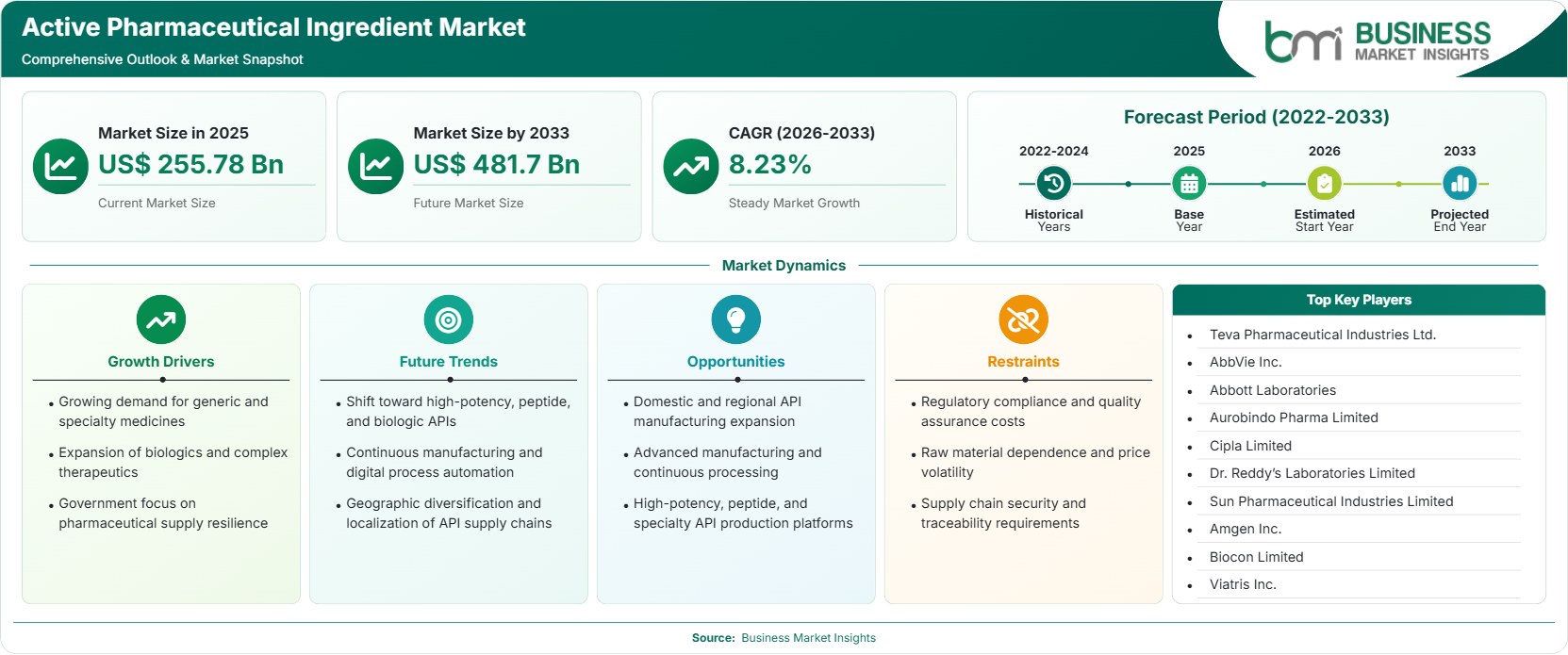
The Active Pharmaceutical Ingredient Market size was valued at US$ 255.78 Billion in 2025 and is projected to reach US$ 481.7 Billion by 2033, growing at a CAGR of 8.23% during 2026–2033, driven by generic medicine demand, biologics expansion, chronic disease treatment, supply-chain localization, complex therapeutics, and advanced manufacturing.

Report Coverage
  • Type: Generic API, Branded API
  • Synthesis: Biological API, Synthetic API
US$ 255.78 Bn Market size in 2025
US$ 481.7 Bn Market Size by 2033
8.23% CAGR, 2026 - 2033
2026-2033 Forecast Period

AI Overview

Active Pharmaceutical Ingredient Market Summary

  • North America Region: North America holds a 47%–48% share in 2025, with a modeled 6.0%–6.5% CAGR during 2026–2033, supported by pharmaceutical innovation, specialty medicines, domestic manufacturing investment, biologics, regulatory quality requirements, and supply-chain resilience. The U.S. accounts for most regional demand, with a 5.9%–6.4% CAGR, supported by specialty drugs, generic medicines, biologics, and domestic API capacity expansion. Published 2025 estimates place North America at 47.22% of global API value.
  • Fastest Growing Region: Asia Pacific holds a 21%–22% share of the Active Pharmaceutical Ingredient market in 2025, with an 8.3%–8.7% CAGR during 2026–2033, supported by manufacturing scale, cost competitiveness, generic medicine production, export capacity, pharmaceutical investments, and expanding regional healthcare access.
  • Leading Segment: Branded API holds a 61%–63% share in 2025, with a 7.1%–7.5% CAGR during 2026–2033, supported by innovative medicines, specialty therapies, high-value molecules, complex formulation requirements, biotechnology investment, and expanding pipelines. Published analysis places branded API at 62.10% in 2026.
  • High Growth Segment: Generic API holds a 33%–35% share in 2025, with a 7.8%–8.3% CAGR during 2026–2033, supported by patent expiries, affordable healthcare initiatives, emerging-market medicine access, outsourcing, chronic disease treatment, and large-volume generic production. Published analysis identifies generic API as the fastest-growing API type.
  • Key Market Opportunity: Supply-chain localization, complex APIs, high-potency molecules, biologics, continuous manufacturing, digital quality systems, and multi-source procurement create attractive opportunities for higher-value API production.
  • Major Market Players: Teva Pharmaceutical Industries Ltd., AbbVie Inc., Abbott Laboratories, Aurobindo Pharma Limited, Cipla Limited, Dr. Reddy’s Laboratories Limited, Sun Pharmaceutical Industries Limited, Amgen Inc., Biocon Limited, and Viatris Inc.
Strategic Insights

Active Pharmaceutical Ingredient Market: Strategic Insights

Active Pharmaceutical Ingredient Market Strategic Framework
FREE PDF
Request your free sample
Request free sample
Stakeholder View

Key Takeaways

  • The value chain is moving beyond basic bulk API production toward complex molecules, high-potency compounds, peptides, biologics, and specialty ingredients where technical barriers and regulatory expertise support stronger differentiation.
  • Generic API production remains an important expansion opportunity because patent expiries, cost-sensitive healthcare systems, and rising pharmaceutical consumption continue to support high-volume demand across emerging and developed markets.
  • Digital manufacturing is becoming strategically important as producers integrate real-time process data, predictive analytics, automated quality monitoring, and connected manufacturing systems to improve yield, consistency, traceability, and operational efficiency.
  • India provides a compelling investment case because of its established API ecosystem, export capabilities, technical workforce, manufacturing scale, and extensive regulatory experience across major pharmaceutical markets.
  • Supply-chain localization is encouraging pharmaceutical companies to diversify API sourcing and develop additional production capacity closer to end markets. AbbVie’s U.S. investments demonstrate this movement toward domestic API manufacturing.
  • M&A and strategic partnerships increasingly target specialty manufacturing, biologics, complex chemistry, CDMO capabilities, and technology platforms rather than undifferentiated commodity capacity.
Geographic Outlook

Active Pharmaceutical Ingredient Market Regional Highlights

North America Active Pharmaceutical Ingredient Market

North America accounted for a 47%–48% share in 2025 and is modeled at a 6.0%–6.5% CAGR during 2026–2033. Published 2025 research places regional share at 47.22%, making North America the largest regional market. The region benefits from innovative drug pipelines, specialty pharmaceuticals, biologics, stringent quality systems, and increasing domestic manufacturing investment.

  • Domestic manufacturing investment is increasing as pharmaceutical companies seek greater control over critical API supplies and reduce exposure to international production disruptions.
  • Biologics, oncology medicines, peptides, and high-potency therapies require advanced manufacturing infrastructure, creating demand for specialized facilities and containment technologies.
  • U.S. regulatory initiatives are encouraging domestic pharmaceutical manufacturing through faster review pathways and facility-readiness programs.
  • Canada contributes through pharmaceutical research, specialty manufacturing, contract development, and cross-border supply relationships.

US Active Pharmaceutical Ingredient Market

The U.S. represented approximately 88%–90% of the Active Pharmaceutical Ingredient market share of North American API demand in 2025 and is modeled at a 5.9%–6.4% CAGR during 2026–2033. Its position reflects high pharmaceutical consumption, advanced drug development, specialty medicines, and renewed investment in domestic manufacturing. FDA data show that only 11% of API manufacturers supplying FDA-approved products were U.S.-based in 2025.

  • U.S. manufacturers are expanding domestic API capacity to strengthen supply resilience for neuroscience, oncology, immunology, obesity, and other high-value therapeutic categories.
  • FDA PreCheck is designed to improve regulatory predictability for new domestic pharmaceutical manufacturing facilities and strengthen supply-chain resilience.
  • Specialty API production provides opportunities for manufacturers with advanced chemistry, containment, analytical, and regulatory capabilities.

Europe Active Pharmaceutical Ingredient Market

Europe represented approximately a 23%–24% share in 2025 and is modeled at a 5.7%–6.2% CAGR of the Active Pharmaceutical Ingredient market during 2026–2033. Published 2025 estimates place Europe at US$56.78 billion, equivalent to approximately 23% of global API value. Germany, France, Italy, Switzerland, and the U.K. remain important pharmaceutical manufacturing markets.

  • Germany remains a major pharmaceutical manufacturing base, supporting demand for high-purity APIs, specialty molecules, and regulated production services.
  • France and Switzerland benefit from sophisticated pharmaceutical R&D, innovative medicines, biotechnology, and specialty ingredient manufacturing.
  • The U.K. maintains opportunities in advanced pharmaceutical research, specialty manufacturing, biologics, and contract development services.
  • European policymakers are emphasizing supply resilience, with initiatives aimed at reducing excessive dependence on overseas sources for critical medicines and ingredients.

Asia Pacific Active Pharmaceutical Ingredient Market

Asia Pacific held approximately a 21%–22% share in 2025 and is modeled at an 8.3%–8.7% CAGR during 2026–2033, making it the fastest-growing region. Published research places the region at approximately 25% under a broader API market definition and identifies an 8.5% growth trajectory. India and China remain major manufacturing hubs.

  • India combines extensive API manufacturing capacity, skilled pharmaceutical labor, export infrastructure, and large generic-drug production capabilities.
  • China remains important for chemical intermediates, API manufacturing, pharmaceutical raw materials, and large-scale production infrastructure.
  • Japan and South Korea provide opportunities in high-quality specialty APIs, innovative medicines, biotechnology, and advanced pharmaceutical manufacturing.
  • Southeast Asia is gaining relevance as pharmaceutical companies diversify production and establish regional supply-chain networks.

Rest of World Active Pharmaceutical Ingredient Market

Rest of World accounted for approximately a 7%–8% share in 2025 and is modeled at a 6.0%–6.6% CAGR of the Active Pharmaceutical Ingredient market during 2026–2033. Latin America benefits from generic medicine demand and increasing pharmaceutical manufacturing, while the Middle East is developing localized pharmaceutical production and strategic healthcare manufacturing capabilities.

South America offers opportunities in Brazil, Mexico, and Argentina due to improved healthcare delivery and pharmaceutical firms' search for regional supplies. The Middle East is increasingly inclined toward investment in pharmaceutical production and medical security.

  • Brazil provides the strongest Latin American opportunity through its large pharmaceutical market, domestic manufacturing base, and expanding demand for affordable medicines.
  • Mexico benefits from proximity to the U.S., established pharmaceutical manufacturing, and growing opportunities for regional supply-chain integration.
  • Saudi Arabia is promoting domestic pharmaceutical manufacturing as part of broader healthcare industrialization and supply-security objectives.
  • The UAE provides opportunities in pharmaceutical logistics, specialty healthcare, regional distribution, and advanced manufacturing investment.
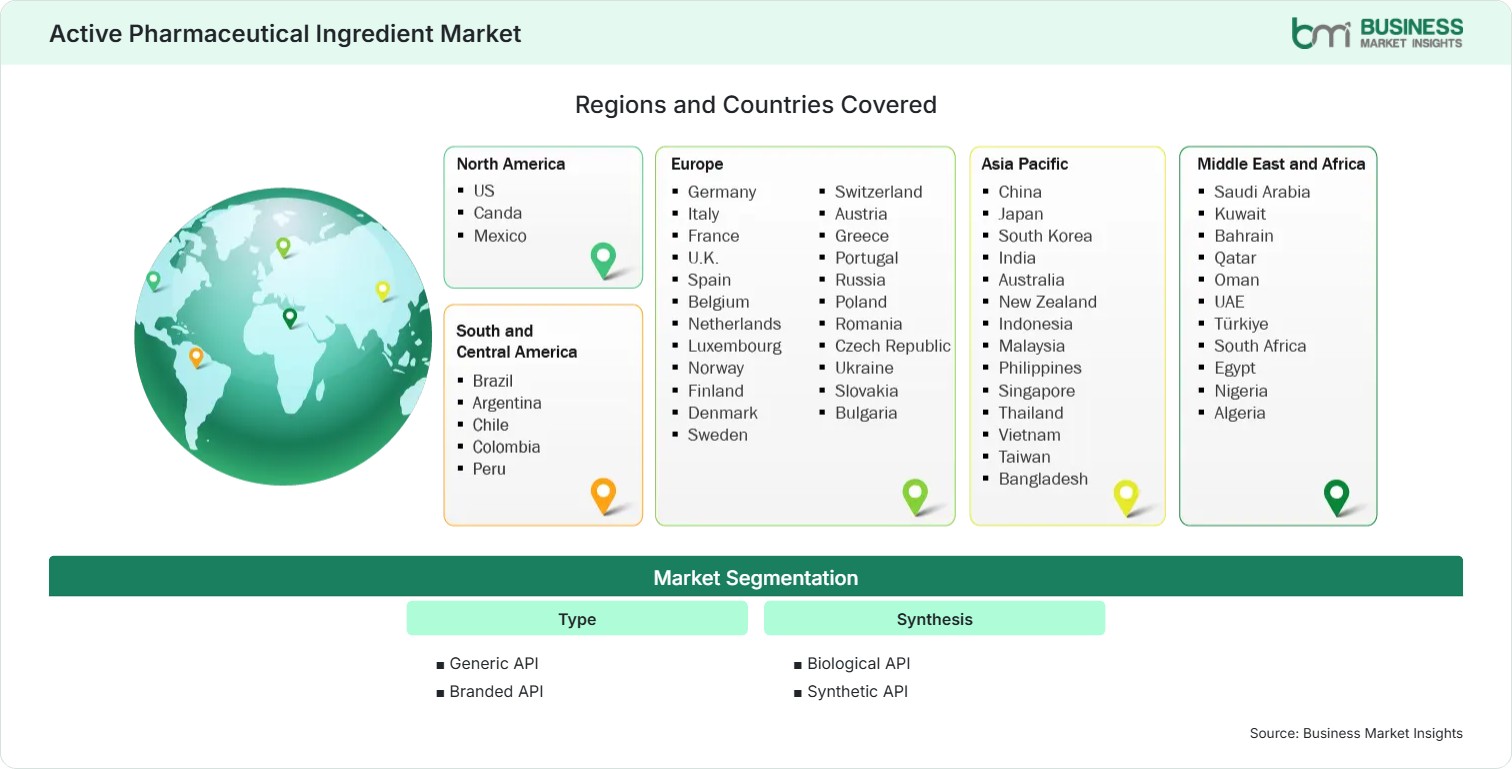
Global Market Geography
FREE PDF
Request your free sample
Request free sample
Segment Analysis

Active Pharmaceutical Ingredient Market Segmentation

Type

Type Category contains Generic API and Branded API. Branded API has around 61%-63% market share in 2025 and is forecast to grow at a CAGR of 7.1%-7.5% from 2026-2033, driven by innovative medicines, specialty drugs, high-value molecules, and ongoing pharmaceutical development. According to published literature, the branded API has a share of 62.10% for 2026.

  • Generic API: Generic API demand is supported by patent expiries, affordable medicine programs, chronic disease treatment, emerging-market healthcare expansion, and large-volume manufacturing requirements.
  • Branded API: Branded APIs benefit from innovative medicines, specialty therapeutics, complex molecules, proprietary formulations, and continued investment in new drug development.

Synthesis

The Synthesis segment includes Biological API and Synthetic API. Synthetic API represented approximately 74% share in 2025 and is modeled at 7.0%–7.4% CAGR during 2026–2033, supported by mature chemistry, large-scale production, and broad use across pharmaceutical formulations. Active Pharmaceutical Ingredient market report published research confirms synthetic API dominance at more than 74% in 2025.

  • Biological API: Biological APIs are gaining adoption through biologics, biosimilars, recombinant proteins, advanced therapies, and increasingly complex manufacturing requirements.
  • Synthetic API: Synthetic APIs retain broad demand because established chemical processes support scalable production, cost efficiency, reproducibility, and extensive pharmaceutical applications.
Market Forces

Active Pharmaceutical Ingredient Market Dynamics

Key Market Drivers

Growing Demand for Generic and Specialty Medicines

The use of pharmaceuticals and patent expirations have been fuelling demand for APIs in both traditional and new healthcare systems. Analysis reveals that 66% of the market was captured by innovative APIs in 2025, while 34% was captured by generic APIs, indicating a mix of innovation and generics in the market. Growth in the Active Pharmaceutical Ingredient market will be driven by the need to cure diseases, improved healthcare accessibility, and increased demand for affordable drugs. There is a need for affordable APIs from generic drug manufacturers, while specialty drug manufacturers require sophisticated, pure molecules.

Expansion of Biologics and Complex Therapeutics

There is an increasing need for specialty APIs due to the use of biologics, biosimilars, peptides, potent compounds, and targeted therapies. Biologics include identification of APIs from oncology, cardiology, CNS, pulmonology, gastroenterology, nephrology, ophthalmology, and endocrinology. The Active Pharmaceutical Ingredient Market trends indicate that companies with high-end analytical capabilities, containment, process development, sterile capabilities, and biological manufacturing capabilities would benefit. Increased complexity in drug formulations will create additional value for technical transfer, regulatory documentation, process optimization, and QbD. Companies that manufacture difficult-to-make drug molecules will create more differentiation than companies competing through price advantage.

Government Focus on Pharmaceutical Supply Resilience

Supply chain security has emerged as an important factor in the strategic analysis of dependency on foreign-based pharmaceutical production facilities. According to FDA data, by 2025, 53% of brand-name and 69% of generic drug products available in the U.S. market were produced abroad, and only 11% of API producers had facilities in the U.S. The existing state of affairs is spurring additional investments in production, production localization, supplier diversity, and the construction of highly developed facilities. Therefore, the Active Pharmaceutical Ingredient Market growth opportunity goes beyond the pharmaceutical demand to include investments in infrastructure. Manufacturers with geographically diversified operations and validated quality systems can become preferred suppliers as governments and pharmaceutical companies prioritize continuity, redundancy, and critical-medicine security.

Key Market Opportunities

Domestic and Regional API Manufacturing Expansion

Domestic API manufacturing presents an important investment opportunity, as governments increasingly recognize the need for pharmaceutical security through domestic production. FDA PreCheck is aimed at assisting in the setting up of priority pharmaceutical manufacturing facilities in the United States. Active Pharmaceutical Ingredient Market Forecasts are therefore expected to support companies that have invested in state-of-the-art manufacturing plants, flexible production processes, high-end analytical technologies, and multifunctional plants. India and other Asian markets can be supported by global pharmaceutical companies through diversified sourcing of active pharmaceutical ingredients. Such investments can meet the needs of pharmaceutical companies seeking dual- or multi-sourcing options for API strategies.

Advanced Manufacturing and Continuous Processing

Continuous manufacturing, process analytical technology, automation, real-time monitoring, and digital quality systems can improve process consistency and manufacturing efficiency. Dr. Reddy’s has emphasized the strengths of its API business unit's advanced API development, process engineering, analytics, and continuous manufacturing capabilities. These innovations have the potential to reduce variability, enhance quality assurance, maximize resource efficiency, and shorten the development period. Continuous and intensified processes are particularly significant for APIs in which reproducibility and containment are critical. Investment in these capabilities can shift competition from basic capacity toward process excellence and technical differentiation.

High-Potency, Peptide, and Specialty API Platforms

Specialty APIs, peptides, oncology products, and other such molecules present promising possibilities because their manufacture requires specialized equipment, techniques, and expertise. Dr. Reddy’s has high-potency API manufacturing capabilities, including specialized containment controls and process development. Demand from oncology, rare disease, immunology, metabolic disease, and advanced therapy products could enable premium pricing for qualified suppliers. Suppliers with capabilities in research and development, scale-up, regulatory compliance, and production would be able to build strong relationships with customers and minimize technology transfer issues.

Market Restraints and Challenges

Complex Regulatory and Quality Requirements

Factor: API manufacturers must satisfy rigorous GMP, analytical, documentation, impurity-control, validation, inspection, and filing requirements across multiple jurisdictions. FDA identifies manufacturing quality issues as the most common reason for drug shortages, while regulatory delays and raw-material constraints can also disrupt supply.

Impact: Compliance failures can delay approvals, interrupt production, increase remediation costs, and weaken customer confidence. Manufacturers therefore need continuous investment in quality systems, inspection readiness, analytical testing, data integrity, and regulatory expertise. Smaller producers may face greater financial pressure because compliance infrastructure must be maintained even when production volumes are limited.

Raw-Material Dependence and Manufacturing Cost Pressure

Factor: API production can depend on complex chemical intermediates, biological inputs, energy, specialized equipment, and geographically concentrated suppliers. Supply interruptions, price fluctuations, transportation disruptions, and geopolitical constraints can increase manufacturing costs.

Impact: Higher input costs can compress margins, especially for generic APIs competing in price-sensitive procurement markets. Pharmaceutical companies may also require multiple qualified suppliers, increasing validation and technology-transfer expenses. Manufacturers can mitigate these pressures through backward integration, multi-source procurement, inventory planning, regional production, process optimization, and long-term supplier agreements, but these measures require additional capital and operational coordination.

Company Analysis

Competitive Landscape

Competitive positioning depends on manufacturing scale, API breadth, regulatory approvals, complex chemistry, biological production, analytical capabilities, geographic diversification, and supply reliability. The Active Pharmaceutical Ingredient Market analysis indicates that leading companies increasingly compete through specialty APIs, backward integration, manufacturing resilience, technical services, and differentiated development capabilities.

Company Name

Overview

Products and Services relevant to this market

Teva Pharmaceutical Industries Ltd.

Global pharmaceutical company with extensive generic and specialty medicine operations and manufacturing capabilities.

Generic APIs, specialty pharmaceutical ingredients, manufacturing, development, regulatory support, and integrated pharmaceutical supply.

AbbVie Inc.

Research-driven pharmaceutical company expanding U.S. API manufacturing capacity for next-generation medicines.

Chemical synthesis APIs, specialty pharmaceutical manufacturing, neuroscience, immunology, oncology, and advanced production capabilities.

Abbott Laboratories

Diversified healthcare company with pharmaceutical and healthcare manufacturing capabilities across global markets.

Pharmaceutical ingredients, branded generics, formulation manufacturing, quality systems, and integrated healthcare production.

Aurobindo Pharma Limited

Indian pharmaceutical manufacturer with a substantial API business serving global generic drug markets.

APIs, intermediates, generic formulations, specialty products, manufacturing, and regulatory support. Its FY2025 API business grew 1.9%.

Cipla Limited

Indian pharmaceutical company with broad generic medicine and API capabilities.

APIs, respiratory ingredients, complex molecules, generic formulations, development, and manufacturing services.

Dr. Reddy’s Laboratories Limited

Global pharmaceutical company with 250+ APIs and eight USFDA-inspected API production units.

Generic APIs, complex APIs, HPAPIs, peptides, steroids, intermediates, DMFs, R&D, and regulatory services.

Sun Pharmaceutical Industries Limited

Major Indian pharmaceutical company with dedicated API facilities and a broad API portfolio.

Approximately 400 APIs, specialty ingredients, generic APIs, chemical synthesis, manufacturing, and backward integration.

Amgen Inc.

Biotechnology company focused on innovative medicines and advanced biological manufacturing.

Biologic drug substances, biological manufacturing, process development, analytical systems, and specialty therapeutic production.

Biocon Limited

Indian biopharmaceutical company with API and biologics capabilities across multiple therapeutic areas.

APIs, biological ingredients, biosimilars, specialty products, biotechnology manufacturing, and regulated pharmaceutical production.

Viatris Inc.

Global healthcare company created following the combination involving Mylan, with broad generic and established-medicine operations.

Generic pharmaceutical ingredients, established medicines, manufacturing, supply-chain management, and regulatory capabilities.

Trust & Transparency

Research Methodology

The market analysis combines proprietary research with secondary data from government agencies, company disclosures, regulatory filings, industry databases and expert interviews. Market estimates are validated through data triangulation, cross-market benchmarking and analyst review.

View Full Research Methodology

Questions Answered

Frequently Asked Questions

Which API manufacturing capabilities offer the strongest differentiation?

High-potency API containment, peptide synthesis, biologics production, advanced analytical testing, continuous processing, complex chemistry, regulatory expertise, and integrated R&D-to-commercial manufacturing capabilities offer strong differentiation.

What role does continuous manufacturing play in API production?

Continuous manufacturing can improve process control, consistency, resource efficiency, and production flexibility. It is particularly valuable for complex APIs where tighter process control and reproducibility can improve commercial manufacturing performance.

How is pharmaceutical supply-chain localization affecting APIs?

Governments and pharmaceutical companies are encouraging geographically diversified API production to reduce dependence on concentrated overseas supply. This is supporting new domestic facilities, dual sourcing, regional manufacturing, and strategic inventory investments.

Why are complex APIs becoming strategically important?

Complex APIs require specialized chemistry, containment, analytical methods, process development, and regulatory expertise. These barriers can reduce commoditization and create stronger opportunities for manufacturers with advanced technical platforms.

What determines API supplier selection?

Supplier selection depends on regulatory history, manufacturing capacity, product quality, analytical documentation, supply reliability, cost competitiveness, technical expertise, geographic diversification, and the ability to support regulatory filings and technology transfer.

Access the Full Active Pharmaceutical Ingredient Market Report

Get segment-level forecasts, regional estimates, competitive benchmarking, company profiles and downloadable Excel datasets.

Access the full Active Pharmaceutical Ingredient Market Report
350 pages PDF & Excel | 2026-08-27