
Active Packaging Market Outlook: Size, Share, Trends, Growth Analysis, Competitive Landscape & Forecast, 2026-2033

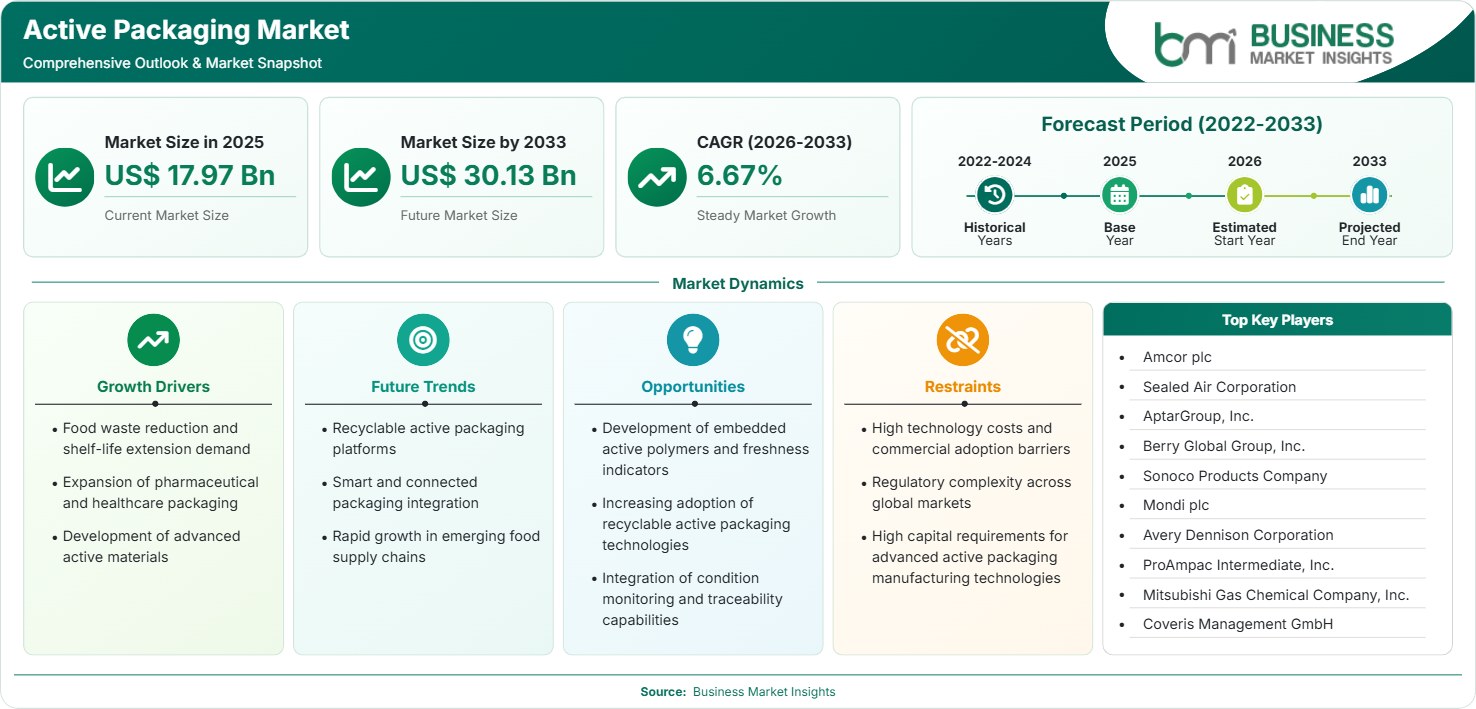
The Active Packaging Market size was valued at US$ 17.97 Billion in 2025 and is projected to reach US$ 30.13 Billion by 2033, growing at a CAGR of 6.67% during 2026–2033. Rising packaged food consumption, pharmaceutical protection requirements, food waste reduction initiatives, and smart packaging adoption are key drivers, while sustainable materials and cold-chain expansion create new opportunities.

Report Coverage
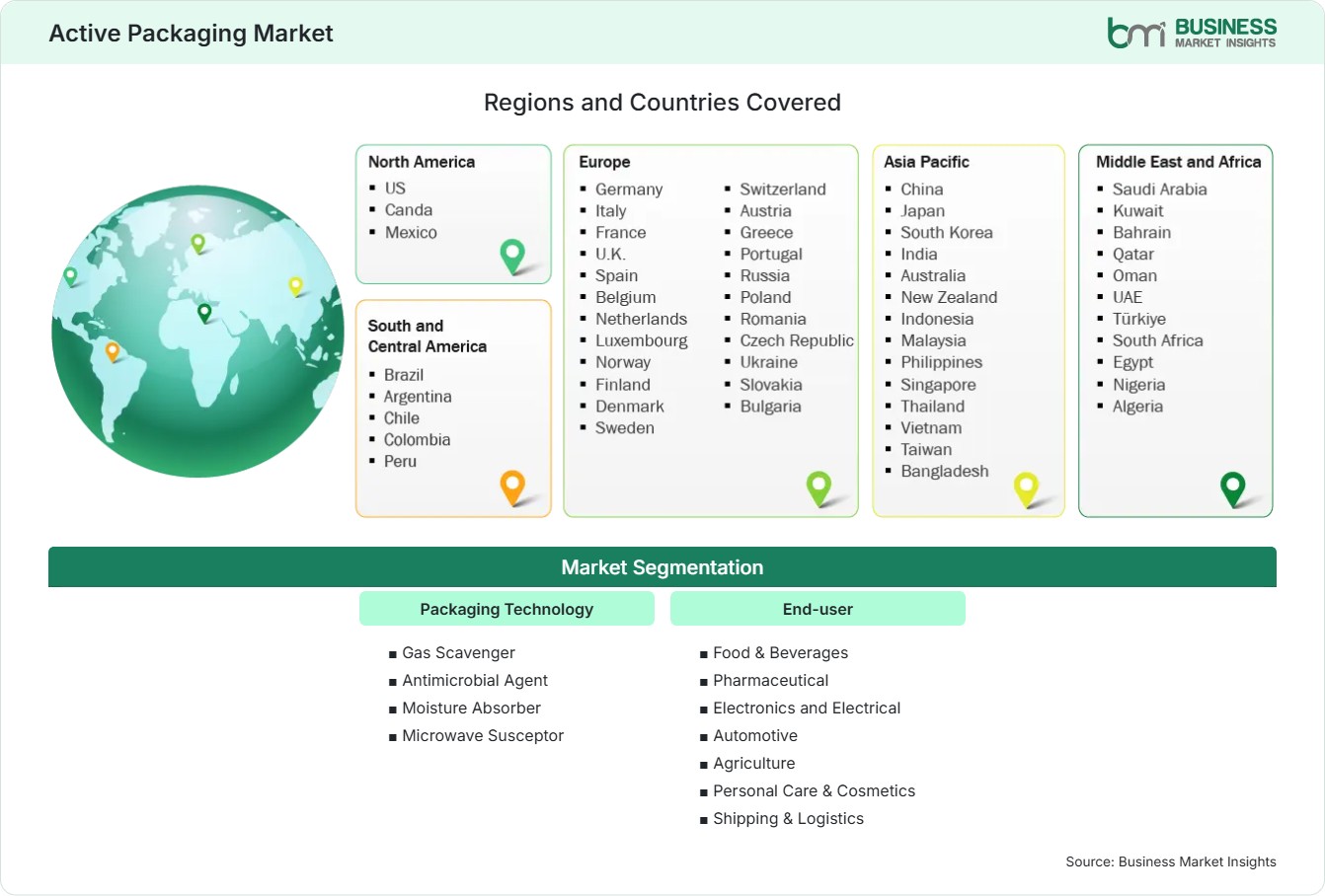
  • Packaging Technology: Gas Scavenger, Antimicrobial Agent, Moisture Absorber, Microwave Susceptor
  • End-user: Food & Beverages, Pharmaceutical, Electronics and Electrical, Automotive, Agriculture, Personal Care & Cosmetics, Shipping & Logistics
US$ 17.97 Bn Market size in 2025
US$ 30.13 Bn Market Size by 2033
6.67% CAGR, 2026 - 2033
2026-2033 Forecast Period

AI Overview

Active Packaging Market Summary

  • North America Region: North America holds a 34%–37% share in 2025, growing at a CAGR of 5.8%–6.3% during 2026–2033. Key drivers include packaged food safety regulations, pharmaceutical demand, and cold-chain expansion. Opportunities emerge from recyclable active materials and intelligent packaging integration. The U.S. market benefits from advanced food preservation technologies and pharmaceutical packaging innovation, expanding at 5.9%–6.4% CAGR.
  • Fastest Growing Region: Asia Pacific holds 27%–30% share in 2025 and advances at a CAGR of 7.8%–8.4% during 2026–2033. Growth is supported by urbanization, packaged food demand, pharmaceutical manufacturing expansion, export-oriented agriculture, and investments in advanced packaging infrastructure.
  • Leading Segment: Food & Beverages accounts for 44%–48% share in 2025 with CAGR of 6.2%–6.8%. Demand is driven by shelf-life extension, waste reduction targets, food safety compliance, convenience products, and growing retail distribution networks worldwide.
  • High Growth Segment: Pharmaceutical represents 14%–17% share in 2025 and expands at 7.5%–8.1% CAGR. Drivers include biologics distribution, moisture-sensitive drug protection, serialization requirements, temperature-controlled logistics, and stricter quality assurance standards.
  • Key Market Opportunity: Integration of recyclable active packaging solutions with smart indicators enables longer shelf life, reduced wastage, stronger traceability, and premium product differentiation across food, healthcare, and logistics applications globally.
  • Major Market Players: Amcor plc, Sealed Air Corporation, AptarGroup, Inc., Berry Global Group, Inc., Sonoco Products Company, Mondi plc, Avery Dennison Corporation, ProAmpac Intermediate, Inc., Mitsubishi Gas Chemical Company, Inc., Coveris Management GmbH.
Strategic Insights

Active Packaging Market: Strategic Insights

Active Packaging Market Strategic Framework
FREE PDF
Request your free sample
Request free sample
Stakeholder View

Key Takeaways

  • The value chain is becoming more integrated as material suppliers, active additive providers, converters, and brand owners collaborate on tailored preservation solutions.
  • Pharmaceutical packaging presents one of the strongest upside opportunities due to rising biologics, specialty medicines, and moisture-sensitive formulations.
  • Innovation is shifting from standalone absorbers toward embedded active polymers, smart freshness indicators, and digitally trackable packaging systems.
  • Asia Pacific offers a compelling investment case through food processing expansion, pharmaceutical exports, and strengthening logistics infrastructure.
  • Strategic partnerships and acquisitions increasingly focus on sustainable materials, active film technologies, and intelligent packaging capabilities.
  • Companies capable of balancing performance, regulatory compliance, and recyclability are positioned to secure premium margins and long-term contracts.
Geographic Outlook

Active Packaging Market Regional Highlights

North America Active Packaging Market

North America represented approximately 34%–37% of global demand in 2025 and is projected to expand at 5.8%–6.3% CAGR through 2033. The region benefits from mature food processing industries, stringent FDA requirements, advanced cold-chain networks, and strong pharmaceutical manufacturing. The Active Packaging Market share remains significant due to early adoption of oxygen scavengers and antimicrobial technologies. Demand is also reinforced by retailer efforts to reduce spoilage and improve distribution efficiency across food and healthcare channels.

  • Food waste reduction programs are encouraging broader deployment of freshness-preserving technologies across packaged meat, dairy, bakery, and ready-to-eat products.
  • Pharmaceutical manufacturers increasingly adopt active moisture-control packaging to protect biologics and specialty medicines during storage and transportation.
  • Sustainability objectives are driving investments in recyclable active materials integrated into flexible and rigid packaging formats.
  • E-commerce grocery growth continues to strengthen demand for protective and shelf-life-extending packaging solutions.

US Active Packaging Market

The United States accounts for 78%–82% of North American Active Packaging Market demand and advances at 5.9%–6.4% CAGR. Strong packaged food consumption, pharmaceutical innovation, and widespread cold-chain logistics continue supporting adoption. Domestic manufacturers invest heavily in advanced barrier technologies, active films, and smart packaging solutions. Consumer preference for convenience products and extended freshness remains a major demand catalyst.

  • Food brands prioritize longer shelf life and quality preservation amid growing omnichannel distribution.
  • Pharmaceutical packaging innovation supports drug stability and compliance across complex healthcare supply chains.
  • Smart packaging pilots integrating indicators and traceability functions are gaining commercial acceptance.
  • Investments in sustainable packaging research accelerate product commercialization.

Europe Active Packaging Market

Europe held approximately 28%–31% Active Packaging Market share in 2025 and is expected to grow at a CAGR of 5.9%–6.5%. Regional growth is supported by food safety regulations, sustainability mandates, and technological innovation. Germany leads regional revenue generation, while Eastern European markets exhibit stronger expansion rates near the upper end of the regional range. Adoption is prominent in meat, dairy, bakery, and pharmaceutical applications.

  • EU circular economy initiatives encourage development of recyclable active packaging technologies.
  • Germany remains the leading market due to advanced food manufacturing and packaging engineering capabilities.
  • Poland and other Central European countries are among faster-growing markets supported by export-oriented food industries.
  • Pharmaceutical compliance requirements stimulate demand for moisture and oxygen management solutions.
  • Retailers increasingly emphasize waste reduction through shelf-life optimization.

Asia Pacific Active Packaging Market

Asia Pacific accounted for 27%–30% share during 2025 and is forecast to record the highest CAGR of 7.8%–8.4%. China leads regional demand, while India and Southeast Asian markets exhibit the fastest expansion. Rising urbanization, processed food consumption, pharmaceutical production, and export agriculture create robust opportunities. Advanced packaging investments continue expanding across manufacturing hubs and logistics networks.

  • China dominates regional revenues through scale in food processing and consumer goods manufacturing.
  • India demonstrates accelerated adoption supported by packaged food and pharmaceutical sector expansion.
  • Export-oriented agriculture increasingly deploys moisture-control and freshness-enhancing packaging technologies.
  • Governments encourage food security measures aimed at reducing post-harvest losses.
  • Modern retail and e-commerce channels create demand for higher-performance packaging formats.

Rest of World Active Packaging Market

The rest of the world contributes around 8%–10% Active Packaging Market share and is projected to expand at 6.8%–7.4% CAGR. Brazil leads South and Central America, while Saudi Arabia and the UAE drive Middle East growth. Food exports, pharmaceutical development, and logistics investments support adoption. Regional industries increasingly recognize the commercial value of reducing spoilage and improving product quality.

  • Brazil remains the principal Latin American market due to strong food export activity.
  • Mexico benefits from integration with North American supply chains and packaging investments.
  • Gulf countries expand demand through food security initiatives and healthcare infrastructure growth.
  • Fresh produce exports encourage use of active moisture and gas management technologies.
  • Modern logistics networks support penetration across emerging economies.
Global Market Geography
FREE PDF
Request your free sample
Request free sample
Segment Analysis

Active Packaging Market Segmentation

Packaging Technology

Packaging Technology accounted for 52%–56% of total market revenue in 2025 and is projected to expand at 6.7%–7.2% CAGR. The Active Packaging Market scope within this segment continues widening as manufacturers prioritize shelf-life enhancement, safety improvement, and waste reduction. Material innovations and regulatory compliance remain major growth enablers.

  • Gas Scavenger: Widely used for oxygen management in food and pharmaceutical products, supporting freshness preservation, contamination reduction, and extended storage performance across global distribution channels.
  • Antimicrobial Agent: Gains traction through ability to inhibit microbial growth, enhancing product safety and reducing spoilage risks in packaged foods and healthcare applications.
  • Moisture Absorber: Essential for humidity-sensitive products, helping maintain quality, stability, and integrity throughout storage, transportation, and retail display environments.
  • Microwave Susceptor: Increasingly adopted in convenience food packaging to improve heating performance, texture retention, and consumer experience.

End-user

End-user demand remains diversified, with Food & Beverages representing the largest segment at 44%–48% share and expanding at 6.2%–6.8% CAGR. The Active Packaging Market trends indicate increasing penetration across healthcare, industrial, and logistics applications as preservation requirements become more sophisticated.

  • Food & Beverages: Largest application area driven by freshness preservation, food safety regulations, waste reduction goals, and growing consumption of processed foods.
  • Pharmaceutical: Strong adoption supported by moisture-sensitive drugs, biologics distribution, compliance requirements, and quality assurance initiatives.
  • Electronics and Electrical: Used to protect components from moisture and contamination during manufacturing, storage, and transportation processes.
  • Automotive: Supports protection of sensitive components against environmental exposure, corrosion, and storage-related degradation.
  • Agriculture: Helps preserve harvested produce quality while reducing losses during domestic and export distribution.
  • Personal Care & Cosmetics: Enhances product stability through oxygen and moisture control, supporting premium formulations and extended shelf life.
  • Shipping & Logistics: Increasingly utilized to reduce damage, maintain quality, and improve cargo condition during long-distance transportation.
Market Forces

Active Packaging Market Dynamics

Key Market Drivers

Food Waste Reduction and Shelf-Life Extension Demand

According to the FAO, roughly one-third of food produced globally is lost or wasted, creating strong incentives for preservation technologies. Active packaging addresses this challenge through oxygen management, moisture regulation, and antimicrobial functionality. The food industry has started looking for packaging that would prolong shelf life without any negative effect on quality. At the same time, retailers have been embracing technology solutions that help them avoid losses and optimize stock management. Sustainability considerations, along with operational efficiency, are increasingly driving the adoption of technology in packaged foods. Increased consumption of prepared foods, fruits, and vegetables contributes to this trend.

Expansion of Pharmaceutical and Healthcare Packaging

The global pharmaceutical sector continues expanding as biologics, specialty medicines, and temperature-sensitive treatments gain prominence. Active packaging technologies aid in the management of moisture, oxygen, and other environmental factors, which have the potential to affect product efficacy. There has been an increased focus on the stability and safety of healthcare products by the regulatory authorities, leading to a push towards the use of active packaging. Pharmaceutical companies need packaging that allows for distribution over a wide range of geographical areas and under diverse storage conditions. The demand for active packaging remains high for injectables and diagnostics.

Development of Advanced Active Materials

Material science advancements are enabling the incorporation of active functions directly into films, containers, and flexible structures. These new polymer substrates have been found to offer better properties for oxygen uptake, moisture control, and antimicrobial activity. The manufacturers will get better functionality without having to use any inserts or sachets separately. Such efficiencies would help in providing better convenience to consumers and make operations scalable. Research is being done on the use of sustainable active materials that fit into the recycling agenda.

Key Market Opportunities

Recyclable Active Packaging Platforms

Sustainability concerns have opened up tremendous possibilities in terms of recycling active material technologies. The growing demand is for a package that can protect products while also complying with circular economy goals. Active materials, mono-materials, and functionalities make the need for multi-layered packaging unnecessary. Investors look at such developments positively due to their regulatory compliance and consumer demands fulfillment potential. Active Packaging Market Forecasts indicate expanding commercial acceptance among food producers, healthcare companies, and retailers seeking long-term environmental compliance. The opportunity extends beyond developed economies as emerging markets adopt stricter waste-management policies and sustainability standards.

Smart and Connected Packaging Integration

Combining active technologies with intelligent indicators creates differentiated value propositions. Condition sensors, QR-code-based tracking systems, and condition monitoring tools increase transparency within the chain of supply. The need for customers to have more information about products and authenticity increases the usage of these technologies. Food exporters, pharmaceutical companies, and logistics companies understand better how they can benefit from monitoring the condition of their goods during transportation. They will get opportunities to apply premium pricing, avoid losses, and gain the trust of their customers.

Rapid Growth in Emerging Food Supply Chains

Urbanization and dietary shifts across Asia, Latin America, and parts of Africa are increasing demand for packaged and processed foods. Further expansion of cold chain infrastructure will enable the distribution of perishables on a much larger scale, yet it will increase the need for more effective preservation measures. Here, active packaging proves to be an effective option, as well as an opportunity for the government's desire for improved food security. Any participant in the market who can provide the technology economically will have good growth prospects.

Market Restraints and Challenges

High Technology Costs and Commercial Adoption Barriers

Factor: Advanced active materials, specialty additives, and integrated technologies often increase packaging costs relative to conventional alternatives. Impact: Adoption might be postponed due to cost considerations, despite the technology's positive performance impact. Food processing firms of smaller sizes face a higher degree of such problems since their packaging costs affect competitiveness and profitability. Difficulties in commercialization may come about as a result of process change and need for validation of the new technology. Despite potential long-term benefits from minimizing spoilage, cost remains a constraint in certain developing countries.

Regulatory Complexity Across Global Markets

Factor: Active substances incorporated into packaging frequently face rigorous safety, migration, and compliance requirements that vary between jurisdictions. Impact: The product approval process may take longer, increasing development costs and delaying market launch. Companies that conduct business on an international scale have to contend with different regulations at once, adding more bureaucracy to the process. Documentation, testing, and certification may take much time and effort, especially for medical and food contact products. Uncertainty about regulatory status may discourage innovation even when technology works well.

Company Analysis

Competitive Landscape

The competitive environment reflects ongoing innovation, sustainability initiatives, and technology differentiation. This Active Packaging Market analysis highlights leading participants.

Company Name

Overview

Products and Services relevant to this market

Amcor plc

Global packaging leader serving food, healthcare and consumer markets through advanced materials innovation.

Active films, barrier packaging, recyclable solutions and preservation-focused packaging systems.

Sealed Air Corporation

Major provider of protective and food packaging technologies with global manufacturing presence.

Freshness preservation solutions, barrier systems and food packaging technologies.

AptarGroup, Inc.

Develops dispensing and active material technologies for healthcare and consumer applications.

Moisture-control systems, active polymers and pharmaceutical protection solutions.

Berry Global Group, Inc.

Produces engineered packaging and specialty materials across multiple industries.

Flexible packaging, active material integration and protection-focused packaging products.

Sonoco Products Company

Diversified packaging company with global industrial and consumer packaging operations.

Protective packaging and specialized preservation-oriented solutions.

Mondi plc

International packaging and paper group focused on sustainable innovation.

High-performance packaging materials and active barrier structures.

Avery Dennison Corporation

Global materials science company supporting packaging, labeling and identification applications.

Smart packaging, functional materials and traceability-enabling technologies.

ProAmpac Intermediate, Inc.

Flexible packaging specialist emphasizing innovation and sustainability.

Active packaging films, moisture-control solutions and food packaging materials.

Mitsubishi Gas Chemical Company, Inc.

Developer of oxygen absorber technologies and specialty chemicals.

Oxygen scavengers and freshness-preservation systems.

Coveris Management GmbH

European packaging manufacturer serving food, medical and industrial sectors.

Barrier packaging and active packaging applications focused on shelf-life enhancement.

Trust & Transparency

Research Methodology

The market analysis combines proprietary research with secondary data from government agencies, company disclosures, regulatory filings, industry databases and expert interviews. Market estimates are validated through data triangulation, cross-market benchmarking and analyst review.

View Full Research Methodology

Questions Answered

Frequently Asked Questions

What does an Active Packaging Market Report typically evaluate?

It generally assesses market size, competitive positioning, segment performance, regional opportunities, technology trends, supply-chain developments, regulatory influences, and future growth scenarios.

What factors influence adoption decisions?

Cost effectiveness, regulatory compliance, sustainability performance, shelf-life extension benefits, and compatibility with existing packaging operations are the most important purchasing considerations.

Which region offers the strongest growth potential?

Asia Pacific presents the strongest long-term expansion prospects due to rising packaged food consumption, pharmaceutical manufacturing growth, urbanization, and increasing investments in supply-chain infrastructure.

How does active packaging differ from conventional packaging?

Active packaging interacts with the packaged product or surrounding environment through oxygen control, moisture absorption, antimicrobial action, or other preservation functions, whereas conventional packaging mainly provides containment and protection.

What industries generate the highest demand for active packaging?

Food and beverages remain the largest consumer, followed by pharmaceuticals. Electronics, agriculture, cosmetics, automotive, and logistics applications are also increasing as product protection and lifespan requirements become more demanding.

Access the Full Active Packaging Market Report

Get segment-level forecasts, regional estimates, competitive benchmarking, company profiles and downloadable Excel datasets.

Access the full Active Packaging Market Report
350 pages PDF & Excel | 2026-08-27