
Well Intervention Market Outlook: Size, Share, Trends, Growth Analysis, Competitive Landscape & Forecast, 2026-2033

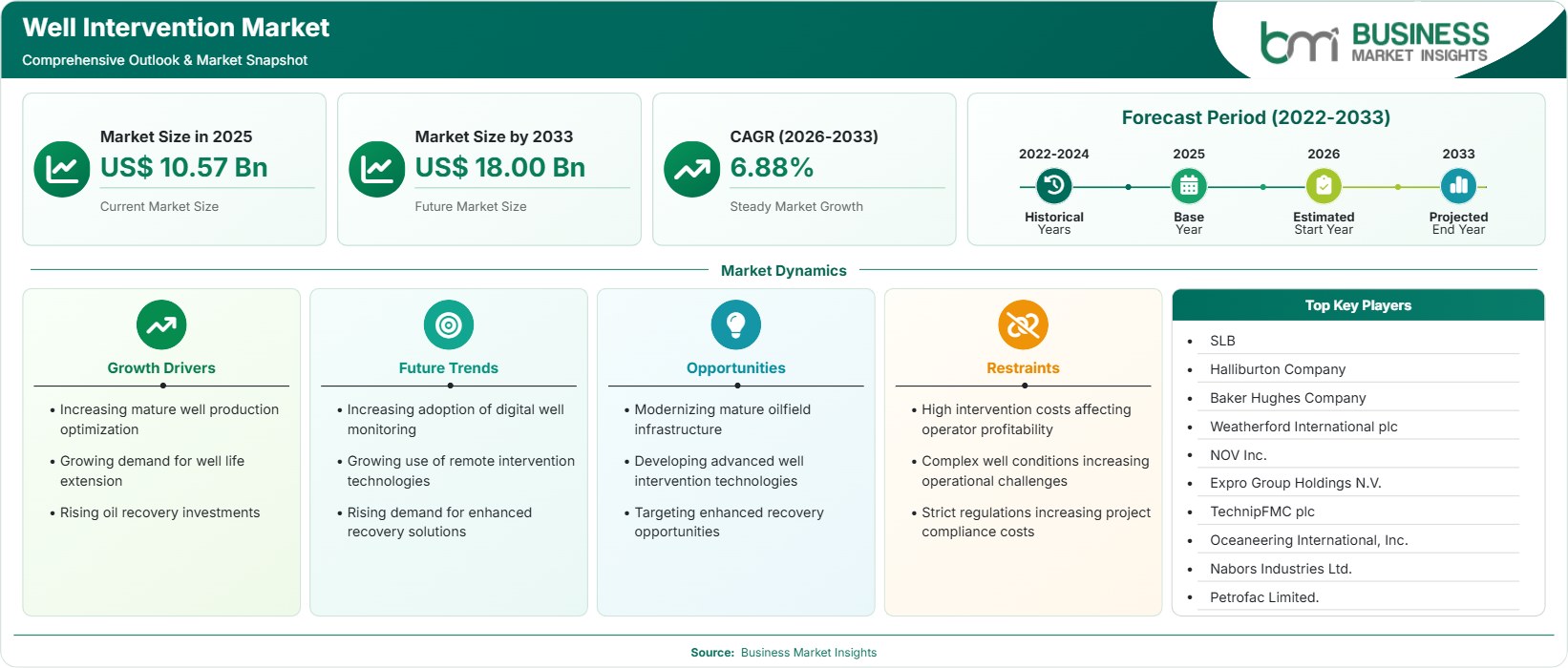
The Well Intervention Market size was valued at US$ 10.57 Billion in 2025 and is projected to reach US$ 18.00 Billion by 2033, growing at a CAGR of 6.88% during 2026–2033. Increasing mature well production optimization activities, growing demand for well life extension, and rising investments in oil recovery enhancement are driving market growth. Technological advancements in intervention services and expanding recovery programs continue creating new opportunities across onshore and offshore assets.

Report Coverage
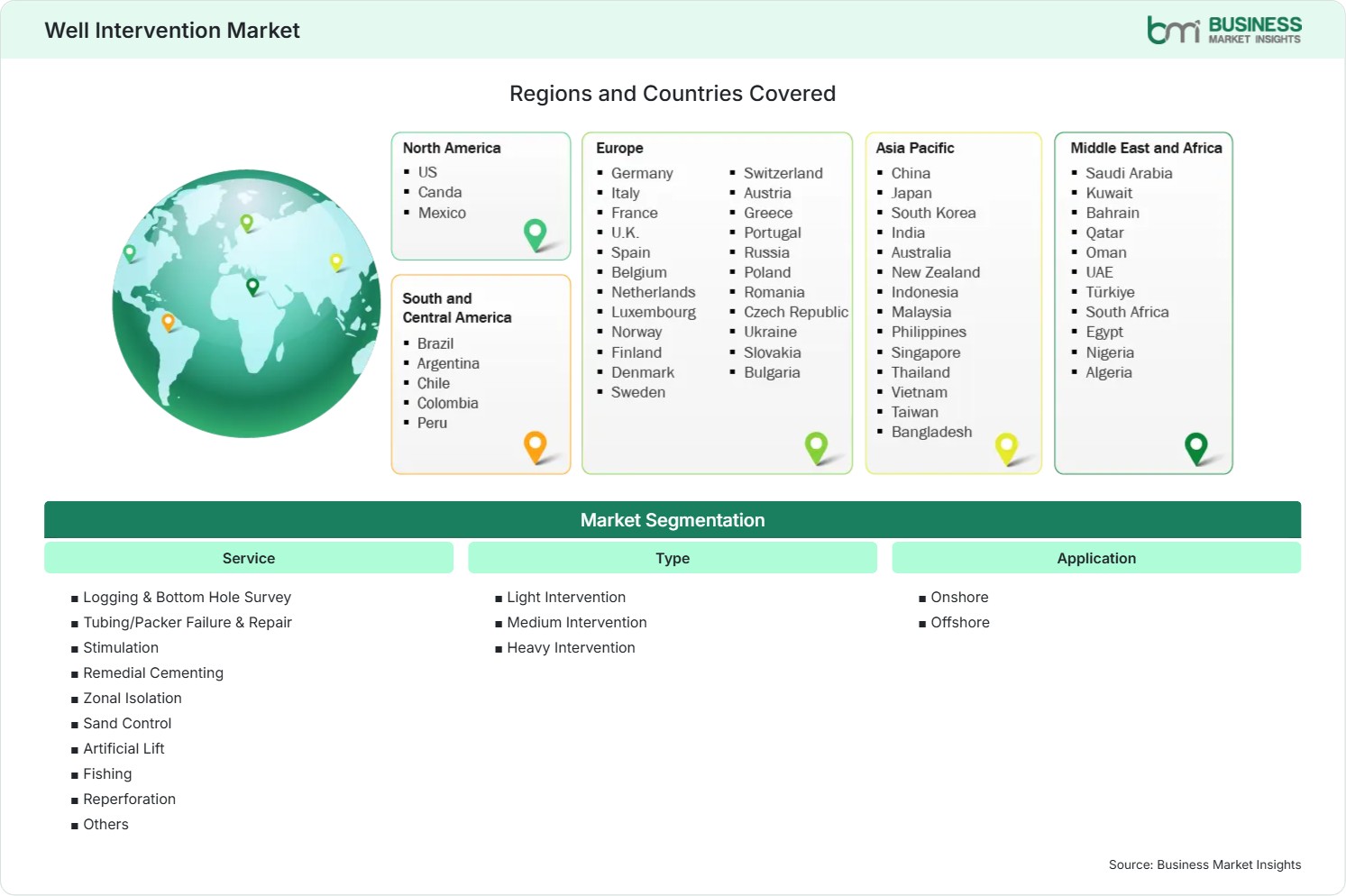
  • Service: Logging & Bottom Hole Survey, Tubing/Packer Failure & Repair, Stimulation, Remedial Cementing, Zonal Isolation, Sand Control, Artificial Lift, Fishing, Reperforation, Others
  • Type: Light Intervention, Medium Intervention, Heavy Intervention
  • Application: Onshore, Offshore
US$ 10.57 Bn Market size in 2025
US$ 18.00 Bn Market Size by 2033
6.88% CAGR, 2026 - 2033
2026-2033 Forecast Period

01 AI Overview

Well Intervention Market Summary

  • North America Region: North America holds 33%–36% share in 2025, growing at a 6.4%–7.0% CAGR during 2026–2033. Strong shale production activity, extensive mature well infrastructure, increasing recovery optimization programs, and growing intervention spending support market expansion. The US market is projected to grow at a 6.5%–7.1% CAGR.
  • Fastest Growing Region: Asia Pacific accounts for 23%–26% share in 2025 and is expected to expand at a 7.5%–8.2% CAGR during 2026–2033. Rising offshore exploration, increasing hydrocarbon production targets, growing energy demand, and investment in well productivity enhancement continue supporting growth.
  • Leading Segment: Onshore represented 66%–69% share in 2025 and is expected to grow at a 6.3%–6.9% CAGR during 2026–2033. Large inventories of producing wells, lower intervention costs, and increasing production maintenance requirements support segment dominance.
  • High Growth Segment: Heavy Intervention accounted for 24%–27% share in 2025 and is projected to register a 7.2%–7.9% CAGR during 2026–2033. Increasing complexity of mature wells and rising requirements for significant well restoration activities continue supporting adoption.
  • Key Market Opportunity: Development of advanced intervention technologies, digital monitoring capabilities, and enhanced recovery solutions is creating considerable opportunities for operators seeking to maximize existing asset productivity.
  • Major Market Players: SLB, Halliburton Company, Baker Hughes Company, Weatherford International plc, NOV Inc., Expro Group Holdings N.V., TechnipFMC plc, Oceaneering International, Inc., Nabors Industries Ltd., Petrofac Limited.
02 Strategic Insights

Well Intervention Market: Strategic Insights

Well Intervention Market Strategic Framework
FREE PDF
Request your free sample
Request free sample
03 Stakeholder View

Key Takeaways

  • Mature field redevelopment programs continue driving demand for intervention services as operators seek to maximize production from existing assets and improve recovery efficiency without significant new drilling expenditure.
  • Offshore intervention projects present significant growth opportunities owing to increasing activity in deepwater and ultra-deepwater developments requiring specialized technologies and advanced service capabilities.
  • Technological innovation is increasingly focused on digital monitoring, advanced coiled tubing solutions, intelligent intervention systems, real-time well diagnostics, and production optimization technologies.
  • Asia Pacific and the Middle East continue presenting attractive investment opportunities due to increased oilfield development, enhanced recovery initiatives, and growing hydrocarbon production targets.
  • Strategic partnerships between service providers and exploration operators are supporting operational efficiency improvements and accelerating deployment of advanced intervention technologies.
  • Companies capable of reducing intervention costs while improving well productivity, operational safety, and recovery performance are expected to strengthen their competitive advantage through 2033.
04 Geographic Outlook

Well Intervention Market Regional Highlights

North America Well Intervention Market

North America accounted for 33%–36% Well Intervention Market share in 2025 and is projected to expand at a 6.4%–7.0% CAGR during 2026–2033. The region remains a leading market due to extensive unconventional oil and gas production, large inventories of mature wells, and continuous investments in production optimization. Operators increasingly utilize intervention services to maintain output, improve reservoir performance, and extend well life. Technological innovation and strong oilfield service infrastructure continue supporting Well Intervention Market growth.

  • Mature shale wells increasingly require intervention solutions to sustain productivity and improve recovery performance.
  • Operators continue investing in well maintenance programs to optimize production and reduce decline rates.
  • Advanced intervention technologies are improving operational efficiency and reducing downtime.
  • Strong oilfield service infrastructure supports rapid deployment of intervention activities.
  • Investment in digital monitoring solutions continues enhancing intervention planning and execution.

US Well Intervention Market

The US represented 80%–84% share within North America in 2025 and is anticipated to register a 6.5%–7.1% CAGR during 2026–2033. Extensive shale activity, large numbers of aging producing wells, and continued emphasis on production optimization support market growth. Operators increasingly focus on intervention programs that improve output while reducing operational costs. Ongoing technological innovation strengthens adoption across major producing basins.

  • Well life extension programs continue generating demand for intervention services across mature assets.
  • Production enhancement strategies are increasing utilization of stimulation and artificial lift services.
  • Operators prioritize cost-effective intervention solutions that improve field economics.
  • Digital technologies continue supporting more efficient well diagnostics and operational planning.

Europe Well Intervention Market

Europe held 22%–25% share in 2025 and is expected to grow at a 6.2%–6.8% CAGR during 2026–2033. Demand is supported by mature offshore oilfields, redevelopment projects, and efforts to maximize production from existing assets. North Sea operators continue investing in intervention services to enhance productivity and extend asset life. Growing emphasis on operational efficiency and recovery optimization continues supporting regional Well Intervention Market growth.

  • The United Kingdom remains a major market supported by extensive offshore intervention activity.
  • Norway continues investing in field optimization and production enhancement solutions.
  • Mature asset redevelopment projects are supporting intervention service demand.
  • Advanced offshore technologies are improving intervention effectiveness and operational efficiency.
  • Recovery optimization remains a key strategic objective for regional operators.

Asia Pacific Well Intervention Market

Asia Pacific accounted for 23%–26% share in 2025 and is projected to expand at a 7.5%–8.2% CAGR during 2026–2033, making it the fastest-growing regional market. Increasing energy demand, rising offshore development activities, and growing investments in mature field management are supporting market growth. National energy companies are focusing on improving recovery rates from existing assets while maximizing production efficiency. Expanding offshore projects and increasing intervention requirements across aging wells continue creating growth opportunities for service providers across the region in Well Intervention Market forecasts.

  • China remains a major market due to extensive hydrocarbon production activities and continued investment in mature field optimization.
  • India is witnessing increased intervention demand supported by production enhancement initiatives and offshore field development.
  • Southeast Asian countries are increasing offshore intervention programs to sustain output from aging reservoirs.
  • National oil companies continue investing in technologies that improve recovery rates and extend well life.
  • Growing adoption of advanced intervention solutions is improving operational efficiency and production performance.

Rest of World Well Intervention Market

Rest of World accounted for 10%–13% share in 2025 and is anticipated to register a 6.7%–7.3% CAGR during 2026–2033. The Middle East remains a critical market due to extensive mature oilfields and major hydrocarbon production operations. Latin America continues generating intervention demand through offshore developments and production optimization projects. Operators across these regions increasingly focus on maximizing output and extending asset lifecycles through advanced intervention solutions in Well Intervention Market.

  • Saudi Arabia and the UAE continue investing heavily in well optimization and production enhancement activities.
  • Brazil remains a significant market due to offshore developments and enhanced recovery initiatives.
  • National oil companies increasingly utilize intervention services to improve production efficiency.
  • Mature field redevelopment projects continue supporting intervention service demand across key producing markets.
  • Advanced reservoir management strategies are creating opportunities for specialized intervention technologies.
Global Market Geography
FREE PDF
Request your free sample
Request free sample
05 Segment Analysis

Well Intervention Market Segmentation

Service

Service accounted for 41%–44% share in 2025 and is projected to grow at a 7.0%–7.6% CAGR during 2026–2033. The Well Intervention Market scope is expanding as operators increasingly prioritize production optimization, well integrity management, and recovery enhancement activities. Demand is supported by mature field redevelopment programs, rising intervention frequency, and growing efforts to maximize production from existing assets while controlling operational costs.

  • Logging & Bottom Hole Survey: Widely used to assess reservoir conditions, monitor well performance, and support intervention planning.
  • Tubing/Packer Failure & Repair: Essential for maintaining well integrity and restoring production efficiency in aging assets.
  • Stimulation: Increasingly adopted to improve reservoir productivity and enhance hydrocarbon flow rates.
  • Remedial Cementing: Supports zonal isolation, well integrity improvement, and prevention of fluid migration.
  • Zonal Isolation: Critical for controlling unwanted fluid movement and improving reservoir management.
  • Sand Control: Helps prevent formation damage and maintain consistent production performance.
  • Artificial Lift: Growing demand due to increasing requirements for production enhancement in mature wells.
  • Fishing: Supports retrieval of lost or damaged equipment from wellbores.
  • Reperforation: Enables access to bypassed hydrocarbon zones and improves

Type

Type represented 32%–35% share in 2025 and is expected to expand at a 7.2%–7.9% CAGR during 2026–2033. Increasing complexity of mature wells and the need for effective well restoration programs are supporting intervention demand. Operators continue selecting intervention methods based on well conditions, reservoir characteristics, and production objectives to maximize operational efficiency and economic returns.

  • Light Intervention: Commonly used for routine maintenance, diagnostics, and production monitoring activities.
  • Medium Intervention: Supports corrective work, production enhancement, and mechanical repairs requiring moderate equipment deployment.
  • Heavy Intervention: Increasingly utilized for major well restoration projects, extensive repairs, and complex production optimization activities.

Application

Application accounted for 66%–69% share in 2025 and is forecast to register a 6.3%–6.9% CAGR during 2026–2033. The Well Intervention Market trends highlight sustained demand from onshore fields due to the large number of producing wells worldwide. Offshore developments are also generating strong opportunities as operators invest in maximizing productivity from high-value offshore assets.

  • Onshore: Remains the dominant application category due to broad field coverage, lower service costs, and extensive mature well inventories.
  • Offshore: Experiences strong growth driven by increased intervention activity in deepwater and mature offshore production assets.
06 Market Forces

Well Intervention Market Dynamics

Key Market Drivers

Increasing mature well production optimization

The increasing number of aging oil and gas wells worldwide is driving demand for intervention services to ensure efficient production and maximize hydrocarbon recovery. Many operators are focusing on mature field management initiatives to prolong well life and improve performance, rather than investing solely in drilling. Well interventions include various operations such as stimulation, installation of artificial lift systems, re-perforation, and remediation, which will be useful in addressing declining well production and improving well performance. Mature fields will continue to play an important role in global hydrocarbon production, and increasing amounts of investment will be made in intervention activities.

Growing demand for well life extension

There has been a trend among oil and gas firms toward seeking ways to maximize the service life of their productive wells to enhance profitability and ensure optimal utilization of the resources at hand. Well intervention services offer efficient ways to address any challenges that may arise during extraction. Services such as tubing repair, zonal isolation, sand control, and remedial cementing help to prolong the productive life of the wells while avoiding the costs associated with well abandonment. As companies look for ways to maximize their current facilities amid uncertain energy prices and capital management, the market for life-extension services will continue to expand throughout the forecast period.

Rising oil recovery investments

The increasing emphasis on improved recovery techniques is making significant contributions to market development. The operators are adopting intervention techniques to make the reservoir more accessible, boost hydrocarbon production, and ensure maximum recovery. The rising demand for energy, along with the need to maximize output from available resources, is leading companies to focus more on intervention and recovery technologies. Advanced intervention solutions are playing an important role in enhancing oil recovery efforts by improving well performance and accessing bypassed resources.

Key Market Opportunities

Modernizing mature oilfield infrastructure

Mature oilfields across major producing regions present substantial opportunities for intervention service providers. Many aging assets require modernization programs that improve production efficiency, strengthen well integrity, and extend field life. Operators are increasingly investing in infrastructure upgrades, reservoir management improvements, and advanced intervention solutions to maximize economic returns from existing assets. These projects often involve extensive intervention activities designed to enhance productivity and reduce operational challenges. As companies continue focusing on production optimization rather than large-scale greenfield developments, opportunities associated with mature oilfield modernization are expected to increase significantly through 2033.

Developing advanced well intervention technologies

Technological innovation continues to create attractive growth opportunities within the industry. Service providers are investing in advanced intervention tools, digital monitoring systems, intelligent diagnostics, and automated service solutions that improve operational efficiency and reduce risk. Modern technologies enable more accurate well assessments, faster intervention execution, and improved production outcomes. Digitalization is also supporting predictive maintenance and real-time decision-making capabilities. Companies that successfully commercialize innovative intervention technologies capable of reducing costs and enhancing performance are expected to benefit from increasing operator demand for efficient and reliable intervention solutions across complex well environments.

Targeting enhanced recovery opportunities

The trend of enhanced recovery programs continues to grow worldwide in developed oil and gas fields. Oil companies require modern intervention services for better access to reservoirs, increased production rates, and maximum possible extraction. In old oilfields with emphasis on recovery optimization, this issue is especially relevant. Services for artificial lifting, stimulation, reperforation, and zone isolation are becoming more popular to improve the efficiency of oilfields. The industry will continue to require such services, with a high likelihood of profitable cooperation in the long term.

Market Restraints and Challenges

High intervention costs affecting operator profitability

Factor: Well intervention projects often require specialized equipment, highly skilled personnel, extensive planning, and sophisticated technologies. Offshore interventions in particular can involve substantial mobilization and operational expenses. Impact: Elevated intervention costs can affect project economics and reduce operator profitability, especially during periods of volatile oil prices. Smaller operators may postpone intervention activities when cost structures become difficult to justify. Service providers face increasing pressure to improve efficiency and deliver measurable production gains that support favorable investment returns. Managing costs while maintaining operational quality remains a major industry challenge.

Complex well conditions increasing operational challenges

Factor: Many intervention projects involve aging wells, difficult reservoir conditions, high-pressure environments, and technical complications that increase execution complexity. Deepwater and mature offshore assets often present particularly demanding operating conditions. Impact: Complex well conditions can increase project timelines, operational risks, and service costs. Unexpected technical issues may affect intervention effectiveness and overall production outcomes. Service providers must continuously develop advanced technologies and technical expertise to manage challenges effectively. Ensuring safe and efficient operations in complex well environments remains critical for maintaining profitability and supporting broader market growth.

07 Company Analysis

Competitive Landscape

The Well Intervention Market analysis highlights a competitive environment characterized by technological advancement, operational efficiency, integrated well services, and the ability to improve asset productivity across mature and producing wells. Market participants are focusing on expanding intervention capabilities, enhancing reservoir recovery rates, reducing operational downtime, and developing advanced solutions for complex onshore and offshore well environments. Strategic investments in digital technologies, intervention equipment modernization, and integrated service offerings continue strengthening competitive positioning across global oil and gas markets.

Company Name

Overview

Products and Services Relevant to the Market

SLB

Global oilfield technology leader with extensive intervention and production optimization capabilities.

Well intervention services, stimulation, logging, artificial lift, production enhancement solutions.

Halliburton Company

Major energy services provider supporting intervention and asset optimization activities globally.

Intervention technologies, coiled tubing, cementing, stimulation, reservoir management solutions.

Baker Hughes Company

Energy technology company offering integrated intervention and production services.

Well diagnostics, intervention systems, production optimization and integrity solutions.

Weatherford International plc

Oilfield service company focused on maximizing well productivity and asset performance.

Artificial lift, intervention technologies, fishing services, stimulation solutions.

NOV Inc.

Provider of equipment and technologies supporting intervention and well maintenance activities.

Intervention systems, completion technologies, well service equipment.

Expro Group Holdings N.V.

Energy services company specializing in well access and intervention solutions.

Well intervention, integrity services, production support technologies.

TechnipFMC plc

Engineering and technology provider supporting offshore and subsea intervention projects.

Subsea intervention systems, offshore production support services.

Oceaneering International, Inc.

Offshore service provider with specialized intervention capabilities.

Subsea intervention, inspection, well maintenance and offshore support services.

Nabors Industries Ltd.

Drilling and production technology company supporting field optimization.

Well services, intervention support, production enhancement solutions.

Petrofac Limited

Energy infrastructure and services provider serving global oil and gas markets.

Well engineering, intervention services, production optimization support.

10 Trust & Transparency

Research Methodology

The market analysis combines proprietary research with secondary data from government agencies, company disclosures, regulatory filings, industry databases and expert interviews. Market estimates are validated through data triangulation, cross-market benchmarking and analyst review.

View Full Research Methodology

11 Questions Answered

Frequently Asked Questions

What are the primary challenges affecting market growth?

High intervention costs, complex well conditions, operational risks, offshore project complexities, and fluctuating oil and gas investment cycles remain major challenges for market participants.

Which region leads the Well Intervention Market report?

North America leads the market owing to extensive shale production, mature well inventories, advanced oilfield service infrastructure, and strong investment in production optimization technologies.

Why is heavy intervention showing strong growth?

Heavy intervention is growing because aging wells increasingly require extensive repair, restoration, and production enhancement activities to sustain output and extend operational life.

Which application segment dominates the market?

Onshore remains the leading segment due to the large number of producing wells, lower intervention costs, broad geographic deployment, and continued production optimization requirements.

What is driving growth in the Well Intervention Market?

The market is driven by increasing mature well production optimization activities, growing demand for well life extension, rising investment in oil recovery programs, and the need to maximize production from existing assets.

Access the Full Well Intervention Market Report

Get segment-level forecasts, regional estimates, competitive benchmarking, company profiles and downloadable Excel datasets.

Access the full Well Intervention Market Report
350 pages PDF & Excel | 2026-08-24