
Web Hosting Services Market Outlook: Size, Share, Trends, Growth Analysis, Competitive Landscape & Forecast, 2026-2033

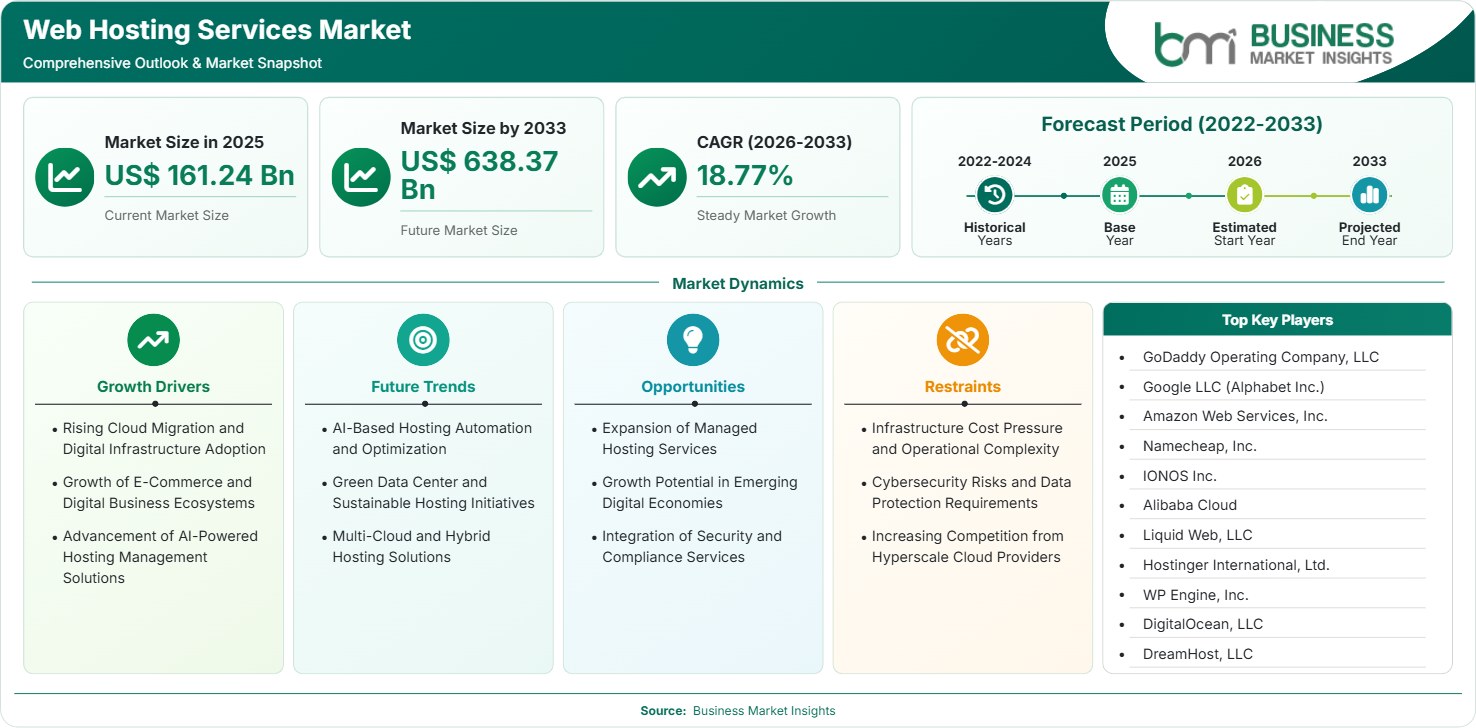
The Web Hosting Services Market size was valued at US$ 161.24 Billion in 2025 and is projected to reach US$ 638.37 Billion by 2033, growing at a CAGR of 18.77% during 2026–2033, driven by cloud adoption, digital transformation, AI-powered infrastructure, enterprise migration, and scalable online services.

Report Coverage
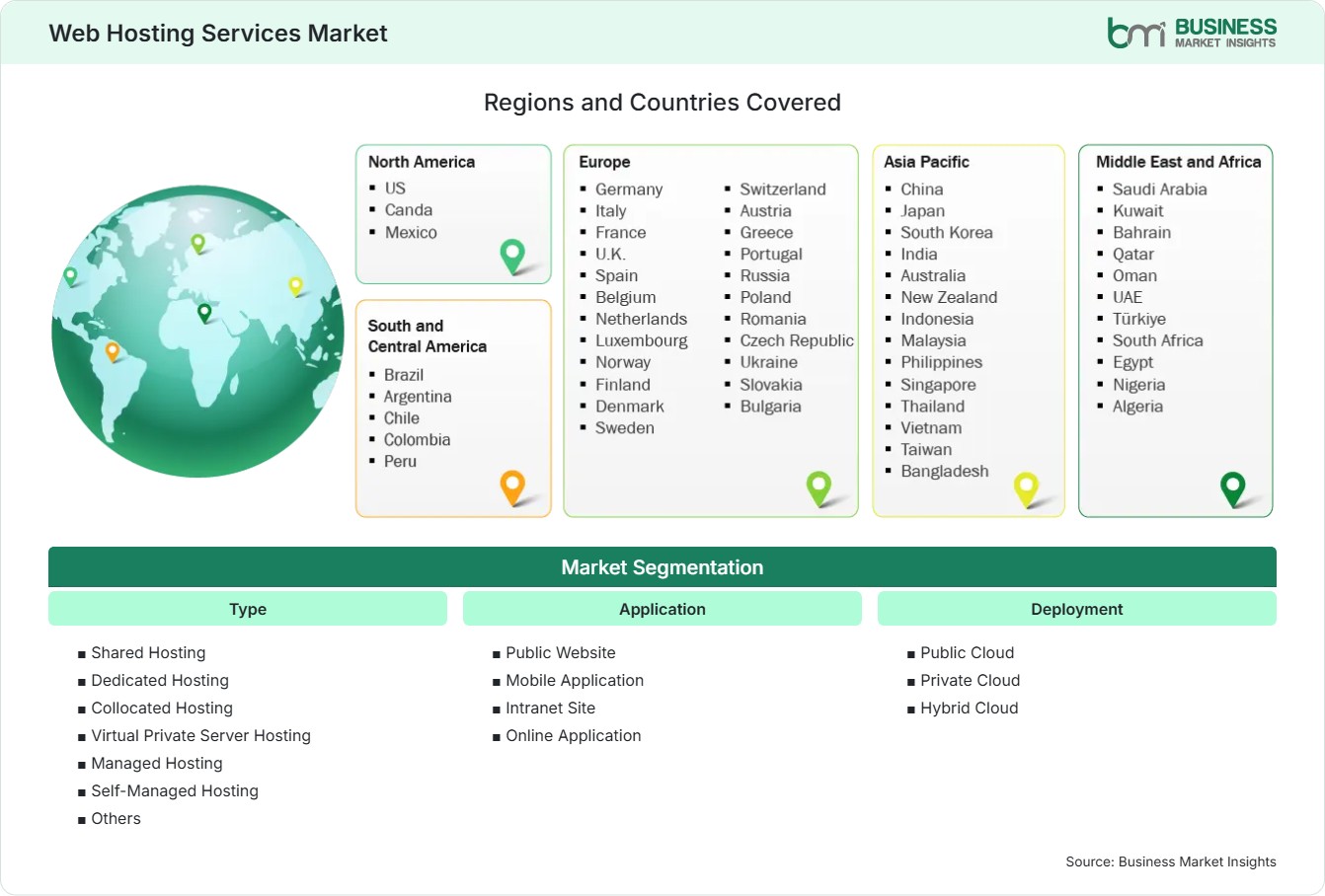
  • Type: Shared Hosting, Dedicated Hosting, Collocated Hosting, Virtual Private Server Hosting, Managed Hosting, Self-Managed Hosting, Others
  • Application: Public Website, Mobile Application, Intranet Site, Online Application
  • Deployment: Public Cloud, Private Cloud, Hybrid Cloud
US$ 161.24 Bn Market size in 2025
US$ 638.37 Bn Market Size by 2033
18.77% CAGR, 2026 - 2033
2026-2033 Forecast Period

AI Overview

Web Hosting Services Market Summary

  • North America Region: North America holds market share of 35%–38% in 2025, growing with a CAGR of 17%–19% influenced by enterprise cloud migration, cybersecurity investments, digital commerce expansion, and AI infrastructure demand. The US market analysis indicates a CAGR of 17%–19% between 2026–2033, supported by hyperscale providers, SaaS growth, and advanced hosting ecosystems.
  • Fastest Growing Region: Asia Pacific maintains market share of 28%–31% in 2025, expanding with a CAGR of 21%–23% driven by internet penetration, startup ecosystems, mobile-first applications, cloud investments, and government digitalization initiatives across emerging economies.
  • Leading Segment: Shared Hosting accounts for market share of 32%–35% in 2025, progressing with a CAGR of 15%–17% supported by small business adoption, affordable website deployment, managed tools, and increasing demand among independent online creators.
  • High Growth Segment: Virtual Private Server Hosting represents market share of 22%–25% in 2025, advancing with a CAGR of 20%–22% due to flexible resources, improved performance requirements, developer adoption, and scalable workloads.
  • Key Market Opportunity: Increasing enterprise reliance on cloud-native applications, AI workloads, edge computing, and digital platforms creates opportunities for providers offering automated management, enhanced security, and performance optimization services.
  • Major Market Players: Second Section – GoDaddy Operating Company, LLC, Google LLC (Alphabet Inc.), Amazon Web Services, Inc., Namecheap, Inc., IONOS Inc., Alibaba Cloud, Liquid Web, LLC, Hostinger International, Ltd., WP Engine, Inc., Digital Ocean, LLC, and Dream Host, LLC.
Strategic Insights

Web Hosting Services Market: Strategic Insights

Web Hosting Services Market Strategic Framework
FREE PDF
Request your free sample
Request free sample
Stakeholder View

Key Takeaways

  • There is a trend whereby the ecosystem is changing from basic hosting providers to digital infrastructure platforms offering domains, security, cloud computing, analytics, and application management services. Service providers with diversified service offerings are likely to enjoy greater customer lifetime value.
  • There is increased demand for managed hosting, VPS hosting, and cloud hosting as corporations need to achieve better reliability, scalability, and ease of operation for websites and online applications.
  • There is need for innovation by the providers as they will focus more on AI-driven resource allocation, automated troubleshooting, and security improvement.
  • Asia-Pacific region is a very good area for investment because of the increase in internet users, growth in digital entrepreneurship and cloud hosting in places like India, China, and other emerging nations. There is an increase in consolidation as providers improve their capabilities through partnering, platform building, and acquiring firms that are specialized in cloud infrastructure, security, and developer hosting services.
Geographic Outlook

Web Hosting Services Market Regional Highlights

North America Web Hosting Services Market

North America accounted for a 35%–38% share in 2025 and is projected to expand at a CAGR of 17%–19% during 2026–2033. The region benefits from mature cloud infrastructure, enterprise technology adoption, and strong presence of global hosting providers. The Web Hosting Services Market share remains concentrated among established platforms serving businesses of all sizes.

  • Migration to enterprise clouds is steadily picking pace since companies migrate from traditional infrastructure to scalable hosting systems that provide better reliability and automation.
  • The USA is still the major contributor to growth owing to advanced digital ecosystems, increased software usage, and the demands of technology firms.
  • The integration of cybersecurity is becoming a critical competitive advantage for companies that prefer secure hosting environments and meet the regulations.
  • Hosting management services powered by AI are becoming increasingly popular among hosting service providers.

US Web Hosting Services Market

The United States represented a 30%–33% share within North America in 2025 and is estimated to grow at a CAGR of 17%–19% from 2026–2033. The market benefits from extensive cloud infrastructure, enterprise digitization, and a large base of online businesses. The Web Hosting Services Market growth is supported by SaaS expansion and developer-focused hosting solutions.

  • Leading cloud providers continue investing in data centers, improving availability zones, computing capacity, and hosting performance for enterprise customers.
  • Small and medium businesses increasingly adopt managed hosting services to reduce technical complexity and improve operational efficiency.
  • Demand for secure hosting environments is increasing due to rising cyber threats and stronger compliance expectations.
  • Digital commerce expansion continues creating demand for reliable website infrastructure and application hosting services.

Europe Web Hosting Services Market

Europe accounted for a 24%–27% share in 2025 and is forecast to register a CAGR of 16%–18% during 2026–2033. Germany, the United Kingdom, and France represent leading markets, while Eastern European countries show higher expansion potential due to digital transformation initiatives. Data privacy requirements and regional cloud strategies influence hosting adoption.

  • Germany demonstrates strong demand through enterprise hosting requirements, industrial digitalization, and preference for compliant infrastructure solutions.
  • The United Kingdom benefits from advanced online businesses, fintech ecosystems, and growing cloud application deployment.
  • France is expanding through government digital programs and increased enterprise adoption of managed infrastructure services.
  • European providers emphasize data sovereignty, sustainability, and compliance-focused hosting solutions.
  • Emerging Eastern European markets are attracting investments due to skilled technology workforces and growing online enterprises.

Asia Pacific Web Hosting Services Market

Asia Pacific generated a 28%–31% share in 2025 and is projected to grow at a CAGR of 21%–23% between 2026–2033. China, India, Japan, and Southeast Asian economies are major contributors. The region demonstrates strong Web Hosting Services Market trends through digital entrepreneurship, mobile applications, and cloud infrastructure expansion.

  • China maintains significant demand through large internet platforms, cloud investments, and expanding enterprise digital services.
  • India represents a high-growth market due to startups, online businesses, government digital initiatives, and increasing technology adoption.
  • Southeast Asian countries are experiencing rising hosting demand through e-commerce growth and SME digitalization.
  • Japan continues adopting advanced hosting solutions driven by enterprise modernization and automation requirements.
  • Regional cloud investments are increasing as businesses seek scalable infrastructure and localized services.

Rest of World Web Hosting Services Market

Rest of World accounted for a 9%–12% share in 2025 and is expected to grow at a CAGR of 19%–21% during 2026–2033. South and Central America are expanding through online business growth, while Middle East and Africa markets benefit from digital transformation programs and infrastructure investment.

  • Brazil and Mexico lead Latin American adoption through expanding e-commerce, digital businesses, and cloud service requirements.
  • Middle Eastern countries are investing in data infrastructure, smart city initiatives, and enterprise digital platforms.
  • African markets demonstrate potential through increasing connectivity, mobile adoption, and online entrepreneurship.
  • Government technology programs are supporting demand for secure and scalable hosting environments.
  • Regional providers are developing localized solutions to address pricing, compliance, and performance requirements.
Global Market Geography
FREE PDF
Request your free sample
Request free sample
Segment Analysis

Web Hosting Services Market Segmentation

Type

The Type segment represents the foundation of hosting service adoption, covering diverse infrastructure models used by businesses and individuals. It accounted for 2025 market distribution based on service flexibility, cost requirements, and performance needs. The segment is projected to expand at varying rates through 2033 as customers increasingly transition toward managed and scalable solutions.

  • Shared Hosting: Shared Hosting remains widely adopted among small businesses, individuals, and entry-level websites due to affordability, simplified management, and bundled website creation features supporting digital presence expansion.
  • Dedicated Hosting: Dedicated Hosting serves enterprises requiring exclusive server resources, enhanced control, improved security, and customized configurations for demanding workloads and mission-critical applications.
  • Collocated Hosting: Collocated Hosting enables organizations to place owned hardware within professional facilities, supporting businesses requiring infrastructure control, reliability, and specialized operational management.
  • Virtual Private Server Hosting: Virtual Private Server Hosting provides isolated resources with improved flexibility compared with shared environments, supporting developers, growing businesses, and applications requiring scalable performance.
  • Managed Hosting: Managed Hosting delivers operational support, monitoring, maintenance, and optimization services, helping organizations reduce technical workload while improving hosting reliability and security.
  • Self-Managed Hosting: Self-Managed Hosting allows technical users to control configurations, software installations, and infrastructure decisions while requiring greater internal expertise for maintenance.

By Application

Application-based adoption reflects increasing reliance on online platforms, digital services, and connected business operations. The segment is influenced by enterprise modernization, consumer internet growth, and application complexity. The market scope expands as organizations deploy websites, mobile applications, and internal digital systems requiring dependable hosting infrastructure.

  • Public Website: Public Website hosting supports businesses, organizations, and individuals requiring online visibility, content delivery, customer engagement, and digital commerce capabilities.
  • Mobile Application: Mobile Application hosting demand is increasing through app-based services, API integration, and scalable backend requirements supporting growing smartphone usage.
  • Intranet Site: Intranet Site hosting enables internal communication, employee collaboration, and secure organizational information sharing across distributed workforces.
  • Online Application: Online Application hosting supports cloud-based platforms, SaaS products, and interactive services requiring reliable performance, scalability, and continuous availability.

By Deployment

Deployment models define infrastructure flexibility, security preferences, and operational approaches adopted by organizations. Businesses increasingly evaluate hosting environments based on workload requirements, compliance considerations, and scalability objectives. The market trends indicate rising adoption of cloud deployment models through enterprise modernization initiatives.

  • Public Cloud: Public Cloud deployment provides scalable resources, cost efficiency, and rapid provisioning, making it suitable for businesses requiring flexible infrastructure without significant capital investment.
  • Private Cloud: Private Cloud deployment supports organizations requiring enhanced security, compliance control, and dedicated infrastructure management for sensitive workloads and regulated applications.
  • Hybrid Cloud: Hybrid Cloud deployment combines public and private environments, allowing organizations to optimize performance, security, and operational flexibility across different workloads.
Market Forces

Web Hosting Services Market Dynamics

Key Market Drivers

Rising Cloud Migration and Digital Infrastructure Adoption

The expansion of cloud-based operations is a major driver shaping the Web Hosting Services Market growth as organizations seek scalable, cost-efficient, and resilient infrastructure. Global cloud spending continues increasing as enterprises modernize legacy systems and deploy digital applications. According to industry analyses, cloud infrastructure services have maintained double-digit annual growth rates as businesses prioritize flexibility and operational efficiency. The transition from traditional hosting toward cloud-enabled platforms supports demand for managed environments, automated resource allocation, and integrated security solutions. These trends are strengthened by increasing adoption among small businesses, developers, and enterprises requiring reliable online operations.

Growth of E-Commerce and Digital Business Ecosystems

With an increasing number of online transactions, the need for reliable web hosting facilities increases. Increase in global internet usage and digitization in business is compelling organizations to create a strong web presence in the form of websites and apps. Businesses will be requiring web hosting services that can accommodate variable traffic, security and performance of the applications and websites. The Web Hosting Services market growth is supported by the increase in the number of startups, sole proprietors and enterprises using digital mediums.

Advancement of AI-Powered Hosting Management Solutions

The technology of artificial intelligence is revolutionizing the process of hosting services through predictive monitoring, optimization, and effective security management. AI technology is being adopted by hosting providers to detect any problem areas and optimize the server performance along with offering better support to customers. Such technologies have given rise to differentiated service offers rather than merely providing access to infrastructure. AI automation decreases complexities and increases reliability for organizations that lack technical expertise. There is a growing trend in the market that favors intelligent infrastructure platforms.

Key Market Opportunities

Expansion of Managed Hosting Services

Managed hosting represents a strong opportunity as organizations increasingly outsource infrastructure administration, monitoring, and security responsibilities. Businesses seeking operational efficiency are adopting service models that reduce internal technology requirements while improving platform reliability. The opportunity is particularly relevant among small and medium enterprises requiring enterprise-grade capabilities without extensive technical teams. Providers can strengthen market positioning by developing specialized managed solutions for e-commerce, SaaS platforms, and application-intensive businesses. The Web Hosting Services Market Forecasts indicate continued opportunity for companies offering automation, cybersecurity integration, and performance optimization services.

Growth Potential in Emerging Digital Economies

Opportunities exist for emerging markets because of growing levels of internet penetration, startups, and digitization programs by governments. Markets throughout the Asia Pacific, Latin America, and Africa regions are putting more money into connecting and cloud computing infrastructure. Domestic companies are using web pages, mobile applications, and online platforms to increase their audience. Hosting providers can address demand with local products, regional data centers, pricing systems, and ecosystem technology partnerships. Growing numbers of digital entrepreneurship create opportunities for providers who can facilitate the scaling of infrastructure needs.

Integration of Security and Compliance Services

Cybersecurity issues that are on the rise provide possibilities for hosting companies to use their advantages in terms of cybersecurity. Businesses need such solutions that will ensure protection against malware, automatic data backup, identity management, and compliance with regulations. Regulations for data protection in different geographical locations drive organizations to choose such hosting companies that offer better security services. Hosting companies that integrate infrastructure with cybersecurity will be able to maintain customer loyalty and offer more valuable services.

Market Restraints and Challenges

Infrastructure Cost Pressure and Operational Complexity

Factor: Rising infrastructure investment requirements create cost pressure for hosting providers. Impact: Companies face challenges maintaining competitive pricing while investing in data centers, energy efficiency, cybersecurity, and advanced technologies. Building reliable infrastructure requires significant capital expenditure, particularly as customers demand higher availability, faster performance, and geographically distributed services. Smaller providers may experience difficulty competing with global cloud companies possessing extensive resources and established ecosystems. Operational complexity also increases as hosting businesses manage hardware upgrades, network optimization, compliance requirements, and evolving customer expectations across multiple markets.

Cybersecurity Risks and Data Protection Requirements

Factor: Rising cyber threats and increasing demands on data protection raise problems.

Impact: It is necessary for hosting service providers to constantly enhance their security measures, compliance programs, and monitoring procedures in order to preserve the trust of their customers. Any cyber threats toward web sites, applications, and cloud computing may influence the performance and reputation of the company. The regulations connected with the processing of data and data localization impose the changes in infrastructure strategies for different regions.

Company Analysis

Competitive Landscape

The Web Hosting Services Market analysis indicates a competitive environment shaped by global cloud providers, domain specialists, managed hosting companies, and developer-focused infrastructure platforms. Companies compete through pricing strategies, security capabilities, automation features, geographic expansion, and integrated digital services.

Company Name

Overview

Products and Services relevant to this market

GoDaddy Operating Company, LLC

Global domain and hosting provider serving individuals, small businesses, and enterprises through digital presence solutions.

Website hosting, managed WordPress hosting, domain services, website builders, security tools, and online business solutions.

Google LLC (Alphabet Inc.)

Technology leader providing cloud infrastructure and digital platforms supporting global application hosting requirements.

Google Cloud hosting, virtual machines, managed databases, cloud storage, application deployment, and infrastructure services.

Amazon Web Services, Inc.

Leading cloud infrastructure provider offering scalable computing and hosting capabilities worldwide.

Cloud hosting, Amazon EC2, storage services, databases, application hosting, and developer infrastructure solutions.

Namecheap, Inc.

Domain registration and hosting company serving individuals, startups, and small businesses globally.

Shared hosting, VPS hosting, dedicated servers, domain management, SSL certificates, and website solutions.

IONOS Inc.

Hosting and cloud services provider focused on businesses requiring scalable digital infrastructure.

Web hosting, cloud servers, managed applications, domain services, and business infrastructure solutions.

Alibaba Cloud

Cloud computing provider supporting businesses with infrastructure services across global markets.

Cloud hosting, computing resources, storage, databases, security services, and enterprise cloud solutions.

Liquid Web, LLC

Managed hosting specialist serving professional users and businesses requiring high-performance infrastructure.

Managed VPS hosting, dedicated servers, cloud hosting, WordPress hosting, and application management services.

Hostinger International, Ltd.

Hosting provider focused on affordable digital solutions for individuals and growing businesses.

Shared hosting, cloud hosting, VPS services, website builders, domain services, and managed solutions.

WP Engine, Inc.

Managed WordPress platform supporting businesses requiring optimized website performance.

Managed WordPress hosting, WooCommerce hosting, security services, performance optimization, and developer tools.

Digital Ocean, LLC

Cloud infrastructure provider serving developers and technology businesses globally.

Cloud hosting, virtual servers, Kubernetes services, databases, storage, and developer infrastructure platforms.

Dream Host, LLC

Web hosting company offering website solutions for individuals and businesses.

Shared hosting, managed WordPress hosting, VPS hosting, dedicated servers, domains, and website services.

Trust & Transparency

Research Methodology

The market analysis combines proprietary research with secondary data from government agencies, company disclosures, regulatory filings, industry databases and expert interviews. Market estimates are validated through data triangulation, cross-market benchmarking and analyst review.

View Full Research Methodology

Questions Answered

Frequently Asked Questions

What is driving competitive differentiation among hosting providers?

Providers are differentiating through cybersecurity services, automation, managed solutions, performance optimization, geographic availability, and integrated digital tools that improve customer outcomes.

Which deployment model is gaining enterprise attention?

Hybrid cloud deployment is gaining attention because it combines flexibility, security, and workload optimization. Organizations use hybrid environments to balance operational control with scalable cloud resources.

How are small businesses influencing hosting adoption?

Small businesses are increasing adoption through affordable hosting packages, website builders, and managed solutions that enable digital presence without requiring extensive technical expertise.

What role does artificial intelligence play in hosting services?

Artificial intelligence supports automated monitoring, predictive maintenance, security enhancement, and resource optimization. Hosting providers increasingly integrate AI capabilities to improve operational efficiency and customer experience.

What factors are increasing demand for hosting services globally?

The Web Hosting Services Market report highlights that growing digital business adoption, cloud migration, e-commerce expansion, and application-based services are increasing demand for scalable infrastructure. Businesses require reliable platforms supporting websites, applications, and online operations with improved security and performance capabilities.

Access the Full Web Hosting Services Market Report

Get segment-level forecasts, regional estimates, competitive benchmarking, company profiles and downloadable Excel datasets.

Access the full Web Hosting Services Market Report
350 pages PDF & Excel | 2026-08-18