
Vacuum Evaporators Market Outlook: Size, Share, Trends, Growth Analysis, Competitive Landscape & Forecast, 2026-2033

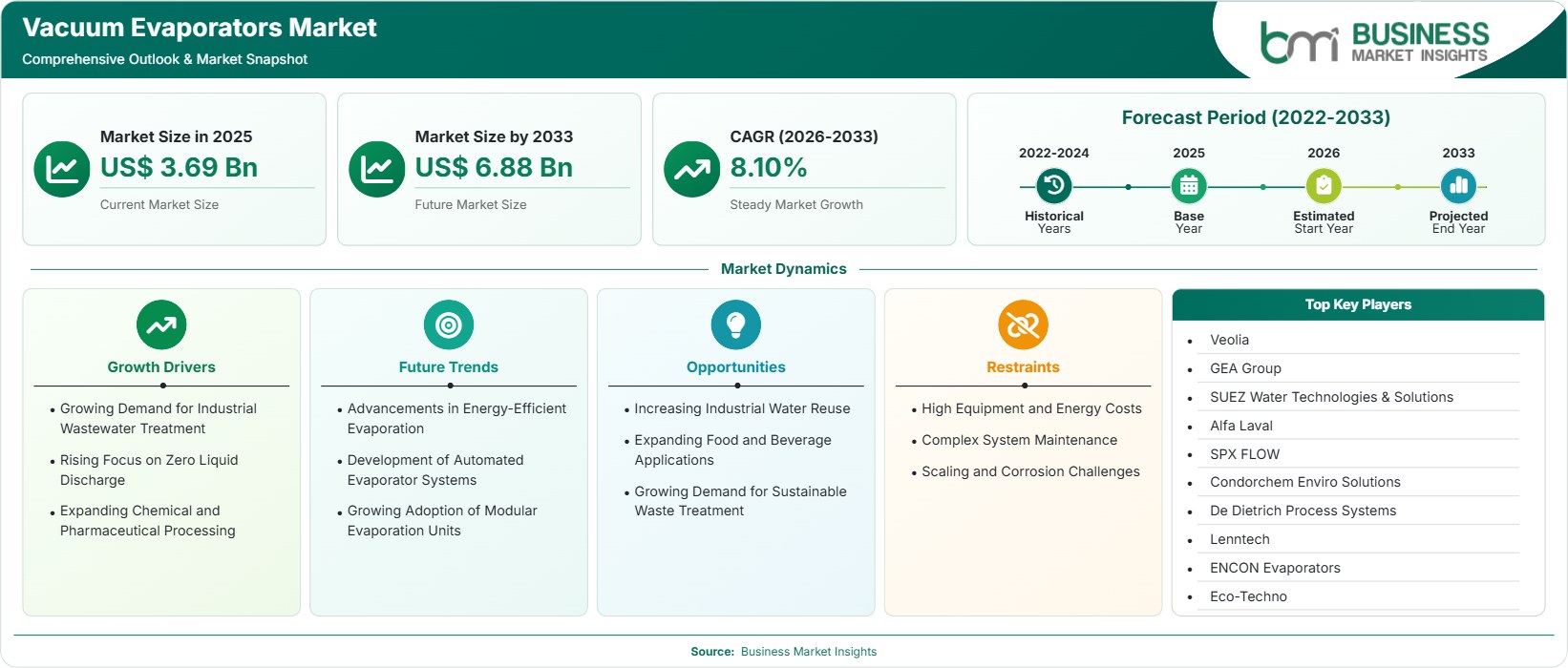
The Vacuum Evaporators Market size was valued at US$ 3.69 Billion in 2025 and is projected to reach US$ 6.88 Billion by 2033, growing at a CAGR of 8.10% during 2026–2033, supported by industrial wastewater treatment investments, zero liquid discharge adoption, resource recovery initiatives, stricter environmental compliance requirements, and increasing demand for sustainable process optimization technologies.

Report Coverage
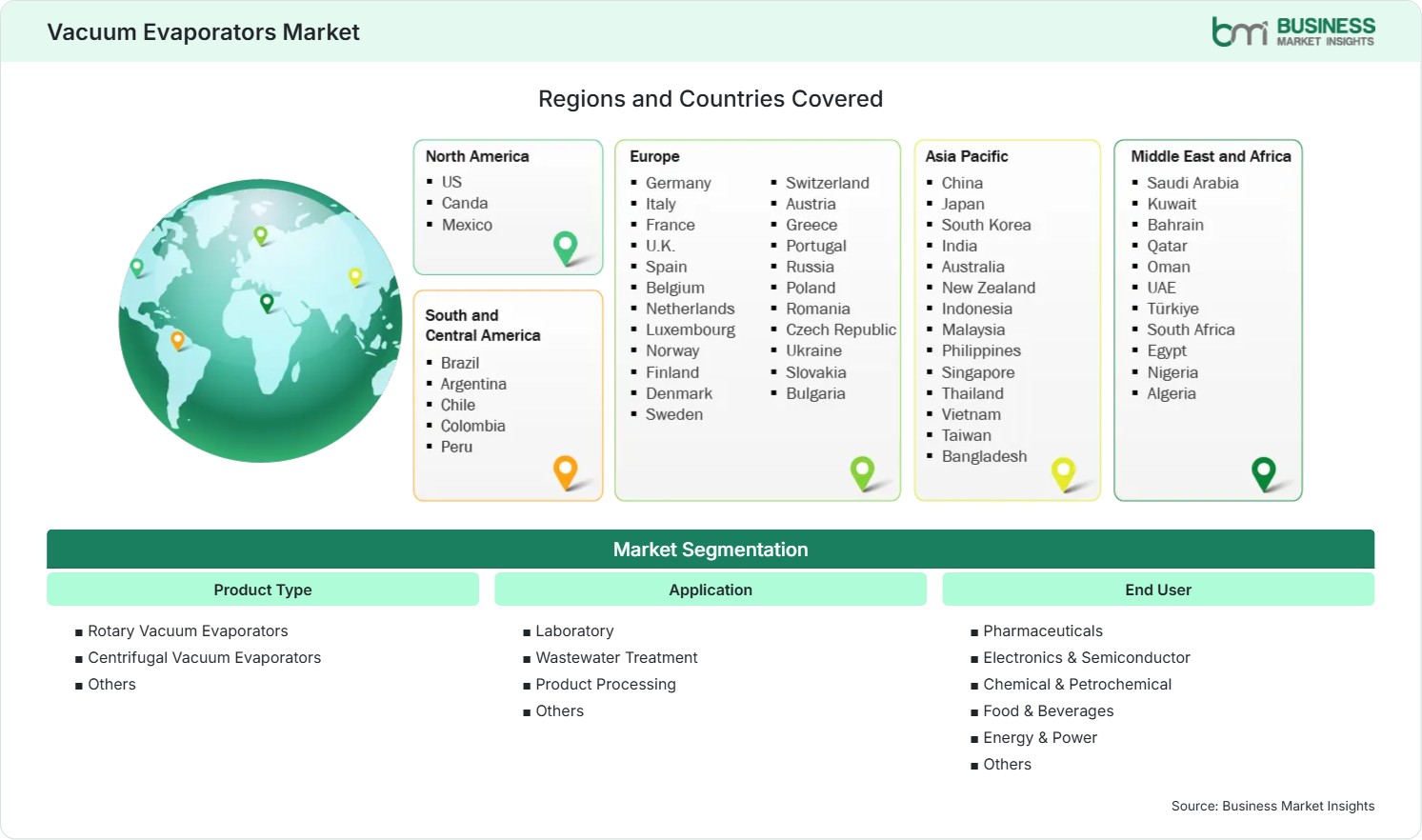
  • Product Type: Rotary Vacuum Evaporators, Centrifugal Vacuum Evaporators, Others
  • Application: Laboratory, Wastewater Treatment, Product Processing, Others
  • End User: Pharmaceuticals, Electronics & Semiconductor, Chemical & Petrochemical, Food & Beverages, Energy & Power, Others
US$ 3.69 Bn Market size in 2025
US$ 6.88 Bn Market Size by 2033
8.10% CAGR, 2026 - 2033
2026-2033 Forecast Period

01 AI Overview

Vacuum Evaporators Market Summary

  • North America Region: North America holds a market share of 34%–37% in 2025, growing with a CAGR of 7.4%–8.1% during 2026–2033. Demand is supported by industrial wastewater recycling, environmental compliance mandates, manufacturing modernization, rising adoption of circular water management strategies, and investments in advanced treatment infrastructure. The U.S. market benefits from rising industrial water reuse investments and environmental compliance initiatives, advancing at a CAGR of 7.6%–8.3%.
  • Fastest Growing Region: Asia Pacific accounts for 26%–29% market share in 2025 and is projected to expand at a CAGR of 9.2%–10.0% during 2026–2033. Industrial expansion, tightening discharge regulations, increasing semiconductor manufacturing capacity, water scarcity concerns, and investments in sustainable processing technologies continue to stimulate adoption.
  • Leading Segment: Wastewater Treatment applications represent 38%–42% share in 2025 and are forecast to grow at a CAGR of 8.3%–9.0% during 2026–2033. Increasing regulatory oversight, industrial water reuse programs, hazardous effluent management requirements, and zero liquid discharge initiatives support widespread deployment.
  • High Growth Segment: Electronics & Semiconductor end users account for 15%–18% share in 2025 and are expected to register a CAGR of 9.5%–10.4% during 2026–2033. Expanding chip fabrication facilities, ultrapure water requirements, wastewater concentration needs, and sustainability commitments are strengthening equipment demand.
  • Key Market Opportunity: Expanding industrial water circularity programs and resource recovery initiatives create opportunities for advanced concentration technologies that reduce disposal volumes, recover valuable materials, and improve sustainability performance metrics.
  • Major Market Players: Veolia Environnement S.A., GEA Group AG, SUEZ Water Technologies & Solutions, Alfa Laval AB, SPX FLOW, Inc., Condorchem Envitech S.L., De Dietrich Process Systems, Lenntech B.V., ENCON Evaporators, and Eco-Techno S.r.l.
02 Strategic Insights

Vacuum Evaporators Market: Strategic Insights

Vacuum Evaporators Market Strategic Framework
FREE PDF
Request your free sample
Request free sample
03 Stakeholder View

Key Takeaways

  • The industry ecosystem is evolving from standalone evaporation equipment toward integrated water treatment platforms combining concentration, crystallization, monitoring, automation, and resource recovery capabilities.
  • Wastewater treatment applications present the strongest volume opportunity as industries seek efficient methods to reduce disposal costs and comply with increasingly stringent environmental regulations.
  • Research and development activity is focused on energy-efficient thermal technologies, heat recovery systems, digital process optimization, and automation features that enhance operational productivity.
  • Asia Pacific offers a compelling investment opportunity due to rapid industrial growth, increasing manufacturing output, tightening wastewater discharge regulations, and significant infrastructure spending.
  • Strategic partnerships between process technology providers, engineering firms, and industrial operators are accelerating deployment of advanced treatment systems in high-compliance industries.
  • Resource recovery is becoming a critical competitive differentiator, enabling industrial facilities to extract reusable water and valuable byproducts while improving sustainability performance and reducing operational expenses.
04 Geographic Outlook

Vacuum Evaporators Market Regional Highlights

North America Vacuum Evaporators Market

North America accounts for 34%–37% of Vacuum Evaporators Market regional revenue share in 2025 and is projected to expand at a CAGR of 7.4%–8.1% during 2026–2033. The region benefits from established industrial infrastructure and growing implementation of zero liquid discharge systems designed to reduce waste disposal expenses while improving resource efficiency across industrial operations.

  • Stringent wastewater discharge regulations encourage manufacturers to invest in evaporation technologies that reduce liquid waste volumes and simplify compliance with federal and state environmental standards.
  • Industrial operators increasingly adopt closed-loop water management systems to minimize freshwater consumption, reduce treatment costs, and improve sustainability performance across production facilities.
  • Rising investment in pharmaceutical manufacturing and specialty chemicals strengthens demand for concentration and recovery solutions with high operational reliability and process efficiency.
  • Digital monitoring capabilities and automation platforms are increasingly integrated into treatment systems, improving operational visibility, maintenance planning, and energy management performance.

US Vacuum Evaporators Market

The United States Vacuum Evaporators Market represents approximately 72%–76% share within North America in 2025 and is forecast to grow at a CAGR of 7.6%–8.3% through 2033. Demand remains concentrated across pharmaceuticals, electronics manufacturing, aerospace components, industrial coatings, and chemical processing. Increasing focus on reducing wastewater disposal volumes and recovering valuable process materials is driving technology adoption.

  • Semiconductor fabrication expansion is increasing demand for advanced wastewater concentration technologies capable of supporting high-purity manufacturing environments and stringent discharge requirements.
  • Industrial sustainability programs emphasize water reuse and resource recovery, creating attractive opportunities for advanced thermal separation and treatment solutions.
  • Pharmaceutical production facilities increasingly deploy evaporation systems to manage complex process streams while maintaining regulatory compliance and operational efficiency.
  • Automation investments improve equipment performance, enabling real-time process control, predictive maintenance, and reduced operating costs for industrial users.

Europe Vacuum Evaporators Market

Europe holds a 29%–32% of Vacuum Evaporators Market share in 2025 and is expected to expand at a CAGR of 7.8%–8.5% during 2026–2033. Sustainability regulations, circular economy objectives, and industrial decarbonization strategies are supporting equipment deployment across manufacturing sectors. Germany leads regional demand through its strong industrial base, while Eastern European countries are witnessing faster adoption rates due to infrastructure modernization.

  • Germany remains the leading national market due to strong chemical, pharmaceutical, and engineering industries requiring efficient wastewater treatment infrastructure.
  • Poland and the Czech Republic represent high-growth opportunities supported by industrial expansion, foreign investment, and modernization of environmental management systems.
  • Circular economy policies encourage manufacturers to recover water and valuable materials from process streams rather than relying solely on disposal methods.
  • Food and beverage processors increasingly implement advanced treatment technologies to reduce operational environmental impacts and improve resource utilization.
  • Higher sustainability reporting requirements motivate industrial facilities to invest in technologies that support measurable environmental performance improvements.

Asia Pacific Vacuum Evaporators Market

Asia Pacific generates 26%–29% Vacuum Evaporators Market share in 2025 and is forecast to record the fastest expansion at a CAGR of 9.2%–10.0% during 2026–2033. Rapid industrialization, increasing water scarcity concerns, and stricter environmental regulations are key market accelerators. China represents the largest regional market due to extensive manufacturing activity, while India emerges as the fastest-growing country supported by industrial infrastructure investments.

  • China leads regional demand through extensive industrial manufacturing capacity and large-scale investments in environmental protection infrastructure.
  • India exhibits the strongest growth momentum supported by expanding pharmaceutical production, chemical manufacturing, and wastewater management initiatives.
  • Semiconductor investments across East Asia are creating sustained demand for advanced wastewater concentration and treatment technologies.
  • Water scarcity challenges encourage industries to implement recovery and reuse solutions that reduce dependence on freshwater resources.
  • Rapid industrial development increases demand for technologies capable of supporting regulatory compliance while maintaining production efficiency.

Rest of World Vacuum Evaporators Market

The Rest of World region accounts for 9%–12% share in 2025 and is projected to advance at a CAGR of 8.1%–8.8% through 2033. South and Central America benefit from mining, food processing, and industrial wastewater treatment investments. In the Middle East and Africa, water scarcity, desalination-linked projects, and industrial diversification strategies are supporting adoption.

  • Brazil leads demand in South and Central America due to growing industrial output and increasing investments in wastewater treatment infrastructure.
  • Chile represents a high-growth mining-focused market requiring advanced liquid waste concentration and resource recovery technologies.
  • Saudi Arabia benefits from industrial diversification programs and strong focus on water conservation initiatives across manufacturing sectors.
  • The United Arab Emirates continues investing in industrial sustainability and advanced environmental management technologies.
  • Resource efficiency objectives and water scarcity concerns remain important long-term adoption drivers across regional industrial markets.
Global Market Geography
FREE PDF
Request your free sample
Request free sample
05 Segment Analysis

Vacuum Evaporators Market Segmentation

Product Type

Product Type represents the core equipment structure, with a modeled 31%–34% share for the leading configuration in 2025 and an overall segment trajectory of 8.00%–8.80% CAGR through 2033. Adoption depends on feed properties, evaporation capacity, separation objectives, operating scale, and process integration. The Vacuum Evaporators Market scope spans laboratory units through industrial systems requiring robust continuous operation.

  • Rotary Vacuum Evaporators: Widely suited to controlled laboratory and specialized processing, these systems support solvent removal, concentration, and product preparation where precise temperature management and compact equipment are priorities.
  • Centrifugal Vacuum Evaporators: Designed for applications requiring controlled evaporation under centrifugal conditions, these systems support laboratory and specialized processing needs involving sensitive samples and concentrated outputs.
  • Others: Alternative configurations address specialized industrial requirements where conventional rotary or centrifugal arrangements may not provide the desired capacity, integration, material compatibility, or operating configuration.

Application

Application represents a diversified demand base, with Product Processing modeled as the leading application at 31%–34% share in 2025 and 8.20%–8.90% CAGR through 2033. The Vacuum Evaporators Market trends across applications are shaped by concentration requirements, wastewater reduction, recovery objectives, product sensitivity, and process integration needs.

  • Laboratory: Laboratory systems support solvent removal, concentration, sample preparation, and controlled evaporation, with demand shaped by precision, compact design, reproducibility, and flexible operating conditions.
  • Wastewater Treatment: Evaporation enables concentration and recovery of water from difficult industrial streams, supporting applications where conventional treatment may face high dissolved-solids or waste-volume challenges.
  • Product Processing: Product processing uses evaporation to concentrate materials, remove solvents or water, and achieve desired process characteristics while maintaining controlled operating conditions.
  • Others: Additional applications span specialized industrial processes where evaporation contributes to concentration, separation, recovery, or waste minimization without fitting the primary application categories.

End User

End User demand is distributed across process-intensive industries, with a modeled 8.00%–8.90% CAGR through 2033 for the leading end-user group. Adoption reflects process complexity, waste characteristics, recovery objectives, and equipment integration. End-user diversity strengthens the Vacuum Evaporators Market by reducing dependence on one industrial vertical.

  • Pharmaceuticals: Pharmaceutical users require controlled evaporation for concentration and solvent-management processes, emphasizing precise operating conditions, cleanability, material compatibility, and reproducible performance.
  • Electronics & Semiconductor: Semiconductor-related processing creates requirements for carefully controlled wastewater and process streams, favoring systems capable of handling specialized liquid compositions and recovery objectives.
  • Chemical & Petrochemical: Chemical and petrochemical users require robust equipment capable of handling demanding feed conditions, concentration requirements, corrosion considerations, and continuous industrial operation.
  • Food & Beverages: Food and beverage applications use evaporation for concentration and water removal, with equipment requirements shaped by process consistency, hygiene, throughput, and product characteristics.
  • Energy & Power: Energy and power facilities can apply evaporation to challenging liquid streams, concentrating waste and supporting water-recovery strategies within complex industrial treatment systems.
  • Others: Other end users include specialized manufacturing and processing facilities where evaporation provides targeted concentration, separation, recovery, or waste-reduction benefits.
06 Market Forces

Vacuum Evaporators Market Dynamics

Key Market Drivers

Growing Demand for Industrial Wastewater Treatment

The growing demand in the chemical, metal, pharmaceutical, electronic and surface treatments industry is pushing the need for reduced wastewater output and compliance with ever-stricter environmental standards. The ever-growing production from industrial plants in developed and developing countries continues to generate wastewater which needs efficient technology. Technologies that will assist in lowering the costs of wastewater disposal and perform efficiently from an environmental perspective are highly favored, thereby creating a trend for water conservation and wastage minimization. Such trends are driving the Vacuum Evaporators Market growth as industrial producers seek efficient and reliable options in dealing with wastewater.

Rising Focus on Zero Liquid Discharge

Zero Liquid Discharge schemes are now gaining strategic significance for industrial companies seeking to reduce wastewater discharge and increase resource recycling. Vacuum evaporators play a vital role in such systems through concentrating effluent streams and reusing water. Power plants, chemical companies, miners, and pharmaceutical firms are more frequently adopting solutions that enable them to implement a circular approach to water management. Regulatory bodies also encourage less harm to the environment by imposing higher requirements on wastewater discharge. As the use of closed-loop water management systems is growing worldwide, some emerging Vacuum Evaporators Market trends are observed.

Expanding Chemical and Pharmaceutical Processing

Efficient concentration and separation equipment is needed for chemical and pharmaceutical companies to achieve high-quality products, solvent recovery, and optimum process conditions. The use of vacuum evaporators allows for efficient handling of heat-sensitive materials while still remaining efficient and producing minimal waste. The increasing capacity to produce specialty chemicals, active pharmaceutical ingredients, and industrial intermediates will result in increased utilization of the equipment within the processing plants. With the global demand for health care and investments in modern manufacturing facilities, there will continue to be growth in production levels.

Key Market Opportunities

Increasing Industrial Water Reuse

Water scarcity challenges and rising freshwater procurement costs are encouraging industries to invest in water reuse infrastructure. The vacuum evaporators contribute towards this approach due to the provision of separation of contaminants in process flows along with the reuse of treated water within the facilities. The industries today consider water as a strategically important resource instead of a consumable commodity. The Vacuum Evaporators Market Forecasts suggest a rising tendency towards adoption of circular approaches in water management especially in areas where there is regulatory pressure and a shortage of resources.

Expanding Food and Beverage Applications

Food and beverage manufacturers are exploring advanced concentration and wastewater management technologies to improve sustainability performance and optimize production efficiency. Vacuum evaporation technologies allow concentration applications to be achieved by providing an opportunity for waste minimization and conservation efforts. The rising need for processed foods, beverages, and specialty ingredients has led to increased manufacturing volume, hence the need for treatment. In addition, companies are also implementing environmentally-friendly manufacturing strategies in line with the demands of consumers and regulatory authorities. With increased efficiency becoming a key concern, vacuum evaporation technologies have gained an opening in a number of applications.

Growing Demand for Sustainable Waste Treatment

Industries worldwide are prioritizing sustainable waste treatment solutions capable of reducing environmental impact while improving economic performance. The use of vacuum evaporation equipment will ensure minimization of waste generation, reuse of resources, and achievement of the compliance objectives. The need for sustainability-driven investments and commitment to environmental issues among organizations ensures that treatment plants get modernized. Waste-to-resource recovery initiatives add value to the process through the recovery of reusable resources from concentrated waste flows. Organizations are now making their choices for equipment based on the sustainability of equipment in its lifecycle and not just on the basis of acquisition cost.

Market Restraints and Challenges

High Equipment and Energy Costs

Factor: Vacuum evaporation systems often require substantial capital investment, specialized engineering, and energy-intensive operation depending on application requirements. Impact: High upfront expenditure can limit adoption among small and medium-sized enterprises with constrained capital budgets. Although long-term savings may offset installation costs, decision-makers frequently evaluate projects based on near-term financial considerations. Rising electricity prices in several industrial regions further increase operational expenditures and lengthen payback periods. These cost-related considerations remain among the most significant barriers to wider adoption, particularly within cost-sensitive industrial environments and developing economies.

Complex System Maintenance

Factor: Vacuum evaporators operate under demanding industrial conditions and require regular maintenance to sustain efficiency, reliability, and regulatory compliance. Impact: Maintenance complexity can increase operational costs and create downtime risks when skilled technical personnel are unavailable. Fouling, scaling, corrosion, and component wear may affect performance if preventive maintenance practices are insufficient. In facilities with limited engineering expertise, maintenance requirements may reduce adoption attractiveness despite the potential environmental and operational benefits offered by advanced evaporation technologies.

07 Company Analysis

Competitive Landscape

The competitive structure reflects a combination of diversified water-technology companies, process-equipment manufacturers, and specialized evaporation suppliers. The Vacuum Evaporators Market analysis indicates that differentiation is primarily shaped by engineering capability, application expertise, equipment configuration, system integration, and service support.

Company Name

Overview

Products and Services relevant to this market

Veolia

Global environmental technology provider with capabilities spanning water management, treatment, resource recovery, and industrial process solutions.

Industrial evaporation, water-treatment integration, resource recovery, process engineering, and wastewater management solutions.

GEA Group

Process engineering company serving food, pharmaceutical, chemical, and industrial processing applications requiring specialized separation technologies.

Evaporation systems, process engineering, concentration equipment, thermal processing, and integrated industrial processing solutions.

SUEZ Water Technologies & Solutions

Water technology specialist focused on industrial water treatment, process optimization, and resource management applications.

Industrial water treatment, evaporation-related systems, wastewater solutions, water recovery, and process integration services.

Alfa Laval

Engineering company with extensive expertise in heat transfer, separation, fluid handling, and industrial processing technologies.

Evaporation equipment, heat exchangers, separators, process systems, and thermal treatment technologies.

SPX FLOW

Flow-process technology provider serving industrial applications requiring fluid handling, separation, and thermal processing capabilities.

Evaporation-related process equipment, pumps, heat-transfer technologies, fluid handling, and engineered process solutions.

Condorchem Enviro Solutions

Environmental engineering specialist focused on industrial wastewater treatment and waste-management technologies.

Industrial evaporation systems, wastewater treatment, concentration solutions, and integrated environmental engineering services.

De Dietrich Process Systems

Process equipment specialist serving demanding pharmaceutical, chemical, and advanced industrial applications.

Evaporation equipment, process systems, engineered vessels, separation technologies, and application-specific process solutions.

Lenntech

Water and wastewater technology company providing treatment systems for industrial and specialized applications.

Water treatment, wastewater treatment, concentration technologies, process equipment, and integrated treatment solutions.

ENCON Evaporators

Specialized evaporation company focused on industrial wastewater and liquid waste concentration applications.

Industrial evaporators, wastewater concentration systems, water recovery equipment, and engineered evaporation solutions.

Eco-Techno

Technology provider focused on industrial wastewater treatment and process applications requiring specialized separation and recovery systems.

Evaporation systems, wastewater treatment equipment, process integration, concentration technologies, and environmental solutions.


10 Trust & Transparency

Research Methodology

The market analysis combines proprietary research with secondary data from government agencies, company disclosures, regulatory filings, industry databases and expert interviews. Market estimates are validated through data triangulation, cross-market benchmarking and analyst review.

View Full Research Methodology

11 Questions Answered

Frequently Asked Questions

How can companies improve the lifecycle economics of evaporation systems?

Appropriate system sizing, heat recovery, optimized operating conditions, preventive maintenance, automation, durable materials, and integration with existing utilities can improve utilization and reduce avoidable operating or maintenance burdens.

Why is system integration becoming more important?

Integration allows evaporation to operate as part of a broader treatment or production workflow. Linking pretreatment, evaporation, condensate handling, automation, and residue management can improve process coordination and reduce operational complexity.

Which applications offer the broadest equipment opportunities?

Wastewater treatment, product processing, pharmaceuticals, chemicals, food and beverages, laboratories, and specialized industrial processes provide diversified demand because each application creates distinct concentration, recovery, separation, or waste-reduction requirements.

How does vacuum operation influence evaporation applications?

Vacuum operation enables evaporation under reduced pressure, allowing process designers to manage boiling conditions according to application requirements. This can be useful when products or process streams require controlled thermal exposure.

What factors should buyers evaluate before selecting an evaporation system?

Feed composition, required evaporation capacity, solids loading, corrosion potential, energy availability, condensate requirements, automation level, maintenance access, footprint, and integration with existing treatment or production equipment should be evaluated together.

Access the Full Vacuum Evaporators Market Report

Get segment-level forecasts, regional estimates, competitive benchmarking, company profiles and downloadable Excel datasets.

Access the full Vacuum Evaporators Market Report
350 pages PDF & Excel | 2026-08-24