Time Sensitive Networking Market Regional Highlights
North America Time Sensitive Networking Market
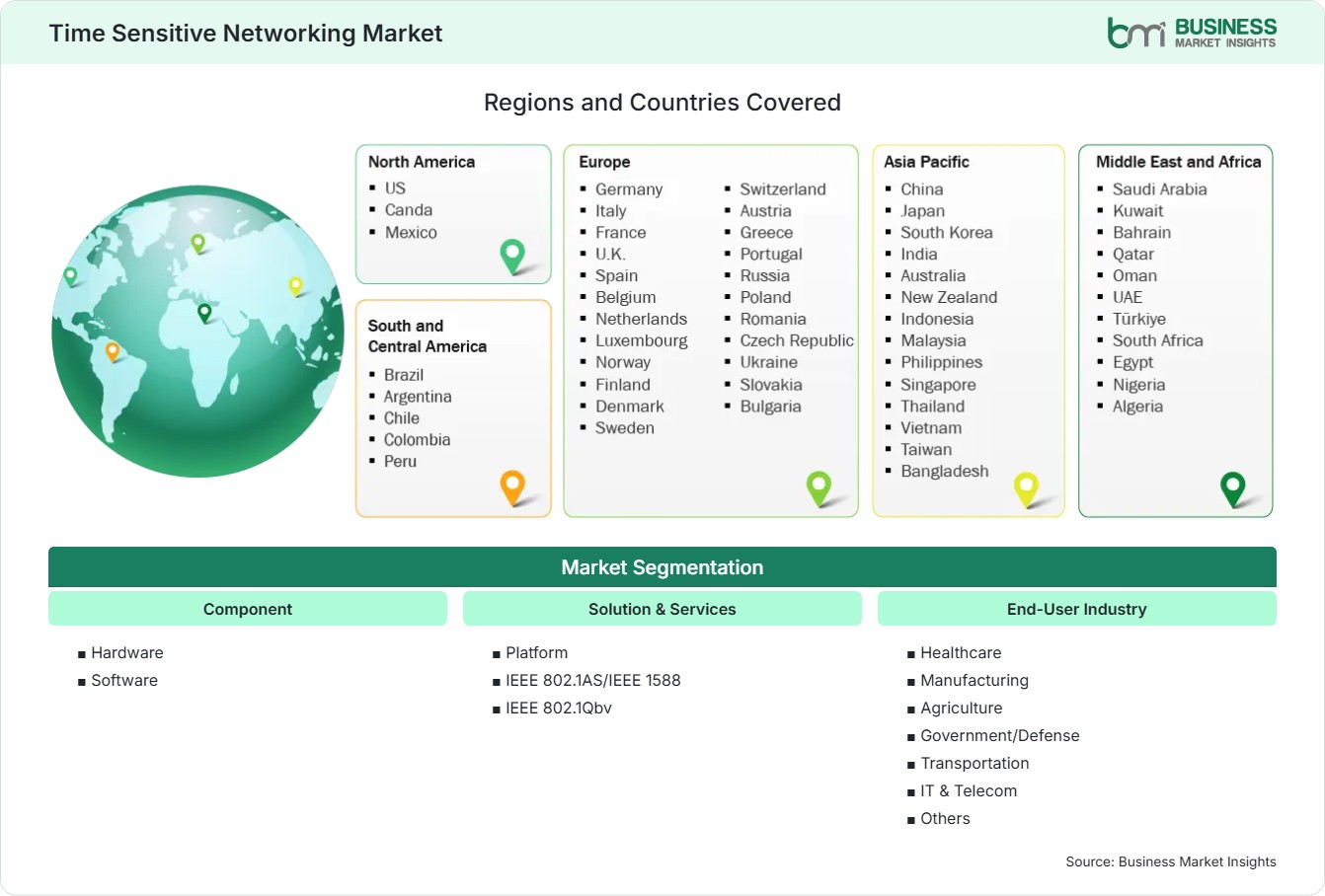
North America holds a 32%–35% share in 2025 and is expected to grow at a 26.2%–28.0% CAGR during 2026–2033. Advanced industrial automation, semiconductor innovation, connected infrastructure, and defense applications support adoption. The Time Sensitive Networking Market share is strengthened by established digital infrastructure and demand for deterministic communication.
- Advanced manufacturing facilities are adopting deterministic networking to improve synchronization between controllers, machines, robotics, sensors, and production systems operating within increasingly automated environments.
- Healthcare and research environments create opportunities for synchronized data communication where connected equipment and time-dependent applications require reliable information exchange and predictable performance.
- Defense and aerospace applications support demand for resilient networking architectures capable of coordinating complex systems while maintaining communication performance under demanding operational conditions.
- Edge computing adoption is encouraging tighter integration between data processing and communication infrastructure, increasing interest in networks capable of supporting time-sensitive applications near operational assets.
US Time Sensitive Networking Market
The US accounts for a 76%–80% share of the North American market in 2025 and is projected to expand at a 26.8%–28.7% CAGR through 2033. Automation, semiconductor development, industrial connectivity, defense modernization, and intelligent infrastructure support demand. Adoption increasingly depends on integrating deterministic communication with existing Ethernet environments while maintaining interoperability across diverse equipment and applications.
- Industrial modernization programs are supporting adoption where manufacturers seek more synchronized communication between automated equipment, controllers, sensors, and digital production management systems.
- Transportation and aerospace applications create opportunities for predictable data exchange across connected platforms where timing accuracy and communication reliability influence operational performance.
- Digital infrastructure investment supports network upgrades capable of handling increasingly complex combinations of conventional enterprise traffic and time-critical operational communications.
Europe Time Sensitive Networking Market
Europe represents a 25%–28% share in 2025 and is projected to grow at a 27.5%–29.8% CAGR during 2026–2033. Germany remains the leading regional market, while Italy demonstrates strong expansion potential. Germany is projected to grow at a 27.8%–30.0% CAGR, while Italy could expand at a 29.5%–32.0% CAGR. Industrial automation, automotive production, robotics, and connected manufacturing infrastructure continue supporting regional deployment.
- Germany benefits from extensive industrial automation capabilities and demand for interoperable communication across manufacturing, automotive engineering, and increasingly digital production systems.
- Italy presents opportunities through automation investment, machinery manufacturing, industrial modernization, and broader adoption of connected production technologies among specialized manufacturers.
- European manufacturers are increasingly integrating information and operational technology, increasing demand for standardized communication architectures supporting multiple equipment types and applications.
- Transportation digitization supports deterministic networking where connected control systems require predictable communication across vehicles, infrastructure, and operational management platforms.
Asia Pacific Time Sensitive Networking Market
Asia Pacific holds a 28%–32% share in 2025 and is expected to grow at a 31.5%–34.0% CAGR through 2033. China leads regional deployment, while India offers stronger expansion potential. China is projected to grow at a 31.0%–33.5% CAGR, while India could advance at a 33.0%–36.0% CAGR. The Time Sensitive Networking Market growth reflects automation investment, electronics manufacturing, robotics, transportation development, and expanding industrial digitalization.
- China supports significant demand through industrial automation, electronics production, robotics, automotive manufacturing, and continued investment in intelligent factory infrastructure.
- India offers opportunities as manufacturers increase automation, telecommunications infrastructure expands, and digital transformation initiatives encourage connected industrial and public systems.
- Japan and South Korea continue investing in advanced manufacturing, robotics, automotive technology, and precision equipment requiring reliable and synchronized network communication.
- Southeast Asian economies are expanding industrial capacity and digital infrastructure, creating opportunities for networking solutions supporting automation and connected production environments.
Rest of World Time Sensitive Networking Market
Rest of World accounts for a 8%–11% share in 2025 and is projected to grow at a 29.0%–31.5% CAGR through 2033. South and Central America is expanding industrial automation, while Middle Eastern countries are investing in intelligent infrastructure. Brazil is projected to grow at a 29.8%–32.2% CAGR, while Saudi Arabia could advance at a 31.0%–33.8% CAGR.
South and Central America benefits from manufacturing modernization and industrial digitalization. The Middle East is creating opportunities through smart infrastructure, transportation development, energy projects, and broader investment in connected technologies.
- Brazil offers potential through industrial modernization, connected manufacturing, transportation infrastructure, and increasing adoption of digital technologies across major production industries.
- Saudi Arabia supports technology investment through infrastructure modernization, industrial development, intelligent city projects, and expanding demand for advanced digital communication systems.
- African markets provide longer-term opportunities as industrial connectivity and digital infrastructure expand, although investment availability and network readiness vary significantly.
- System integration capabilities and cybersecurity requirements will influence adoption as organizations modernize existing infrastructure while incorporating deterministic networking technologies.