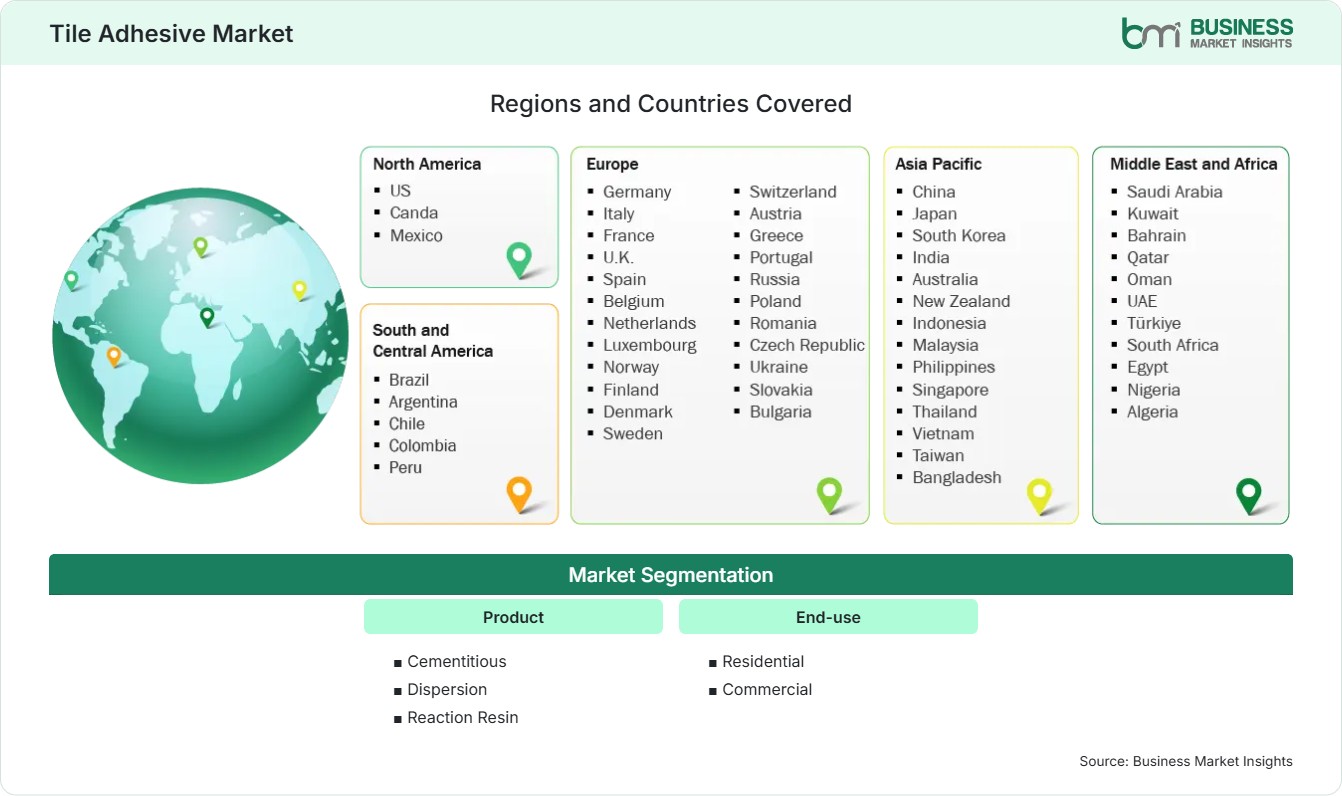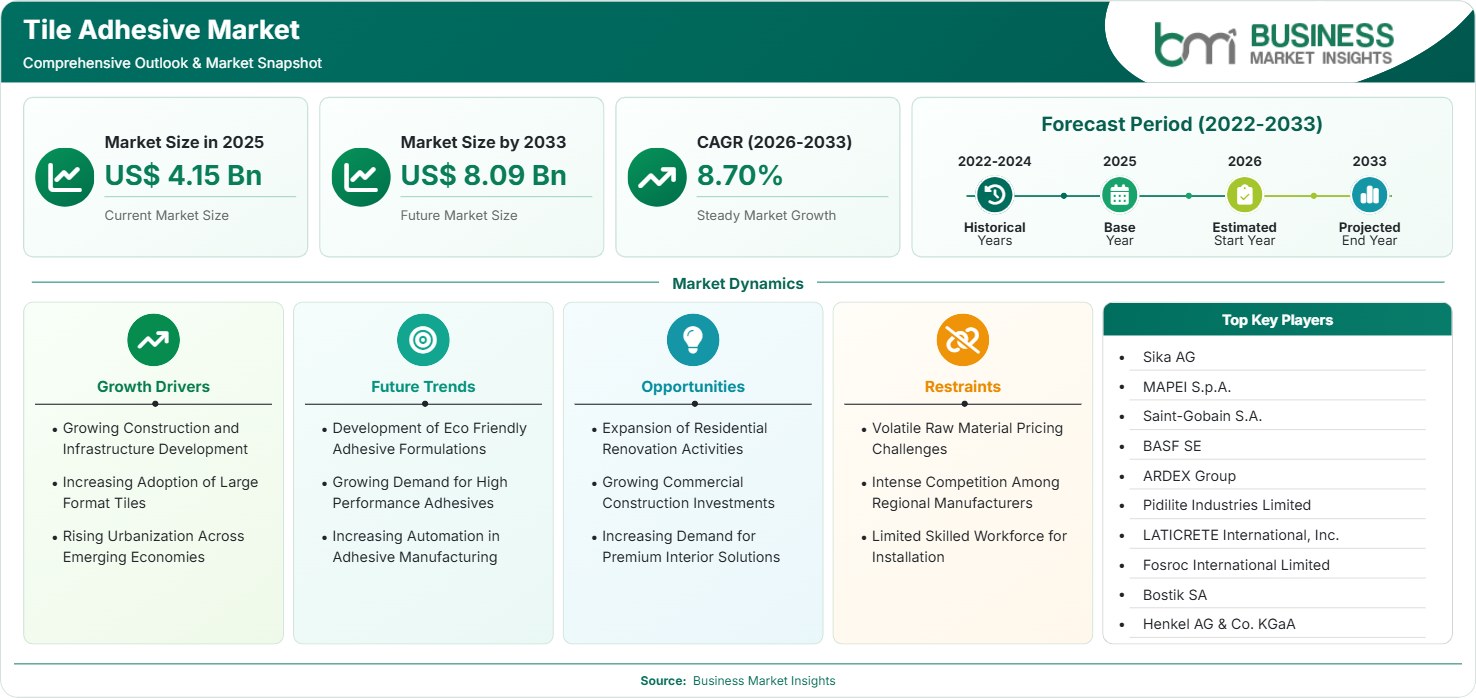
Tile Adhesive Market Regional Highlights
North America Tile Adhesive Market
North America accounts for a 24%–28% share in 2025 and grows at a CAGR of 7%–9% during 2026–2033, supported by renovation activities, commercial construction, and demand for advanced installation materials. The region’s Tile Adhesive Market share is influenced by mature construction practices and replacement demand. The Tile Adhesive Market growth is supported by remodeling projects, sustainable building materials, and adoption of high-performance adhesive formulations across residential and commercial applications.
- The United States represents the largest regional contributor due to strong renovation expenditure, housing improvement projects, and increasing preference for durable tile installation technologies.
- Canada demonstrates steady adoption through residential construction, infrastructure upgrades, and demand for environmentally responsible adhesive products supporting modern building requirements.
- Commercial developers are increasingly selecting advanced adhesive systems to improve installation efficiency, reduce maintenance requirements, and support complex architectural designs.
- Manufacturers are expanding distribution networks and introducing specialized products suitable for diverse climatic conditions across North American construction markets.
US Tile Adhesive Market
The US represents approximately 20%–24% of the global Tile Adhesive Market share in 2025 and expands at a CAGR of 7%–9% through 2026–2033. Growth is supported by residential remodeling, commercial infrastructure development, and increasing demand for premium flooring materials. Home improvement activity, hospitality construction, and retail expansion continue driving consumption of reliable adhesive solutions. Manufacturers are focusing on performance enhancement and sustainable product development.
- Residential renovation remains a key demand generator as homeowners increasingly upgrade kitchens, bathrooms, and living spaces with modern tile applications.
- Commercial construction projects including offices, hotels, and retail facilities are increasing adoption of specialized adhesive formulations requiring strength and durability.
- Sustainable construction initiatives are encouraging manufacturers to develop low-emission products aligned with evolving environmental standards and green building requirements.
Europe Tile Adhesive Market
Europe represents a 22%–26% share in 2025 and grows at a CAGR of 6%–8% during 2026–2033. The region benefits from renovation activities, stringent construction quality standards, and demand for energy-efficient buildings. Germany, the United Kingdom, France, and Italy remain important markets. European manufacturers are emphasizing sustainable formulations, improved application performance, and compliance with environmental regulations. Increasing refurbishment projects across urban areas support market expansion.
- Germany leads adoption through advanced construction practices, industrial expertise, and increasing demand for high-performance tile installation materials.
- France and Italy demonstrate strong renovation demand due to heritage building upgrades, residential improvements, and premium interior design applications.
- The United Kingdom is expanding consumption through residential refurbishment projects and commercial property modernization initiatives.
- European adhesive producers are investing in environmentally friendly formulations to comply with sustainability requirements and reduce construction emissions.
- Eastern European countries provide growth opportunities through infrastructure development, housing projects, and increasing adoption of modern construction materials.
Asia Pacific Tile Adhesive Market
Asia Pacific holds a 38%–42% share in 2025 and records the highest growth with a CAGR of 10%–12% during 2026–2033. The region benefits from rapid urbanization, infrastructure investment, residential construction growth, and expanding commercial development. China, India, Japan, and Southeast Asian countries are major contributors. Rising disposable incomes, government housing programs, and modernization of construction practices are increasing demand for efficient tile installation solutions across developing economies.
- China remains a major market due to extensive infrastructure projects, urban redevelopment initiatives, and large-scale residential construction activities.
- India is witnessing strong demand through affordable housing programs, urban expansion, and increasing adoption of modern building materials.
- Southeast Asian economies are expanding consumption through tourism infrastructure, commercial development, and residential construction investments.
- Japan and South Korea are adopting advanced adhesive technologies for renovation projects and high-quality construction applications.
- Regional manufacturers are strengthening production capacity and distribution networks to serve growing construction demand across emerging markets.
Rest of World Tile Adhesive Market
Rest of World contributes approximately 10%–14% share in 2025 and grows at a CAGR of 8%–10% during 2026–2033. South and Central America are experiencing rising demand through housing development, urban improvement programs, and commercial construction. Middle East and Africa markets are supported by infrastructure investments, hospitality projects, and modernization initiatives. Increasing adoption of advanced construction materials is creating opportunities across developing regions.
- Brazil and Mexico are emerging markets due to residential development, commercial expansion, and increasing preference for efficient tile installation methods.
- Middle Eastern countries including Saudi Arabia and the United Arab Emirates are investing in large infrastructure and hospitality projects requiring high-performance adhesives.
- African construction markets are expanding through urban development initiatives, housing programs, and infrastructure modernization efforts.
- Regional distributors are improving access to international adhesive brands through stronger supply networks and construction partnerships.
- Demand is increasing for durable products capable of performing under challenging climatic conditions across tropical and desert environments.