
Temporary Bonding Adhesive Market Outlook: Size, Share, Trends, Growth Analysis, Competitive Landscape & Forecast, 2026-2033

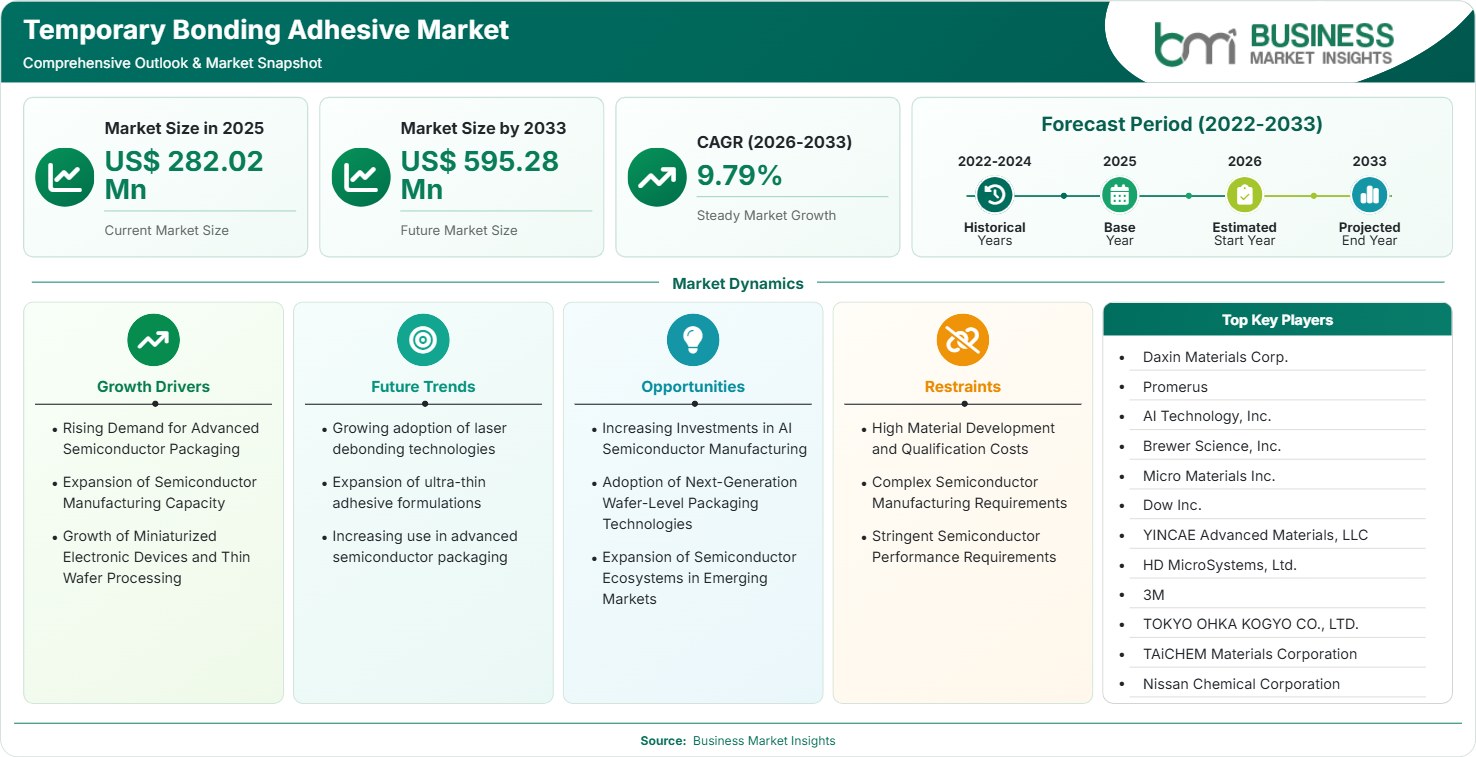
The Temporary Bonding Adhesive Market size was valued at US$ 282.02 Million in 2025 and is projected to reach US$ 595.28 Million by 2033, growing at a CAGR of 9.79% during 2026–2033, driven by semiconductor miniaturization, advanced packaging demand, wafer-level processing expansion, and increasing investments in next-generation electronic manufacturing technologies.

Report Coverage
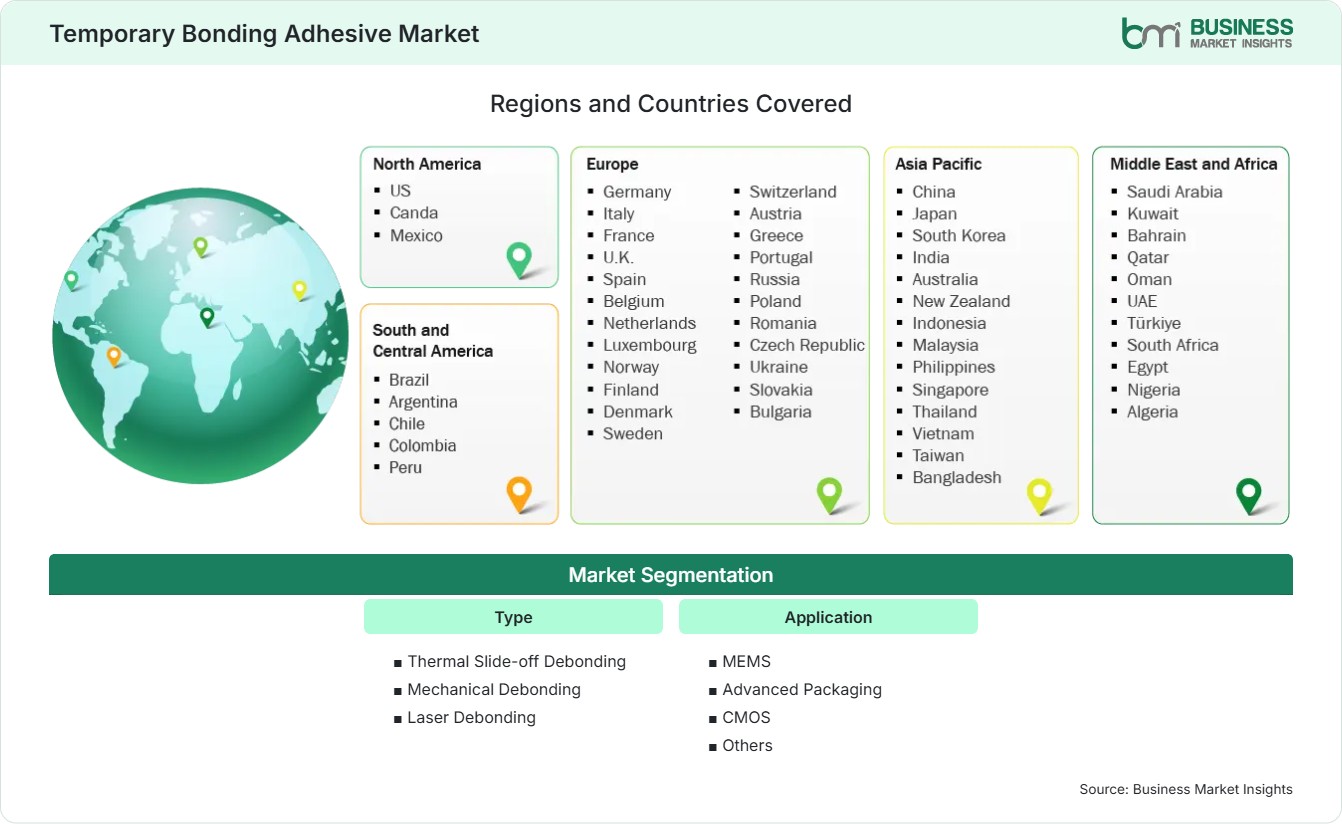
  • Type: Thermal Slide-off Debonding, Mechanical Debonding, Laser Debonding
  • Application: MEMS, Advanced Packaging, CMOS, Others
US$ 282.02 Mn Market size in 2025
US$ 595.28 Mn Market Size by 2033
9.79% CAGR, 2026 - 2033
2026-2033 Forecast Period

01 AI Overview

Temporary Bonding Adhesive Market Summary

  • North America Region: North America holds a market share of 31%–34% in 2025, growing with a CAGR of 9.0%–9.8% during 2026–2033, influenced by semiconductor manufacturing investments, advanced packaging development, research activities, and demand for high-performance bonding materials. The U.S. market is expanding at a CAGR of 9.2%–10.0%, supported by semiconductor ecosystem development, wafer processing innovation, and domestic manufacturing initiatives.
  • Fastest Growing Region: Asia Pacific holds a market share of 42%–45% in 2025, expanding at a CAGR of 10.3%–11.1% during 2026–2033, supported by semiconductor foundry expansion, advanced packaging adoption, electronics manufacturing growth, and increasing investments in wafer fabrication infrastructure.
  • Leading Segment: Advanced Packaging holds a market share of 38%–41% in 2025, advancing at a CAGR of 10.0%–10.8% during 2026–2033, driven by heterogeneous integration, 3D packaging requirements, chiplet architectures, and increasing demand for high-density semiconductor solutions.
  • High Growth Segment: Laser Debonding holds a market share of 24%–27% in 2025, recording a CAGR of 11.2%–12.0% during 2026–2033, supported by precise wafer separation requirements, thin wafer processing, flexible manufacturing approaches, and advanced semiconductor packaging applications.
  • Key Market Opportunity: Increasing semiconductor investments, advanced wafer processing, 3D integration, artificial intelligence chips, and next-generation packaging technologies create opportunities for adhesive manufacturers, material suppliers, and semiconductor equipment providers globally.
  • Major Market Players: Daxin Materials Corp.; Promerus; AI Technology, Inc.; Brewer Science, Inc.; Micro Materials Inc.; Dow Inc.; YINCAE Advanced Materials, LLC; HD MicroSystems, Ltd.; 3M; TOKYO OHKA KOGYO CO., LTD.; TAiCHEM Materials Corporation; Nissan Chemical Corporation.
02 Strategic Insights

Temporary Bonding Adhesive Market: Strategic Insights

Temporary Bonding Adhesive Market Strategic Framework
FREE PDF
Request your free sample
Request free sample
03 Stakeholder View

Key Takeaways

  • The semiconductor materials ecosystem is shifting toward highly specialized solutions where adhesive manufacturers, wafer processing companies, equipment suppliers, and chip producers collaborate to improve manufacturing precision, productivity, and yield performance.
  • Advanced packaging applications represent a major opportunity area as semiconductor companies increasingly adopt wafer-level packaging, 3D integration, and chiplet-based designs requiring reliable temporary bonding solutions.
  • Technology development is focused on improving thermal resistance, chemical compatibility, residue reduction, and debonding precision to support increasingly complex semiconductor fabrication processes.
  • Asia Pacific offers strong investment potential due to concentrated semiconductor manufacturing capabilities, expanding foundry capacity, and government-supported electronics supply chain development programs.
  • Strategic collaborations, technology partnerships, and material innovation initiatives are increasing as companies seek to strengthen capabilities in advanced packaging and next-generation semiconductor applications.
  • Sustainability considerations are becoming increasingly important as manufacturers develop cleaner processing materials, improve chemical efficiency, and reduce waste generation during semiconductor production workflows.
04 Geographic Outlook

Temporary Bonding Adhesive Market Regional Highlights

North America Temporary Bonding Adhesive Market

North America accounted for 31%–34% of the Temporary Bonding Adhesive Market share in 2025 and is projected to expand at a CAGR of 9.0%–9.8% during 2026–2033. The region benefits from semiconductor research investments, advanced packaging development, and increasing domestic manufacturing initiatives. The United States remains the leading contributor due to strong semiconductor design capabilities, government-supported chip manufacturing programs, and demand from high-performance computing applications.

  • Semiconductor manufacturers are investing in advanced packaging facilities requiring high-performance temporary bonding materials for complex wafer processing applications.
  • Research institutions and technology companies are developing next-generation semiconductor processes that require improved bonding precision and thermal performance.
  • Domestic semiconductor expansion initiatives are encouraging material suppliers to strengthen regional production and technical support capabilities.
  • Growing demand for artificial intelligence and automotive semiconductor applications is increasing requirements for advanced wafer processing solutions.

US Temporary Bonding Adhesive Market

The United States represented approximately 80%–84% of North American Temporary Bonding Adhesive Market revenue in 2025 and is expected to register a CAGR of 9.2%–10.0% during 2026–2033. Increasing semiconductor investments, advanced manufacturing initiatives, and demand for high-performance electronic components are strengthening market opportunities. The country continues attracting investments from semiconductor manufacturers, material suppliers, and research organizations.

  • Government-supported semiconductor manufacturing programs are encouraging expansion of domestic fabrication and advanced packaging capabilities.
  • Technology companies are increasing investments in artificial intelligence chips, high-performance computing components, and advanced semiconductor architectures.
  • Material developers are focusing on improving adhesive performance for thinner wafers and complex manufacturing processes.
  • Collaboration between research institutions and semiconductor companies is supporting innovation in bonding and debonding technologies.

Europe Temporary Bonding Adhesive Market

Europe accounted for 18%–21% of global Temporary Bonding Adhesive Market revenue in 2025 and is projected to grow at a CAGR of 8.4%–9.2% during 2026–2033. The region is supported by semiconductor research activities, automotive electronics demand, and strategic efforts to strengthen local chip manufacturing capabilities. Germany, France, and the Netherlands remain important markets, while Italy and Belgium demonstrate increasing semiconductor ecosystem development with growth rates between 9.0%–9.7%.

  • European semiconductor initiatives are supporting development of advanced manufacturing technologies and specialized material solutions.
  • Automotive electronics growth is increasing demand for reliable semiconductor packaging and wafer processing materials.
  • Research organizations are collaborating with manufacturers to improve semiconductor fabrication efficiency and performance.
  • Increasing investments in power electronics and industrial semiconductor applications are expanding regional opportunities.

Asia Pacific Temporary Bonding Adhesive Market

Asia Pacific captured 42%–45% of global Temporary Bonding Adhesive Market revenue in 2025 and is forecast to achieve the fastest CAGR of 10.3%–11.1% during 2026–2033. The region dominates due to extensive semiconductor manufacturing infrastructure, electronics production capabilities, and growing investments in advanced packaging. China, Japan, South Korea, and Taiwan remain major contributors, while India is emerging as a developing semiconductor manufacturing hub with growth between 10.8%–11.6%.

  • Semiconductor foundries across Asia Pacific are increasing advanced packaging capacity to support high-performance computing and consumer electronics demand.
  • Electronics manufacturing growth is creating demand for specialized materials used in wafer processing and device assembly.
  • Government initiatives supporting semiconductor self-reliance are encouraging investments across fabrication and packaging ecosystems.
  • Material suppliers are expanding regional capabilities to serve growing semiconductor manufacturing requirements.

Rest of World Temporary Bonding Adhesive Market

South & Central America and the Middle East & Africa collectively represented 6%–8% of global Temporary Bonding Adhesive Market revenue in 2025 and are expected to expand at a CAGR of 8.6%–9.4% during 2026–2033. These regions are developing semiconductor-related capabilities through technology investments, electronics manufacturing expansion, and industrial diversification programs. Emerging markets are gradually increasing adoption of advanced manufacturing materials.

  • Technology investments are supporting development of electronics manufacturing capabilities in selected emerging economies.
  • Industrial diversification programs are encouraging adoption of advanced materials and semiconductor technologies.
  • International semiconductor companies are exploring regional partnerships to strengthen supply chain resilience.
  • Growing electronics demand is creating opportunities for specialized material suppliers and technology providers.
Global Market Geography
FREE PDF
Request your free sample
Request free sample
05 Segment Analysis

Temporary Bonding Adhesive Market Segmentation

Type

The Type segment accounted for approximately 100% of revenue in 2025 and is expected to grow at a CAGR of 9.79% during 2026–2033. Different debonding approaches are selected based on wafer thickness, substrate material, processing temperature, and manufacturing requirements. The Temporary Bonding Adhesive Market scope continues expanding as semiconductor manufacturers require flexible solutions for advanced fabrication and packaging processes.

  • Thermal Slide-off Debonding: Thermal slide-off methods support efficient wafer separation through controlled temperature processing, enabling reliable manufacturing workflows for semiconductor applications.
  • Mechanical Debonding: Mechanical debonding solutions provide controlled separation processes for applications requiring compatibility with different wafer materials and production environments.
  • Laser Debonding: Laser debonding enables precise separation of bonded wafers through advanced optical processing, supporting thin wafer applications and complex semiconductor packaging requirements.

Application

The Application segment represented approximately 100% of Temporary Bonding Adhesive Market revenue in 2025 and is projected to expand at a CAGR of 9.79% during 2026–2033. Increasing semiconductor complexity, miniaturization, and demand for advanced electronic devices are driving adoption across multiple application areas. Manufacturers are developing bonding materials compatible with diverse semiconductor manufacturing processes.

  • MEMS: MEMS applications utilize temporary bonding materials to support precise wafer handling, sensor manufacturing, and miniature device fabrication processes.
  • Advanced Packaging: Advanced packaging applications require reliable bonding solutions for wafer-level integration, 3D structures, chiplets, and high-performance semiconductor devices.
  • CMOS: CMOS applications use temporary bonding materials during semiconductor processing to improve wafer stability and enable advanced manufacturing techniques.
06 Market Forces

Temporary Bonding Adhesive Market Dynamics

Key Market Drivers

Rising Demand for Advanced Semiconductor Packaging

The increasing complexity of semiconductor devices is driving demand for advanced packaging technologies requiring precise wafer handling solutions. Semiconductor manufacturers are adopting temporary bonding materials to support thin wafer processing, 3D integration, and heterogeneous packaging architectures. Growth in artificial intelligence, high-performance computing, and automotive electronics is increasing demand for advanced chips with improved performance and smaller form factors. The Temporary Bonding Adhesive Market growth is supported by investments in wafer-level packaging and chiplet-based designs. Material suppliers are developing solutions with improved thermal stability, low residue characteristics, and compatibility with advanced substrates to support next-generation semiconductor manufacturing requirements.

Expansion of Semiconductor Manufacturing Capacity

Global semiconductor supply chain expansion is increasing demand for specialized manufacturing materials used throughout fabrication and packaging processes. Governments and technology companies are investing in domestic semiconductor production capabilities to improve supply chain resilience. These investments are supporting new fabrication facilities, packaging plants, and research initiatives that require advanced bonding materials. The Temporary Bonding Adhesive Market trends indicate increasing adoption as manufacturers focus on improving wafer processing efficiency and production yields. Semiconductor ecosystems in Asia Pacific, North America, and Europe are strengthening material demand through capacity expansion, technology upgrades, and increased production of advanced electronic components.

Growth of Miniaturized Electronic Devices and Thin Wafer Processing

Consumer demand for smaller, lighter, and more powerful electronic devices is driving the development of processes associated with thin wafers. The consumer electronics industry, the medical devices sector, the automotive industry, and many other sectors are increasingly using semiconductors that need to be smaller and more efficient. Temporary bonding helps support the wafer throughout the grinding, etching, and lithography processes without damaging its structure. The trend is being driven by semiconductor companies seeking greater accuracy in their production processes.

Key Market Opportunities

Increasing Investments in AI Semiconductor Manufacturing

The expansion of artificial intelligence infrastructure is creating new opportunities for semiconductor manufacturers and material suppliers. AI processors require advanced packaging approaches to manage higher computing performance, thermal requirements, and integration complexity. The use of temporary bonding materials is gaining importance in the manufacturing process of advanced artificial intelligence semiconductors. With investment in semiconductor manufacturing, companies are motivated to develop new ways of bonding semiconductors. Companies supplying materials that offer improved efficiency can benefit from the growing demand in this area.

Adoption of Next-Generation Wafer-Level Packaging Technologies

Advanced wafer-level packaging technologies are creating significant opportunities for manufacturers. Semiconductor companies are adopting technologies such as 3D stacking, fan-out packaging, and heterogeneous integration to improve chip functionality. These processes require reliable temporary bonding solutions capable of supporting complex manufacturing steps. Increasing demand for high-performance electronics is encouraging investments in packaging innovation and material development. The Temporary Bonding Adhesive Market Forecasts indicate continued opportunities as semiconductor manufacturers seek solutions that improve yield, reduce processing challenges, and enable advanced device architectures.

Expansion of Semiconductor Ecosystems in Emerging Markets

Emerging semiconductor industries have created business opportunities for material providers in the growing electronics manufacturing and technology space. Nations building their semiconductor industries are investing in fabrication plants, packaging, and industrial infrastructure. All these developments are driving up the need for specific manufacturing materials. Business relationships between international technology firms and regional manufacturing firms are opening doors for local manufacturing and logistics operations. Companies offering efficient bonding solutions are set to benefit greatly from the growth of the semiconductor industry.

Market Restraints and Challenges

High Material Development and Qualification Costs

Factor: Developing advanced temporary bonding materials requires significant research investment, extensive testing, and qualification processes to meet semiconductor manufacturing standards. Adhesive formulations must demonstrate thermal stability, chemical resistance, low contamination levels, and compatibility with complex fabrication environments. Impact: High development costs may limit participation among smaller material suppliers and increase commercialization timelines. Semiconductor manufacturers often require lengthy validation cycles before adopting new materials, creating barriers for market entry. Companies must continuously invest in research capabilities to maintain competitiveness and address evolving semiconductor processing requirements.

Complex Semiconductor Manufacturing Requirements

Factor: Semiconductor fabrication processes involve strict performance requirements related to temperature resistance, wafer handling accuracy, debonding precision, and contamination control. Variations in substrate materials and manufacturing processes create technical challenges for adhesive suppliers. Impact: Increasing process complexity can raise development challenges and require customized solutions for different semiconductor applications. Manufacturers must continuously improve material performance while maintaining cost efficiency. Failure to meet advanced processing requirements may restrict adoption opportunities and delay integration into high-value semiconductor manufacturing workflows.

07 Company Analysis

Competitive Landscape

The Temporary Bonding Adhesive Market analysis highlights increasing competition among material suppliers focusing on advanced semiconductor processing solutions, specialized formulations, and technology partnerships. Companies are investing in research and development to improve bonding performance, debonding efficiency, and compatibility with next-generation semiconductor applications.

Company Name

Overview

Products and Services relevant to this market

Daxin Materials Corp.

Chinese materials company specializing in advanced chemical solutions for semiconductor and electronic applications.

Temporary bonding materials, semiconductor process chemicals, wafer processing solutions, and advanced material technologies.

Promerus

U.S.-based specialty materials company focused on advanced polymers and semiconductor-related applications.

High-performance polymers, bonding materials, electronic materials, and specialty chemical solutions.

AI Technology, Inc.

U.S. materials provider serving semiconductor, electronics, and advanced manufacturing industries.

Adhesives, thermal materials, semiconductor assembly solutions, and electronic manufacturing materials.

Brewer Science, Inc.

Global semiconductor materials company specializing in wafer processing technologies.

Temporary bonding materials, wafer-level processing solutions, lithography materials, and semiconductor chemicals.

Micro Materials Inc.

U.S. company providing advanced material solutions for semiconductor applications.

Adhesive materials, electronic chemicals, bonding solutions, and manufacturing support products.

Dow Inc.

Global chemical company developing advanced materials for electronics and industrial applications.

Semiconductor materials, specialty polymers, adhesives, electronic chemicals, and processing solutions.

YINCAE Advanced Materials, LLC

U.S. advanced materials company focused on electronic and semiconductor applications.

Temporary Bonding Adhesive, semiconductor materials, thermal solutions, and electronic adhesives.

HD MicroSystems, Ltd.

Japan-based materials company specializing in electronic polymers and semiconductor materials.

Polyimide materials, semiconductor coatings, electronic materials, and wafer processing solutions.

3M

Global technology company providing advanced materials for electronics and industrial applications.

Adhesive solutions, electronic materials, bonding technologies, and semiconductor manufacturing products.

TOKYO OHKA KOGYO CO., LTD.

Japanese chemical company supplying semiconductor and electronics materials globally.

Photoresists, semiconductor chemicals, advanced packaging materials, and processing solutions.

TAiCHEM Materials Corporation

Chinese chemical materials company serving semiconductor and electronics industries.

Electronic chemicals, semiconductor materials, specialty coatings, and bonding-related solutions.

Nissan Chemical Corporation

Japanese chemical company producing advanced functional materials for electronics markets.

Semiconductor materials, specialty chemicals, coatings, and advanced electronic solutions.

10 Trust & Transparency

Research Methodology

The market analysis combines proprietary research with secondary data from government agencies, company disclosures, regulatory filings, industry databases and expert interviews. Market estimates are validated through data triangulation, cross-market benchmarking and analyst review.

View Full Research Methodology

11 Questions Answered

Frequently Asked Questions

What information does a Temporary Bonding Adhesive Market Report provide?

A report provides market size analysis, technology trends, regional insights, segmentation analysis, competitive landscape, growth factors, challenges, and future opportunities.

What challenges affect adoption of temporary bonding technologies?

Challenges include material qualification requirements, processing complexity, high development costs, and the need for compatibility with evolving semiconductor manufacturing processes.

Why is advanced packaging becoming important for semiconductor companies?

Advanced packaging improves chip performance, integration density, and power efficiency, supporting applications requiring higher computing capability and compact device designs.

How does temporary bonding support semiconductor manufacturing?

Temporary bonding provides wafer stability during grinding, thinning, lithography, etching, and packaging processes, enabling manufacturers to handle thinner substrates with improved precision.

What industries are increasing demand for temporary bonding materials?

Semiconductor manufacturing, artificial intelligence hardware, automotive electronics, MEMS devices, and advanced computing applications are increasing demand for temporary bonding materials due to growing packaging complexity.

Access the Full Temporary Bonding Adhesive Market Report

Get segment-level forecasts, regional estimates, competitive benchmarking, company profiles and downloadable Excel datasets.

Access the full Temporary Bonding Adhesive Market Report
350 pages PDF & Excel | 2026-08-13