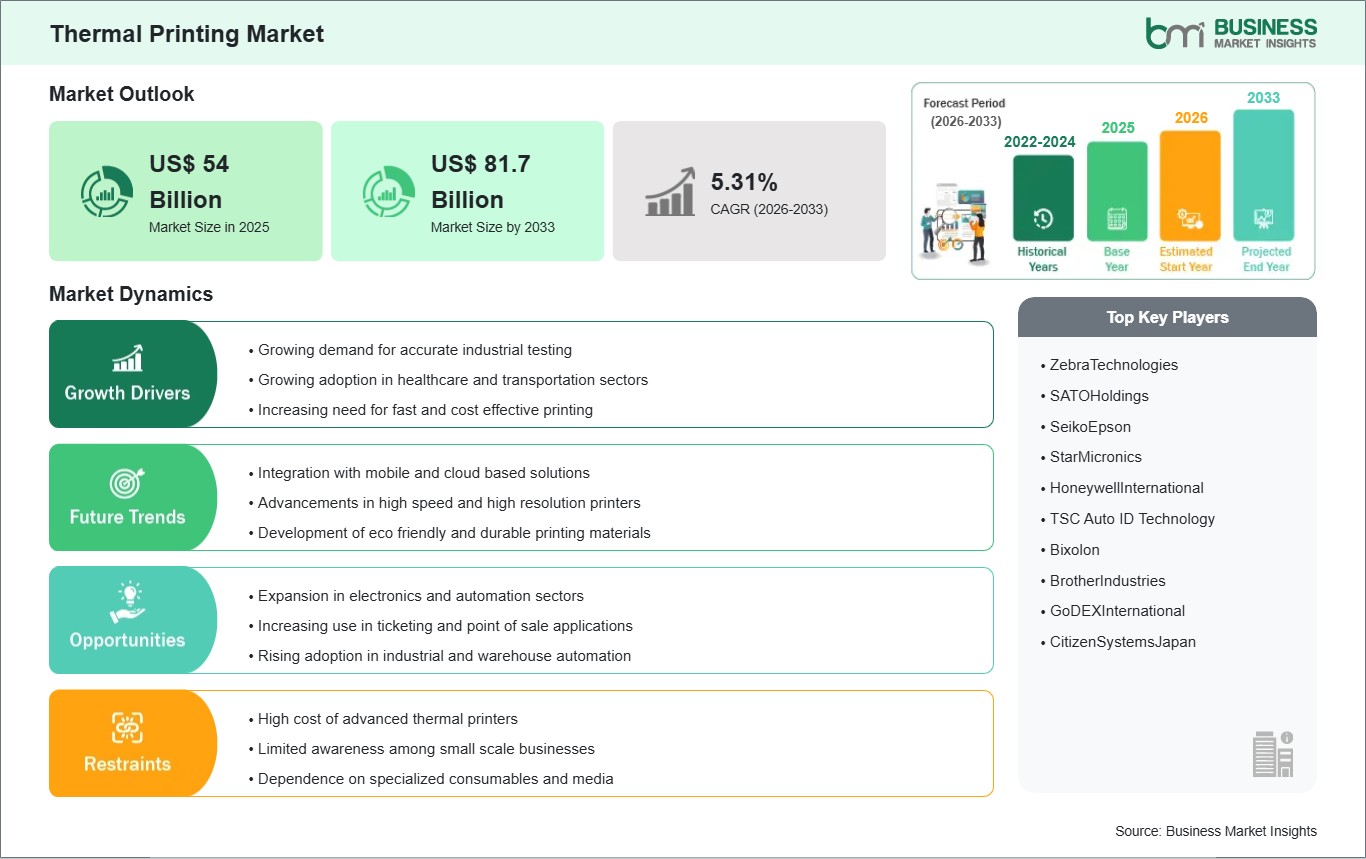
The Thermal Printing Market size is expected to reach US$ 81.7 billion by 2033 from US$ 54. billion in 2025. The market is estimated to record a CAGR of 5.31% from 2026 to 2033.
The evolution of the thermal printing market will continue at a significant rate due to the desire for faster, more economical and longer-lasting printed materials among multiple end-users, including retail, supply chain and distribution, healthcare and manufacturing. The introduction of improved thermal transfer and direct thermal technologies is allowing higher print resolutions, increased print speeds and greater operational efficiencies, allowing businesses to meet increasingly stringent labeling and traceability requirements. In addition to the above, significant contributions by the growth of e-commerce have increased demand for reliable and environmentally-friendly barcode, shipping label and ticket printing solutions.
Further, as sustainability has become an important consideration for all businesses, the use of eco-friendly thermal ribbons, recyclable substrates and energy-efficient printers is growing in popularity and supporting Corporate Social Responsibility (CSR) programs. Other key trends include the introduction of IoT-enabled smart printers, cloud-based management platforms, increased use of mobile printers and RFID-equipped labels and increased popularity of personalized printing. The integration of these products with other digital systems/solutions is helping to redefine operational workflows and improve real-time monitoring, predictive maintenance and remote management practices. The product differentiation strategies of manufacturers vary significantly in areas such as speed, durability and compatibility with digital systems/solutions.
Mergers and strategic partnerships within and across competitive boundaries have created a unique opportunity for all manufacturers to take advantage of global distribution networks. Emerging thermal printing applications such as mobile printing, RFID-enabled labels, and personalized retail printing are providing an exciting potential for continued, sustained growth and technological advancement for the thermal printing market overall.

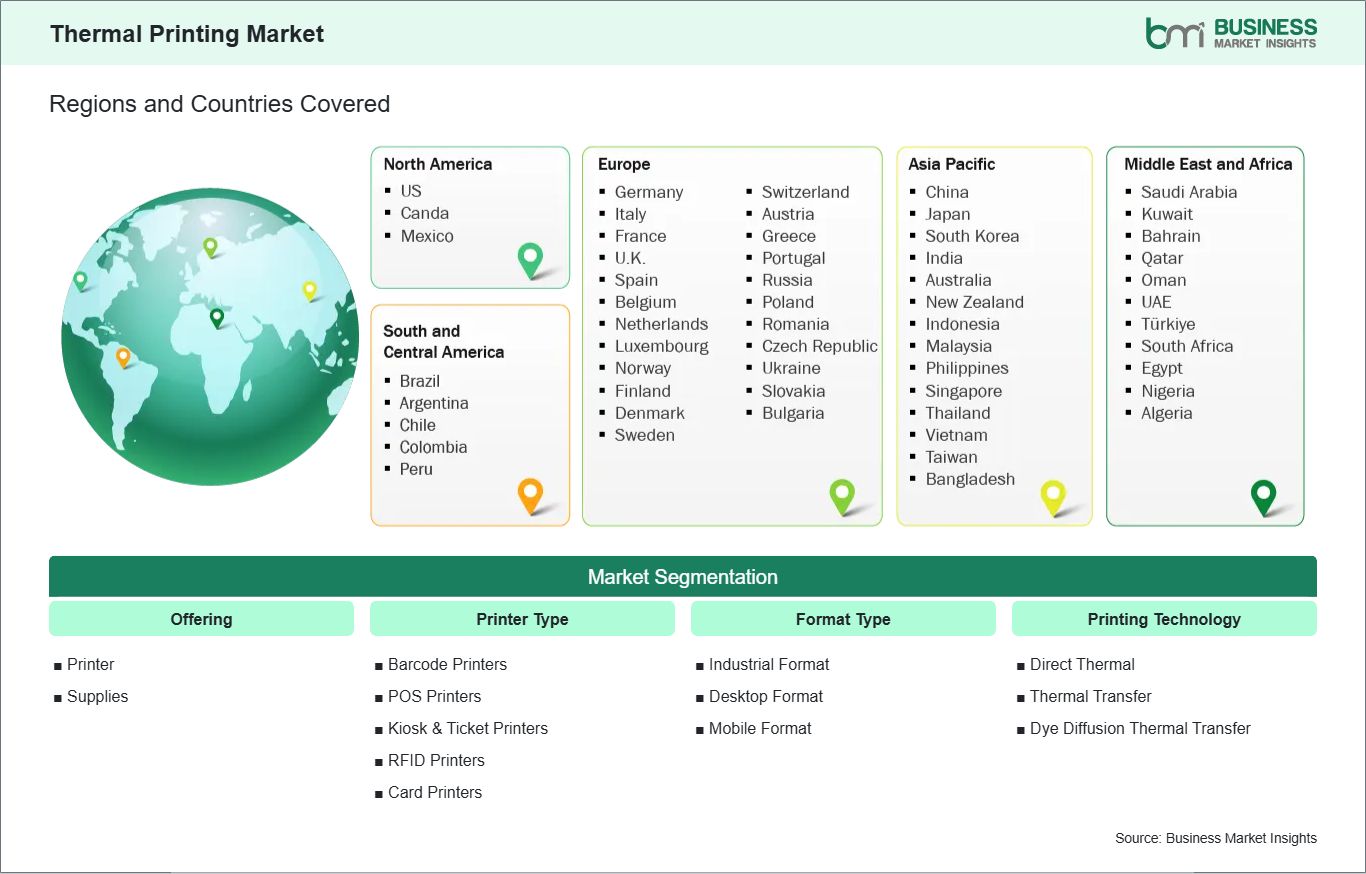
Key segments that contributed to the derivation of the thermal printing market analysis are offering, printer type, format type, printing technology, and application.
The global thermal printing market is experiencing strong growth due to rising demand for retail and logistics labeling. Businesses worldwide are adopting thermal printers for barcode labels, shipping tags, and receipts, as these solutions offer high-speed printing, durability, and minimal maintenance. Thermal printing ensures clear, scannable labels that enhance operational efficiency, reduce errors, and streamline supply chain management. Rapid growth in e-commerce and omnichannel retail is further boosting the need for reliable labeling solutions. As fulfillment centers and distribution networks expand, businesses require high-volume, accurate, and automated printing to handle increasing parcel and inventory flows.
Thermal printers provide the flexibility and speed necessary to maintain seamless operations in fast-paced environments, driving consistent global adoption. Technological improvements, including high-resolution printing, energy-efficient mechanisms, and integration with cloud-based inventory systems, are also enhancing the market appeal. These innovations allow businesses to implement end-to-end labeling solutions that are scalable, cost-effective, and capable of supporting complex logistics workflows, reinforcing the global demand for thermal printing technologies.
The global market for mobile and on-demand thermal printing is expanding rapidly as businesses seek flexible and portable printing solutions. Mobile thermal printers allow printing of labels, receipts, and tickets on-site, supporting dynamic operations in retail, logistics, and field services. The portability and wireless connectivity of these devices enable real-time printing from handheld terminals, tablets, or cloud systems, enhancing operational efficiency. On-demand printing reduces dependency on centralized printing stations and allows businesses to meet fast-changing labeling requirements instantly.
It is increasingly used for dynamic pricing, promotions, returns processing, and last-mile delivery operations. By printing only what is needed, companies can minimize waste, improve accuracy, and respond rapidly to supply chain fluctuations, making on-demand thermal printing a critical solution globally. Advancements in technology, such as long-lasting batteries, ruggedized devices, and wireless IoT integration, are supporting the expansion of mobile thermal printing. Cloud-managed printing systems enable centralized control and remote monitoring of devices, allowing businesses to scale operations efficiently while ensuring consistent print quality, which drives continuous growth in the global market.

The thermal printing market demonstrates steady growth, with size and share analysis highlighting evolving trends and competitive dynamics among key players. The report examines subsegments categorized within offering, printer type, format type, printing technology, and application, offering insights into their contribution to overall market performance.
By Offering, the printer subsegment dominated the market in 2025, driven by the rising demand for efficient, high-speed printing solutions in commercial and industrial settings.
Based on Printer Type, the barcode printers subsegment dominated the market in 2025, owing to its widespread adoption in retail, logistics, and manufacturing for product tracking and inventory management.
On the Basis of Format Type, the desktop format subsegment dominated the market in 2025, supported by its ease of deployment in small and medium-scale businesses.
By Printing Technology, the thermal transfer (TT) subsegment dominated the market in 2025, due to its durability and versatility across diverse applications.
By Application, the retail subsegment dominated the market in 2025, propelled by the growth of e-commerce, POS systems, and product labeling requirements.
| Report Attribute | Details |
|---|---|
| Market size in 2025 | US$ 54 Billion |
| Market Size by 2033 | US$ 81.7 Billion |
| Global CAGR (2026 - 2033) | 5.31% |
| Historical Data | 2022-2024 |
| Forecast period | 2026-2033 |
| Segments Covered | By Offering
|
|
Regions and Countries Covered
| |
| North America | US, Canada, Mexico |
| Europe | Belgium, Austria, Finland, Denmark, Greece, Poland, Romania, Russia, Ukraine, Czech Republic, Slovakia, Bulgaria, Italy, Luxembourg, Germany, Switzerland, France, Netherlands, Norway, Portugal, Spain, Sweden, United Kingdom |
| Asia-Pacific | Australia, China, India, Japan, South Korea, Indonesia, Malaysia, Philippines, Singapore, Thailand, Vietnam, Bangladesh, New Zealand, Taiwan |
| South and Central America | Brazil, Argentina, Peru, Chile, Colombia |
| Middle East and Africa | Bahrain, Kuwait, Oman, Qatar, Saudi Arabia, United Arab Emirates, Turkiye, South Africa, Egypt, Algeria, Nigeria |
| Market leaders and key company profiles |
|
The "Thermal Printing Market Size and Forecast (2022 - 2033)" report provides a detailed analysis of the market covering below areas:
The geographical scope of the Thermal Printing Market report is divided into North America, Asia Pacific, Europe, Middle East & Africa, and South & Central America. North America held the largest share in 2025.
Regional trends in terrestrial laser scanning adoption reflect differences in industrial infrastructure, technological readiness, and sector-specific demands. North America leads in TLS adoption due to advanced construction, mining, and infrastructure monitoring applications, with emphasis on integration with BIM workflows and smart city planning.
Europe demonstrates strong usage in heritage preservation, industrial automation, and urban planning, leveraging high-resolution TLS for structural assessment and compliance with strict regulatory standards.
Asia Pacific is witnessing rapid growth, driven by large-scale infrastructure projects, mining expansion, and industrial modernization; mobile and cloud-enabled TLS solutions are increasingly deployed to optimize project timelines and reduce operational risks.
Middle East & Africa is gradually adopting TLS for oil and gas facility monitoring, mining operations, and large-scale construction, where harsh environmental conditions require durable and portable scanning systems. South & Central America is expanding usage in civil engineering, transportation projects, and resource exploration, often focusing on cost-effective TLS solutions adaptable to varying terrain and infrastructure conditions.
Across all regions, the market is shaped by factors such as project complexity, investment in digital infrastructure, availability of skilled operators, and the need for precise spatial data, highlighting TLS as a strategic technology for enhancing accuracy, efficiency, and risk management in engineering and surveying operations globally.

The Thermal Printing Market is evaluated by gathering qualitative and quantitative data post primary and secondary research, which includes important corporate publications, association data, and databases. A few of the key developments in the spatial light Modulator market are:
The Thermal Printing Market is valued at US$ 54 Billion in 2025, it is projected to reach US$ 81.7 Billion by 2033.
As per our report Thermal Printing Market, the market size is valued at US$ 54 Billion in 2025, projecting it to reach US$ 81.7 Billion by 2033. This translates to a CAGR of approximately 5.31% during the forecast period.
The Thermal Printing Market report typically cover these key segments-
The historic period, base year, and forecast period can vary slightly depending on the specific market research report. However, for the Thermal Printing Market report:
The Thermal Printing Market is populated by several key players, each contributing to its growth and innovation. Some of the major players include:
The Thermal Printing Market report is valuable for diverse stakeholders, including:
Essentially, anyone involved in or considering involvement in the Thermal Printing Market value chain can benefit from the information contained in a comprehensive market report.
Please tell us your area of interest
(Market Segments/ Regions and Countries/ Companies)