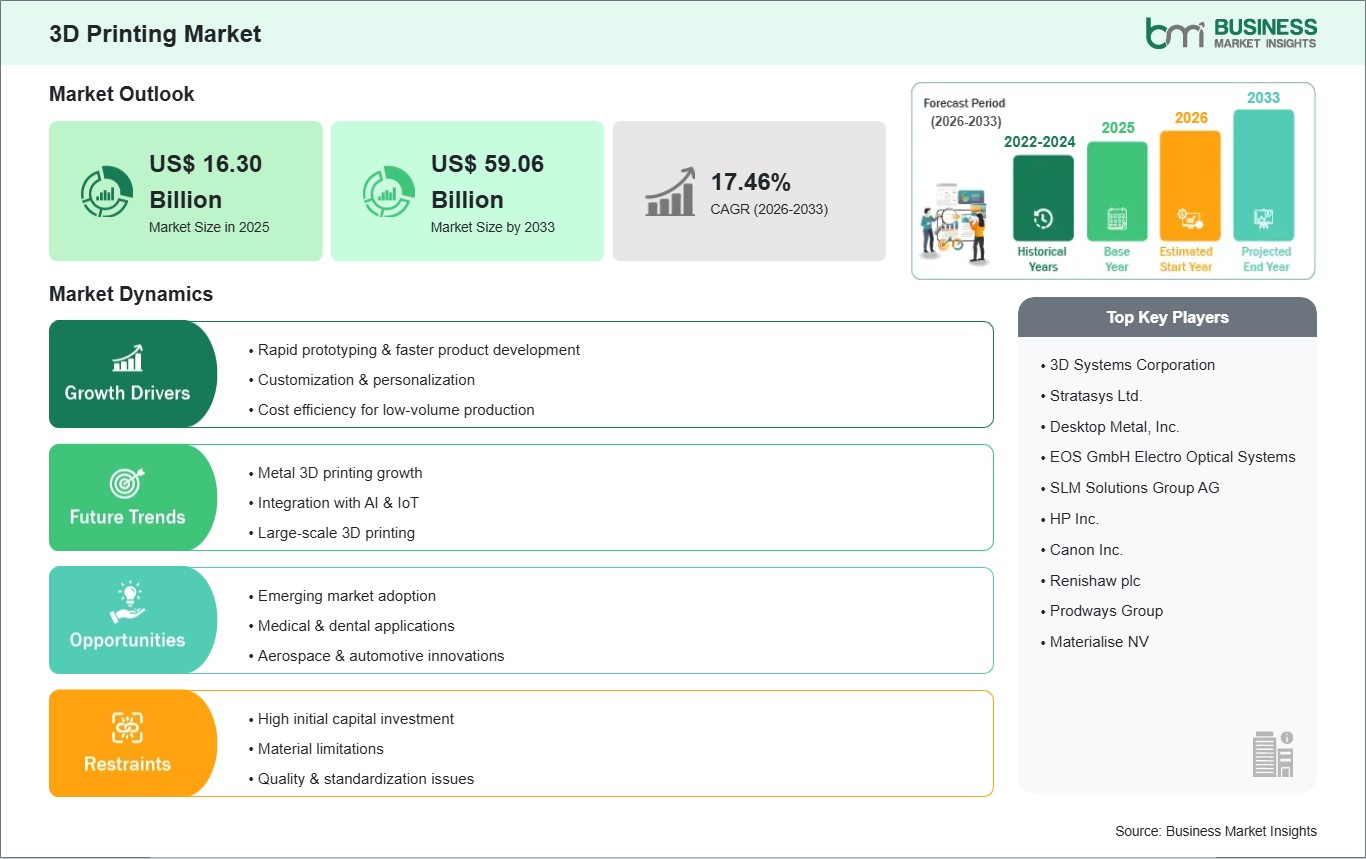
The 3D Printing Market size is expected to reach US$ 59.06 Billion by 2033 from US$ 16.30 Billion in 2025. The market is estimated to record a CAGR of 17.46% from 2026 to 2033.
The global 3D printing market is experiencing significant transformation as additive manufacturing transitions from a prototyping tool to a fully integrated production method across multiple industries, including automotive, aerospace, healthcare, consumer goods, and industrial machinery. The technology’s ability to fabricate highly complex geometries, reduce material waste, and enable on-demand production is driving widespread adoption. Increasing demand for lightweight components, customized products, and rapid prototyping solutions is motivating manufacturers to incorporate 3D printing into their core production strategies. Moreover, developments in multi-material printing, improved printing speeds, and the integration of AI-driven design and simulation software are expanding the potential applications of additive manufacturing, allowing companies to produce both functional parts and end-use products. Key factors driving the market include the growing emphasis on sustainability, where additive manufacturing minimizes scrap material and lowers carbon footprints compared to traditional subtractive processes. Additionally, industries are seeking to localize production, reduce inventory, and accelerate product development timelines, further supporting adoption. However, the market faces challenges such as high upfront investment for industrial-grade printers, limitations in printable materials for certain applications, and the need for skilled personnel to operate and maintain sophisticated machines. Despite these restraints, ongoing technological innovation and increasing industrial integration are expected to solidify 3D printing as a cornerstone of global manufacturing, enabling flexible, cost-effective, and highly customized production worldwide.

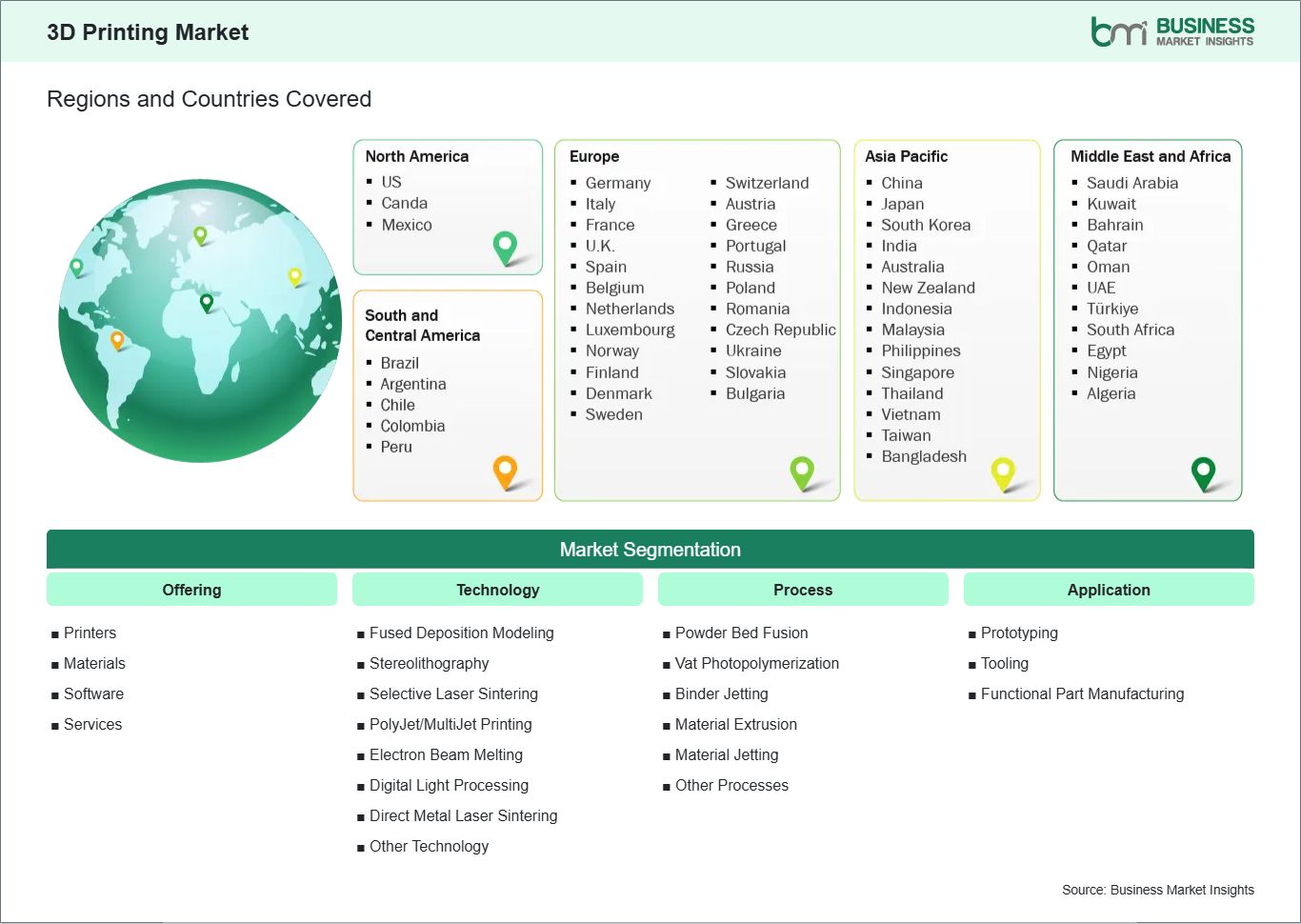
Key segments that contributed to the derivation of the 3D printing market analysis are offering, technology, process, application, and vertical
The Western European 3D printing market has been significantly influenced by the need for rapid prototyping and quick product development in a number of different industrial sectors. For example, in the advanced manufacturing corridors of Germany’s Baden-Württemberg region or the Netherlands’ Eindhoven district, engineering companies are increasingly utilizing 3D printing technology to minimize the cost and time traditionally involved in the tooling of product prototypes. For example, where it once took weeks to develop a working prototype of a product, it’s now possible to rapidly develop a number of different product designs in a matter of days using desktop or industrial-scale 3D printers, thereby allowing the engineering departments of companies to investigate a number of different product possibilities much earlier in the product development phase. This has been particularly important for SMEs that must often compete against the larger multinational corporations, as the ability to rapidly prototype products has allowed them to get new products to market much more quickly.
In countries such as France and Scandinavian nations, the integration of 3D printing with digital design tools has further increased the pace of development. In industries like consumer electronics and precision engineering, companies are using cloud-based CAD tools that integrate with local 3D printing services. This has enabled the development of products like wearable health sensors in a Paris-based startup that has reduced prototype development times from three weeks to less than five days with the adoption of in-house 3D printing equipment. This is not only true for startups but also for large automotive suppliers in the UK who are using rapid prototyping tools to test hundreds of part variants in a single development sprint.
The strategic importance of rapid prototyping is also demonstrated in terms of collaborative initiatives between industry and research organizations. In Switzerland and Austria, existing research labs are working closely with local manufacturers to help develop new materials and techniques that can further reduce the gap between conceptualization and production-ready parts. These initiatives also include testing cutting-edge polymer and metal printing technologies that can endure real-world mechanical stress, allowing engineers to test product functionality earlier and with greater confidence. Therefore, Western European organizations are not only improving their speed in product development but also creating more robust innovation cultures that place greater emphasis on iterative design methodologies, inter-disciplinary learning, and rapid product-to-market cycles.
The aerospace and automotive industries in Western Europe have emerged as major growth drivers for 3D printing technology, with the emphasis on achieving lightweight structures, fuel efficiency, and unique component design solutions. Aerospace companies in the Toulouse region of France and the West Midlands in the UK are increasingly adopting additive manufacturing technology for making mission-critical parts such as engine brackets, cooling ducts, and interior parts that take advantage of topology optimization and lightweight component design. Lightweight component design has the potential to achieve major fuel efficiency by even a small percentage, making 3D printed parts highly attractive to major OEMs in the aerospace industry. Several European-based aerospace suppliers claim that a growing percentage of their supply chains include 3D printed metal parts, specifically for applications where component complexity cannot be cost-effectively produced by conventional machining processes.
In the automotive industry, Baden-Württemberg and Bavaria states in Germany remain hotbeds for additive manufacturing innovation, with premium car manufacturers using 3D printing not only for rapid prototyping purposes but also for actual production. In this industry, fixtures, tools, and assembly aids designed using 3D printing are now common in production lines, reducing production times and eliminating supplier dependencies. In electric vehicle production, customized structural parts and cooling channel geometries designed using additive manufacturing are enabling manufacturers to optimize thermal management and overall vehicle efficiency. Small-scale automotive parts manufacturers in Spain and Italy are also investing in polymer and metal 3D printing technologies to produce customized parts for limited edition vehicle production.
As new initiatives in cross-industry collaboration continue to take shape, the position of 3D printing in the advanced manufacturing landscape of Western Europe continues to be further reinforced. New research collaborations in Sweden and Denmark are seeing the coming together of academic institutions, automotive giants, and aerospace companies in a bid to create new types of materials and hybrid manufacturing processes that combine additive and subtractive manufacturing processes. This has the potential to address the current limitations in surface finishes and the properties of the materials used in 3D printing, thereby making the technology applicable in a wider range of critical structural parts in the aerospace and automotive industries in Western Europe.

The global 3D printing market is experiencing steady growth, with market size and share analysis reflecting evolving treatment preferences and competitive dynamics among key players. The report evaluates important subsegments categorized within offering, technology, process, application, and vertical highlighting their respective contributions to overall market performance.
By offering, the printers subsegment dominated the market in 2025 because the pace of adoption across industries—especially automotive, healthcare, aerospace, and consumer goods—hinges on having the right hardware capable of producing reliable, high‑quality parts.
By technology, the fused deposition modeling (FDM) segment subsegment dominated the market in 2025 due ue to its widespread use and accessibility. FDM printers are relatively affordable, easy to operate, and compatible with a broad range of thermoplastics, which makes them suitable for both beginners and industrial users. Their versatility allows companies to create everything from basic prototypes to functional jigs and fixtures, driving higher adoption volumes worldwide compared with more specialized or expensive technologies.
By process, the powder bed fusion (PBF) subsegment dominated the market in 2025 Because powder bed fusion can work with metals and high‑performance polymers, it’s particularly valuable for industries like aerospace and medical devices that demand high structural integrity and performance, helping it capture a larger share of the overall printing process market.
By application, the functional part manufacturing subsegment dominated the market in 2025 because technologies continue to mature and materials become more capable, 3D printing is moving beyond just prototyping and tooling into the creation of end‑use components.
By vertical, the automotive subsegment dominated the market in 2025 because car manufacturers are aggressively adopting 3D printing to produce lightweight components, reduce assembly complexity, and quickly iterate designs.
| Report Attribute | Details |
|---|---|
| Market size in 2025 | US$ 16.30 Billion |
| Market Size by 2033 | US$ 59.06 Billion |
| Global CAGR (2026 - 2033) | 17.46% |
| Historical Data | 2022-2024 |
| Forecast period | 2026-2033 |
| Segments Covered | By Offering
|
|
Regions and Countries Covered
| |
| North America | US, Canada, Mexico |
| Europe | Belgium, Austria, Finland, Denmark, Greece, Poland, Romania, Russia, Ukraine, Czech Republic, Slovakia, Bulgaria, Italy, Luxembourg, Germany, Switzerland, France, Netherlands, Norway, Portugal, Spain, Sweden, United Kingdom |
| Asia-Pacific | Australia, China, India, Japan, South Korea, Indonesia, Malaysia, Philippines, Singapore, Thailand, Vietnam, Bangladesh, New Zealand, Taiwan |
| South and Central America | Brazil, Argentina, Peru, Chile, Colombia |
| Middle East and Africa | Bahrain, Kuwait, Oman, Qatar, Saudi Arabia, United Arab Emirates, Turkiye, South Africa, Egypt, Algeria, Nigeria |
| Market leaders and key company profiles |
|
The "3D printing market size and Forecast (2022 - 2033)" report provides a detailed analysis of the market covering below areas:
The geographical scope of the 3D printing market report is divided into: North America, Asia Pacific, Europe, Middle East & Africa, and South & Central America. North America held the largest share in 2025.
North America leads the global 3D printing market due to its mature industrial ecosystem, advanced R&D infrastructure, and strong focus on technological innovation. The United States, in particular, has become a key hub for additive manufacturing, with aerospace, automotive, and healthcare sectors driving demand for both prototyping and end-use production. Aerospace companies leverage 3D printing to produce lightweight, high-strength components that reduce fuel consumption, while automotive manufacturers utilize additive manufacturing for rapid prototyping, tooling, and small-batch production of specialized parts. Healthcare adoption is also growing rapidly, with hospitals and medical device companies producing patient-specific implants, prosthetics, surgical models, and dental appliances. North America’s dominance is reinforced by a well-established network of 3D printing solution providers, educational programs, and technology incubators that support innovation and skill development. Regulatory clarity and standardization efforts in the region help mitigate risks associated with additive manufacturing, particularly in highly regulated industries such as medical devices and aerospace. Challenges include the high cost of industrial 3D printers, ongoing material limitations, and the need for skilled operators and engineers to optimize production workflows. Nonetheless, North America continues to set global benchmarks in additive manufacturing, fostering the adoption of cutting-edge technologies and creating a dynamic market environment that serves as a model for other regions.

The 3D printing market is evaluated by gathering qualitative and quantitative data post primary and secondary research, which includes important corporate publications, association data, and databases. A few of the key developments in the 3D printing market are:
The 3D Printing Market is valued at US$ 16.30 Billion in 2025, it is projected to reach US$ 59.06 Billion by 2033.
As per our report 3D Printing Market, the market size is valued at US$ 16.30 Billion in 2025, projecting it to reach US$ 59.06 Billion by 2033. This translates to a CAGR of approximately 17.46% during the forecast period.
The 3D Printing Market report typically cover these key segments-
The historic period, base year, and forecast period can vary slightly depending on the specific market research report. However, for the 3D Printing Market report:
The 3D Printing Market is populated by several key players, each contributing to its growth and innovation. Some of the major players include:
The 3D Printing Market report is valuable for diverse stakeholders, including:
Essentially, anyone involved in or considering involvement in the 3D Printing Market value chain can benefit from the information contained in a comprehensive market report.
Please tell us your area of interest
(Market Segments/ Regions and Countries/ Companies)