Market Summary
Executive Summary and Global Market Analysis
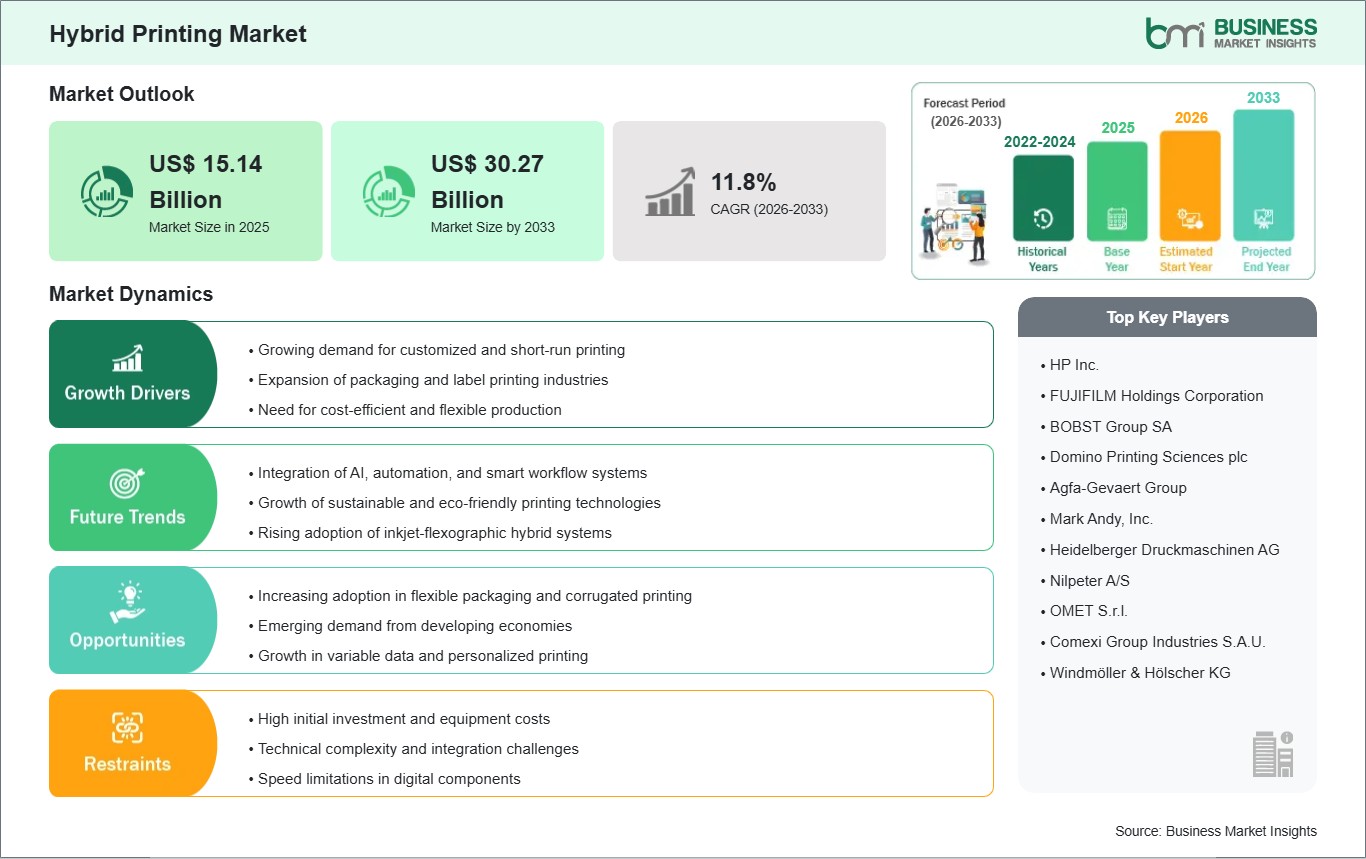
Hybrid printing technology is defined as the integrated application of analog and digital printing processes, designed to combine the high-speed, cost-effective volume of traditional methods with the variable-data flexibility of digital inkjet. These systems employ a coordinated hardware framework, most commonly combining flexographic or offset units with UV-inkjet modules, to enable the production of complex, high-quality labels and packaging in a single pass. This technology is essential to the operational infrastructure of the modern labeling, flexible packaging, and textile industries. Market growth is driven by the global shift toward short-run SKU proliferation, the increasing institutional demand for sustainable and personalized packaging, and the expanded integration of inline finishing capabilities that reduce manual labor and turnaround times.
However, several factors may constrain market development. The high capital requirements associated with fully integrated hybrid platforms, compared to single-technology presses, remain a significant barrier for small and medium-sized converters. The industry continues to encounter technical challenges related to technology integration, as the seamless synchronization of diverse analog and digital components demands advanced software and skilled personnel capable of managing both systems. Furthermore, the proliferation of specialized components has heightened concerns about a shortage of dual-skilled operators, since technicians must possess expertise in both traditional ink chemistry and digital electronic maintenance. These challenges, combined with global supply chain volatility for specialized printing chemicals and rising raw material costs, increase the total cost of ownership and may extend the return on investment period for traditional print houses transitioning to hybrid models.
Despite these challenges, the market outlook remains favorable as the sector shifts toward modular and AI-enhanced printing ecosystems. Opportunities are emerging through the adoption of retrofit-compatible solutions; the market is experiencing increased deployment of modular digital units that can be integrated into existing analog presses, enabling companies to modernize incrementally without substantial upfront investment. The packaging segment is expanding rapidly, driven by growing demand for QR-enabled smart packaging that supports real-time traceability and brand authentication. Additionally, the adoption of UV-LED curing systems, which substantially reduce energy consumption and environmental impact, supports global objectives for sustainable manufacturing and carbon reduction.
Segment Analysis
Hybrid Printing Market Segmentation
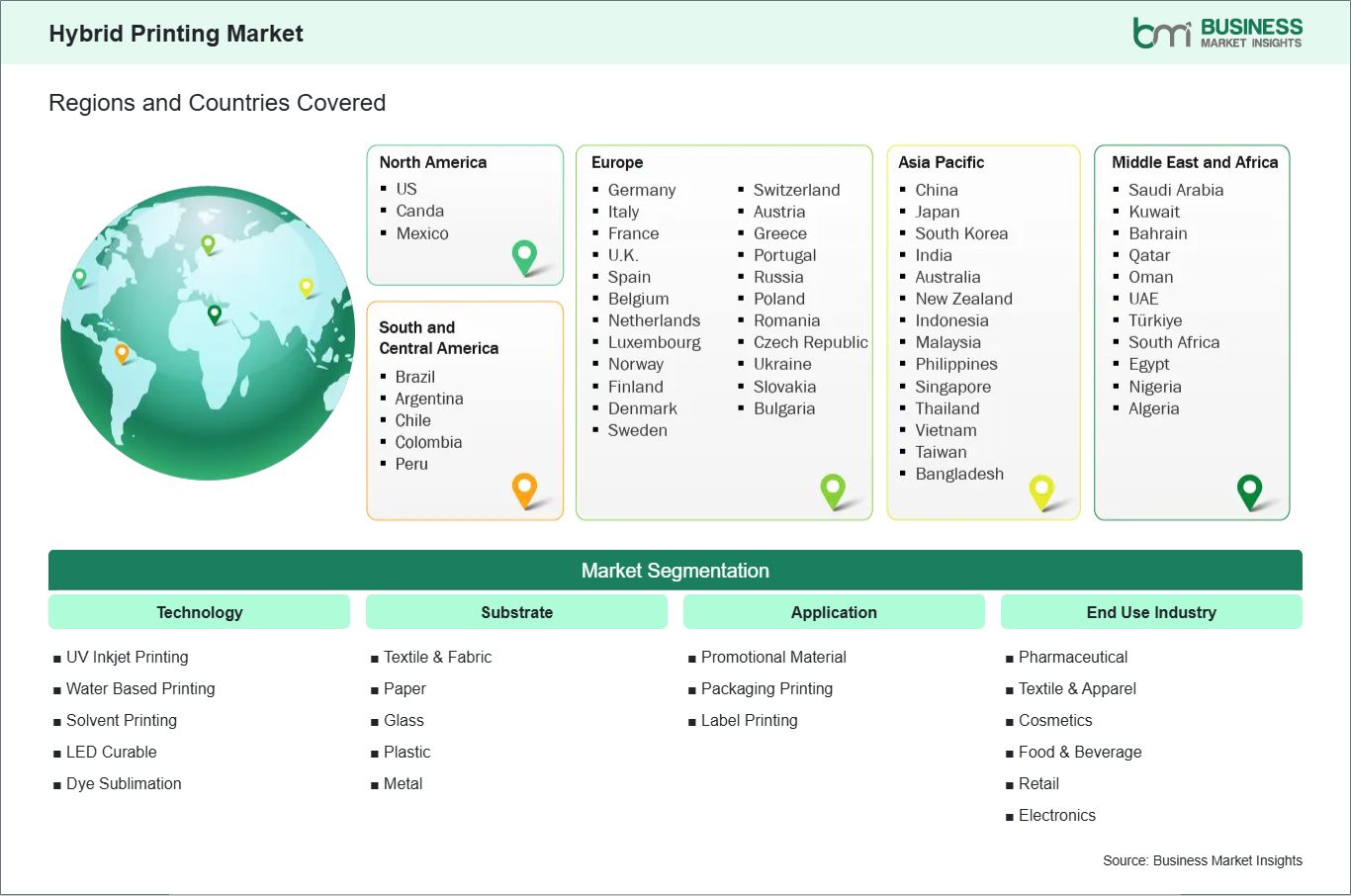
Key segments that contributed to the derivation of the Hybrid Printing market analysis are technology, substrate, application, and end-use industry.
- By Technology, the market is segmented into UV Inkjet Printing, Water Based Printing, Solvent Printing, LED Curable, and Dye Sublimation.
- By Substrate, the market is divided into Textile & Fabric, Paper, Glass, Plastic, and Metal.
- By Application, the market is categorized into Promotional Material, Packaging Printing, and Label Printing.
- By End-use Industry, the market is segmented into Pharmaceutical, Textile & Apparel, Cosmetics, Food & Beverage, Retail, and Electronics.
Market Forces
Hybrid Printing Market Drivers and Opportunities
Rising Demand for Customization, Efficiency, and Versatility
The hybrid printing market is being driven by the growing need for customization, production efficiency, and versatility across packaging, textiles, commercial printing, and industrial applications. Hybrid printing combines traditional analog methods such as flexographic or offset printing with digital printing technologies, enabling high‑quality output with flexible customization. The rapid expansion of e‑commerce and personalized packaging is amplifying adoption, as brands seek cost‑effective solutions for short runs, variable data, and on‑demand designs. Textiles and apparel industries are reinforcing demand, with hybrid printing supporting vibrant, durable prints while reducing turnaround times. Commercial printing is also fueling growth, as hybrid systems allow printers to balance large‑volume jobs with personalized elements. Additionally, stricter sustainability standards are propelling investment in hybrid printing solutions that minimize waste, reduce ink consumption, and optimize energy use. Collectively, customization priorities, efficiency requirements, and versatility goals are sustaining momentum in the global hybrid printing market.
Rising Integration of Digitalization, Sustainability, and Emerging Applications
Opportunities in the hybrid printing market are expanding through the integration of digitalization, sustainability initiatives, and emerging cross‑industry applications. Digital‑enabled hybrid systems are opening lucrative opportunities by offering real‑time design changes, variable data printing, and automated workflows that enhance flexibility. The growing emphasis on sustainability is fueling demand for eco‑friendly inks, recyclable substrates, and energy‑efficient printing technologies that align with global environmental goals. Emerging applications in healthcare and electronics are driving innovation, as hybrid printing supports medical labeling, circuit printing, and specialized packaging. The rise of smart packaging and connected products is reinforcing opportunities, where hybrid printing integrates QR codes, RFID tags, and interactive designs for enhanced consumer engagement. Additionally, the expansion of 3D printing and additive manufacturing is creating new pathways, with hybrid printing bridging traditional and digital processes for prototyping and production. Vendors who focus on digital‑ready, sustainable, and industry‑specific hybrid printing solutions are well‑positioned to capture growth. The convergence of digitalization, sustainability, and advanced applications underscores a transformative trajectory for the global hybrid printing market.
Size and Share Analysis
Hybrid Printing Market Size and Share Analysis
The Hybrid Printing market demonstrates steady growth, with size and share analysis revealing evolving trends and competitive positioning among key players. The report examines subsegments categorized within technology, substrate, application, and end-use industry, offering insights into their contribution to overall market performance.
Based on Technology, the UV Inkjet Printing subsegment dominates adoption, as it is indispensable for high‑quality, durable prints across packaging, labels, and promotional materials. UV inkjet offers fast curing, vibrant colors, and compatibility with diverse substrates. The Water‑Based Printing subsegment is essential for eco‑friendly applications, particularly in food packaging and textiles, where sustainability and safety are critical. The Solvent Printing subsegment anchors demand in outdoor signage and industrial applications, offering durability and resistance to harsh environments. The LED Curable subsegment is critical for energy‑efficient printing, enabling faster curing with reduced environmental impact. The Dye Sublimation subsegment supports demand in textiles and apparel, delivering vivid, long‑lasting prints. Together, these technologies highlight the versatility of hybrid printing across industries.
Report Coverage
Hybrid Printing Market Report Coverage and Deliverables
The “Hybrid Printing Market Size and Forecast (2022–2033)” report provides a detailed analysis of the market covering below areas:
- Market size and forecast at global, regional, and country levels for all market segments covered under the scope
- Market trends, as well as drivers, restraints, and opportunities
- Market analysis covering key trends, global and regional framework, major players, and recent developments
- Market concentration, heat map analysis, prominent players, and recent developments
- Detailed company profiles, including SWOT analysis
Geographic Insights
Hybrid Printing Market Geographic Insights
The geographical scope of the Hybrid Printing market report is divided into five regions: North America, Asia Pacific, Europe, Middle East & Africa, and South & Central America.
North America maintains a preeminent position within the global industry, a status reinforced by the region's advanced manufacturing infrastructure and the rapid adoption of digital transformation in the commercial print sector. The regional landscape is characterized by a strategic shift toward merging traditional analog processes with cutting-edge digital technologies to meet evolving customer demands for short-run customization and high-volume consistency. This market leadership is supported by a robust ecosystem of technology pioneers, including HP Inc., Xerox Corporation, EFI, and Eastman Kodak Company, who drive the commercialization of modular hybrid presses and AI-integrated workflow solutions.
Industrial and enterprise trends in the region reflect a decisive shift toward AI-Driven Automation and Hybrid Workflow Optimization. Organizations are increasingly moving away from manual calibration to adopt intelligent platforms that utilize machine learning for real-time adjustments in ink deposition, curing temperatures, and registration. Furthermore, the region is witnessing an escalating demand for Smart Packaging and Printed Electronics. This focus on Functional Printing is accelerated by the growth of e-commerce, which requires intricate branding, variable data printing, and the integration of RFID tags and sensors into sustainable packaging materials.
Industry Activity
Recent Developments
The Hybrid Printing market is evaluated by gathering qualitative and quantitative data post primary and secondary research, which includes important corporate publications, association data, and databases. A few of the key developments in the Hybrid Printing market are:
- In March 2026, Mimaki launched the UJ330H-160, a hybrid UV inkjet printer combining roll and rigid printing in a single system. This development strengthens the hybrid printing market by enhancing production flexibility and enabling print service providers to handle diverse applications on one platform. The solution supports cost-efficient, space-saving operations, aligning with the growing demand for versatile and integrated printing technologies.
- In September 2025, Fujifilm’s Acuity Ultra Hybrid LED was installed at PressOn, enhancing production speed, substrate versatility, and sustainability. This development strengthens the hybrid printing market by showcasing real-world adoption of flexible, high-performance hybrid UV printing technology and enabling print service providers to diversify applications efficiently.
Trust & Transparency
Research Methodology
The market analysis combines proprietary research with secondary data from government agencies, company disclosures, regulatory filings, industry databases and expert interviews. Market estimates are validated through data triangulation, cross-market benchmarking and analyst
review.
View Full Research Methodology
Key Sources Referred:
World Bank & Global Trade IndicatorsWorld Trade Organization (WTO)International Monetary Fund (IMF)International Trade Administration (ITA)Company WebsitesCompany Annual ReportsCompany Investor Presentations