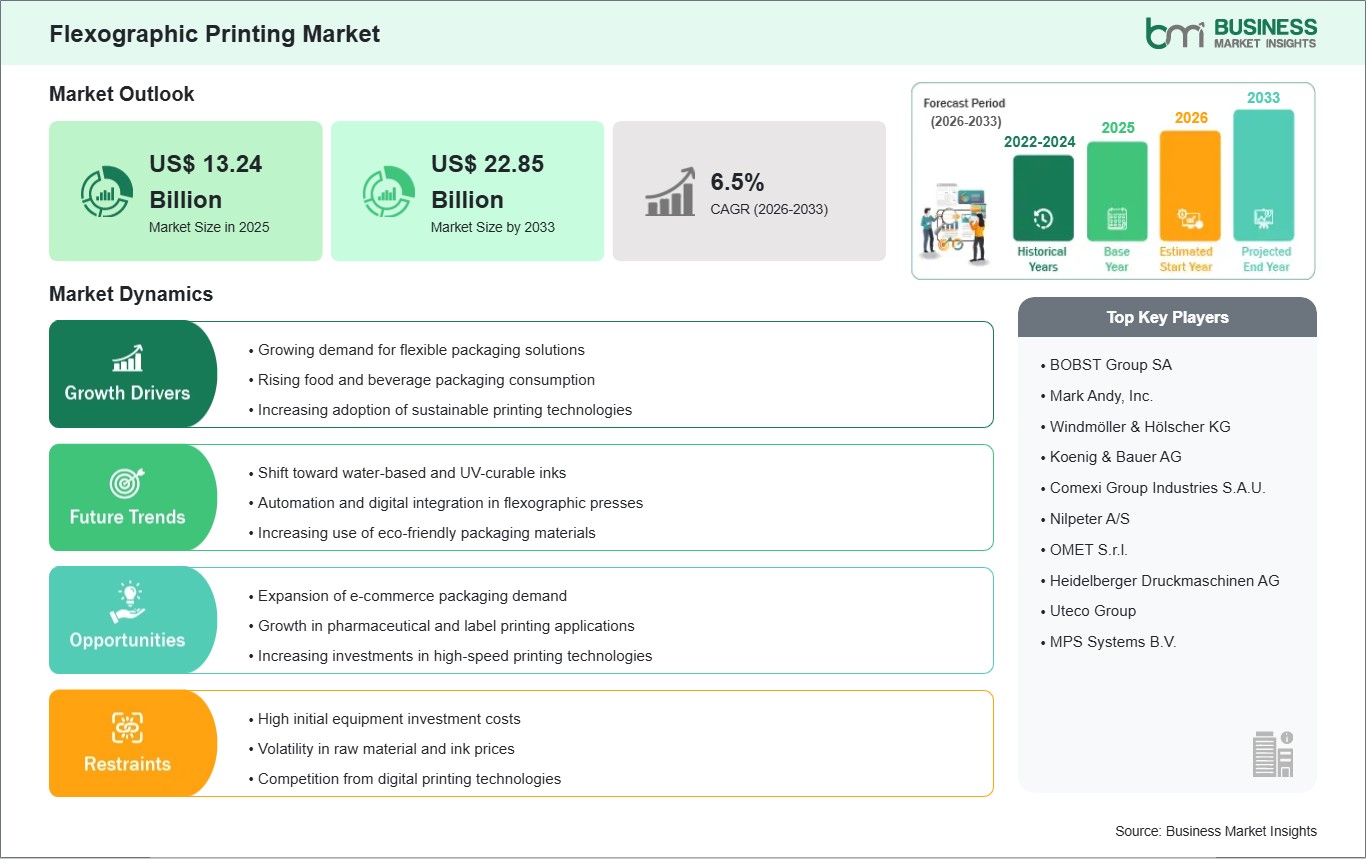
The Flexographic Printing market size is expected to reach US$ 22.85 billion by 2033 from US$ 13.24 billion in 2025. The market is estimated to record a CAGR of 6.50% from 2026 to 2033.
Flexographic printing refers to the integrated application of high-speed, rotary relief printing processes engineered to transfer ink onto a diverse range of flexible and rigid substrates. By utilizing a coordinated framework of hardware, including flexible photopolymer or rubber relief plates, anilox rollers for precise ink distribution, and automated drying systems, these presses facilitate the high-volume production of packaging and labeling materials. This technology is fundamental to the operational architecture of the food and beverage, pharmaceutical, and e-commerce logistics sectors. Market expansion is being propelled by the global transition toward flexible packaging solutions, the rising institutional requirement for sustainable and food-compliant water-based inks, and the increasing integration of AI-enabled press automation to reduce material waste and setup times.
However, several factors may restrain market progression. The high capital intensity associated with the initial setup of advanced, fully automated flexo presses, which often include modular finishing units and servo-driven precision controls, remains a primary hurdle for smaller converting firms. The industry also faces persistent technical challenges regarding the volatility of raw material prices, particularly for specialized photopolymer plates and chemical components, which can diminish profit margins for print service providers. Additionally, the proliferation of digital inkjet technologies has intensified concerns regarding short-run cannibalization, as digital systems often offer superior cost-efficiency for small-batch, highly customized orders. These hurdles, compounded by a documented shortage of skilled press operators proficient in complex color matching and machine maintenance, increase the total cost of ownership and may lengthen the modernization cycle for traditional printing hubs.
Despite these hurdles, the market outlook remains highly favorable as the sector transitions toward Intelligent and Hybrid printing ecosystems. Opportunities are emerging through the adoption of Digital-Flexo Hybrid Systems; the market is witnessing a surge in platforms that combine the speed and low unit cost of flexography with the variable data capabilities of digital inkjet. The flexible packaging segment is gaining significant traction, driven by the requirement for lightweight, durable materials that offer superior barrier properties for consumer goods. Furthermore, the growth of Sustainable Corrugated Logistics, utilizing water-based inks with low volatile organic compound (VOC) emissions, aligns with global goals for carbon footprint reduction and regulatory compliance in food-contact applications.

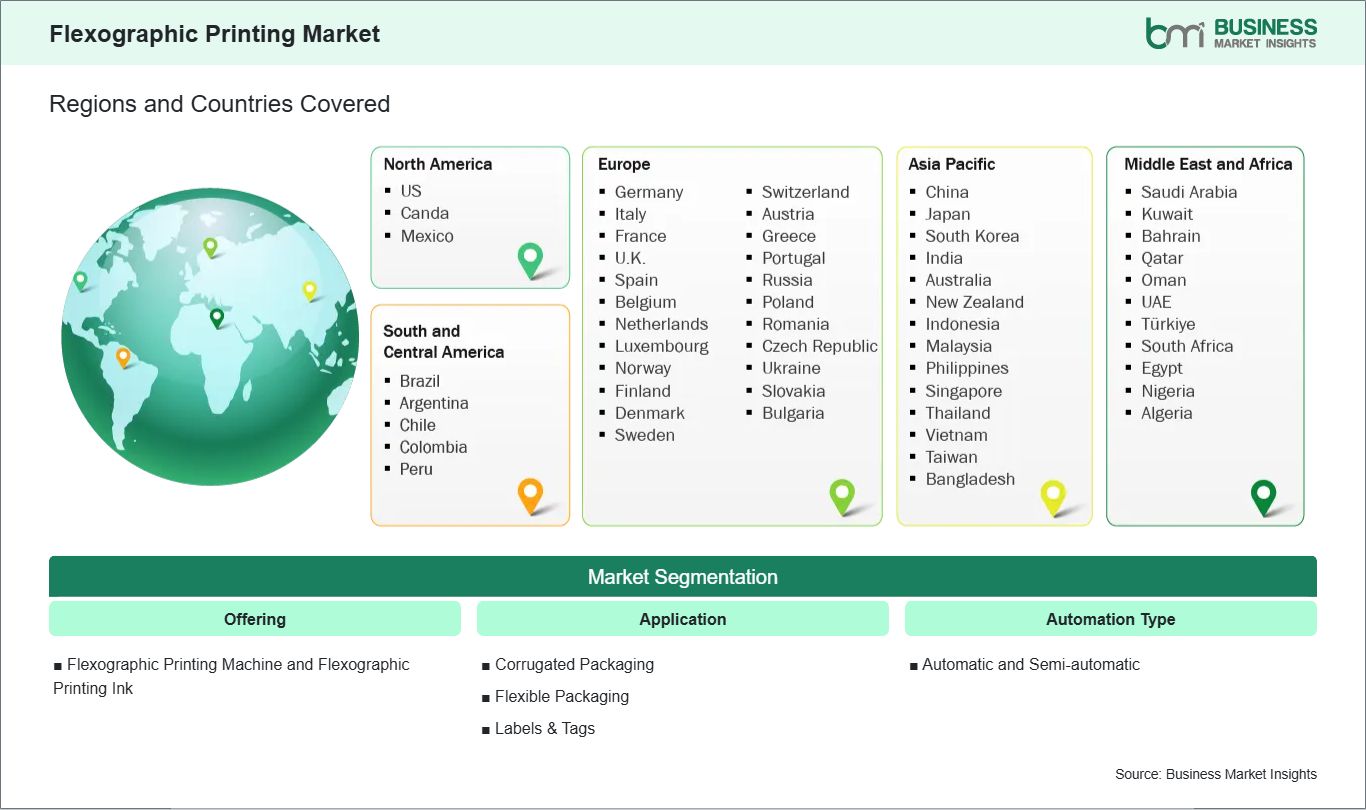
Key segments that contributed to the derivation of the Flexographic Printing market analysis are offering, application, and automation type.
The flexographic printing market is being driven by the growing need for packaging solutions, cost efficiency, and high-quality output across food & beverage, pharmaceuticals, consumer goods, and industrial sectors. Flexographic printing, known for its versatility, speed, and ability to handle a wide range of substrates, is widely used in printing on flexible packaging materials, corrugated boxes, labels, and cartons. The rapid expansion of e-commerce and retail is amplifying adoption, as brands increasingly require durable, visually appealing packaging to enhance customer experience and strengthen brand recognition. Food and beverage industries are reinforcing demand, with flexographic printing supporting compliance with labeling regulations, high-volume production, and consistent quality standards. Cost efficiency is another major driver, as flexographic presses enable long runs at lower costs compared to digital alternatives, making them ideal for mass production. Additionally, stricter regulatory standards for sustainability and recyclability are propelling investment in eco-friendly inks, water-based solutions, and biodegradable substrates. Collectively, packaging priorities, cost reduction goals, and quality requirements are sustaining momentum in the global flexographic printing market.
Opportunities in the flexographic printing market are expanding through the integration of digitalization, sustainability initiatives, and emerging cross‑industry applications. Hybrid flexo‑digital systems are opening lucrative opportunities by offering variable data printing, customization, and short‑run flexibility while maintaining high‑volume efficiency. Sustainability trends are gaining traction, fueling demand for water‑based inks, recyclable substrates, and energy‑efficient printing technologies that align with global environmental goals. The growing emphasis on smart packaging is fueling demand for interoperable printing solutions that integrate QR codes, RFID tags, and interactive designs for enhanced consumer engagement. Emerging applications in pharmaceuticals are driving innovation, as flexographic printing supports secure labeling, anti‑counterfeiting measures, and compliance with stringent safety standards. Logistics and e‑commerce are reinforcing opportunities, where flexographic printing enables durable barcodes, shipping labels, and branded packaging. Additionally, advancements in automation and robotics are encouraging deployment of intelligent flexographic presses that reduce waste and improve precision. The expansion of hybrid printing, sustainable packaging, and digital transformation is creating new pathways for adoption. Vendors who focus on digital‑ready, eco‑friendly, and industry‑specific flexographic solutions are well‑positioned to capture growth. The convergence of sustainability, digitalization, and packaging innovation underscores a transformative trajectory for the global flexographic printing market.

The Flexographic Printing market demonstrates steady growth, with size and share analysis revealing evolving trends and competitive positioning among key players. The report examines subsegments categorized within offering, application, and automation type, offering insights into their contribution to overall market performance.
Based on Application, the Corrugated Packaging subsegment holds a strong presence, as flexographic printing is indispensable for producing durable, high‑quality prints on corrugated boxes used in shipping and logistics. The Flexible Packaging subsegment is essential for food, beverage, and pharmaceutical industries, offering lightweight, customizable, and cost‑efficient packaging solutions. The Labels & Tags subsegment anchors demand in retail, logistics, and consumer goods, ensuring product identification, branding, and compliance. Each application demonstrates how flexographic printing supports diverse packaging needs, from protective corrugated materials to visually appealing labels and flexible wraps.
| Report Attribute | Details |
|---|---|
| Market size in 2025 | US$ 13.24 Billion |
| Market Size by 2033 | US$ 22.85 Billion |
| Global CAGR (2026 - 2033) | 6.5% |
| Historical Data | 2022-2024 |
| Forecast period | 2026-2033 |
| Segments Covered | By Offering
|
|
Regions and Countries Covered
| |
| North America | US, Canada, Mexico |
| Europe | Belgium, Austria, Finland, Denmark, Greece, Poland, Romania, Russia, Ukraine, Czech Republic, Slovakia, Bulgaria, Italy, Luxembourg, Germany, Switzerland, France, Netherlands, Norway, Portugal, Spain, Sweden, United Kingdom |
| Asia-Pacific | Australia, China, India, Japan, South Korea, Indonesia, Malaysia, Philippines, Singapore, Thailand, Vietnam, Bangladesh, New Zealand, Taiwan |
| South and Central America | Brazil, Argentina, Peru, Chile, Colombia |
| Middle East and Africa | Bahrain, Kuwait, Oman, Qatar, Saudi Arabia, United Arab Emirates, Turkiye, South Africa, Egypt, Algeria, Nigeria |
| Market leaders and key company profiles |
|
The “Flexographic Printing Market Size and Forecast (2022–2033)” report provides a detailed analysis of the market covering below areas:
The geographical scope of the Flexographic Printing market report is divided into five regions: North America, Asia Pacific, Europe, Middle East & Africa, and South & Central America.
North America maintains a preeminent position within the global industry, a status reinforced by the region's advanced packaging infrastructure and the rapid expansion of high-speed volume printing. The regional landscape is characterized by a mature innovation ecosystem in the United States and Canada, where the transition toward high-definition flexography and sustainable substrates has become a strategic priority for the consumer goods and logistics sectors. This market leadership is supported by a robust presence of technology pioneers, including Mark Andy Inc., Bobst, Nilpeter A/S, Barry-Wehmiller, and Flint Group, who drive the commercialization of sophisticated inline presses, central impression systems, and advanced plate-making technologies.
Industrial and enterprise trends in the region reflect a decisive shift toward Automation and Hybrid Printing Integration. Manufacturers are increasingly moving away from manual setup processes to adopt intelligent presses that utilize automated turret rewinders and inline finishing solutions to minimize production downtime. Furthermore, the region is witnessing an escalating demand for Flexible Packaging and Sustainable Ink Solutions. This focus on Circular Economy Integration is driving the adoption of water-based and UV-LED cured inks, which reduce volatile organic compound emissions and energy consumption while maintaining high print quality on diverse substrates such as corrugated boxes, folding cartons, and flexible films.

The Flexographic Printing market is evaluated by gathering qualitative and quantitative data post primary and secondary research, which includes important corporate publications, association data, and databases. A few of the key developments in the Flexographic Printing market are:
The Flexographic Printing Market is valued at US$ 13.24 Billion in 2025, it is projected to reach US$ 22.85 Billion by 2033.
As per our report Flexographic Printing Market, the market size is valued at US$ 13.24 Billion in 2025, projecting it to reach US$ 22.85 Billion by 2033. This translates to a CAGR of approximately 6.5% during the forecast period.
The Flexographic Printing Market report typically cover these key segments-
The historic period, base year, and forecast period can vary slightly depending on the specific market research report. However, for the Flexographic Printing Market report:
The Flexographic Printing Market is populated by several key players, each contributing to its growth and innovation. Some of the major players include:
The Flexographic Printing Market report is valuable for diverse stakeholders, including:
Essentially, anyone involved in or considering involvement in the Flexographic Printing Market value chain can benefit from the information contained in a comprehensive market report.
Please tell us your area of interest
(Market Segments/ Regions and Countries/ Companies)