Market Summary
Executive Summary and Global Market Analysis
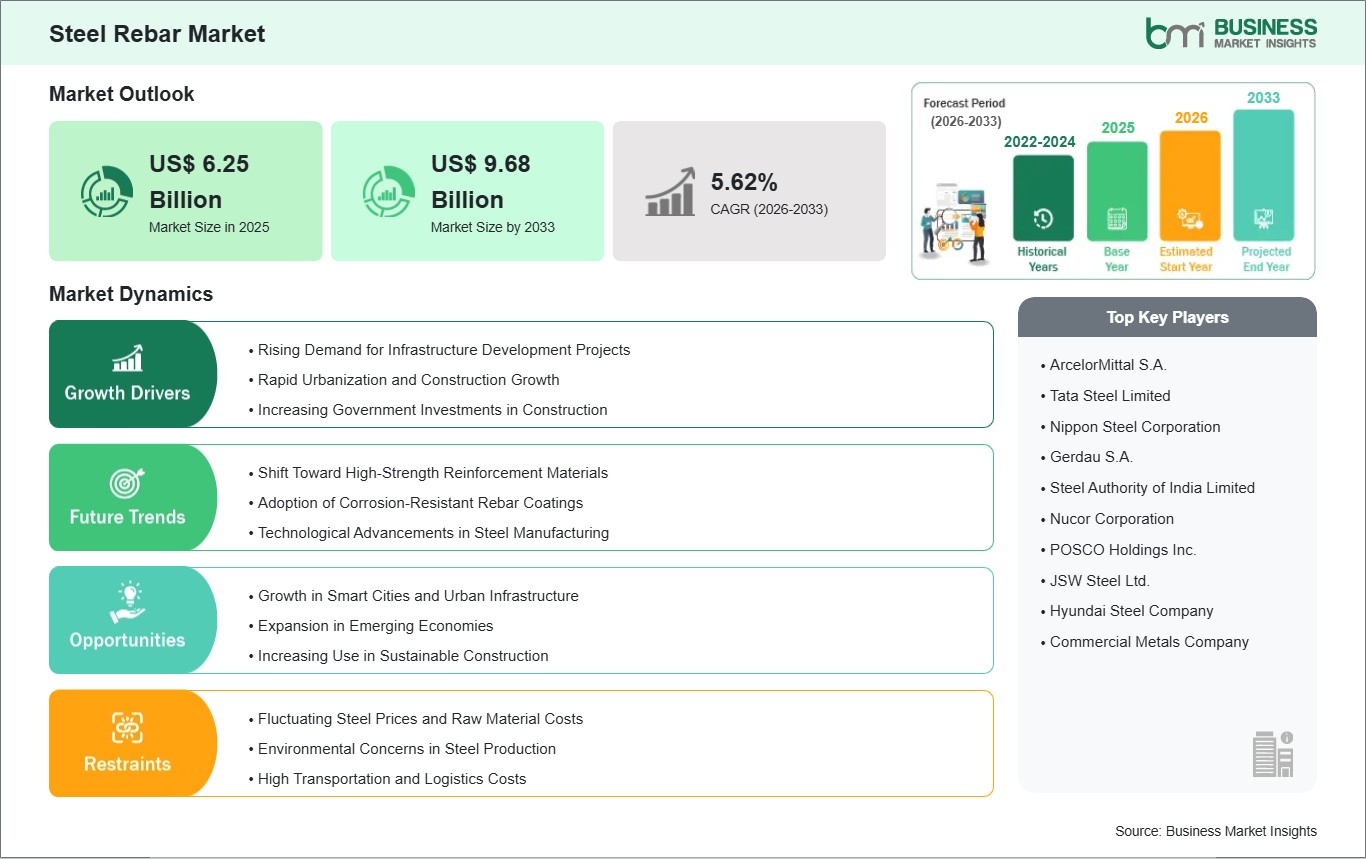
The steel rebar market is witnessing steady growth due to increasing demand from the construction and infrastructure sectors. Steel rebar is a key component in building concrete structures, providing strength, durability, and stability. Deformed steel rebars lead in terms of type due to their high bonding capabilities, while plain carbon steel rebars dominate in coating type due to cost advantages. The construction segment leads due to rapid urbanization and increasing building activities. The market is strongly influenced by infrastructure development and government initiatives in construction. Steel rebars are widely used to ensure structural integrity and safety. Additionally, growing smart city projects are positively impacting market growth. Despite challenges such as fluctuating raw material prices and environmental concerns, the market is expected to grow steadily, supported by global construction demand and infrastructure investments.
Segment Analysis
Steel Rebar Market Segmentation
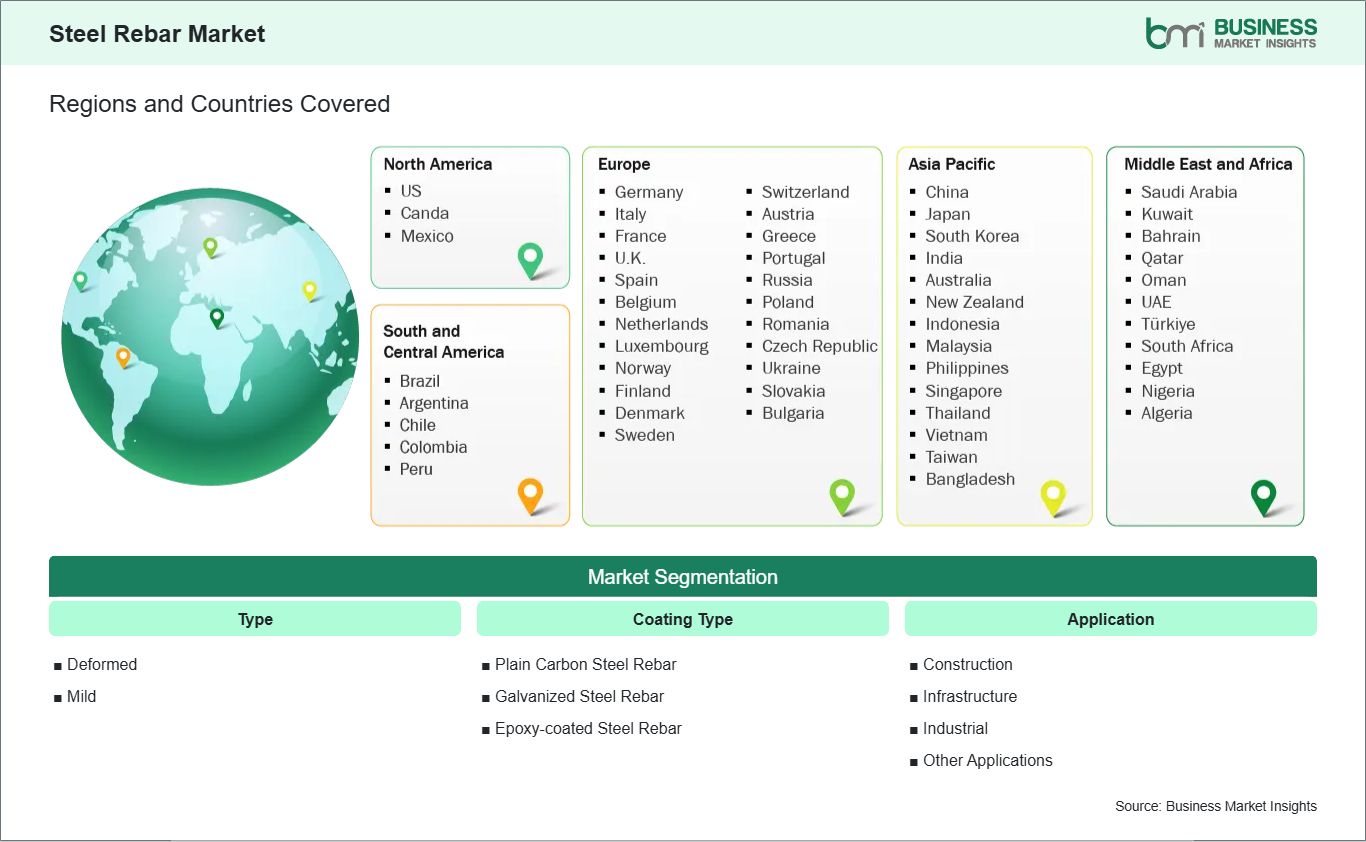
Key segments that contributed to the derivation of the Steel Rebar market analysis are type, coating type, and application.
- By type, the steel rebar market is segmented into Deformed and Mild. The Deformed segment dominated the market in 2025.
- By coating type, the steel rebar market is segmented into Plain Carbon Steel Rebar, Galvanized Steel Rebar, and Epoxy-coated Steel Rebar. The Plain Carbon Steel Rebar segment dominated the market in 2025.
- By application, the steel rebar market is segmented into Construction, Infrastructure, Industrial, and Others. The Construction segment dominated the market in 2025.
Market Forces
Steel Rebar Market Drivers and Opportunities
Rising Demand for Infrastructure Development Projects
The increasing demand for infrastructure development projects is a major factor influencing the steel rebar market. Governments worldwide are investing in transportation infrastructure, bridges, highways, and urban development to support economic growth and population expansion. Steel rebar is a critical component in these projects as it provides tensile strength to concrete, ensuring durability and long-term performance. Infrastructure projects require materials that can withstand environmental conditions and heavy loads, making steel rebar essential. The growing need to upgrade existing infrastructure and develop new projects is driving demand. Emerging economies are also investing heavily in infrastructure development, further boosting market growth. As global infrastructure development continues to expand, the demand for steel rebar is expected to increase steadily.
Growth in Smart Cities and Urban Infrastructure
The growth in smart cities and urban infrastructure presents significant opportunities for the steel rebar market. Governments and urban planners are focusing on developing advanced infrastructure systems that enhance efficiency, sustainability, and quality of life. Steel rebar is widely used in the construction of smart buildings, transportation systems, and public utilities. Smart city projects involve high-rise buildings, metro systems, bridges, and integrated infrastructure, all of which require strong and durable reinforcement materials. Steel rebar ensures structural integrity and supports the development of resilient infrastructure. Increasing investments in urban development projects are creating new growth opportunities. Government initiatives promoting sustainable construction and advanced building technologies are further driving demand. As smart city initiatives expand globally, the steel rebar market is expected to benefit from increased construction activity.
Size and Share Analysis
Steel Rebar Market Size and Share Analysis
The global Steel Rebar market is experiencing steady growth, with market size and share analysis reflecting evolving treatment preferences and competitive dynamics among key players. The report evaluates important subsegments categorized within type, coating type, and application, highlighting their respective contributions to overall market performance.
By type, the Deformed subsegment dominated the market in 2025 due to its superior bonding with concrete, enhanced tensile strength, and improved load distribution, making it widely used in reinforced concrete structures.
By coating type, the Plain Carbon Steel Rebar subsegment dominated the market in 2025 due to its cost-effectiveness, widespread availability, and extensive use in general construction applications.
By application, the Construction subsegment dominated the market in 2025 due to rapid urbanization and increasing demand for residential and commercial buildings requiring strong and durable reinforcement materials.
Report Coverage
Steel Rebar Market Report Coverage and Deliverables
The "Steel Rebar Market Size and Forecast (2022 - 2033)" report provides a detailed analysis of the market covering below areas:
- Steel Rebar market size and forecast at the regional and country levels for segments covered under the scope
- Steel Rebar market trends, as well as drivers, restraints, and opportunities
- Steel Rebar market analysis covering key trends, regional framework, major players, regulations, and recent developments
- Industry landscape and competition analysis covering market concentration, heat map analysis, prominent players, and recent developments for the Steel Rebar market
- Detailed company profiles, including SWOT analysis
Geographic Insights
Steel Rebar Market Geographic Insights
The geographical scope of the Steel Rebar market report is divided into: North America, Asia Pacific, Europe, Middle East & Africa, and South & Central America. North America held the largest share in 2025.
North America dominated the steel rebar market due to strong construction activity, advanced infrastructure development, and significant government investments. The United States plays a key role, with extensive projects in residential, commercial, and transportation infrastructure driving demand. The region benefits from well-established construction practices and major steel manufacturers. Increasing focus on infrastructure modernization and repair of aging structures is further boosting demand. Canada also contributes through its construction and infrastructure initiatives. Government policies supporting sustainable construction and efficient building practices are encouraging the use of high-quality reinforcement materials. With ongoing investments in infrastructure and urban development, North America is expected to maintain its dominant position.
Industry Activity
Recent Developments
The Steel Rebar market is evaluated by gathering qualitative and quantitative data post primary and secondary research, including corporate publications, association data, and databases. A few key developments in the Steel Rebar market are:
- In July 2023, JSW Steel commissioned new rebar production lines at its Vijayanagar plant in India.
- In September 2024, Tata Steel introduced high-strength, corrosion-resistant rebar products for coastal and high-humidity regions.
Trust & Transparency
Research Methodology
The market analysis combines proprietary research with secondary data from government agencies, company disclosures, regulatory filings, industry databases and expert interviews. Market estimates are validated through data triangulation, cross-market benchmarking and analyst
review.
View Full Research Methodology
Key Sources Referred:
American Iron and Steel Institute (AISI) ASTM International - Committee on Reinforcing Steel International Stainless Steel Forum (ISSF) World Steel Association (WSA) Steel Reinforcement Institute of Australia (SRIA) Company Websites Company Annual Reports Company Investor Presentations