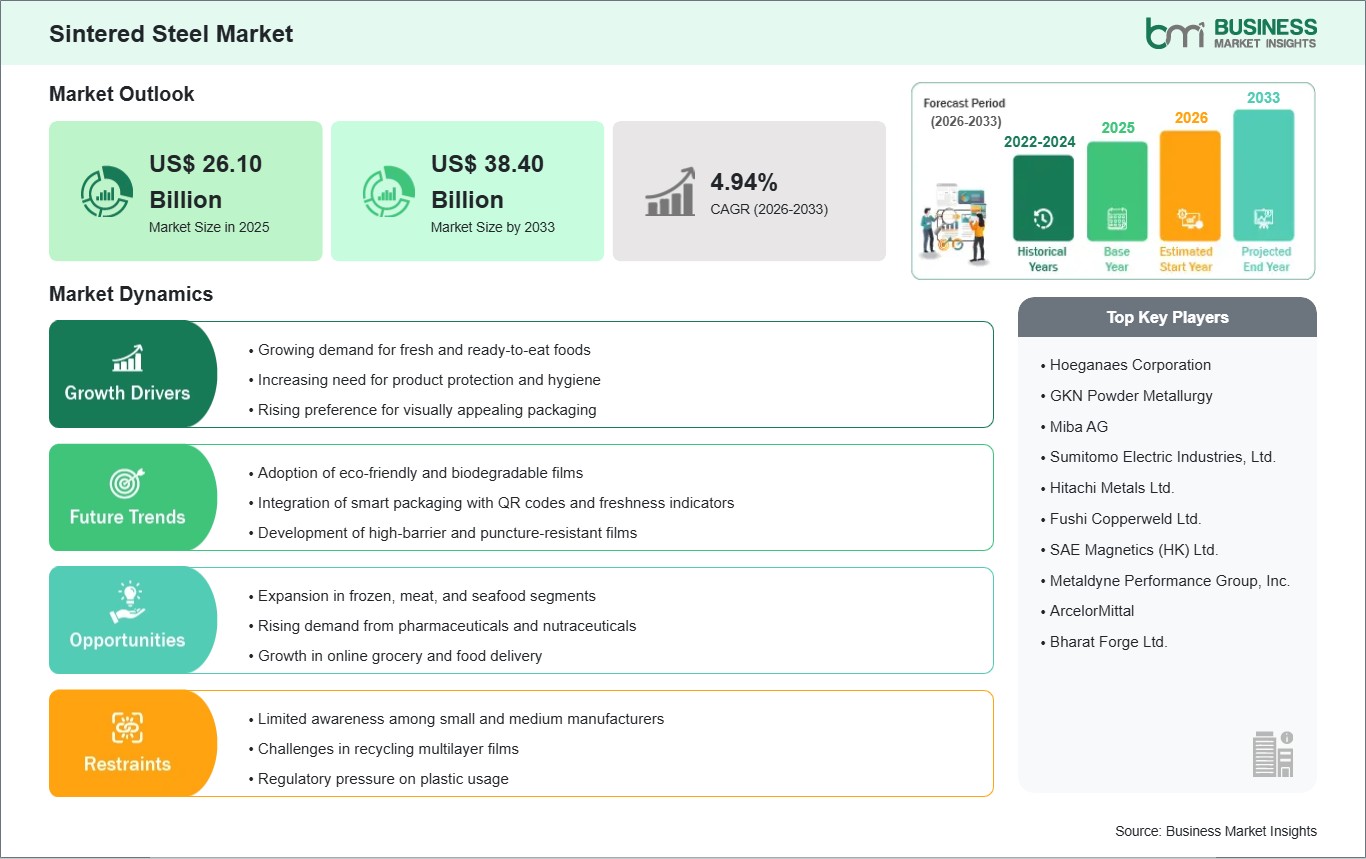
The Sintered Steel Market size is expected to reach US$ 38.4 billion by 2033 from US$ 26.1 billion in 2025. The market is estimated to record a CAGR of 4.94% from 2026 to 2033.
The global market for sintered steels is experiencing a major transformation due to the increased demand for cost-effective products with high performance in various industries like automotive, industrial machinery, and aerospace. Sintered steels, manufactured using powder metallurgy technology, exhibit dimensional accuracy, efficient material utilization, and enhanced mechanical properties, making them suitable for various applications like gears, bearings, structural components, and engine components. The market is fueled by the global drive for lightweight, strong, and efficient products, especially in automotive and industrial machinery industries where weight reduction without compromising strength is critical.
With technological advancements, such as alloy development, sintering, and hybrid technologies, there has been an increasing possibility of developing sintered steel products with better wear resistance, fatigue strength, and corrosion protection. Environmental factors, including reduced waste and energy consumption, also contribute to increasing product demand. However, there are some factors that might act as barriers to the development of this product. These factors include high capital costs associated with powder metallurgy, production complexities, and difficulties in manufacturing large products. Fluctuating raw material prices will be one more factor affecting pricing strategy. Despite all these barriers, the product has been gaining popularity, thanks to advancements in material science, industrial automation, and increasing product use in critical applications.

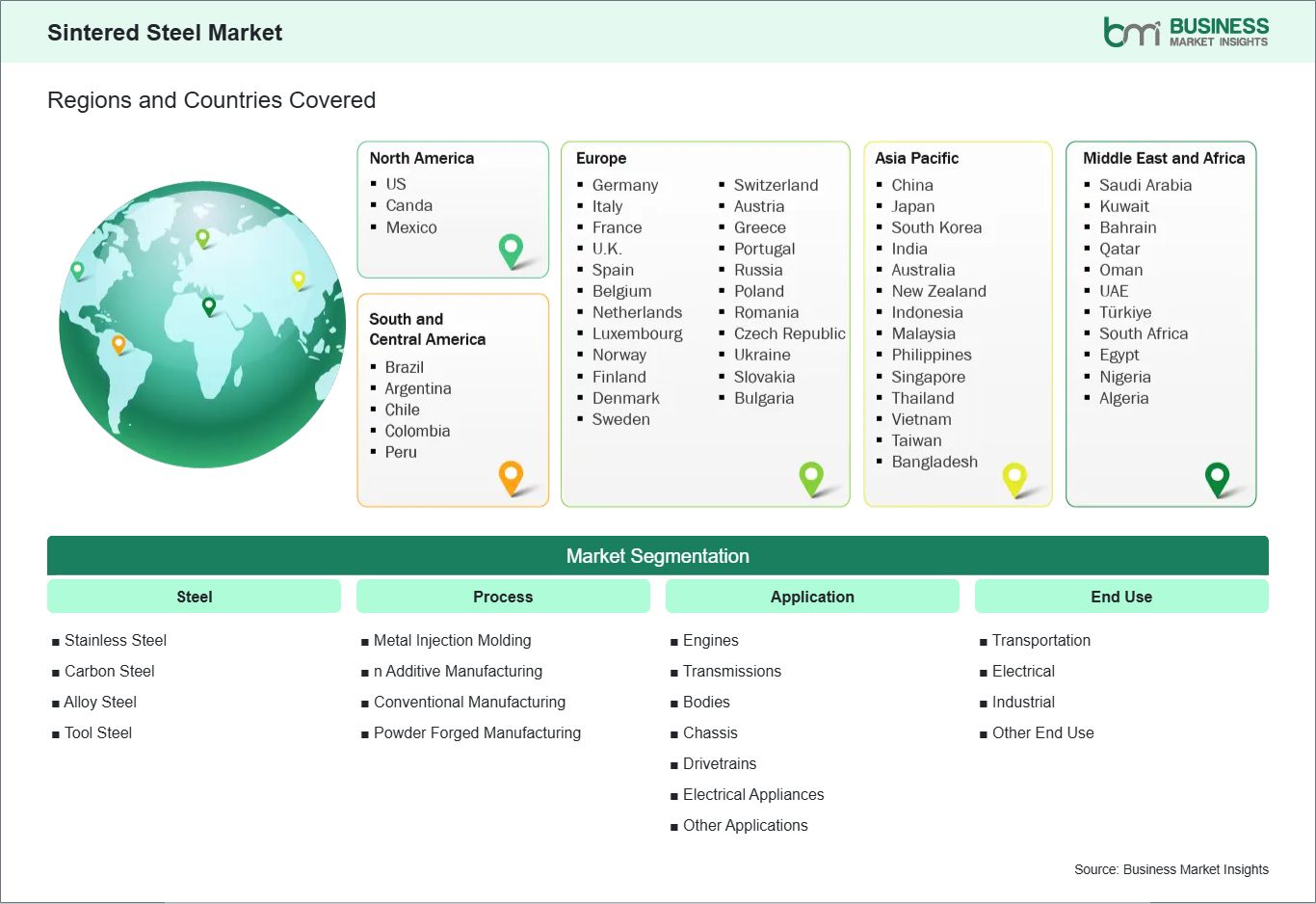
Key segments that contributed to the derivation of the sintered steel market analysis are steel, process, application, and end use.
Emerging urban and semi-urban markets across Western Europe are providing new opportunities for sintered steel manufacturers. As population centers in cities like Lisbon, Milan, and Lyon expand, there is rising investment in automated manufacturing and infrastructure, which requires durable metal components. Sintered steel, known for its wear resistance and strength-to-weight ratio, is increasingly used in compact industrial machinery, precision engineering, and transportation systems in these growing urban hubs. In Italy’s Lombardy region, small and medium-sized factories are modernizing equipment for local food, automotive, and packaging industries, driving incremental demand for sintered steel parts such as powder metallurgy gears, bushings, and bearings.
In Spain, semi-urban processing clusters near Valencia and Zaragoza are upgrading machinery in food and beverage production lines to meet rising domestic and European export demand. Sintered steel components are favored due to their ability to reduce assembly costs, improve energy efficiency in motors, and extend service life under continuous operation. Manufacturers report that integrating sintered steel has lowered machine downtime and maintenance frequency, making production more resilient and competitive.
Additionally, the expansion of cold-chain logistics across Western Europe has indirectly increased demand for sintered steel. Machines handling packaging, sealing, and labeling in refrigerated environments require components that can withstand temperature variations and moisture exposure. As the fresh and ready-to-eat food market grows, manufacturers are expected to prioritize machinery longevity and operational reliability, supporting continuous adoption of sintered steel components throughout the region’s food processing sector.
Emerging urban and semi-urban markets across Western Europe are providing new opportunities for sintered steel manufacturers. As population centers in cities like Lisbon, Milan, and Lyon expand, there is rising investment in automated manufacturing and infrastructure, which requires durable metal components. Sintered steel, known for its wear resistance and strength-to-weight ratio, is increasingly used in compact industrial machinery, precision engineering, and transportation systems in these growing urban hubs. In Italy’s Lombardy region, small and medium-sized factories are modernizing equipment for local food, automotive, and packaging industries, driving incremental demand for sintered steel parts such as powder metallurgy gears, bushings, and bearings.
In Spain, semi-urban processing clusters near Valencia and Zaragoza are upgrading machinery in food and beverage production lines to meet rising domestic and European export demand. Sintered steel components are favored due to their ability to reduce assembly costs, improve energy efficiency in motors, and extend service life under continuous operation. Manufacturers report that integrating sintered steel has lowered machine downtime and maintenance frequency, making production more resilient and competitive.
Furthermore, the expansion of urban logistics networks and automation in semi-urban industrial zones is contributing to demand for high-precision sintered steel components in conveyor systems, robotic arms, and handling equipment. Countries like Belgium and France are deploying automated warehouse and distribution systems for groceries and fresh products, where sintered steel is essential for reliable performance under continuous mechanical stress. Overall, as Western Europe’s urban and semi-urban markets continue to grow, sintered steel is expected to see sustained demand across multiple industrial applications beyond traditional manufacturing hubs.

The sintered steel market is experiencing steady growth, with market size and share analysis reflecting evolving treatment preferences and competitive dynamics among key players. The report evaluates important subsegments categorized within steel, process, application, and end use highlighting their respective contributions to overall market performance.
By steel, the alloy steel subsegment dominated the Sintered steel market in 2025 because they offer the best combination of strength, toughness, and wear resistance once sintered and heat‑treated. Their alloying elements (like nickel, molybdenum, chromium) allow engineers to tailor mechanical properties for demanding parts without excessive machining.
Based on process, the conventional manufacturing subsegment dominated the sintered steel market in 2025 because it balances high throughput, low cost per part, and consistent quality. Most industrial users choose this method over more specialized routes because it’s proven, easily scalable, and suitable for large runs of complex shapes.
On a basis of application, the glass manufacturing subsegment dominated the sintered steel market in 2025 because hey contain a high number of precision, load‑bearing sintered components like gears, synchronizers, and shift forks. The performance requirements for torque transmission and wear resistance make sintered steel an efficient choice versus machined forged parts, especially in modern automatic and dual‑clutch transmissions where compact, tightly toleranced parts are essential.
In terms of end use, the transportation subsegment dominated the sintered steel market in 2025 due to the sheer volume of components used in engines, drivetrains, and transmissions. Sintered steel’s ability to deliver precise geometry with minimal post‑machining makes it ideal for cost‑sensitive, high‑volume vehicle production. Growth in electric and hybrid vehicles also supports this dominance, as more transmission and motor components are adapted to powder metallurgy.
| Report Attribute | Details |
|---|---|
| Market size in 2025 | US$ 26.10 Billion |
| Market Size by 2033 | US$ 38.40 Billion |
| Global CAGR (2026 - 2033) | 4.94% |
| Historical Data | 2022-2024 |
| Forecast period | 2026-2033 |
| Segments Covered | By Steel
|
|
Regions and Countries Covered
| |
| North America | US, Canada, Mexico |
| Europe | Belgium, Austria, Finland, Denmark, Greece, Poland, Romania, Russia, Ukraine, Czech Republic, Slovakia, Bulgaria, Italy, Luxembourg, Germany, Switzerland, France, Netherlands, Norway, Portugal, Spain, Sweden, United Kingdom |
| Asia-Pacific | Australia, China, India, Japan, South Korea, Indonesia, Malaysia, Philippines, Singapore, Thailand, Vietnam, Bangladesh, New Zealand, Taiwan |
| South and Central America | Brazil, Argentina, Peru, Chile, Colombia |
| Middle East and Africa | Bahrain, Kuwait, Oman, Qatar, Saudi Arabia, United Arab Emirates, Turkiye, South Africa, Egypt, Algeria, Nigeria |
| Market leaders and key company profiles |
|
The "Sintered steel market Size And Forecast (2022 - 2033)" report provides a detailed analysis of the market covering below areas:
The geographical scope of the Sintered steel market report is divided into five regions: North America, Asia Pacific, Europe, Middle East & Africa, and South & Central America. The Sintered steel market in North America is expected to grow during the forecast period.
North America is the leader in the global sintered steel market, and this is mainly because of the advanced manufacturing facilities, the automotive and industrial industries, and the emphasis on innovation and technology. The region is also home to major automotive and industrial companies, and they need high-quality, lightweight, and durable components, and sintered steel is the best solution for them, especially for gears, bearings, and engine components. The United States and Canada are the major players in the global market, and they are the pioneers in the production of advanced sintered steel alloys, especially through the powder metallurgy method, and the region is also embracing the concept of automation and smart manufacturing, and this is helping the production of high-precision and high-volume sintered steel components.
In addition, the region is also focused on sustainable and energy-efficient technologies, and industries are also shifting to sintered steel because the production process is energy-efficient and less wastage of raw materials compared to steel components. Although the region is facing challenges, especially because the production cost is high and the complexity is also an issue, the region is still the leader in the global market because of the advanced R&D facilities and the strong industrial demand.

The sintered steel market is evaluated by gathering qualitative and quantitative data post primary and secondary research, which includes important corporate publications, association data, and databases. A few of the key developments in the sintered steel market are:
The Sintered Steel Market is valued at US$ 26.10 Billion in 2025, it is projected to reach US$ 38.40 Billion by 2033.
As per our report Sintered Steel Market, the market size is valued at US$ 26.10 Billion in 2025, projecting it to reach US$ 38.40 Billion by 2033. This translates to a CAGR of approximately 4.94% during the forecast period.
The Sintered Steel Market report typically cover these key segments-
The historic period, base year, and forecast period can vary slightly depending on the specific market research report. However, for the Sintered Steel Market report:
The Sintered Steel Market is populated by several key players, each contributing to its growth and innovation. Some of the major players include:
The Sintered Steel Market report is valuable for diverse stakeholders, including:
Essentially, anyone involved in or considering involvement in the Sintered Steel Market value chain can benefit from the information contained in a comprehensive market report.
Please tell us your area of interest
(Market Segments/ Regions and Countries/ Companies)