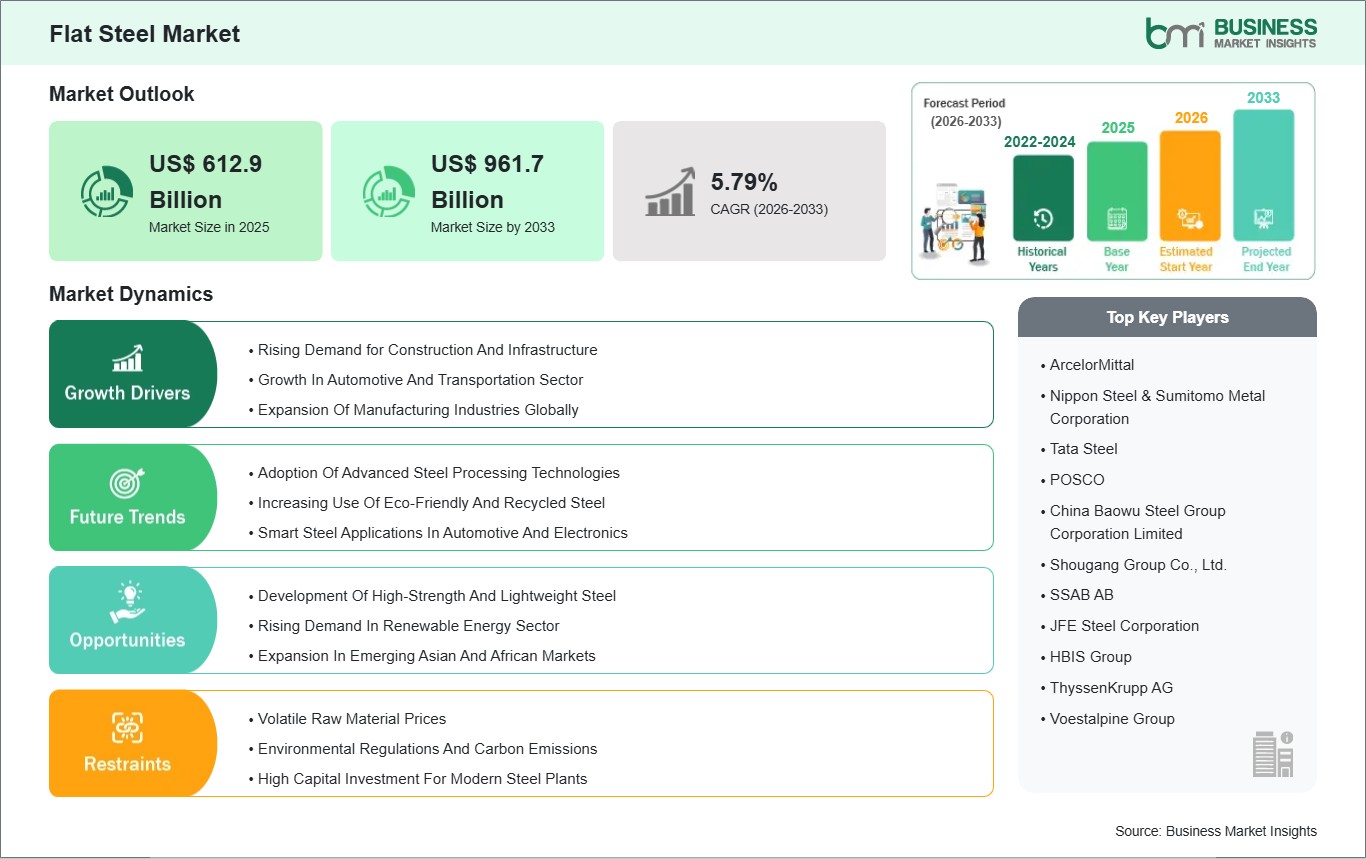
The Flat Steel Market size is expected to reach US$ 961.7 Billion by 2033 from US$ 612.9 Billion in 2025. The market is estimated to record a CAGR of 5.79% from 2026 to 2033.
The global flat steel market refers to steel products made from sheets, strips, or coils. This market has been driven primarily by demand from industries such as automobiles, construction, heavy machinery, consumer appliances, and energy. Moreover, the emphasis on lightweight materials with high strength, particularly in the automobile and aerospace industries, has increased the adoption of flat steel. Urbanization, along with infrastructure development in emerging economies, has been a major growth factor. On the other hand, steel manufacturers are adopting eco-friendly manufacturing practices to ensure environmental sustainability. This has increased the demand for flat steel, as steel can be a green product. However, there are some restraining factors that may affect the rate of growth.
Raw materials like iron ore and steel scraps may fluctuate, which may affect the profitability of production. Additionally, materials like aluminum and composites are increasingly being used in the automotive industry as well as in packaging materials. This may affect steel`s market competition. Trade barriers, tariffs, and geopolitical issues faced in major regions may affect growth. Yet, the flat steel market continues to thrive owing to consistent demand from industries, technological developments, and its use in critical infrastructure like construction, transport, and energy. Strategic planning of production, along with efficient production processes, is necessary.

Key segments that contributed to the derivation of the flat steel market analysis are process, type and end user.
The flat steel market is growing at a significant rate across the globe due to the constant increase in construction and infrastructure projects. Flat steel is known for its strength, flexibility, and dependability, and as such, it is one of the most important building materials in many structural projects. Flat steel is used in many construction projects, including beams, plates, sheets, and cladding, and is widely used in many industrial facilities, bridges, and skyscrapers. Its flexibility in accommodating various construction processes has allowed architects and engineers to develop many sophisticated structures while at the same time providing the necessary strength and durability to the structures. As such, flat steel has become one of the most important building materials in modern construction practices, enabling many structures to be built while at the same time providing the necessary safety and strength to the structures.
The development of infrastructure also leads to a greater demand for flat steel, given its applications in different fields. Infrastructure projects, especially, require materials that can support high loads and extreme conditions. Flat steel ensures quality, mechanical properties, and assembly, which are beneficial for long-term investments in infrastructure that must perform under high stress conditions. Flat steel also promotes new technologies in construction, like prefabricated materials, which enable faster construction times without compromising quality and efficiency.
Sustainability and modernization trends further reinforce the growth of flat steel in construction and infrastructure. Renovation and upgrading of existing structures, including bridges, utilities, and industrial facilities, create additional opportunities for steel products that offer durability and long service life. Flat steel`s recyclability and ability to integrate with environmentally conscious construction practices align with the increasing focus on sustainable development. As construction priorities continue to evolve toward efficiency, resilience, and environmental responsibility, the demand for flat steel is expected to remain strong, presenting ongoing opportunities for innovation, tailored solutions, and product development across the global market.
The development of high-strength and lightweight flat steel represents one of the most significant opportunities in the global market. These advanced steel grades provide exceptional mechanical performance, allowing structures and components to be both stronger and lighter. High-strength flat steel is particularly valuable in applications that demand superior load-bearing capacity, resistance to fatigue, and durability under extreme operating conditions. Lightweight steel variants improve efficiency by reducing material usage and facilitating easier handling and installation, while still maintaining structural integrity. Together, these attributes make high-strength and lightweight flat steel an increasingly preferred choice in industries where both performance and efficiency are critical.
The market demand for these high-grade materials is largely influenced by the need for these materials in various industries and infrastructure development. Industries such as industrial equipment manufacturing, transportation systems, and modern construction practices are increasingly showing a need for materials that provide the best ratio of weight to strength without compromising safety. High-strength flat steel materials provide structures that can be built to last for long periods and endure high usage rates, while lightweight materials provide structures that can be assembled in innovative ways for faster construction processes.
The technological advancements that have been achieved in the production and processing of the product provide additional scope for the increased use of high-strength and lightweight flat steel products. The sustainable production of the product also increases the chances for the increased use of high-strength and lightweight flat steel products, as it meets the environmental needs that have been achieved by the production process. As the need for sustainable and cost-effective production continues to grow in the global industry, the increased use of high-strength and lightweight flat steel products provides a great opportunity for the growth of the industry.

The flat steel market is experiencing steady growth, with market size and share analysis reflecting evolving treatment preferences and competitive dynamics among key players. The report evaluates important subsegments categorized within process, type and end user, highlighting their respective contributions to overall market performance.
By process, the Basic Oxygen Furnace subsegment dominated the Flat Steel market in 2025. Basic oxygen furnace steel offers high production efficiency and consistent quality, making it highly suitable for large-scale steel manufacturing, which drives its widespread adoption.
Based on type, the Sheets & Strips subsegment dominated the Flat Steel market in 2025. Sheets and strips offer versatility, ease of fabrication, and wide applicability in industries such as automotive and construction, making them highly suitable for a wide range of applications, which drives their widespread adoption.
In terms of end user, the Building & Infrastructure subsegment dominated the Flat Steel market in 2025. Building and infrastructure applications demand durable, cost-effective, and versatile steel products, making this segment highly suitable for structural and construction needs, which drives its widespread adoption.
| Report Attribute | Details |
|---|---|
| Market size in 2025 | US$ 612.9 Billion |
| Market Size by 2033 | US$ 961.7 Billion |
| Global CAGR (2026 - 2033) | 5.79% |
| Historical Data | 2022-2024 |
| Forecast period | 2026-2033 |
| Segments Covered | By Process
|
|
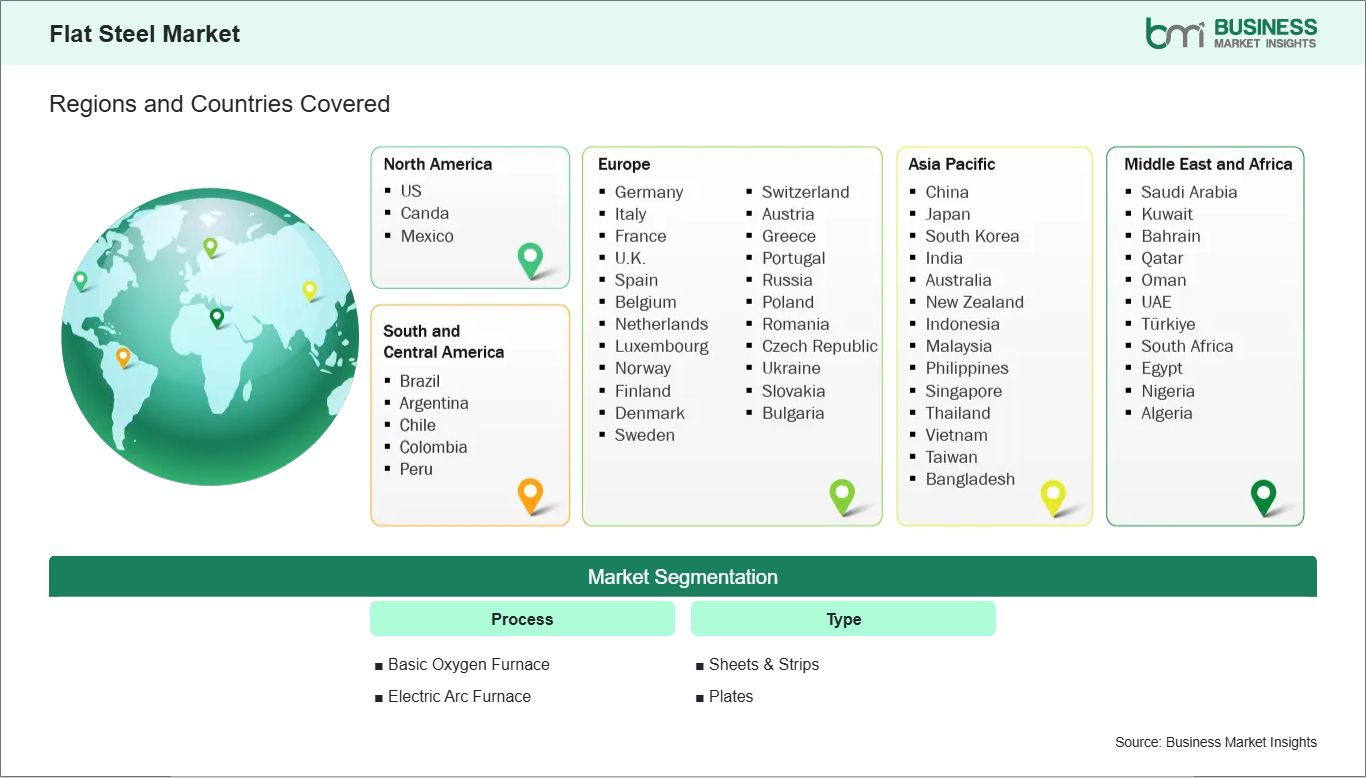
Regions and Countries Covered
| |
| North America | US, Canada, Mexico |
| Europe | Belgium, Austria, Finland, Denmark, Greece, Poland, Romania, Russia, Ukraine, Czech Republic, Slovakia, Bulgaria, Italy, Luxembourg, Germany, Switzerland, France, Netherlands, Norway, Portugal, Spain, Sweden, United Kingdom |
| Asia-Pacific | Australia, China, India, Japan, South Korea, Indonesia, Malaysia, Philippines, Singapore, Thailand, Vietnam, Bangladesh, New Zealand, Taiwan |
| South and Central America | Brazil, Argentina, Peru, Chile, Colombia |
| Middle East and Africa | Bahrain, Kuwait, Oman, Qatar, Saudi Arabia, United Arab Emirates, Turkiye, South Africa, Egypt, Algeria, Nigeria |
| Market leaders and key company profiles |
|
The "Flat Steel Market Size and Forecast (2022 - 2033)" report provides a detailed analysis of the market covering below areas:
The geographical scope of the Flat Steel market report is divided into five regions: North America, Asia Pacific, Europe, Middle East & Africa, and South & Central America. The Flat Steel market in North America is expected to grow during the forecast period.
North America is one of the major markets for flat steel products in the world, supported by its well-developed industrial infrastructure, advanced manufacturing facilities, and a wide range of industries. The region`s automotive and aerospace industries are major consumers of flat steel, as they need high-quality flat steel for their structural, body, and safety-critical parts. Furthermore, there are many infrastructure development projects, residential and commercial building construction, and machinery production in the region, which are also contributing to the demand for flat steel products. Manufacturers in the region are adopting advanced steel production technologies, enabling them to produce flat steel products with higher quality and efficiency. The use of flat steel in renewable energy projects such as wind turbines and solar panels will increase the scope of usage, which indicates the region`s commitment to sustainable industrial development.
Strategic partnerships between steel producers and consumers will promote long-term supply contracts, product customization, and innovation in lightweight steel products. However, despite all the positive factors, the market faces challenges from increased production costs compared to low-cost competitors from around the world. Environmental regulations are another challenge facing the industry, which aims to reduce emissions. However, North America`s technological capabilities, industrial demands, and supply chain networks confirm its status as a major contributor to the global flat steel market. Innovation and strategic market positioning will continue to be major growth factors for the region.

The flat steel market is evaluated by gathering qualitative and quantitative data post primary and secondary research, which includes important corporate publications, association data, and databases. A few of the key developments in the flat steel market are:
The Flat Steel Market is valued at US$ 612.9 Billion in 2025, it is projected to reach US$ 961.7 Billion by 2033.
As per our report Flat Steel Market, the market size is valued at US$ 612.9 Billion in 2025, projecting it to reach US$ 961.7 Billion by 2033. This translates to a CAGR of approximately 5.79% during the forecast period.
The Flat Steel Market report typically cover these key segments-
The historic period, base year, and forecast period can vary slightly depending on the specific market research report. However, for the Flat Steel Market report:
The Flat Steel Market is populated by several key players, each contributing to its growth and innovation. Some of the major players include:
The Flat Steel Market report is valuable for diverse stakeholders, including:
Essentially, anyone involved in or considering involvement in the Flat Steel Market value chain can benefit from the information contained in a comprehensive market report.
Please tell us your area of interest
(Market Segments/ Regions and Countries/ Companies)