
Static and Rotating Equipment Market Outlook: Size, Share, Trends, Growth Analysis, Competitive Landscape & Forecast, 2026-2033

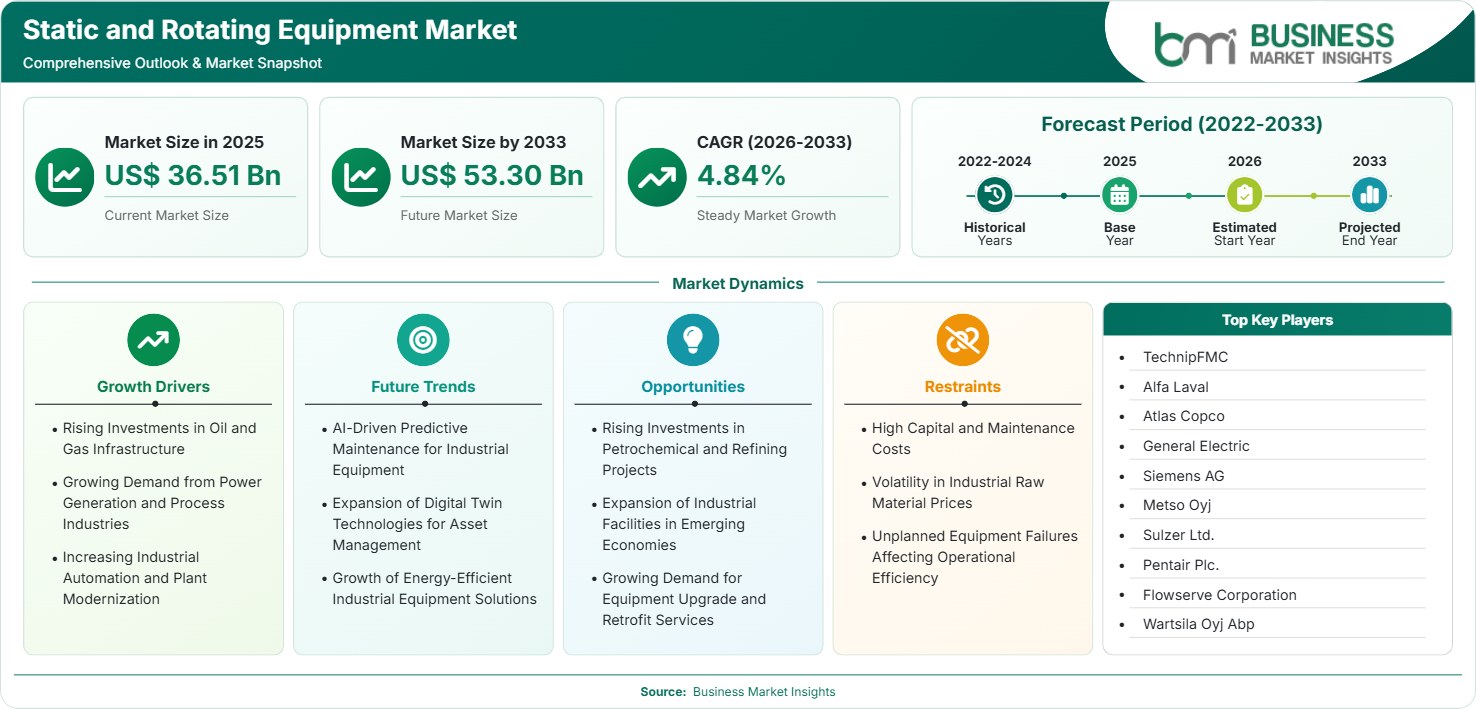
The Static and Rotating Equipment Market size was valued at US$ 36.51 Billion in 2025 and is projected to reach US$ 53.30 Billion by 2033, growing at a CAGR of 4.84% during 2026–2033. Rising investments in oil & gas infrastructure, increasing industrial automation, growing refinery modernization projects, and expanding energy production activities are supporting market growth globally.

Report Coverage
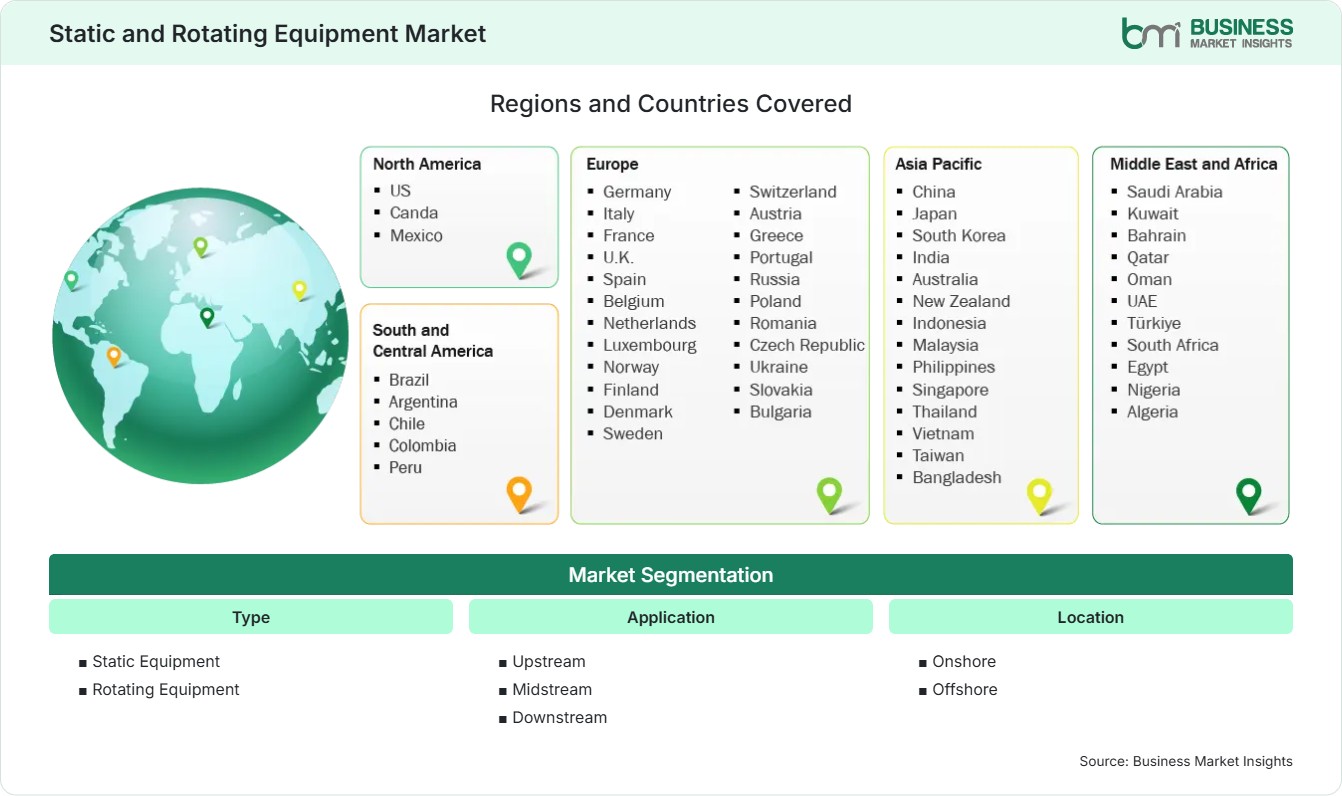
  • Type: Static Equipment, Rotating Equipment
  • Application: Upstream, Midstream, Downstream
  • Location: Onshore, Offshore
US$ 36.51 Bn Market size in 2025
US$ 53.30 Bn Market Size by 2033
4.84% CAGR, 2026 - 2033
2026-2033 Forecast Period

AI Overview

Static and Rotating Equipment Market Summary

  • North America Region: North America holds a static and rotating equipment market share of 35%–38% in 2025, growing with a CAGR of 4.5%–5.2% during 2026–2033. Increasing investments in oil & gas production, refinery upgrades, and industrial infrastructure modernization continue supporting regional leadership. The U.S. market is expected to register a CAGR of 4.7%–5.4%.
  • Fastest Growing Region: Asia Pacific accounts for 28%–31% share in 2025 and is projected to grow at a CAGR of 5.3%–6.0% through 2033. Expanding industrialization, increasing refining capacity, and rising energy demand continue driving regional growth.
  • Leading Segment: Rotating Equipment represents 54%–57% share in 2025 and is expected to grow at a CAGR of 4.9%–5.6% through 2033. Extensive utilization of pumps, compressors, turbines, and motors across industrial processes continues supporting segment dominance.
  • High Growth Segment: Downstream accounts for 38%–41% share in 2025 and is forecast to grow at a CAGR of 5.2%–5.9% during 2026–2033. Rising refinery expansions, petrochemical investments, and fuel processing capacity enhancements continue accelerating segment growth.
  • Key Market Opportunity: Expansion of refinery modernization projects, offshore oil & gas developments, industrial digitalization, and predictive maintenance technologies is creating substantial growth opportunities.
  • Major Market Players: TechnipFMC, Alfa Laval, Atlas Copco, General Electric, Siemens AG, Metso Oyj, Sulzer Ltd., Pentair Plc., Flowserve Corporation, and Wartsila Oyj Abp.
Strategic Insights

Static and Rotating Equipment Market: Strategic Insights

Static and Rotating Equipment Market Strategic Framework
FREE PDF
Request your free sample
Request free sample
Stakeholder View

Key Takeaways

  • Static and rotating equipment remain critical assets across energy, industrial, and processing environments.
  • Rotating equipment continues dominating the static and rotating equipment market due to extensive deployment of pumps, compressors, and turbines.
  • Downstream applications remain the leading segment supported by refinery and petrochemical expansion projects.
  • Industrial digitalization and predictive maintenance technologies are improving equipment performance and reliability.
  • Energy infrastructure modernization continues creating demand for advanced process equipment.
  • North America remains the leading market due to strong oil & gas and industrial investments.
  • Asia Pacific is projected to witness the fastest growth owing to expanding industrialization and refining capacity additions.
  • Offshore developments, refinery upgrades, and automation initiatives are expected to create significant long-term opportunities.
Geographic Outlook

Static and Rotating Equipment Market Regional Highlights

North America Static and Rotating Equipment Market

North America accounts for 35%–38% Static and Rotating Equipment Market share in 2025 and is projected to grow at a CAGR of 4.5%–5.2% through 2033. Strong oil & gas production, increasing refinery modernization projects, and growing investments in industrial infrastructure continue supporting regional leadership. The region benefits from advanced operational capabilities and extensive energy sector investments.

  • Energy companies continue investing in equipment modernization programs to improve reliability, operational efficiency, and asset lifecycle performance across upstream and downstream facilities.
  • Growing pipeline and midstream infrastructure development is supporting demand for pumps, compressors, valves, and associated processing equipment.
  • Refinery operators are increasingly adopting advanced monitoring and predictive maintenance solutions to maximize equipment availability and reduce downtime.
  • Industrial automation initiatives are encouraging deployment of highly efficient rotating equipment across manufacturing and processing sectors.
  • Offshore and unconventional oil & gas development activities continue generating demand for specialized industrial equipment.
  • Sustainability objectives are promoting adoption of energy-efficient systems designed to reduce operational costs and environmental impact.

US Static and Rotating Equipment Market

The United States contributes approximately 85%–89% of North American revenue and is expected to register a CAGR of 4.7%–5.4% through 2033. Strong oil & gas production, extensive refining capacity, and increasing industrial investments continue supporting market leadership.

  • Operators continue replacing aging equipment with advanced systems designed to improve efficiency and operational performance.
  • Growing investments in LNG facilities and refining infrastructure are increasing demand for rotating equipment and process systems.
  • Industrial facilities are increasingly utilizing predictive maintenance technologies to enhance operational reliability.
  • Manufacturing modernization initiatives continue supporting adoption of advanced equipment solutions.
  • Rising energy infrastructure investments remain an important contributor to static and rotating equipment market growth.

Europe Static and Rotating Equipment Market

Europe represents 24%–27% of global revenue in 2025 and is anticipated to expand at a CAGR of 4.8%–5.5% through 2033. Increasing industrial modernization, energy efficiency initiatives, and investments in advanced process infrastructure continue supporting regional growth. Germany remains the leading market while Poland demonstrates stronger growth momentum.

  • Germany continues leading regional demand through strong industrial manufacturing activity and advanced process engineering investments.
  • Poland is among the fastest-growing markets and is estimated to register a CAGR of 5.8%–6.5% during the forecast period due to expanding industrial infrastructure development.
  • Process industries continue investing in upgraded equipment to improve productivity, safety, and operational performance.
  • Energy efficiency initiatives are encouraging adoption of advanced rotating equipment technologies across industrial facilities.
  • Refinery modernization and petrochemical investments remain important drivers of equipment demand throughout the region.
  • Digitalization and asset management programs continue supporting equipment replacement and modernization activities.

Asia Pacific Static and Rotating Equipment Market

Asia Pacific accounts for 28%–31% of global revenue in 2025 and is expected to achieve the fastest CAGR of 5.3%–6.0% through 2033. Rapid industrialization, expanding refining capacity, and increasing energy consumption continue supporting strong regional growth.

  • China remains the largest regional market due to extensive industrial activity, refinery expansion projects, and significant energy infrastructure investments.
  • India is projected to achieve approximately 6.1%–6.8% CAGR, supported by refinery additions, industrial expansion, and increasing infrastructure development activities.
  • Petrochemical and refining companies are investing heavily in new facilities and modernization projects to support growing energy demand.
  • Manufacturers continue expanding production capabilities, increasing demand for efficient process equipment and industrial machinery.
  • Energy infrastructure investments are encouraging deployment of advanced static and rotating equipment technologies.
  • Industrial automation and digitalization initiatives continue creating long-term opportunities for market participants.

Rest of World Static and Rotating Equipment Market

Rest of World accounts for 8%–11% of global revenue in 2025 and is projected to expand at a CAGR of 4.6%–5.3% through 2033. Growing energy investments, industrial development, and infrastructure modernization initiatives continue supporting market growth.

  • Brazil continues generating demand through upstream energy developments and industrial expansion projects.
  • The UAE is strengthening investments in refinery modernization, petrochemicals, and energy infrastructure development.
  • Saudi Arabia is expected to achieve approximately 5.4%–6.1% CAGR through 2033, supported by large-scale energy sector diversification and industrial projects.
  • Oil & gas operators continue investing in advanced equipment technologies to improve productivity and operational efficiency.
  • Growing industrialization is increasing demand for reliable fluid handling and process equipment across multiple sectors.
  • Infrastructure modernization initiatives are supporting long-term equipment replacement and expansion opportunities.
Global Market Geography
FREE PDF
Request your free sample
Request free sample
Segment Analysis

Static and Rotating Equipment Market Segmentation

Type

The type segment represents the fundamental equipment categories deployed across oil & gas, power generation, petrochemical, mining, and industrial processing facilities. The segment accounts for approximately 54%–57% share in 2025 and is projected to grow at a CAGR of 4.9%–5.6% through 2033. The expanding Static and Rotating Equipment Market scope is supported by rising energy demand, industrial infrastructure expansion, and increasing investments in plant reliability and operational efficiency.

  • Static Equipment: Static equipment includes pressure vessels, heat exchangers, separators, tanks, boilers, columns, and reactors that perform critical processing, storage, and heat transfer functions. Demand remains strong due to their extensive deployment across refining, petrochemical, and energy facilities.
  • Rotating Equipment: Rotating equipment dominates the market owing to widespread utilization of pumps, compressors, turbines, motors, blowers, and generators in industrial operations. These systems play a crucial role in fluid movement, power generation, process control, and production efficiency.

Application

Application diversity continues driving demand as equipment remains essential throughout the oil & gas value chain. This segment accounts for approximately 38%–41% share in 2025 and is expected to register a CAGR of 5.2%–5.9% through 2033. Current Static and Rotating Equipment Market trends indicate increasing investments in downstream processing and infrastructure modernization.

  • Upstream: Upstream operations utilize static and rotating equipment for exploration, drilling, well production, separation, and field processing activities.
  • Midstream: Midstream applications rely on pumps, compressors, storage tanks, and pressure vessels to facilitate transportation, storage, and distribution of hydrocarbons.
  • Downstream: Downstream remains the leading segment due to extensive equipment deployment across refineries, petrochemical facilities, processing plants, and fuel distribution infrastructures.

Location

Location-based deployment plays a significant role in determining equipment specifications, maintenance requirements, and operational performance. This segment accounts for approximately 63%–66% share in 2025 and is forecast to grow at a CAGR of 4.8%–5.5% through 2033.

  • Onshore: Onshore installations dominate the market due to extensive deployment across refineries, petrochemical plants, industrial facilities, power stations, and storage terminals.
  • Offshore: Offshore applications continue witnessing steady growth as operators invest in deepwater and offshore energy developments requiring highly durable and specialized processing equipment.
Market Forces

Static and Rotating Equipment Market Dynamics

Key Market Drivers

Rising Investments in Oil and Gas Infrastructure

Growing investments in oil and gas exploration, production, processing, transportation, and storage facilities continue supporting demand for static and rotating equipment. Energy companies are expanding infrastructure to meet global energy demand while modernizing existing assets to improve operational efficiency and safety. Equipment such as compressors, pumps, pressure vessels, and heat exchangers remain essential for maintaining production reliability and process performance. Large-scale upstream, midstream, and downstream projects continue generating sustained demand across the industry. As energy infrastructure investments expand worldwide, equipment deployment is expected to remain robust throughout the forecast period.

Growing Demand from Power Generation and Process Industries

Power generation facilities and process industries increasingly rely on static and rotating equipment for critical operational functions. Growing electricity consumption, industrial production, and manufacturing activities are creating demand for equipment capable of improving efficiency and operational reliability. Turbines, compressors, pumps, generators, heat exchangers, and pressure vessels play a central role in supporting continuous production processes. As industrial output and electricity generation continue expanding globally, demand for advanced equipment solutions is expected to increase steadily.

Increasing Industrial Automation and Plant Modernization

Industrial operators are increasingly modernizing facilities through automation, digitalization, and predictive maintenance initiatives. Advanced equipment integrated with monitoring systems and smart analytics helps organizations improve reliability, reduce downtime, and optimize maintenance activities. Modernization projects often involve replacement or upgrading of aging assets to achieve better performance and lower operating costs. As industries continue investing in digital transformation and operational excellence programs, demand for advanced static and rotating equipment solutions is expected to remain strong.

Key Market Opportunities

Rising Investments in Petrochemical and Refining Projects

Increasing investments in petrochemical and refining projects are creating significant growth opportunities for the static and rotating equipment market. Oil and gas companies are expanding production capacities, upgrading existing refineries, and diversifying petrochemical output to meet rising global demand for fuels, chemicals, and specialty products. These projects require extensive deployment of critical equipment such as pumps, compressors, turbines, heat exchangers, pressure vessels, reactors, storage tanks, and piping systems to ensure efficient and reliable plant operations. Additionally, refinery modernization programs focused on improving energy efficiency, reducing emissions, and integrating advanced process technologies are driving demand for high-performance equipment. As governments and private investors continue supporting energy infrastructure development, equipment manufacturers are expected to benefit from increased project investments and long-term maintenance contracts.

Expansion of Industrial Facilities in Emerging Economies

Rapid industrialization across emerging economies is generating substantial demand for static and rotating equipment used in manufacturing, power generation, mining, chemicals, and infrastructure projects. Countries in Asia, the Middle East, Latin America, and Africa are investing heavily in industrial parks, processing plants, energy facilities, and large-scale manufacturing complexes to strengthen economic growth and enhance domestic production capabilities. These developments require reliable pumps, compressors, turbines, heat exchangers, pressure vessels, and other process equipment to support continuous operations and improve production efficiency. Rising foreign direct investment, favorable government policies, and expanding industrial infrastructure are further accelerating market growth in these regions. As industries continue modernizing and expanding capacity, equipment suppliers have significant opportunities to establish long-term partnerships and strengthen their presence in high-growth emerging markets.

Growing Demand for Equipment Upgrade and Retrofit Services

Many industrial facilities operate aging infrastructure that requires modernization to improve safety, efficiency, and reliability. Operators increasingly seek retrofit and upgrade solutions to extend equipment life while reducing capital expenditure associated with full replacements. Advanced monitoring systems, efficiency improvements, and performance enhancement services are becoming increasingly important. Long-term Static and Rotating Equipment Market Forecasts remain favorable as equipment upgrade programs continue expanding globally.

Market Restraints and Challenges

High Capital and Maintenance Costs

Factor: Static and rotating equipment installations often require substantial capital investments involving equipment procurement, engineering services, installation activities, commissioning, and maintenance programs. Additionally, routine inspections, repairs, spare parts management, and performance monitoring contribute to long-term ownership costs.

Impact: High capital and maintenance expenses may delay equipment replacement decisions and impact investment planning, particularly during periods of economic uncertainty or reduced industrial spending. Cost considerations remain a significant factor influencing purchasing decisions across multiple end-user industries.

Volatility in Industrial Raw Material Prices

Factor: Manufacturing of static and rotating equipment relies heavily on raw materials such as steel, specialty alloys, aluminum, and industrial components. Price fluctuations caused by supply chain disruptions, commodity market volatility, geopolitical developments, and energy costs can significantly affect production economics.

Impact: Raw material price volatility can increase equipment costs, reduce manufacturer margins, and create uncertainty for project developers. These fluctuations may influence procurement strategies, project timelines, and capital expenditure decisions across industrial sectors.

Company Analysis

Competitive Landscape

The Static and Rotating Equipment Market analysis is characterized by competition among industrial equipment manufacturers, energy infrastructure suppliers, process engineering companies, and advanced machinery providers. Market participants are focusing on high-efficiency pumps, compressors, turbines, heat exchangers, process vessels, predictive maintenance solutions, and digital asset management technologies to strengthen their market positions. Growing investments in oil & gas infrastructure, refinery modernization, power generation facilities, and industrial automation projects continue driving innovation across the industry. Companies are investing in energy-efficient equipment designs, smart monitoring systems, and lifecycle service offerings to address evolving industrial requirements.

Company Name

Overview

Products and Services relevant to this market

TechnipFMC

Energy technology company serving oil & gas, offshore, and industrial infrastructure sectors.

Process equipment, compression systems, offshore production equipment, subsea technologies, and industrial asset solutions.

Alfa Laval

Industrial equipment company specializing in heat transfer, separation, and fluid handling technologies.

Heat exchangers, separators, pumps, fluid handling equipment, and process optimization solutions.

Atlas Copco

Industrial technology company serving manufacturing, energy, and process industries.

Compressors, vacuum systems, industrial pumps, air treatment equipment, and automation solutions.

General Electric

Technology and industrial equipment company serving energy and industrial sectors globally.

Gas turbines, compressors, generators, rotating machinery, industrial asset monitoring, and power generation solutions.

Siemens AG

Global technology company focused on industrial automation and energy infrastructure.

Turbines, compressors, industrial drives, process automation systems, and digital asset management technologies.

Metso Oyj

Industrial technology company serving mining, aggregates, and process industries.

Pumps, valves, process equipment, industrial machinery, and maintenance optimization solutions.

Sulzer Ltd.

Engineering and industrial equipment company specializing in fluid management technologies.

Pumps, compressors, rotating equipment services, process engineering solutions, and maintenance technologies.

Pentair Plc.

Water treatment and industrial flow management solutions provider.

Pressure vessels, filtration systems, pumps, fluid handling equipment, and industrial process solutions.

Flowserve Corporation

Flow control products and services company serving energy and industrial markets.

Pumps, valves, seals, compressors, process equipment, and lifecycle maintenance services.

Wartsila Oyj Abp

Technology company providing solutions for energy and marine industries.

Engines, power generation equipment, pumping systems, rotating machinery, and industrial performance services.

Trust & Transparency

Research Methodology

The market analysis combines proprietary research with secondary data from government agencies, company disclosures, regulatory filings, industry databases and expert interviews. Market estimates are validated through data triangulation, cross-market benchmarking and analyst review.

View Full Research Methodology

Questions Answered

Frequently Asked Questions

How are digital technologies transforming industrial equipment management?

Digital technologies improve equipment reliability through predictive maintenance, real-time asset monitoring, performance analytics, condition-based maintenance, and remote operational management capabilities.

What does this Static and Rotating Equipment Market Report cover?

This report covers type analysis, application assessment, location analysis, regional trends, competitive landscape evaluation, market drivers, opportunities, restraints, challenges, and future growth prospects through 2033.

Why is Downstream the leading application segment?

The downstream segment leads the market because refineries and petrochemical facilities require large volumes of static and rotating equipment for fluid handling, processing, heat transfer, and operational efficiency.

Which type segment dominates the market?

Rotating Equipment dominates the market due to extensive deployment of pumps, compressors, turbines, motors, and generators across industrial, energy, and process applications.

What is driving growth in the market?

Rising investments in oil and gas infrastructure, growing demand from power generation and process industries, increasing industrial automation, and ongoing plant modernization initiatives are major factors driving market growth.

Access the Full Static and Rotating Equipment Market Report

Get segment-level forecasts, regional estimates, competitive benchmarking, company profiles and downloadable Excel datasets.

Access the full Static and Rotating Equipment Market Report
350 pages PDF & Excel | 2026-08-31
Similar Research

Related Market Reports