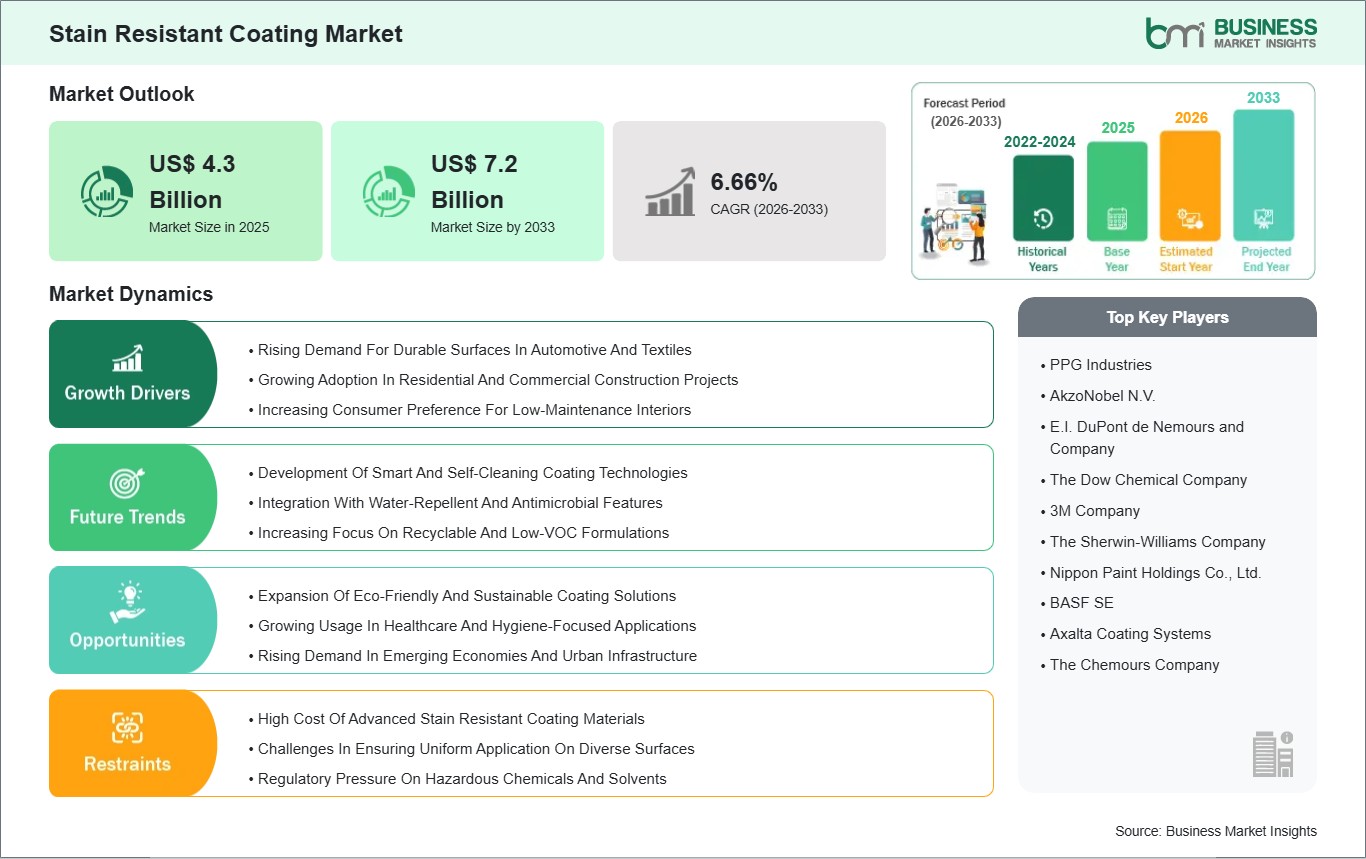
The Stain Resistant Coating Market size is expected to reach US$ 7.2 billion by 2033 from US$ 4.3 billion in 2025. The market is estimated to record a CAGR of 6.66% from 2026 to 2033.
The global stain resistant coating market is evolving rapidly as industries expand their use of surface protection technologies to enhance product longevity and performance. Multiple applications use these coatings to provide essential protection against spills and blemishes, moisture and dirt, and various other contaminants that affect textiles and flooring, automotive interiors, electronics, construction materials and consumer goods. The ongoing increase in consumer demand for home and workplace, and public space surfaces requires low maintenance and high durability solutions, which create demand throughout the world. Stain resistant technologies now incorporate sustainable materials because eco-friendly product requirements have become important to material selection processes. The market expands through continuous development in chemistry and surface engineering, which enables the creation of coatings that match specific substrate requirements and desired performance outcomes.
The mass adoption of stain resistance technology for high-traffic areas and premium product segments operates as one of the main forces that shape the worldwide market. Stain resistant coatings serve as value-added features that improve consumer attraction for textile and apparel products while enabling retailers to demand higher prices. Stain resistance in architectural flooring products and wall systems enhances their operational efficiency while decreasing their upkeep requirements, which fits contemporary architectural design standards that value lasting beauty. Stain resistant coatings in automotive interiors protect seats, carpets and trims from daily damage, which improves the experience for car users.
The market experiences difficulties because of its existing problems. The main obstacle for the system exists because it must achieve optimal performance results while facing environmental standards and regulatory compliance requirements. Manufacturers must spend time and money to develop new environmentally safe solutions because traditional stain resistant chemistries contain substances that regulators now examine because these substances remain in the environment. The industrial sector faces difficulties because different material types create challenges for companies to establish consistent processing methods and material distribution practices throughout their operations. Research activities together with the rising need for surfaces that maintain their functionality over extended periods will enable the global market to continue growing.

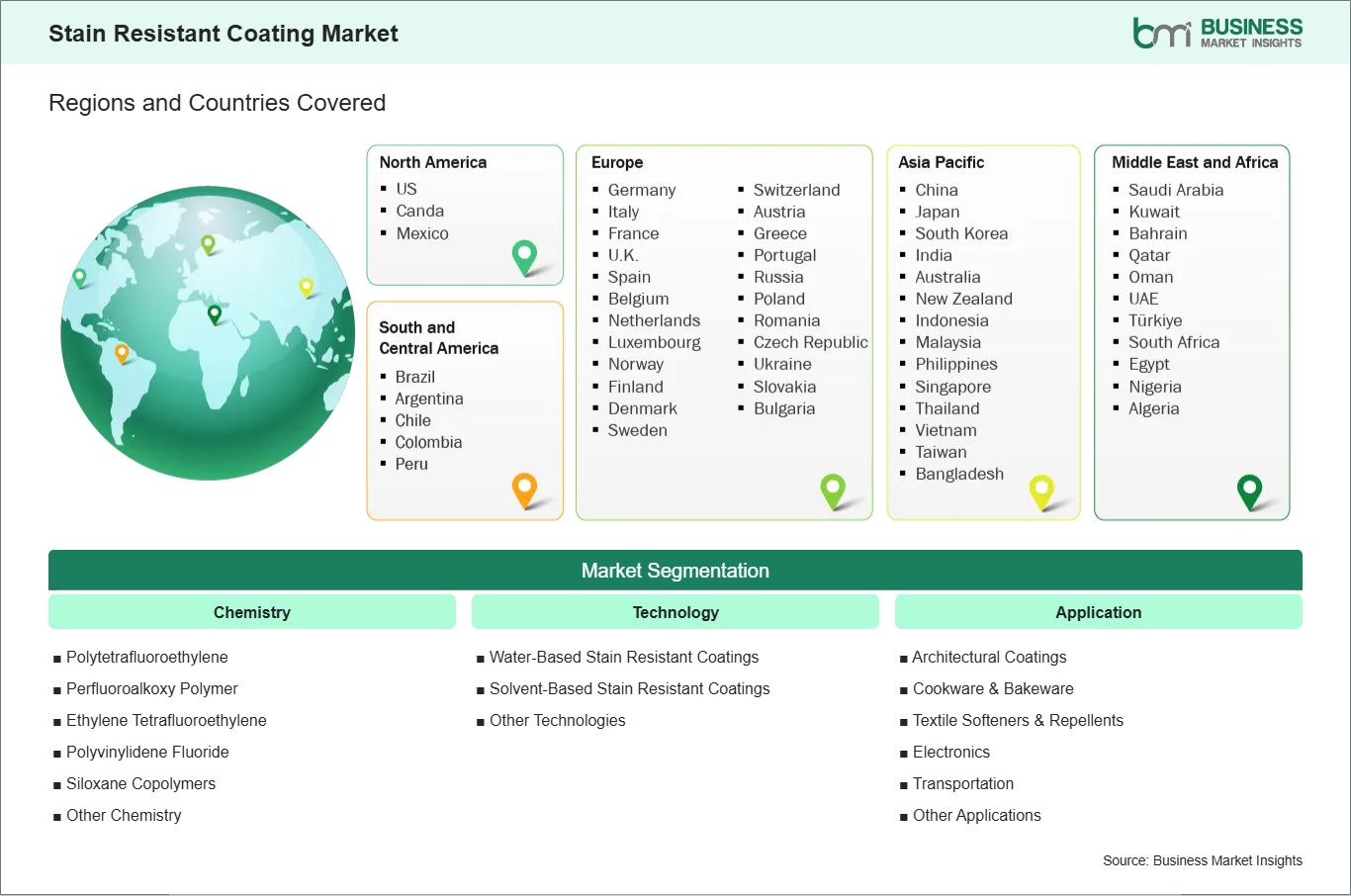
Key segments that contributed to the derivation of the stain resistant coating market analysis are chemistry, technology, and application.
The global stain resistant coating market is significantly propelled by demand within the automotive sector, where vehicle interiors are subject to constant wear and exposure to contaminants. Manufacturers are increasingly integrating advanced stain resistant coatings into seat fabrics, carpets, and trim surfaces to improve resilience and extend service life. As global vehicle ownership grows, especially in regions with harsh environmental conditions, the emphasis on durable interiors becomes a pivotal differentiator for OEMs and aftermarket suppliers. This has elevated stain resistance from an optional feature to a core attribute in automotive material specifications.
In the textile industry, consumer expectations for clothing and home textiles that resist spills and maintain appearance over long durations are changing procurement strategies. Activewear, children`s apparel, and upholstery fabrics now frequently incorporate stain resistant finishes that enhance usability without compromising comfort. Apparel brands are pushing these coatings as value‑added features that resonate strongly with busy lifestyles and household maintenance needs. The global shift toward performance textiles reinforces the importance of coatings that retain fabric breathability while repelling liquids and soils.
Across both sectors, advancements in coating chemistries have enabled more effective performance without undermining the base material`s inherent qualities. For automotive, this means coatings that withstand UV exposure and abrasion, while in textiles it translates to finishes that remain effective after repeated laundering. As consumers increasingly prioritize products that require less maintenance and offer long‑term reliability, demand for stain resistant technologies that enhance durability across automotive and textile materials will continue to be a core market driver.
Environmental sustainability has emerged as a global priority, reshaping the trajectory of the stain resistant coating market toward greener technologies. Traditional stain repellents often relied on chemistries that raised concerns about environmental persistence and chemical safety, prompting manufacturers to seek alternatives that align with sustainability goals. This shift is particularly prominent in regions with strict environmental regulations, encouraging the adoption of water‑based systems and bio‑derived chemistries that reduce volatile organic compounds (VOCs) and hazardous emissions. As sustainability becomes a brand differentiator, adoption of eco‑friendly coatings is gaining traction across industries.
In construction and interior design applications, eco‑friendly stain resistant coatings support broader green building standards and certifications, reinforcing demand among developers and architects. Providers are focusing on developing solutions that deliver performance while minimizing ecological impact, including reformulating products to meet global standards for low toxicity and recyclability. This integration of sustainability with performance requirements has broadened market appeal, especially among environmentally conscious consumers and institutional buyers that emphasize lifecycle impacts of materials.
Textile and apparel manufacturers are also responding to consumer demand for sustainable products by incorporating stain resistant finishes that derive from renewable feedstocks or that can be more easily recycled at end‑of‑life. Retail brands are leveraging these attributes to differentiate product lines, aligning with broader commitments to reduce carbon footprint and environmental burden. As global trends continue to favor sustainable solutions across sectors, the expansion of eco‑friendly stain resistant coatings represents a significant opportunity for innovation and market growth.

The stain resistant coating market demonstrates steady growth, with size and share analysis highlighting evolving trends and competitive dynamics among key players. The report examines subsegments categorized within chemistry, technology, and application, offering insights into their contribution to overall market performance.
By chemistry, the siloxane copolymers subsegment dominated the market in 2025, driven by its low VOC content, excellent water and stain repellency, and wide applicability across architectural and cookware coatings.
Based on technology, the solvent-based stain resistant coatings subsegment dominated the market in 2025, driven by its cost-effectiveness, ease of application, and established industrial adoption.
In terms of application, the architectural coatings subsegment dominated the market in 2025, driven by the growing construction and building sector, which demands durable, stain-resistant finishes for both commercial and residential structures.
| Report Attribute | Details |
|---|---|
| Market size in 2025 | US$ 4.3 Billion |
| Market Size by 2033 | US$ 7.2 Billion |
| Global CAGR (2026 - 2033) | 6.66% |
| Historical Data | 2022-2024 |
| Forecast period | 2026-2033 |
| Segments Covered | By Chemistry
|
|
Regions and Countries Covered
| |
| North America | US, Canada, Mexico |
| Europe | Belgium, Austria, Finland, Denmark, Greece, Poland, Romania, Russia, Ukraine, Czech Republic, Slovakia, Bulgaria, Italy, Luxembourg, Germany, Switzerland, France, Netherlands, Norway, Portugal, Spain, Sweden, United Kingdom |
| Asia-Pacific | Australia, China, India, Japan, South Korea, Indonesia, Malaysia, Philippines, Singapore, Thailand, Vietnam, Bangladesh, New Zealand, Taiwan |
| South and Central America | Brazil, Argentina, Peru, Chile, Colombia |
| Middle East and Africa | Bahrain, Kuwait, Oman, Qatar, Saudi Arabia, United Arab Emirates, Turkiye, South Africa, Egypt, Algeria, Nigeria |
| Market leaders and key company profiles |
|
The "Stain Resistant Coating Market Size and Forecast (2022 - 2033)" report provides a detailed analysis of the market covering below areas:
The geographical scope of the Stain Resistant Coating Market report is divided into North America, Asia Pacific, Europe, Middle East & Africa, and South & Central America. North America held the largest share in 2025.
The global stain resistant coating market exhibits distinct regional dynamics with North America emerging as the dominant region because of its industrial infrastructure, consumer awareness and material innovation presence. North American end-use sectors, which include automotive textiles construction, and consumer electronics use stain resistant coatings to enhance product longevity and reduce maintenance needs and create more visually appealing products. The region benefits from coating formulators, OEMs and material scientists working together to develop low-VOC, eco-friendly and high-performance product formulations.
The Asia Pacific market experiences rapid expansion because urbanization rates increase and people acquire more disposable income, and construction, textile and automotive industries grow in China, India and Japan. The commercial and residential markets drive demand for stain resistant technologies because customers prefer surfaces that require little upkeep and remain intact for long periods.
Europe maintains its important role in sustainable coating solutions because of its effective regulatory systems, which support environmentally friendly and non-harmful coating options and its established customer base that emphasizes performance and visual appeal in textiles, interiors and furniture.
The market in Middle East and Africa experiences growth because premium infrastructure investments, luxury residential and commercial developments and growing public space hygiene requirements drive demand for low-maintenance materials in United Arab Emirates and South Africa.
The construction and automotive industries in South and Central America are driving adoption of new technologies because Brazilian and Argentine consumers increasingly prefer surfaces that last long and require little upkeep. The combination of industrial maturity together with consumer preferences, sustainability efforts, and economic development determines how regional dynamics develop.

The Stain Resistant Coating Market is evaluated by gathering qualitative and quantitative data post primary and secondary research, which includes important corporate publications, association data, and databases. A few of the key developments in the stain resistant coating market are:
The Stain Resistant Coating Market is valued at US$ 4.3 Billion in 2025, it is projected to reach US$ 7.2 Billion by 2033.
As per our report Stain Resistant Coating Market, the market size is valued at US$ 4.3 Billion in 2025, projecting it to reach US$ 7.2 Billion by 2033. This translates to a CAGR of approximately 6.66% during the forecast period.
The Stain Resistant Coating Market report typically cover these key segments-
The historic period, base year, and forecast period can vary slightly depending on the specific market research report. However, for the Stain Resistant Coating Market report:
The Stain Resistant Coating Market is populated by several key players, each contributing to its growth and innovation. Some of the major players include:
The Stain Resistant Coating Market report is valuable for diverse stakeholders, including:
Essentially, anyone involved in or considering involvement in the Stain Resistant Coating Market value chain can benefit from the information contained in a comprehensive market report.
Please tell us your area of interest
(Market Segments/ Regions and Countries/ Companies)