
Smart Infrastructure Market Outlook: Size, Share, Trends, Growth Analysis, Competitive Landscape & Forecast, 2026–2033

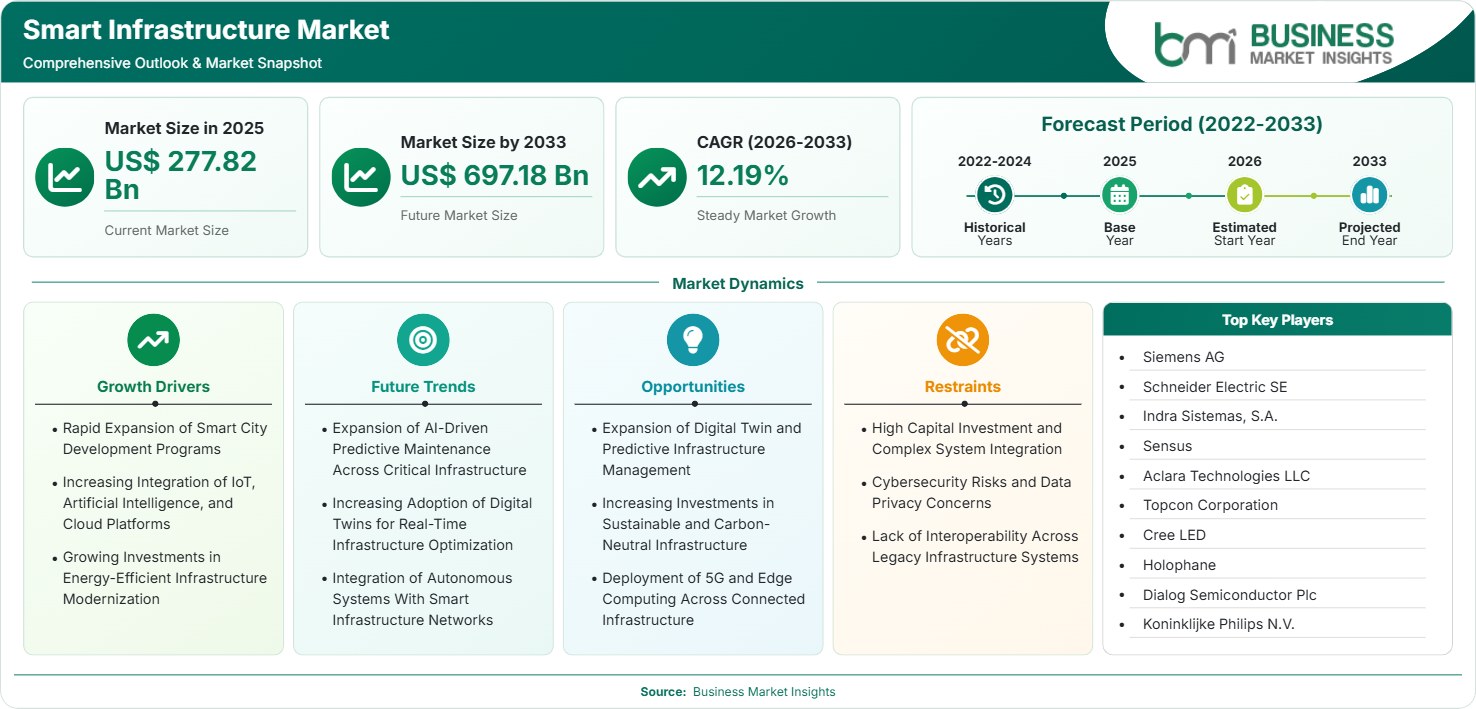
The Smart Infrastructure Market size was valued at US$ 277.82 Billion in 2025 and is projected to reach US$ 697.18 Billion by 2033, growing at a CAGR of 12.19% during 2026–2033. Rising urbanization, digital infrastructure investments, IoT integration, smart city initiatives, and energy-efficient asset management are accelerating market expansion while creating long-term opportunities across utilities, transportation, and connected buildings.

Report Coverage
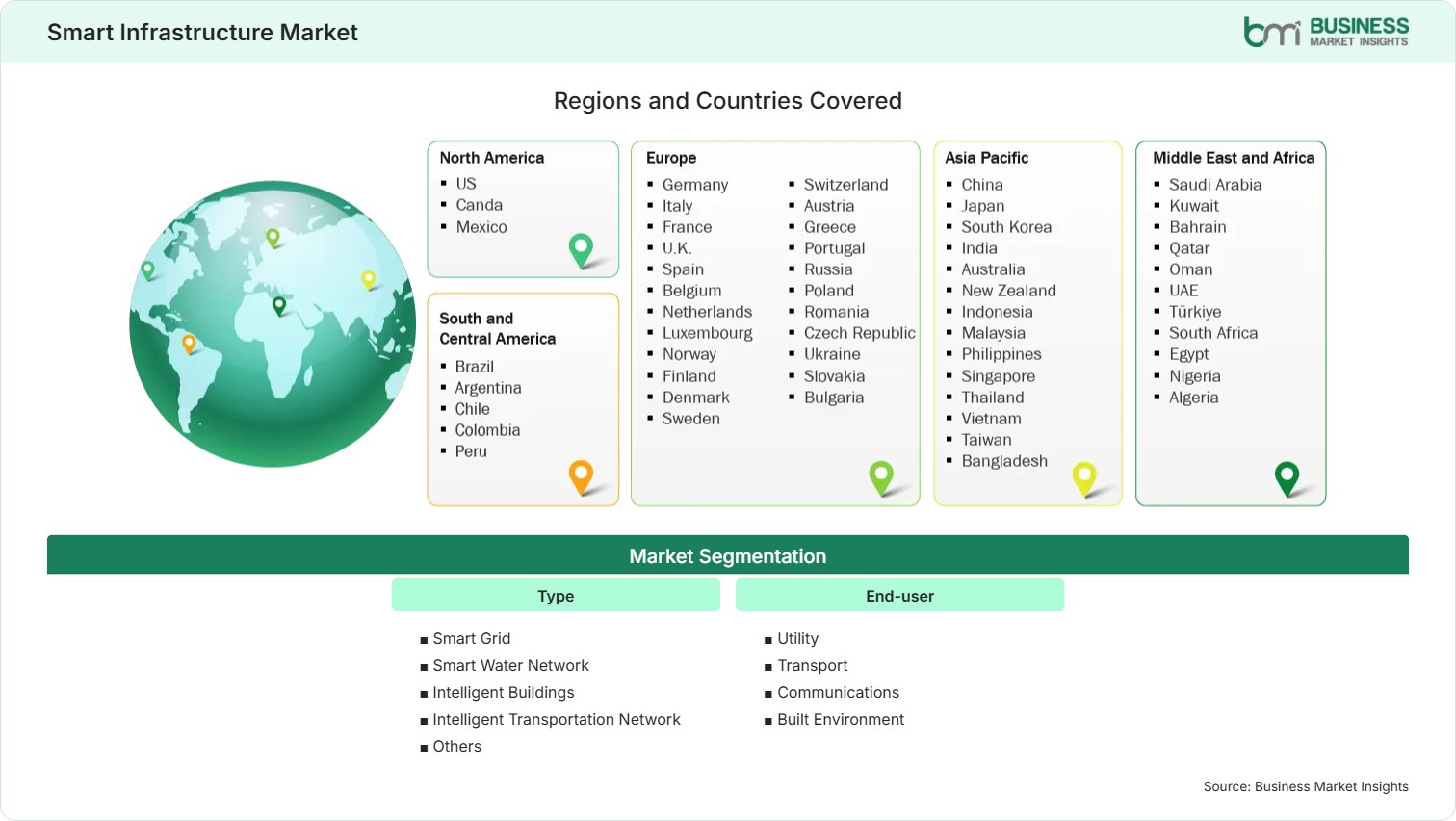
  • Type: Smart Grid, Smart Water Network, Intelligent Buildings, Intelligent Transportation Network, Others
  • End-user: Utility, Transport, Communications, Built Environment
US$ 277.82 Bn Market size in 2025
US$ 697.18 Bn Market Size by 2033
12.19% CAGR, 2026 - 2033
2026-2033 Forecast Period

AI Overview

Smart Infrastructure Market Summary

  • North America Region: North America held 33%–36% share in 2025 and is projected to expand at a CAGR of 11.6%–12.2% during 2026–2033. Growth is supported by smart city investments, grid modernization, intelligent transportation deployment, and digital utility infrastructure. The U.S. leads regional adoption through advanced IoT implementation, federal infrastructure funding, and intelligent building modernization, registering a CAGR of 11.8%–12.4%.
  • Fastest Growing Region: Asia Pacific accounted for 28%–31% share in 2025 and is expected to grow at a CAGR of 13.2%–13.8%. Rapid urbanization, government-led smart city programs, infrastructure digitization, and increasing investments in connected utilities continue driving regional demand.
  • Leading Segment: Smart Grid represented 34%–37% share in 2025 and is projected to grow at a CAGR of 12.3%–12.9%, supported by grid modernization, renewable energy integration, and intelligent energy management.
  • High Growth Segment: Intelligent Buildings are expected to expand at a CAGR of 13.4%–14.0% owing to rising demand for energy-efficient commercial facilities, connected building automation, and AI-enabled facility management.
  • Key Market Opportunity: Growing investments in AI-enabled infrastructure management, digital twins, predictive maintenance, and integrated smart city platforms are creating substantial long-term opportunities across public and private infrastructure projects.
  • Major Market Players: Siemens AG, Schneider Electric SE, Indra Sistemas, S.A., Sensus, Aclara Technologies LLC, Topcon Corporation, Cree LED, Holophane, Dialog Semiconductor Plc, and Koninklijke Philips N.V.
Strategic Insights

Smart Infrastructure Market: Strategic Insights

Smart Infrastructure Market Strategic Framework
FREE PDF
Request your free sample
Request free sample
Stakeholder View

Key Takeaways

  • The market value chain consists of sensors suppliers, communications providers, software providers, integration services providers, utilities, engineering service providers, and government bodies focused on the creation of connected infrastructure ecosystems.
  • Smart buildings, smart grids, and digital utilities provide the greatest opportunity areas as organizations upgrade their outdated infrastructures.
  • AI, digital twins, cloud-based infrastructure management, and predictive analytics are transforming infrastructure planning, maintenance, and lifecycle optimization across multiple industries.
  • Asia Pacific presents attractive investment opportunities due to rapid urbanization, government-backed smart city initiatives, and significant investments in digital infrastructure modernization.
  • Strategic partnerships among technology providers, infrastructure developers, utilities, and governments are accelerating innovation and enabling scalable deployment of integrated smart infrastructure solutions.
  • Digital transformation is reshaping infrastructure planning as governments and enterprises deploy connected technologies to improve operational efficiency, sustainability, and public services.
Geographic Outlook

Smart Infrastructure Market Regional Highlights

North America Smart Infrastructure Market

North America accounted for 33%–36% share in 2025 and is expected to grow at a CAGR of 11.6%–12.2% during 2026–2033. Regional growth is supported by large-scale investments in smart cities, utility modernization, digital transportation infrastructure, and intelligent commercial buildings. Public infrastructure funding, grid modernization initiatives, and increasing deployment of IoT-enabled monitoring systems continue strengthening regional demand. The Smart Infrastructure Market share remains the highest globally due to rapid adoption of connected technologies across utilities and public infrastructure.

  • Utility companies are accelerating deployment of smart grids, intelligent metering systems, and AI-based energy management platforms to improve network resilience.
  • Transportation authorities continue investing in connected traffic management, intelligent highways, and digital mobility infrastructure to improve urban mobility.
  • Commercial buildings are adopting integrated automation systems to improve energy efficiency, occupant comfort, and predictive facility maintenance.
  • Public-private partnerships continue supporting smart city projects integrating digital infrastructure, communication networks, and cloud-based monitoring platforms.

US Smart Infrastructure Market

The United States Smart Infrastructure Market represented 81%–85% of North American revenue in 2025 and is forecast to grow at a CAGR of 11.8%–12.4% through 2033. Government infrastructure funding, modernization of utility networks, intelligent transportation investments, and rapid adoption of digital building technologies continue supporting expansion. Technology providers are integrating AI, IoT, and cloud analytics to improve infrastructure performance while enhancing sustainability and operational efficiency across public and private sectors.

  • Federal infrastructure programs continue encouraging investments in digital transportation, smart utilities, and resilient public infrastructure.
  • Growing deployment of AI-powered monitoring platforms is improving predictive maintenance and operational decision-making across infrastructure assets.
  • Energy companies are expanding smart grid deployments to support renewable integration and improve electricity distribution reliability.

Europe Smart Infrastructure Market

Europe Smart Infrastructure Market accounted for 26%–29% share in 2025 and is projected to register a CAGR of 11.2%–11.8% during 2026–2033. The region benefits from strong sustainability regulations, energy transition initiatives, and extensive investments in intelligent urban infrastructure. Germany, France, the United Kingdom, and the Nordic countries continue leading adoption through modernization of energy systems, intelligent transportation projects, and digital building technologies. The Smart Infrastructure growth is further supported by ambitious carbon neutrality objectives and increasing public investment.

  • Germany leads regional adoption through Industry 4.0 initiatives, smart energy systems, and connected manufacturing infrastructure.
  • France continues investing in digital transportation, intelligent public infrastructure, and smart city modernization projects.
  • The Nordic region promotes connected infrastructure through renewable energy integration and advanced digital utility management.
  • European regulations encouraging energy efficiency continue accelerating adoption of intelligent building technologies.

Asia Pacific Smart Infrastructure Market

Asia Pacific represented 28%–31% share in 2025 and is expected to achieve the fastest CAGR of 13.2%–13.8% during 2026–2033. Rapid urbanization, expanding digital economies, infrastructure modernization, and government-backed smart city programs continue driving regional demand. China, Japan, India, South Korea, and Singapore are leading investment destinations due to increasing deployment of intelligent utilities, connected transportation systems, and digital public infrastructure. The Smart Infrastructure market trends indicate sustained investment in AI-enabled infrastructure management and IoT integration.

  • China is expanding smart city infrastructure through large-scale deployment of digital utilities, intelligent transportation, and connected public services.
  • India is accelerating smart infrastructure investments under urban modernization initiatives and expanding digital utility networks.
  • Japan and South Korea continue adopting advanced automation, AI, and IoT technologies for resilient infrastructure development.
  • Southeast Asian economies are increasing infrastructure investments to support urban growth and digital transformation.

Rest of World Smart Infrastructure Market

The Rest of World accounted for 10%–13% share in 2025 and is projected to expand at a CAGR of 11.4%–12.0% during 2026–2033. Latin America, the Middle East, and Africa are experiencing increasing adoption of intelligent infrastructure through investments in urban development, digital utilities, and transportation modernization. Government initiatives promoting economic diversification and sustainable infrastructure are creating new opportunities for technology providers and engineering companies.

  • Gulf countries are investing in smart cities, digital infrastructure, and intelligent energy management to support economic diversification.
  • Brazil and Mexico are strengthening digital transportation systems and modernizing utility infrastructure to improve operational efficiency.
  • African countries are gradually deploying smart water and energy networks through public infrastructure investment programs.
  • International technology providers are expanding regional partnerships to deliver integrated infrastructure management solutions and accelerate digital transformation.
Global Market Geography
FREE PDF
Request your free sample
Request free sample
Segment Analysis

Smart Infrastructure Market Segmentation

Type

The Type segment comprises Smart Grid, Smart Water Network, Intelligent Buildings, Intelligent Transportation Network, and Others. Smart Grid accounted for the largest 34%–37% share in 2025 and is projected to grow at a CAGR of 12.3%–12.9% during 2026–2033. Rising renewable energy integration, increasing electricity demand, and modernization of aging power infrastructure continue driving adoption. The Smart Infrastructure scope is expanding as governments and utilities prioritize digital energy management, real-time monitoring, and resilient electricity distribution systems.

  • Smart Grid: Smart grids enable real-time electricity monitoring, automated demand response, renewable energy integration, and improved grid reliability through advanced digital communication and intelligent control technologies.
  • Smart Water Network: Smart water networks utilize connected sensors, smart meters, and predictive analytics to improve water distribution efficiency, detect leakages, optimize resource utilization, and strengthen infrastructure resilience.
  • Intelligent Buildings: Intelligent buildings integrate automation systems, IoT sensors, HVAC optimization, lighting controls, and security platforms to improve operational efficiency, occupant comfort, and energy management.
  • Intelligent Transportation Network: Intelligent transportation networks deploy digital traffic management, connected mobility platforms, and intelligent signaling systems to improve transportation efficiency, reduce congestion, and enhance public safety.

End-user

The End-user segment includes Utility, Transport, Communications, and the Built Environment. The Utility segment held the leading 38%–41% share in 2025 and is expected to register a CAGR of 12.1%–12.7% through 2033. Increasing investments in digital electricity grids, smart metering, renewable integration, and intelligent asset management continue supporting growth. Expanding public infrastructure modernization programs and connected utility networks are accelerating technology deployment. The Smart Infrastructure trends indicate rising investment in integrated infrastructure management across all end-user sectors.

  • Utility: Utility organizations are deploying advanced metering infrastructure, digital substations, predictive maintenance systems, and AI-enabled energy management platforms to improve operational performance and service reliability.
  • Transport: Transportation agencies are implementing intelligent traffic control, connected mobility systems, digital tolling, and infrastructure monitoring technologies to enhance traffic flow and commuter safety.
  • Communications: Communications providers support smart infrastructure through high-speed connectivity, IoT networks, cloud computing platforms, and secure data transmission required for connected infrastructure ecosystems.
  • Built Environment: Commercial buildings, residential developments, and public facilities are adopting intelligent automation, integrated security, energy optimization, and digital facility management solutions to improve sustainability and operational efficiency.
Market Forces

Smart Infrastructure Market Dynamics

Key Market Drivers

Rapid Expansion of Smart City Development Programs

Global governments are making significant investments towards the development of smart city projects aimed at enhancing mobility in cities, enhancing public safety and improving energy efficiency and resource management. Digital infrastructures, intelligent transportation systems, smart utilities and public services have become essential elements in the urban planning of many countries. The factors driving the Smart Infrastructure Market include growing government spending, growing urban populations and the need to upgrade old infrastructure. The combination of IoT technology, cloud computing and AI analytics enables the optimal performance of the infrastructure while ensuring better service provision.

Increasing Integration of IoT, Artificial Intelligence, and Cloud Platforms

The rapid adoption of IoT sensors, artificial intelligence analytics, and cloud infrastructure management technologies is revolutionizing how infrastructures are operated globally. Connectivity allows monitoring of transportation networks, utilities, and commercial buildings for predictive maintenance and optimal operation. Artificial intelligence enhances the performance of infrastructures using real-time analytics, decision-making, and resource management. Cloud computing enables centralization of infrastructure management through integration of huge amounts of operational data from various assets. The new technologies help in improving reliability, lowering maintenance expenses, and boosting operational efficiency in support of digital transformation projects within the infrastructure ecosystem.

Growing Investments in Energy-Efficient Infrastructure Modernization

Organizations are updating their infrastructure to make their operations more sustainable and cost-efficient and to facilitate the integration of renewable energy. The installation of intelligent grids, connected buildings, smart water infrastructure, and digital infrastructure for transportation systems will help organizations increase their operational efficiency in the long run. Growing concern about carbon footprint and efficient use of resources is leading to greater use of new monitoring and automation tools. Energy providers are updating old infrastructure with new, intelligent infrastructure that will enable them to distribute energy more efficiently and reduce energy losses.

Key Market Opportunities

Expansion of Digital Twin and Predictive Infrastructure Management

Digital twin technology is creating significant opportunities for infrastructure operators by enabling virtual modeling, real-time asset monitoring, and predictive maintenance. Governments, utilities, and commercial organizations are increasingly adopting digital replicas of physical infrastructure to improve planning, optimize maintenance schedules, and reduce operational downtime. Artificial intelligence and cloud computing further enhance these platforms by generating actionable insights from continuously collected operational data. Technology providers offering integrated digital twin platforms can strengthen long-term customer relationships through value-added services. As infrastructure assets become increasingly connected, demand for predictive infrastructure management solutions is expected to expand across transportation, utilities, buildings, and public infrastructure.

Increasing Investments in Sustainable and Carbon-Neutral Infrastructure

Global commitments toward carbon neutrality are encouraging governments and enterprises to invest in energy-efficient infrastructure capable of reducing emissions and optimizing resource consumption. Smart lighting, intelligent buildings, renewable energy integration, and digital utility systems are becoming central components of sustainable infrastructure development. Infrastructure developers are increasingly selecting connected technologies that improve energy efficiency while supporting long-term environmental objectives. Companies capable of delivering interoperable and scalable smart infrastructure platforms can benefit from increasing public funding and private investment. Sustainability-focused procurement policies are expected to create substantial opportunities for technology vendors and engineering solution providers during the smart infrastructure market forecast period.

Deployment of 5G and Edge Computing Across Connected Infrastructure

The rapid rollout of 5G communication networks and edge computing platforms is improving the performance of connected infrastructure systems. Low-latency communication enables real-time monitoring, autonomous traffic management, intelligent utility operations, and enhanced public safety applications. Edge computing reduces response times by processing data closer to infrastructure assets, improving reliability and operational efficiency. These technologies support increasing deployment of IoT devices across transportation networks, smart buildings, and energy systems. Infrastructure providers integrating advanced communication technologies into their solutions are expected to benefit from expanding digital transformation programs across both developed and emerging economies.

Market Restraints and Challenges

High Capital Investment and Complex System Integration

Factor: Smart infrastructure projects require substantial capital investment for sensors, communication networks, software platforms, automation systems, and integration with existing infrastructure assets. Impact: High implementation costs can delay project approvals, particularly for municipalities and organizations operating under limited infrastructure budgets. Integration of legacy systems with modern digital technologies often requires extensive engineering expertise, increasing deployment complexity and implementation timelines. These financial and technical barriers may slow adoption in developing regions despite increasing demand for infrastructure modernization.

Cybersecurity Risks and Data Privacy Concerns

Factor: Connected infrastructure generates and exchanges large volumes of operational data across networks, creating greater exposure to cyberattacks, unauthorized access, and data security threats. Impact: Infrastructure operators must implement comprehensive cybersecurity frameworks to protect critical systems, maintain service continuity, and comply with regulatory requirements. Security breaches affecting utilities, transportation systems, or public infrastructure can result in operational disruptions, financial losses, and reduced public confidence.

Company Analysis

Competitive Landscape

The competitive landscape is characterized by investments in intelligent automation, industrial IoT, digital infrastructure platforms, smart energy management, and integrated urban technologies. The Smart Infrastructure market analysis indicates that leading companies are strengthening cloud connectivity, AI-enabled analytics, and infrastructure management capabilities while expanding partnerships with governments, utilities, and transportation authorities.

Company Name

Overview

Products and Services Relevant to this Market

Siemens AG

Global technology company specializing in industrial automation, digital infrastructure, and intelligent energy solutions.

Smart grid solutions, building automation, industrial IoT, digital twins, and intelligent infrastructure platforms.

Schneider Electric SE

Global leader in energy management and automation technologies.

Smart energy systems, building management software, digital substations, automation platforms, and infrastructure services.

Indra Sistemas, S.A.

Technology and engineering company delivering intelligent transportation and defense solutions.

Smart mobility platforms, traffic management systems, transportation analytics, and urban infrastructure technologies.

Sensus

Provider of intelligent utility technologies and digital water management solutions.

Smart metering, utility communication networks, water management platforms, and advanced monitoring systems.

Aclara Technologies LLC

Smart infrastructure company specializing in utility intelligence and communication technologies.

Smart meters, grid communication networks, distribution automation, and utility data management solutions.

Topcon Corporation

Japanese technology company focused on precision positioning and infrastructure solutions.

Construction technology, infrastructure monitoring, geospatial systems, and digital surveying solutions.

Cree LED

Manufacturer of advanced LED technologies for intelligent lighting infrastructure.

Smart lighting systems, LED components, connected illumination technologies, and energy-efficient lighting solutions.

Holophane

Provider of commercial and industrial lighting technologies.

Intelligent lighting systems, outdoor infrastructure lighting, and energy-efficient illumination solutions.

Dialog Semiconductor Plc

Semiconductor company specializing in power management and connectivity technologies.

IoT connectivity chips, power management solutions, and smart infrastructure semiconductor technologies.

Koninklijke Philips N.V.

Global health technology and lighting innovation company.

Connected lighting systems, smart building technologies, IoT-enabled lighting platforms, and urban lighting solutions.

Trust & Transparency

Research Methodology

The market analysis combines proprietary research with secondary data from government agencies, company disclosures, regulatory filings, industry databases and expert interviews. Market estimates are validated through data triangulation, cross-market benchmarking and analyst review.

View Full Research Methodology

Questions Answered

Frequently Asked Questions

How are AI and IoT transforming smart infrastructure?

AI and IoT enable real-time infrastructure monitoring, predictive maintenance, automated decision-making, digital asset management, and efficient resource utilization, helping organizations improve reliability while reducing operational costs.

Which end-user is expected to generate the highest demand?

The Utility sector is expected to remain the leading end-user because of continuous investments in digital electricity networks, advanced metering infrastructure, predictive maintenance, and intelligent energy management technologies.

Which segment holds the largest market share?

The Smart Grid segment accounts for the largest market share due to increasing grid modernization, renewable energy integration, smart metering deployment, and demand for reliable electricity distribution infrastructure.

Which region leads the Smart Infrastructure Market report?

North America leads the market owing to advanced digital infrastructure, strong technology adoption, government infrastructure funding, and extensive implementation of intelligent transportation, utility, and building management solutions.

What is driving the Smart Infrastructure Market?

Growing investments in smart cities, digital utility modernization, IoT deployment, AI-powered infrastructure management, and energy-efficient buildings are accelerating market growth while improving operational efficiency, sustainability, and public service delivery.

Access the Full Smart Infrastructure Market Report

Get segment-level forecasts, regional estimates, competitive benchmarking, company profiles and downloadable Excel datasets.

Access the full Smart Infrastructure Market Report
350 pages PDF & Excel | 2026-08-17
Similar Research

Related Market Reports