
Smart Faucets Market Outlook: Size, Share, Trends, Growth Analysis, Competitive Landscape & Forecast, 2026-2033

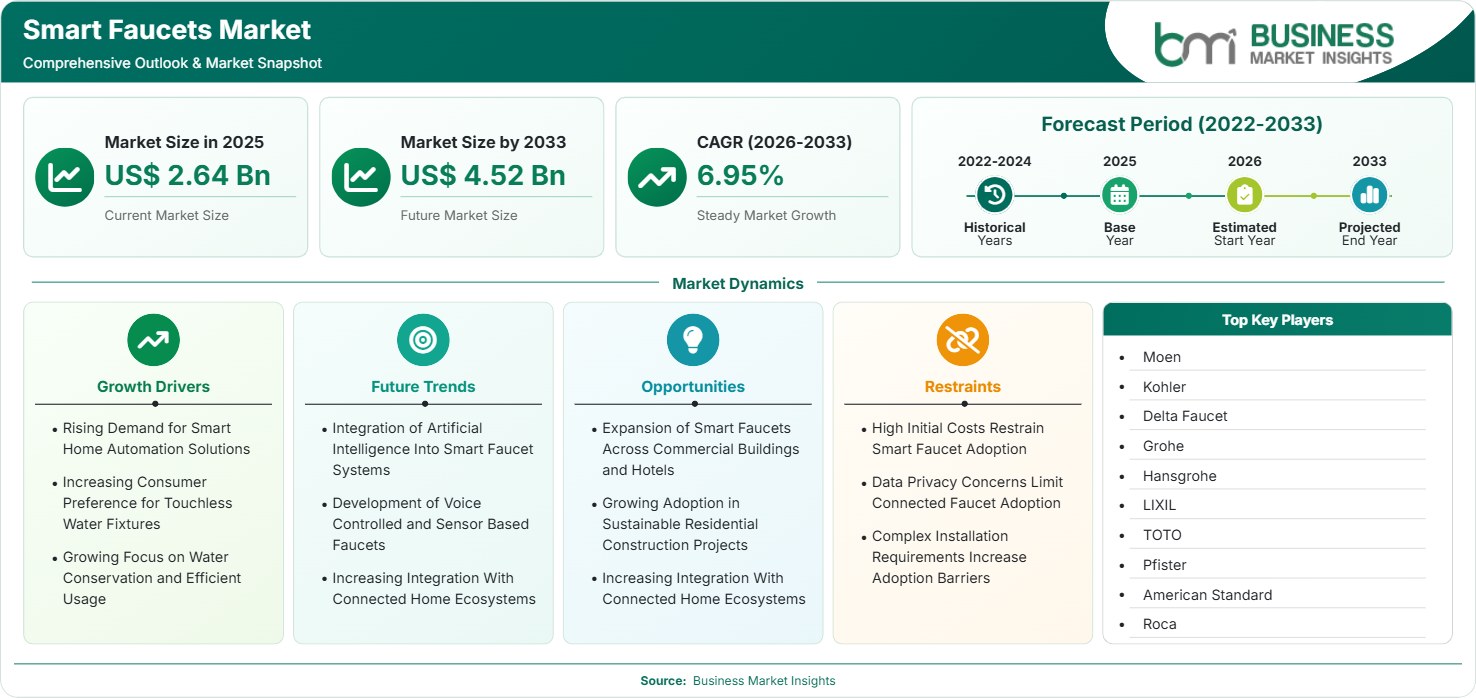
The Smart Faucets Market size was valued at US$ 2.64 billion in 2025 and is projected to reach US$ 4.52 billion by 2033, growing at a CAGR of 6.95% during 2026–2033, supported by smart home automation, touchless fixtures, water conservation, sustainable construction, commercial modernization, and connected home integration.

Report Coverage
  • Type: Touchless, Touch-Activated, Voice-Activated
  • Application: Bathroom, Kitchen
  • End-User: Residential, Commercial
  • Distribution Channel: E-commerce/Online, Retail Outlets/Offline
US$ 2.64 Bn Market size in 2025
US$ 4.52 Bn Market Size by 2033
6.95% CAGR, 2026 - 2033
2026-2033 Forecast Period

01 AI Overview

Smart Faucets Market Summary

  • North America Region: North America held an estimated 34%–38% share in 2025 and is projected to grow at a 6.8%–7.2% CAGR, supported by smart home adoption, premium bathroom renovation, water efficiency initiatives, and established plumbing brands. The U.S. market is projected to grow at a 6.9%–7.3% CAGR, supported by connected home investment, remodeling activity, and demand for touchless fixtures.
  • Fastest Growing Region: Asia Pacific held an estimated 23%–27% share in 2025 and is projected to expand at a 8.2%–8.6% CAGR, driven by urbanization, premium residential construction, hospitality development, digital home technologies, and growing consumer interest in water-efficient fixtures.
  • Leading Segment: Touchless faucets represented an estimated 48%–52% share in 2025 and are projected to grow at a 7.4%–7.8% CAGR, supported by hygiene preferences, sensor technology, water efficiency, commercial installations, and residential smart home adoption.
  • High Growth Segment: Voice-Activated faucets represented an estimated 13%–17% share in 2025 and are projected to grow at a 9.0%–9.4% CAGR, supported by connected home ecosystems, voice assistants, hands-free operation, and increasing smart appliance integration.
  • Key Market Opportunity: Connected faucet integration with home automation platforms can expand adoption by enabling personalized controls, water monitoring, usage analytics, remote management, and coordinated household resource efficiency.
  • Major Market Players: Moen Incorporated, Kohler Co., Delta Faucet Company, Grohe AG, Hansgrohe Deutschland Vertriebs GmbH, LIXIL Corporation, TOTO LTD., Pfister, American Standard Brands, Roca Sanitario, S.A.
02 Strategic Insights

Smart Faucets Market: Strategic Insights

Smart Faucets Market Strategic Framework
FREE PDF
Request your free sample
Request free sample
03 Stakeholder View

Key Takeaways

  • The ecosystem spans plumbing manufacturers, sensor suppliers, connectivity providers, home automation platforms, construction companies, architects, hospitality operators, retailers, and e-commerce marketplaces. Integration across these participants increasingly influences product differentiation.
  • Touchless systems offer the broadest commercial opportunity because they combine hygiene, convenience, and water management. Voice-activated products provide greater upside as connected home adoption increases.
  • Innovations are heading towards integrated sensors, voice control, leakage detection, personalized temperature control, usage tracking, and flow management. This will add more value than replacing the fixture in its traditional sense.
  • Asia Pacific is a strong choice for investment due to the growing traction of urban housing, hotels, luxury developments, and connected home technologies. The region includes China, Japan, South Korea, India, and Southeast Asian Smart Faucets Markets.
  • Strategic partnerships between faucet manufacturers and smart home technology providers can accelerate ecosystem integration, improve interoperability, and increase consumer awareness.
  • Commercial projects may offer stronger near-term scaling opportunities because hotels, offices, healthcare facilities, and public buildings can deploy smart fixtures across multiple locations.
04 Geographic Outlook

Smart Faucets Market Regional Highlights

North America Smart Faucets Market

North America held an estimated 34%–38% share in 2025 and is projected to expand at a 6.8%–7.2% CAGR through 2033. The regional Smart Faucets Market share is supported by established plumbing brands, residential remodeling, smart home adoption, and water efficiency awareness. The U.S. dominates regional demand, while Canada provides opportunities through sustainable construction and premium residential development.

  • The U.S. benefits from strong smart home adoption and established consumer awareness of touchless and digitally controlled plumbing products.
  • Residential remodeling creates replacement opportunities as homeowners upgrade kitchens and bathrooms with premium fixtures offering convenience, hygiene, and water management features.
  • Commercial buildings are increasingly evaluating touchless fixtures for high-traffic environments where hygiene and automated operation can improve user experience.
  • Water conservation initiatives encourage adoption of efficient fixtures that combine low-flow performance with sensor-based activation and automated shutoff capabilities.

US Smart Faucets Market

The U.S. represented an estimated 30%–34% share in 2025 and is projected to grow at a 6.9%–7.3% CAGR through 2033. Strong home automation adoption, premium remodeling, and established distribution networks support demand. The Smart Faucets Market is also benefiting from hospitality renovation and commercial construction, where touchless operation and water efficiency can improve facility management.

  • Smart home platforms are increasing consumer familiarity with connected appliances, creating a stronger environment for digitally enabled kitchen and bathroom fixtures.
  • Home renovation projects provide opportunities for premium faucet upgrades as consumers prioritize convenience, hygiene, aesthetics, and resource efficiency.
  • Hospitality and commercial facilities are adopting touchless fixtures to support hygiene requirements while reducing unnecessary water flow and maintenance requirements.
  • Major plumbing brands and broad retail distribution improve consumer access to smart fixtures across both new construction and replacement markets.

Europe Smart Faucets Market

Europe held an estimated 27%–31% share in 2025 and is projected to grow at a 6.2%–6.6% CAGR through 2033. Germany, the UK, France, and Italy represent leading Smart Faucets Markets, supported by sustainable construction and water efficiency priorities. Germany is projected to grow at a 6.4%–6.8% CAGR, while the UK and France provide opportunities through premium residential and hospitality applications.

  • Germany benefits from strong engineering capabilities and consumer interest in efficient plumbing technologies that support sustainable building objectives.
  • The UK provides opportunities through residential renovation, hospitality upgrades, and increasing interest in connected home technologies.
  • France is benefiting from sustainable construction and premium interior design trends that encourage adoption of technologically advanced bathroom fixtures.
  • Italy offers opportunities through hospitality modernization and premium residential developments emphasizing design, convenience, and water efficiency.

Asia Pacific Smart Faucets Market

Asia Pacific represented an estimated 23%–27% share in 2025 and is projected to grow at a 8.2%–8.6% CAGR through 2033. China, Japan, South Korea, and India lead regional opportunities, supported by urbanization, smart housing, hospitality development, and technology adoption. China is projected to grow at a 8.5%–8.9% CAGR, supported by residential construction and connected home expansion.

  • China offers substantial potential through smart home adoption, urban residential development, premium housing, and growing consumer interest in connected household products.
  • Japan benefits from advanced technology adoption and strong demand for convenience-oriented bathroom solutions, particularly among technology-conscious households.
  • South Korea's connected consumer electronics ecosystem supports integration between smart fixtures and broader home automation platforms.
  • India represents an emerging opportunity as premium housing, hospitality infrastructure, and consumer awareness of smart home technologies expand.

Rest of World Smart Faucets Market

South and Central America accounted for an estimated 6%–8% share in 2025 and are projected to grow at a 5.4%–5.8% CAGR through 2033. Brazil and Mexico lead opportunities through residential construction and hospitality. The Middle East and Africa represented an estimated 5%–7% share and are projected to grow at a 5.0%–5.4% CAGR, supported by luxury development.

  • Brazil offers opportunities through residential modernization and hospitality projects where premium fixtures can improve water efficiency and user convenience.
  • Mexico's growing construction and hospitality industries provide potential for smart plumbing installations in hotels, commercial properties, and premium residential developments.
  • Saudi Arabia's large-scale hospitality and real estate projects create opportunities for connected fixtures that align with premium construction and resource efficiency objectives.
  • The UAE provides strong potential through luxury hotels, high-end residential developments, and technology-focused commercial buildings incorporating advanced building systems.
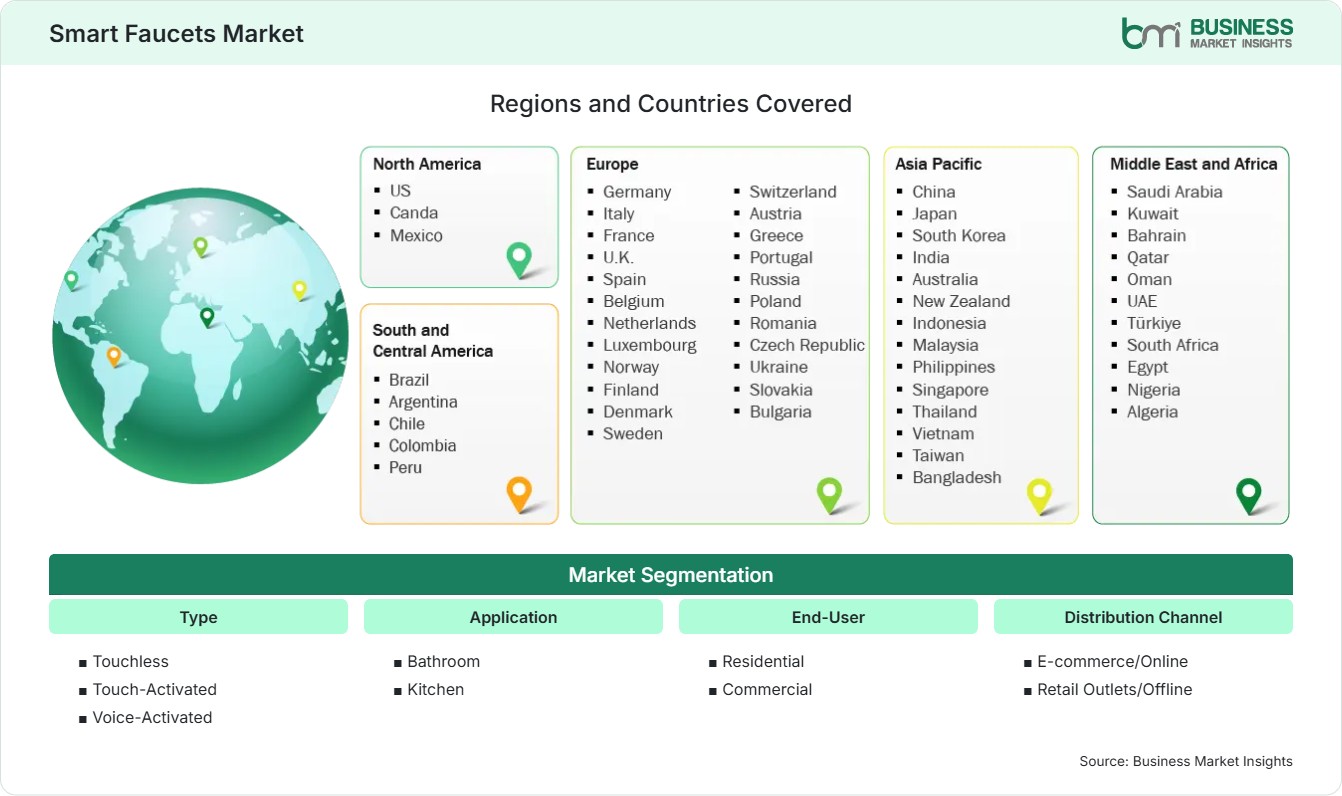
Global Market Geography
FREE PDF
Request your free sample
Request free sample
05 Segment Analysis

Smart Faucets Market Segmentation

Type

Type is led by Touchless faucets, which accounted for an estimated 48%–52% share in 2025 and are projected to grow at a 7.4%–7.8% CAGR between 2026–2033. Smart Faucets Market trends increasingly favor sensor-based operation because touchless systems combine hygiene, convenience, and water efficiency. Voice-enabled products offer the fastest technology-driven opportunity.

  • Touchless: Sensor-operated faucets provide hands-free activation, supporting hygiene and convenience in residential, hospitality, healthcare, commercial, and public environments.
  • Touch-Activated: Touch-activated products combine manual flexibility with electronic control, offering convenient operation for kitchens and bathrooms where users prefer reduced physical contact.
  • Voice-Activated: Voice-controlled faucets integrate with smart home ecosystems, enabling hands-free temperature, flow, and activation commands for connected households and premium residential applications.

Application

Application is led by Bathroom, representing an estimated 57%–61% share in 2025 and projected to grow at a 6.8%–7.2% CAGR through 2033. Bathroom installations benefit from hygiene priorities, touchless operation, and premium renovation. Kitchen applications offer additional growth through voice control, hands-free operation, temperature presets, and integration with connected household systems.

  • Bathroom: Smart bathroom faucets support touchless operation, hygiene, water efficiency, and personalized controls across residential, hospitality, healthcare, and commercial installations.
  • Kitchen: Kitchen products benefit from hands-free operation and voice controls, supporting food preparation, temperature management, and convenient water access.

End-User

End-User demand is led by Residential applications, representing an estimated 62%–66% share in 2025 and projected to grow at a 7.1%–7.5% CAGR through 2033. Residential adoption is supported by smart home integration, remodeling, premium construction, and water conservation. Commercial demand remains important across hotels, offices, healthcare, and public facilities.

  • Residential: Homeowners increasingly adopt connected fixtures for convenience, hygiene, personalized controls, water efficiency, and integration with broader smart home systems.
  • Commercial: Commercial facilities use smart faucets to support hygiene, operational efficiency, water management, and modern user experiences across hotels, offices, healthcare, and public buildings.

Distribution Channel

Distribution Channel is led by Retail Outlets/Offline, representing an estimated 54%–58% share in 2025 and projected to grow at a 6.5%–6.9% CAGR through 2033. Physical retail remains important for premium fixture evaluation and installation planning, while online channels are expanding through product comparison, direct purchasing, and broader consumer access.

  • E-commerce/Online: Online channels improve product discovery and comparison while expanding access to connected fixtures, supporting direct-to-consumer sales and technology-focused purchasing.
  • Retail Outlets/Offline: Physical stores enable consumers and professionals to evaluate design, functionality, compatibility, and installation requirements before purchasing premium smart fixtures.
06 Market Forces

Smart Faucets Market Dynamics

Key Market Drivers

Rising Demand for Smart Home Automation Solutions

The development of connected home environments is prompting consumers to automate not only lighting, security, and home appliances but also plumbing fixtures. The development of smart faucets will make it possible for such plumbing fixtures to connect with digital ecosystems, offering voice commands, temperature adjustments, automatic shut-off, and customization. The Smart Faucets Market growth has been driven by rising consumer awareness of connectivity and the availability of interoperable platforms. With such developments, it will be easier for manufacturers to improve connectivity and design smart faucets that integrate with home automation systems.

Increasing Consumer Preference for Touchless Water Fixtures

The increasing demand for contactless systems is due to the improved convenience in operation and the reduced contact with the faucet's surface when cooking, cleaning, or using the toilet. In addition, sensor technology has improved in its reliability, thus boosting the users' trust in touchless systems. The Smart Faucets Market trends are backed up by the demand for such products in homes, hotels, offices, hospitals, and public buildings. Commercial usage may be higher, as institutions have the capacity to deploy touchless devices across several facilities.

Growing Focus on Water Conservation and Efficient Usage

Water conservation is increasingly an important factor in choosing fixtures because of the need for it among consumers, builders, and building managers. Smart faucets may contribute to water conservation through shut-off, flow control, sensor operation, and individual programming. All these attributes help save more water in comparison with traditional fixtures, which run constantly. Smart fixtures are being installed in sustainable buildings by builders. As water issues become increasingly prominent, manufacturers that integrate smart functionality with efficient water flow will gain a competitive advantage.

Key Market Opportunities

Expansion of Smart Faucets Across Commercial Buildings and Hotels

The potential for commercial buildings and hotels is an excellent opportunity for growth, as large premises can equip themselves with smart fixtures across bathrooms and kitchens. Touch-free operation will increase the level of hygiene and comfort of users, while automation will be helpful in managing water consumption and managing buildings. The Smart Faucets Market forecast suggests that hospitality and commercial construction are potential channels for adoption as property owners renovate their buildings. Manufacturers will be able to approach hotels, offices, healthcare centers, airports, and schools.

Growing Adoption in Sustainable Residential Construction Projects

Construction of sustainable housing offers possibilities for intelligent taps that offer efficient water use along with their connectivity capabilities. Builders can install sensor-equipped devices in sustainable houses and upscale projects to enable resource management goals. Buyers are now interested in convenience and technology, along with environmental sustainability, which creates an ideal environment for plumbing products that offer connected capabilities. The companies can collaborate with the builders and designers and install the fixtures in their plans. This method will help increase the number of installations and make it easier than retrofitting houses already built.

Increasing Integration With Connected Home Ecosystems

Connections with home automation ecosystems could turn smart faucets into integrated household appliances. Personalized control and data tracking could become possible through voice assistants, smartphone apps, smart sensors, and home automation software. Manufacturers can identify opportunities by enhancing compatibility with leading ecosystems and developing application programming interfaces that enable automation. More advanced systems could possibly integrate data on water consumption, leakage detection, automatic shutdown, and household resources management. Technology alliances could expedite the process by minimizing complexity for consumers and offering them the ability to manage various household appliances from a single interface.

Market Restraints and Challenges

High Initial Costs Restrain Smart Faucet Adoption

Factor: Smart faucets require sensors, electronic controls, connectivity components, specialized software, and sometimes battery systems, resulting in higher upfront prices than conventional fixtures.

Impact: Cost can be an impediment to adoption among price-sensitive customers, both at home and in small-business premises, where customers cannot immediately see their savings. Installation will need to be done by professionals, which will increase the cost. Manufacturers can overcome this by diversifying their products, simplifying installation, and using cheaper sensors. Until consumers value the connection to and management of water, cost will remain a barrier.

Data Privacy Concerns Limit Connected Faucet Adoption

Factor: Connected faucets can collect usage information and communicate with mobile applications or smart home platforms, creating concerns about data handling, cybersecurity, and unauthorized access.

Impact: Privacy concerns can deter the use of plumbing fixtures as part of a larger digital network, particularly when there are few benefits to consumers. Security measures have to be put in place by manufacturers, as well as a clear data policy and software updates. Trust from the consumer becomes increasingly important as connectivity increases.

07 Company Analysis

Competitive Landscape

The competitive environment includes global plumbing manufacturers, bathroom specialists, kitchen fixture companies, smart home technology providers, and premium design brands. The Smart Faucets Market analysis indicates that competition increasingly centers on sensor reliability, connectivity, water efficiency, design, installation ease, brand reputation, and ecosystem compatibility.

Company Name

Overview

Products and Services relevant to this market

Moen Incorporated

Major plumbing fixture company offering innovative kitchen and bathroom products with smart technology capabilities.

Smart faucets, touchless faucets, connected water controls, kitchen fixtures, and bathroom solutions.

Kohler Co.

Global design and plumbing company offering premium bathroom and kitchen products with connected technologies.

Touchless faucets, smart plumbing fixtures, kitchen products, bathroom systems, and connected solutions.

Delta Faucet Company

Leading faucet manufacturer known for innovative residential and commercial water fixture technologies.

Touchless faucets, touch-activated faucets, kitchen fixtures, bathroom faucets, and smart water products.

Grohe AG

International bathroom and kitchen fittings company emphasizing design, technology, and water efficiency.

Smart faucets, touchless fixtures, sensor technology, kitchen and bathroom fittings, and water-saving solutions.

Hansgrohe Deutschland Vertriebs GmbH

German manufacturer specializing in premium bathroom and kitchen water products and innovative technologies.

Smart faucets, sensor-controlled fixtures, kitchen fittings, bathroom products, and water efficiency technologies.

LIXIL Corporation

Global housing and water technology company offering comprehensive plumbing and bathroom solutions.

Smart faucets, water fixtures, bathroom systems, kitchen products, and connected water technologies.

TOTO LTD.

Japanese company specializing in advanced bathroom and plumbing products with strong technology capabilities.

Sensor faucets, touchless fixtures, bathroom products, water-saving systems, and smart plumbing solutions.

Pfister

Plumbing fixture brand providing kitchen and bathroom products with modern design and functional technologies.

Touchless faucets, kitchen faucets, bathroom fixtures, smart plumbing products, and water controls.

American Standard Brands

Established plumbing brand serving residential and commercial markets with water-efficient fixture technologies.

Touchless faucets, commercial fixtures, bathroom products, kitchen solutions, and water-saving technologies.

Roca Sanitario, S.A.

Global bathroom company offering sanitaryware, faucets, and integrated bathroom solutions across international markets.

Smart faucets, bathroom fittings, touchless products, water-efficient fixtures, and connected bathroom solutions.

10 Trust & Transparency

Research Methodology

The market analysis combines proprietary research with secondary data from government agencies, company disclosures, regulatory filings, industry databases and expert interviews. Market estimates are validated through data triangulation, cross-market benchmarking and analyst review.

View Full Research Methodology

11 Questions Answered

Frequently Asked Questions

What does the Smart Faucets Market report indicate about future opportunities?

The report indicates that future opportunities will center on commercial buildings, hotels, sustainable residential construction, connected home ecosystems, water monitoring, and intelligent resource management. Improved interoperability and lower product costs can further expand adoption.

What limits smart faucet adoption?

High upfront costs, installation requirements, connectivity concerns, and data privacy issues can restrict adoption. Consumers may also question whether advanced features provide sufficient value compared with conventional fixtures.

Where are smart faucets most commonly used?

Bathrooms currently represent the largest application, supported by touchless hygiene and convenience. Kitchens are also expanding as consumers seek hands-free operation, voice control, temperature presets, and integration with connected home technologies.

Which type of smart faucet has the strongest opportunity?

Touchless faucets currently offer the broadest opportunity in the Smart Faucets Market because they address hygiene, convenience, and water efficiency across residential and commercial applications. Voice-activated faucets offer faster growth potential as connected home ecosystems become more widespread.

What is driving adoption of smart faucets?

Adoption is supported by smart home automation, touchless operation, water conservation, premium remodeling, sustainable construction, and growing demand for convenient connected products. Commercial facilities are also adopting sensor-based fixtures for hygiene and operational efficiency.

Access the Full Smart Faucets Market Report

Get segment-level forecasts, regional estimates, competitive benchmarking, company profiles and downloadable Excel datasets.

Access the full Smart Faucets Market Report
350 pages PDF & Excel | 2026-08-07