
Smart Home Security Market Outlook: Size, Share, Trends, Growth Analysis, Competitive Landscape & Forecast, 2026-2033

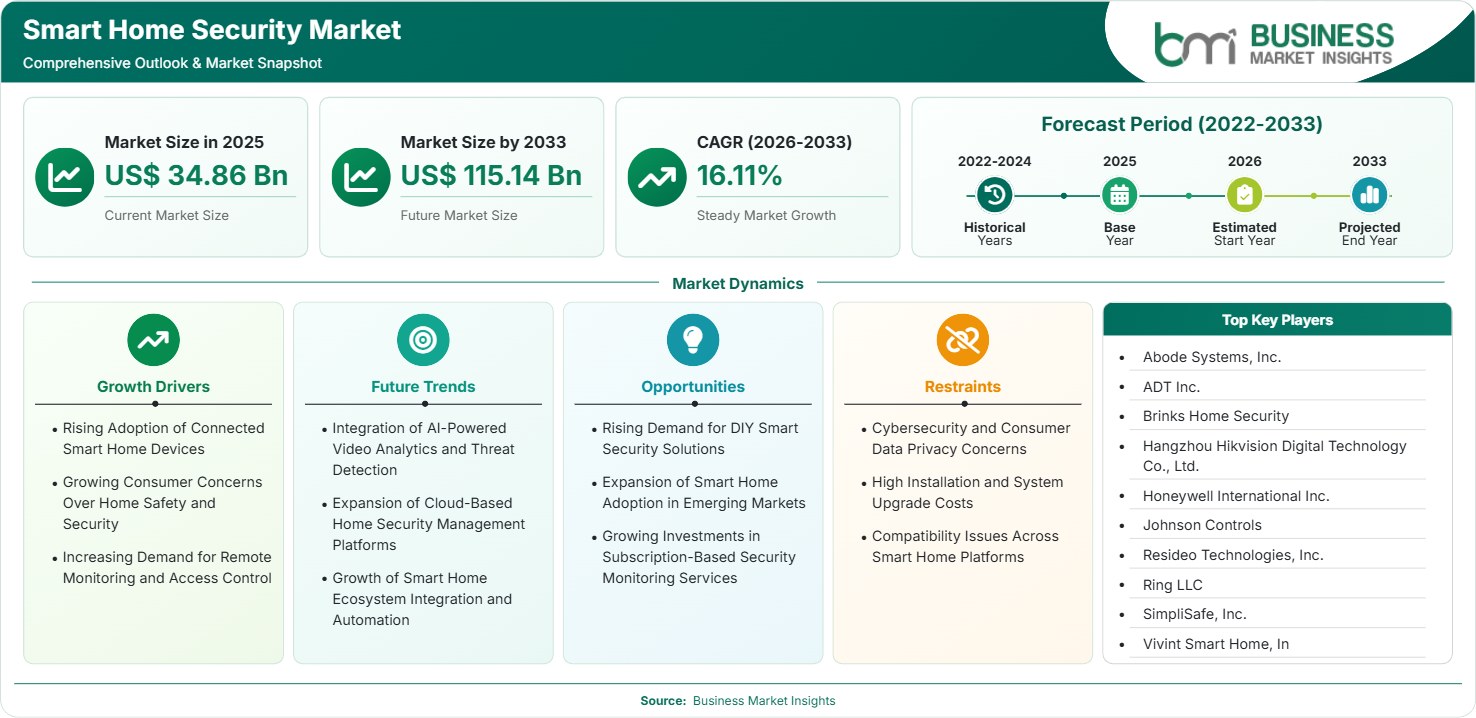
The Smart Home Security Market size was valued at US$ 34.86 Billion in 2025 and is projected to reach US$ 115.14 Billion by 2033, growing at a CAGR of 16.11% during 2026–2033. Rising concerns regarding residential safety, increasing adoption of connected home technologies, growing penetration of IoT-enabled security devices, and expanding demand for remote monitoring solutions are supporting market growth globally.

Report Coverage
  • Connection Type: Wired, Wireless
  • Device Type: Smart Camera Systems, Smart Alarms, Smart Sensors and Detectors, Smart Locks, Others
US$ 34.86 Bn Market size in 2025
US$ 115.14 Bn Market Size by 2033
16.11% CAGR, 2026 - 2033
2026-2033 Forecast Period

01 AI Overview

Smart Home Security Market Summary

  • North America Region: North America holds a market share of 37%–40% in 2025, growing with a CAGR of 15.6%–16.3% during 2026–2033. Strong smart home adoption, high consumer awareness regarding residential security, and advanced digital infrastructure continue supporting regional leadership. The U.S. market is expected to register a CAGR of 15.8%–16.5%.
  • Fastest Growing Region: Asia Pacific accounts for 27%–30% share in 2025 and is projected to grow at a CAGR of 17.2%–17.9% through 2033. Increasing urbanization, rising disposable income, and growing smart home investments continue driving regional growth.
  • Leading Segment: Wireless represents 72%–75% share in 2025 and is expected to grow at a CAGR of 16.5%–17.2% through 2033. Easy installation, scalability, remote accessibility, and compatibility with smart home ecosystems continue supporting segment dominance.
  • High Growth Segment: Smart Camera Systems account for 31%–34% share in 2025 and are forecast to grow at a CAGR of 17.0%–17.7% during 2026–2033. Growing demand for real-time monitoring, cloud-based surveillance, and AI-powered video analytics continues accelerating segment growth.
  • Key Market Opportunity: Expansion of AI-powered home security platforms, cloud-connected surveillance systems, smart access management, and integrated home automation ecosystems is creating substantial growth opportunities.
  • Major Market Players: Abode Systems, Inc., ADT Inc., Brinks Home Security, Hangzhou Hikvision Digital Technology Co., Ltd., Honeywell International Inc., Johnson Controls, Resideo Technologies, Inc., Ring LLC, SimpliSafe, Inc., and Vivint Smart Home, Inc.
02 Strategic Insights

Smart Home Security Market: Strategic Insights

Smart Home Security Market Strategic Framework
FREE PDF
Request your free sample
Request free sample
03 Stakeholder View

Key Takeaways

  • Smart home security solutions are becoming essential components of connected living environments.
  • Wireless technologies continue dominating the market due to flexibility and ease of deployment.
  • Smart camera systems remain the leading device segment supported by growing surveillance requirements.
  • AI-enabled monitoring capabilities are enhancing residential security effectiveness.
  • Cloud-connected security platforms continue improving real-time monitoring and remote access capabilities.
  • North America remains the leading market due to advanced smart home adoption.
  • Asia Pacific is projected to witness the fastest growth owing to urbanization and increasing digitalization.
  • Integrated home automation and intelligent security ecosystems are expected to create significant future opportunities.
04 Geographic Outlook

Smart Home Security Market Regional Highlights

North America Smart Home Security Market

North America accounts for 37%–40% Smart Home Security Market share in 2025 and is projected to grow at a CAGR of 15.6%–16.3% through 2033. The region benefits from widespread smart home adoption, advanced broadband infrastructure, increasing consumer awareness regarding security solutions, and strong demand for connected devices. Continued innovation in residential security technologies supports regional market leadership.

  • Homeowners are increasingly adopting connected surveillance and monitoring systems to improve property protection and situational awareness.
  • Growing integration of security solutions with voice assistants and home automation ecosystems continues driving adoption.
  • AI-powered video analytics and cloud-based monitoring platforms are enhancing security effectiveness and convenience.
  • Demand for self-installed and professionally monitored security systems continues expanding across residential markets.
  • Rising concerns regarding package theft and residential security continue supporting market growth.
  • Smart access control solutions are becoming increasingly popular among homeowners.

US Smart Home Security Market

The United States contributes approximately 88%–92% of North American revenue and is expected to register a CAGR of 15.8%–16.5% through 2033. The country remains the largest market due to strong smart home penetration, advanced technology adoption, and growing investment in connected residential infrastructure.

  • Consumers increasingly prefer integrated security ecosystems that support monitoring, surveillance, and smart access management.
  • Demand for cloud-based video storage and remote monitoring applications continues growing.
  • Home automation platforms are accelerating adoption of connected security devices.
  • AI-enabled monitoring solutions continue improving user experiences and overall system effectiveness.
  • Retail and online sales channels continue strengthening product accessibility.

Europe Smart Home Security Market

Europe represents 23%–26% of global revenue in 2025 and is anticipated to expand at a CAGR of 16.0%–16.7% through 2033. Increasing smart home penetration, rising residential construction activities, and growing security awareness continue supporting regional growth. Germany remains the leading market while Poland demonstrates stronger growth momentum.

  • Germany continues leading regional demand through strong adoption of smart home technologies and advanced residential infrastructure.
  • Poland is among the fastest-growing markets and is estimated to register a CAGR of 16.9%–17.6% during the forecast period, supported by increasing smart device adoption and residential modernization.
  • Consumers continue investing in connected surveillance and alarm systems.
  • Smart lock adoption is increasing across residential properties due to convenience and access control advantages.
  • IoT ecosystem expansion continues supporting integrated home security deployments.
  • Demand for energy-efficient and connected homes is creating additional growth opportunities.

Asia Pacific Smart Home Security Market

Asia Pacific accounts for 27%–30% of global revenue in 2025 and is expected to achieve the fastest CAGR of 17.2%–17.9% through 2033. Rapid urbanization, increasing disposable income, growing smart city initiatives, and expanding residential construction continue supporting strong regional growth.

  • China remains the largest regional market due to extensive smart home adoption and large-scale connected device deployment.
  • India is projected to achieve approximately 18.1%–18.8% CAGR, supported by rising middle-class income levels, increasing internet penetration, and growing awareness of residential security technologies.
  • Consumers are increasingly investing in connected surveillance and monitoring solutions.
  • Smartphone-driven control systems continue accelerating adoption of smart security products.
  • Growth in e-commerce channels is improving accessibility to connected security devices.
  • Smart city initiatives continue creating favorable conditions for market expansion.

Rest of World Smart Home Security Market

Rest of World accounts for 8%–11% of global revenue in 2025 and is projected to expand at a CAGR of 14.8%–15.5% through 2033. Increasing digitalization, rising residential security awareness, and improving access to connected technologies are supporting market growth across Latin America, the Middle East, and Africa.

  • Brazil continues generating demand through increasing smart home adoption and residential technology upgrades.
  • The UAE is witnessing growing implementation of connected home technologies and advanced residential security solutions.
  • Saudi Arabia is expected to achieve approximately 15.7%–16.4% CAGR through 2033, supported by smart city programs and digital transformation initiatives.
  • Homeowners increasingly prefer app-enabled monitoring and surveillance solutions.
  • Residential modernization projects continue encouraging adoption of smart security devices.
  • Growing internet connectivity is improving market accessibility and long-term growth opportunities.
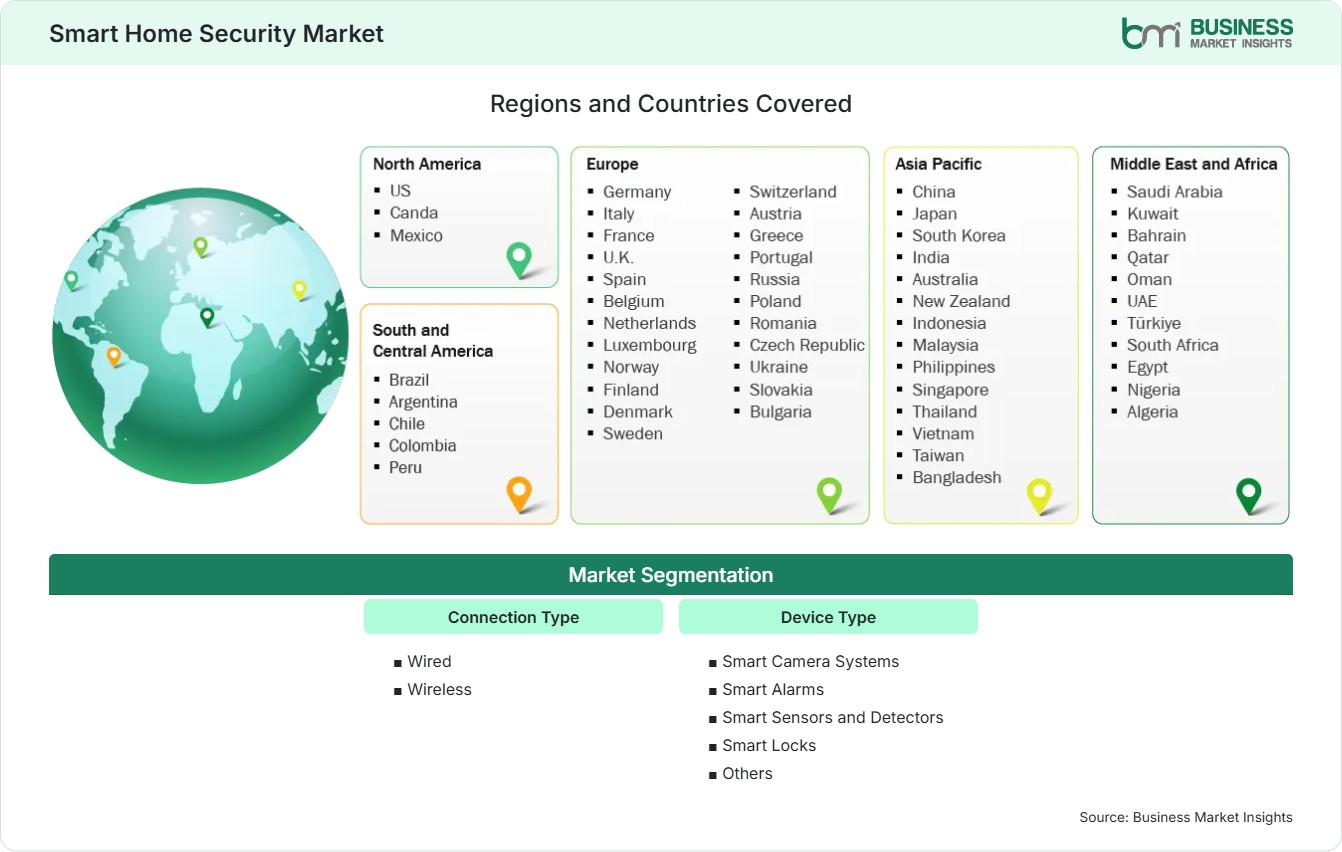
Global Market Geography
FREE PDF
Request your free sample
Request free sample
05 Segment Analysis

Smart Home Security Market Segmentation

Connection Type

The connection type segment represents the primary communication architectures used in smart home security systems to connect cameras, sensors, alarms, locks, and monitoring platforms. This segment accounts for approximately 72%–75% share in 2025 and is projected to grow at a CAGR of 16.5%–17.2% through 2033. The expanding Smart Home Security Market Scope is supported by increasing IoT adoption, rising demand for connected residential devices, and growing integration of security systems with smart home ecosystems.

  • Wired: Wired security systems continue serving applications requiring stable connectivity, low latency, and uninterrupted performance. These systems remain popular in larger residential installations and professionally monitored security environments.
  • Wireless: Wireless systems dominate the market due to ease of installation, scalability, remote accessibility, smartphone integration, and compatibility with modern smart home platforms. Continuous advancements in wireless communication technologies continue driving adoption.

Device Type

The device type segment highlights the major categories of smart security products utilized to improve residential safety, monitoring, and access control. This segment accounts for approximately 31%–34% share in 2025 and is expected to register a CAGR of 17.0%–17.7% through 2033. Current Smart Home Security Market Trends indicate increasing adoption of AI-powered surveillance, cloud-connected security platforms, intelligent access management solutions, and advanced intrusion detection technologies.

  • Smart Camera Systems: Smart camera systems lead the market due to increasing demand for real-time video monitoring, motion detection, cloud storage, facial recognition capabilities, and remote surveillance applications.
  • Smart Alarms: Smart alarms provide automated notifications, emergency alerts, and integration with connected home platforms, enhancing residential security effectiveness.
  • Smart Sensors and Detectors: Sensors and detectors are extensively utilized for intrusion detection, smoke monitoring, water leakage detection, motion sensing, and environmental monitoring applications.
  • Smart Locks: Smart locks continue witnessing strong growth due to increasing demand for keyless entry, remote access control, visitor management, and smartphone-enabled security solutions.
  • Others: Other devices include video doorbells, smart intercom systems, panic buttons, monitoring hubs, and integrated home security controllers.
06 Market Forces

Smart Home Security Market Dynamics

Key Market Drivers

Rising Adoption of Connected Smart Home Devices

The rapid adoption of connected smart home devices is creating significant growth opportunities for the smart home security market. Consumers are increasingly integrating smart cameras, video doorbells, smart locks, motion sensors, and alarm systems into comprehensive home automation ecosystems. Advancements in Internet of Things (IoT) technology, high-speed internet connectivity, cloud computing, and mobile applications have improved the performance, accessibility, and ease of use of connected security solutions. These technologies enable homeowners to monitor and control their properties remotely through smartphones and voice assistants. As demand for intelligent, connected living environments continues to grow, smart home security systems are becoming an essential component of modern residential infrastructure, driving sustained market expansion.

Growing Consumer Concerns Over Home Safety and Security

The rising concerns of people about their safety at homes and the need for protection of their properties is fueling the trend toward increased use of smart home security systems. The growing awareness of the risks of burglary, illegal access, package thefts, and other security issues related to the residence is making homeowners adopt sophisticated surveillance solutions. Smart home security systems offer a range of features, including real-time alerts, remote access, video monitoring, intrusion detection, and emergency alerts. Ongoing innovations in areas such as artificial intelligence, facial recognition, and cloud monitoring services are improving the performance of the systems. The consumers' growing need for personal and property security is contributing to their adoption.

Increasing Demand for Remote Monitoring and Access Control

The increasing demand for remote monitoring and access control is creating significant opportunities for the smart home security market. Homeowners are increasingly seeking security solutions that provide real-time visibility and control over their properties through smartphones, tablets, and other connected devices. Smart security platforms enable users to monitor live video feeds, review recorded footage, lock or unlock doors remotely, manage visitor access, and receive instant alerts about suspicious activities from virtually anywhere. Advancements in cloud computing, mobile applications, and wireless connectivity have further enhanced the reliability and convenience of these systems. As consumers continue prioritizing convenience, flexibility, and continuous home protection, demand for intelligent remote monitoring and access control solutions is expected to grow steadily across residential markets.

Key Market Opportunities

Rising Demand for DIY Smart Security Solutions

Consumers have begun embracing self-installed security systems due to their easy installation, cost savings, and flexibility. The DIY smart security solutions help to avoid lengthy installations by professionals, giving more freedom to the consumers to manage their security systems. To meet the rising demands from the consumers, the manufacturers have started developing easy-to-use devices with simple installation process and mobile applications.

Expansion of Smart Home Adoption in Emerging Markets

There are increased trends in the adoption of smart homes in emerging economies due to factors such as urbanization, increase in disposable income, internet penetration, and digital literacy. The people from these regions are opting for connected home devices to enhance their comfort, convenience, and security. With the affordability of the smart home technology, there are bound to be more demands for security products.

Growing Investments in Subscription-Based Security Monitoring Services

Subscription-based monitoring services are becoming an increasingly important component of modern smart home security ecosystems. Service providers offer real-time monitoring, cloud video storage, emergency response support, AI-driven analytics, and advanced security management capabilities through recurring service models. These offerings provide users with enhanced protection while generating predictable recurring revenue streams for providers. Long-term Smart Home Security Market Forecast projections remain highly favorable as adoption of subscription-based security services continues accelerating globally.

Market Restraints and Challenges

Cybersecurity and Consumer Data Privacy Concerns

Factor: Smart home security systems collect and transmit significant volumes of personal data, video recordings, usage information, and access credentials. Increasing connectivity exposes these devices to potential cybersecurity threats, unauthorized access, and data privacy risks.

Impact: Security vulnerabilities and privacy concerns may reduce consumer confidence and slow adoption of connected security technologies. Manufacturers must invest in robust cybersecurity frameworks, encryption technologies, and data protection measures to address evolving threats.

High Installation and System Upgrade Costs

Factor: Despite decreasing hardware prices, comprehensive smart home security deployments can require substantial investment in devices, connectivity infrastructure, professional services, and ongoing system upgrades. Advanced features may further increase overall costs.

Impact: High ownership costs may limit adoption among budget-conscious consumers and delay technology upgrades. Cost considerations can affect market penetration, particularly in emerging and price-sensitive residential segments.

07 Company Analysis

Competitive Landscape

The Smart Home Security Market Analysis is characterized by strong competition among connected security solution providers, residential monitoring companies, smart device manufacturers, and home automation technology developers. Market participants are focusing on AI-powered surveillance, cloud-based monitoring platforms, smart access control technologies, subscription-based security services, and integrated home automation ecosystems to strengthen their market positions. Rising consumer demand for connected security solutions, increasing smart home adoption, and growing emphasis on remote monitoring capabilities continue driving innovation across the market. Companies are investing in intelligent video analytics, cybersecurity enhancements, mobile-based control platforms, and end-to-end home security ecosystems to improve safety, convenience, and user experience.

Company Name

Overview

Products and Services relevant to this market

Abode Systems, Inc.

Smart home security company focused on DIY and connected security solutions.

Smart security hubs, surveillance cameras, sensors, monitoring services, and home automation platforms.

ADT Inc.

Residential and commercial security provider serving global customers.

Smart alarms, monitoring services, connected security devices, video surveillance solutions, and access control systems.

Brinks Home Security

Security services provider specializing in connected home protection.

Smart home security systems, alarm monitoring, surveillance devices, and mobile-controlled security solutions.

Hangzhou Hikvision Digital Technology Co., Ltd.

Video surveillance and security technology company.

Smart cameras, video monitoring systems, intelligent surveillance solutions, and AI-enabled security technologies.

Honeywell International Inc.

Technology company providing building and residential security solutions.

Smart security systems, sensors, alarms, access control technologies, and integrated monitoring platforms.

Johnson Controls

Building technologies and security solutions provider.

Smart monitoring systems, intrusion detection technologies, surveillance solutions, and security management platforms.

Resideo Technologies, Inc.

Smart home and residential technology company.

Connected security products, smart sensors, home monitoring systems, and automation solutions.

Ring LLC

Consumer smart security company focused on connected residential devices.

Video doorbells, smart cameras, security alarms, cloud monitoring services, and mobile security applications.

SimpliSafe, Inc.

Smart home security provider specializing in wireless solutions.

DIY security systems, alarms, sensors, professional monitoring services, and connected security devices.

Vivint Smart Home, Inc.

Smart home technology company focused on integrated residential solutions.

Smart cameras, connected locks, security monitoring platforms, smart sensors, and home automation systems.

10 Trust & Transparency

Research Methodology

The market analysis combines proprietary research with secondary data from government agencies, company disclosures, regulatory filings, industry databases and expert interviews. Market estimates are validated through data triangulation, cross-market benchmarking and analyst review.

View Full Research Methodology

11 Questions Answered

Frequently Asked Questions

How is artificial intelligence influencing smart home security systems?

Artificial intelligence enhances smart home security by enabling facial recognition, motion analytics, threat detection, behavioral analysis, automated alerts, and intelligent video monitoring, resulting in greater effectiveness and user convenience.

What does this Smart Home Security Market Report cover?

The market report covers connection type analysis, device type assessment, regional trends, competitive landscape analysis, market drivers, opportunities, restraints, challenges, and future growth prospects through 2033.

Why are Smart Camera Systems the leading device type segment?

Smart camera systems lead the market because they provide real-time monitoring, motion detection, cloud recording capabilities, AI-based analytics, and enhanced residential surveillance functionality.

Which connection type segment dominates the market?

Wireless dominates the market due to its ease of installation, flexibility, remote accessibility, smartphone integration, and compatibility with modern smart home platforms.

What is driving growth in the Smart Home Security market?

Rising adoption of connected smart home devices, growing consumer concerns over home safety and security, increasing demand for remote monitoring and access control, and expanding IoT-enabled home ecosystems are major factors driving market growth.

Access the Full Smart Home Security Market Report

Get segment-level forecasts, regional estimates, competitive benchmarking, company profiles and downloadable Excel datasets.

Access the full Smart Home Security Market Report
350 pages PDF & Excel | 2026-08-21