
Security Operation Center Market Outlook: Size, Share, Trends, Growth Analysis, Competitive Landscape & Forecast, 2026-2033

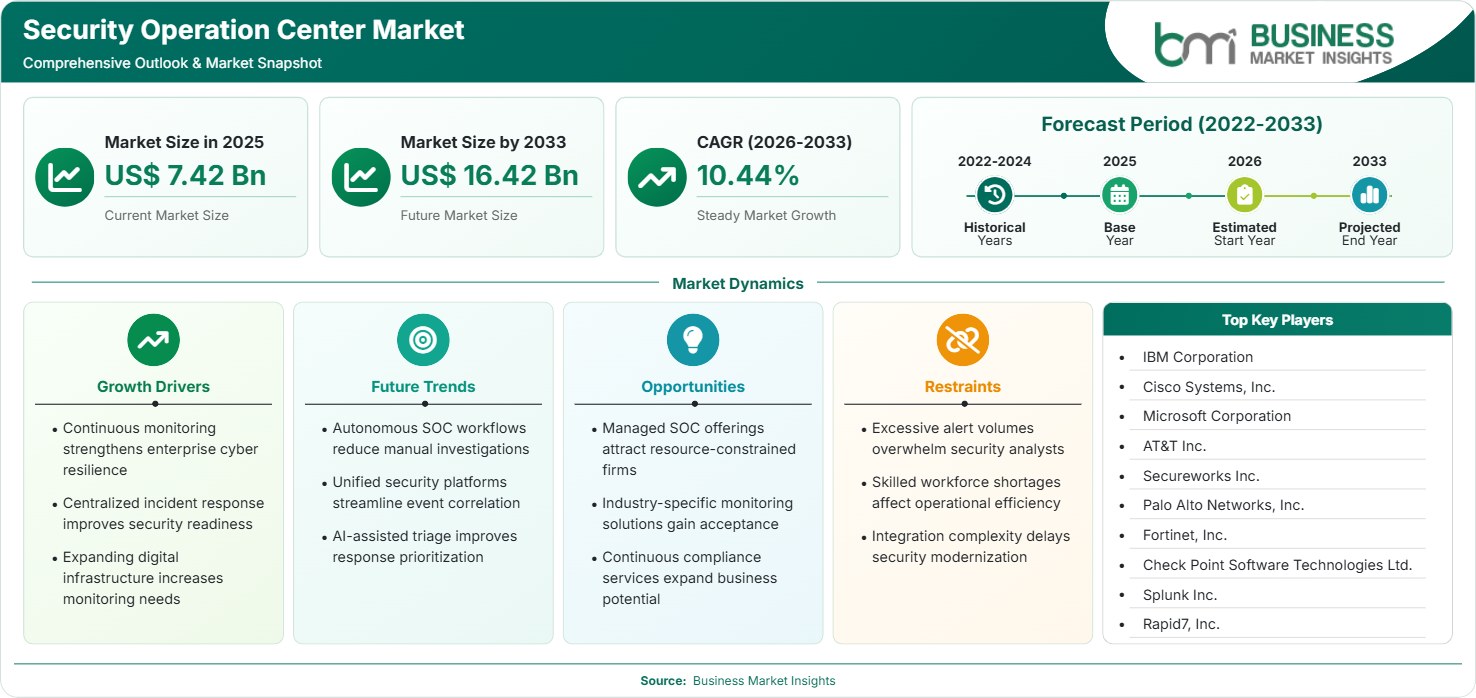
The Security Operation Center Market size was valued at US$ 7.42 billion in 2025 and is projected to reach US$ 16.42 billion by 2033, growing at a CAGR of 10.44% during 2026–2033. Continuous cyber threat monitoring, expanding enterprise digital infrastructure, and increasing investments in centralized security operations continue supporting long-term market expansion.

Report Coverage
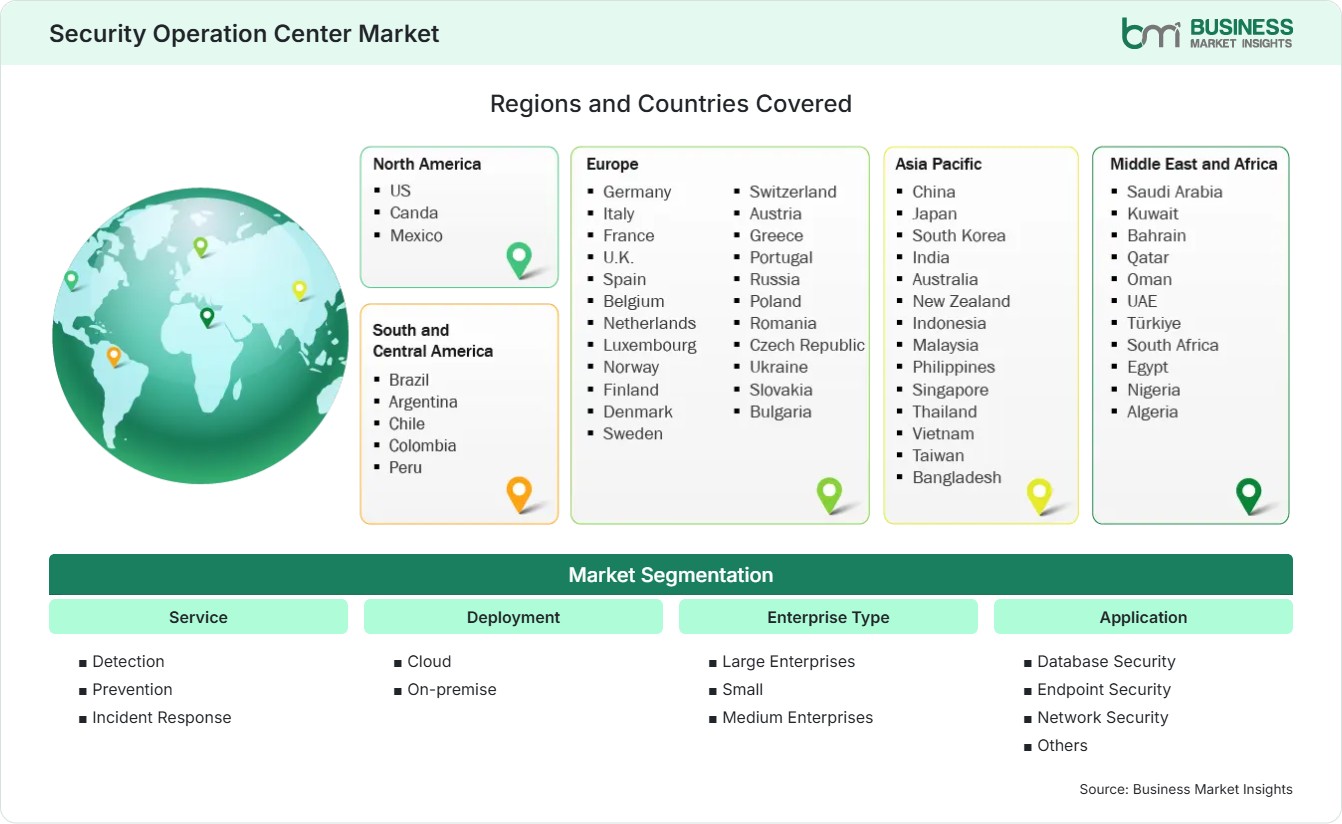
  • Service: Detection, Prevention, and Incident Response
  • Deployment: Cloud, On-premise
  • Enterprise Type: Large Enterprises, Small, Medium Enterprises
  • Application: Database Security, Endpoint Security, Network Security, Others
  • End-user: BFSI, Healthcare, Government, Retail and e-Commerce, Manufacturing, Others
US$ 7.42 Bn Market size in 2025
US$ 16.42 Bn Market Size by 2033
10.44% CAGR, 2026 - 2033
2026-2033 Forecast Period

AI Overview

Security Operation Center Market Summary

  • North America Region: North America holds 36%–39% market share in 2025 and is projected to expand at a CAGR of 9.8%–10.3% during 2026–2033. Strong cybersecurity spending, mature digital infrastructure, and increasing enterprise investments in managed detection services continue supporting growth. The U.S. remains the largest regional market with a CAGR of 9.9%–10.4%, driven by rising ransomware threats and cloud security investments.
  • Fastest Growing Region: Asia Pacific accounts for 24%–27% market share in 2025 and is expected to register a CAGR of 11.7%–12.3% through the forecast period. Digital transformation, expanding cloud adoption, and stronger cybersecurity regulations continue accelerating enterprise demand for security operations.
  • Leading Segment: Detection represents 39%–42% market share in 2025 and is projected to grow at a CAGR of 10.6%–11.1%, supported by increasing demand for real-time threat visibility, security analytics, and automated monitoring capabilities.
  • High Growth Segment: Cloud deployment captures 46%–49% market share in 2025 and is expected to record a CAGR of 11.2%–11.8%, driven by hybrid IT environments, scalable security platforms, and rising cloud-native enterprise deployments.
  • Key Market Opportunity: Expanding managed security services, AI-driven threat intelligence, and compliance-focused monitoring platforms continue creating long-term opportunities for technology providers and cybersecurity service vendors.
  • Major Market Players: IBM Corporation, Cisco Systems, Inc., Microsoft Corporation, AT&T Inc., Secureworks Inc., Palo Alto Networks, Inc., Fortinet, Inc., Check Point Software Technologies Ltd., Splunk Inc., and Rapid7, Inc.
Strategic Insights

Security Operation Center Market: Strategic Insights

Security Operation Center Market Strategic Framework
FREE PDF
Request your free sample
Request free sample
Stakeholder View

Key Takeaways

  • Security operations are evolving from reactive monitoring toward intelligence-driven detection, automated response, and continuous threat hunting across increasingly distributed enterprise environments.
  • The managed SOC service is an excellent opportunity for small and medium sized businesses looking for enterprise-level cybersecurity without an extensive security team in-house.
  • Artificial intelligence, machine learning, and security orchestration technologies continue reducing response times while improving threat detection accuracy and analyst productivity.
  • Asia Pacific offers the strongest long-term investment potential as governments strengthen cybersecurity regulations and enterprises accelerate digital transformation across financial services, manufacturing, and public infrastructure.
  • Strategic partnerships between cybersecurity vendors, cloud providers, and managed service providers continue expanding integrated security offerings and accelerating market innovation.
  • Organizations increasingly prioritize unified security platforms capable of protecting hybrid cloud infrastructure, remote work environments, and expanding digital ecosystems through centralized visibility and automated operations.
Geographic Outlook

Security Operation Center Market Regional Highlights

North America Security Operation Center Market

North America accounts for 36%–39% Security Operation Center Market share in 2025 and is projected to register a CAGR of 9.8%–10.3% during 2026–2033. High enterprise cybersecurity spending, mature cloud adoption, expanding managed security services, and increasing ransomware incidents continue driving regional demand. Organizations are investing in AI-enabled monitoring platforms, security orchestration technologies, and threat intelligence solutions to strengthen cyber resilience across critical industries.

  • Financial institutions continue expanding SOC capabilities to protect digital banking platforms and payment infrastructure.
  • Cloud security investments remain strong as enterprises modernize hybrid IT environments and remote workforce security.
  • Government cybersecurity programs encourage continuous monitoring across critical infrastructure and public sector organizations.
  • AI-enabled threat detection and automated incident response continue improving operational efficiency and reducing response times.

US Security Operation Center Market

The United States contributes 83%–86% of North American revenue and is expected to expand at a CAGR of 9.9%–10.4% during the forecast period. Increasing cyber threats, regulatory compliance requirements, and enterprise investments in advanced security technologies continue supporting long-term market expansion.

  • Large enterprises continue strengthening security operations using AI-powered threat detection platforms.
  • Cloud-native security architectures accelerate demand for centralized monitoring and response capabilities.
  • Critical infrastructure organizations expand cybersecurity investments to improve operational resilience.
  • Managed security service providers continue broadening enterprise cybersecurity offerings across multiple industries.

Europe Security Operation Center Market

Europe represents 27%–30% security operation center market share in 2025 and is anticipated to grow at a CAGR of 10.1%–10.6% through 2026–2033. Regulatory frameworks, including stricter cybersecurity and data protection requirements, continue encouraging enterprise investments in centralized security operations. Germany leads regional adoption, while Poland records the fastest growth through increasing digital infrastructure investment and cybersecurity modernization.

  • Compliance-driven cybersecurity investments continue supporting demand across regulated industries.
  • Cloud migration strategies increase adoption of integrated SOC platforms throughout Europe.
  • Financial institutions strengthen threat intelligence capabilities to counter evolving cyber risks.
  • Public sector modernization programs continue expanding investments in centralized security monitoring.

Asia Pacific Security Operation Center Market

Asia Pacific accounts for 24%–27% security operation center market share in 2025 and is projected to record the fastest 11.7%–12.3% CAGR during 2026–2033. Rapid digitalization, cloud infrastructure expansion, and stronger cybersecurity regulations continue driving enterprise investments in advanced security operations. China remains the largest regional market, while India demonstrates the fastest growth through accelerating enterprise cybersecurity adoption.

  • Rising ransomware attacks continue encouraging organizations to deploy centralized security monitoring.
  • Expansion of cloud services increases demand for scalable SOC platforms and managed security services.
  • Governments strengthen cybersecurity frameworks supporting enterprise investment in continuous monitoring.
  • Banking, healthcare, and manufacturing sectors continue increasing cybersecurity spending to protect critical operations.

Rest of World Security Operation Center Market

The Rest of World region holds 7%–9% security operation center market share in 2025 and is projected to expand at a CAGR of 10.3%–10.8% during 2026–2033. Digital transformation initiatives, cloud adoption, and stronger cyber resilience programs continue supporting market development across Latin America, the Middle East, and Africa.

  • Brazil leads regional adoption through expanding enterprise cybersecurity investment and cloud deployment.
  • GCC countries continue strengthening national cybersecurity infrastructure and digital transformation initiatives.
  • Financial institutions increasingly implement centralized threat monitoring to strengthen cyber resilience.
  • Growing regulatory requirements encourage organizations to modernize security operations and compliance capabilities.
Global Market Geography
FREE PDF
Request your free sample
Request free sample
Segment Analysis

Security Operation Center Market Segmentation

Service

The service segment represents the foundation of enterprise cybersecurity operations by enabling organizations to detect, prevent, and respond to evolving cyber threats through centralized monitoring. It accounted for 39%–42% market share in 2025 and is projected to register a CAGR of 10.6%–11.1% during 2026–2033. Expanding cyber risks, stricter compliance requirements, and rising investments in managed security services continue broadening the Security Operation Center Market scope across enterprises of every size.

  • Detection: Holds the largest share owing to continuous threat monitoring, security information and event management (SIEM), behavioral analytics, and real-time visibility across enterprise networks, endpoints, cloud environments, and applications.
  • Prevention: Organizations increasingly deploy preventive security services to identify vulnerabilities, enforce security policies, strengthen access controls, and reduce cyber risks before incidents disrupt business operations.
  • Incident Response: Demand continues rising as enterprises seek rapid containment, forensic investigation, malware remediation, recovery planning, and business continuity following sophisticated cyberattacks and security breaches.

Deployment

Deployment models continue evolving as enterprises balance scalability, operational flexibility, regulatory compliance, and infrastructure costs. This segment accounted for 46%–49% market share in 2025 and is expected to register a CAGR of 11.2%–11.8% throughout the forecast period. Current Security Operation Center Market trends indicate accelerating migration toward cloud-based monitoring platforms while highly regulated industries continue maintaining hybrid and on-premise security environments.

  • Cloud: Experiences the fastest adoption because it offers scalable monitoring, centralized management, automated updates, remote accessibility, and lower infrastructure costs while supporting hybrid and multi-cloud enterprise environments.
  • On-premise: Maintains strong demand among government agencies, financial institutions, and highly regulated industries requiring direct infrastructure control, strict data governance, and enhanced security customization.

Enterprise Type

Enterprise size significantly influences cybersecurity investment strategies, resource allocation, and SOC implementation models. This segment accounted for 61%–64% market share in 2025 and is projected to grow at a CAGR of 10.1%–10.6% through 2033. Large organizations continue investing in advanced security platforms, while managed service adoption accelerates cybersecurity modernization among smaller businesses.

  • Large Enterprises: Lead adoption through substantial cybersecurity budgets, complex IT infrastructure, dedicated security teams, and increasing deployment of AI-powered threat detection and automated response platforms.
  • Small and Medium Enterprises (SMEs): Growing cyber risks and affordable managed SOC services encourage SMEs to strengthen security capabilities without maintaining extensive internal cybersecurity resources.

Application

Application diversity continues driving investment in specialized monitoring solutions designed to protect enterprise IT assets across increasingly connected digital environments. The segment accounted for 31%–34% market share in 2025 and is projected to register a CAGR of 10.8%–11.4% during the forecast period as organizations expand integrated cybersecurity strategies.

  • Database Security: Organizations strengthen database monitoring to safeguard confidential business information, customer records, financial transactions, and intellectual property against unauthorized access and cyber threats.
  • Endpoint Security: Demand continues increasing with remote work, mobile devices, and distributed enterprise networks requiring continuous endpoint visibility, malware protection, and automated threat detection.
  • Network Security: Remains essential for monitoring enterprise traffic, identifying malicious activity, preventing unauthorized access, and maintaining secure communications across hybrid IT environments.

End-user

End-user demand varies according to regulatory obligations, cyber risk exposure, and digital infrastructure complexity. This segment represented 34%–37% market share in 2025 and is forecast to expand at a CAGR of 10.9%–11.5% through 2033 as cybersecurity becomes a strategic enterprise priority across industries.

  • BFSI: Continues leading adoption because banks and financial institutions require continuous monitoring, fraud prevention, regulatory compliance, and protection against increasingly sophisticated cyberattacks.
  • Healthcare: Hospitals and healthcare providers strengthen SOC capabilities to secure electronic health records, connected medical devices, and critical clinical information systems.
  • Government: Public sector organizations continue investing in centralized monitoring to protect national infrastructure, digital public services, and sensitive government information against evolving cyber threats.
  • Retail and e-Commerce: Retailers deploy advanced security monitoring to secure customer payment systems, online transactions, digital commerce platforms, and consumer data from cybercrime.
  • Manufacturing: Industrial organizations increasingly implement SOC solutions to protect operational technology, connected production systems, industrial control networks, and intellectual property from cyber incidents.
Market Forces

Security Operation Center Market Dynamics

Key Market Drivers

Continuous monitoring strengthens enterprise cyber resilience

The practice of continuous monitoring has gained prominence as a cybersecurity approach because organizations seek ongoing insight into their networks, cloud infrastructure, applications, and devices. Contemporary security operations centers utilize intelligence, analytics, security information and event management (SIEM) technology, and automation systems to detect abnormal behavior that can evolve into a serious security incident. The growing number of ransomware attacks, phishing, and advanced persistent threats is pushing businesses to improve their monitoring practices. These developments continue supporting the Security Operation Center Market growth, enabling organizations to improve threat detection accuracy, reduce response times, and maintain business continuity across increasingly complex digital environments.

Centralized incident response improves security readiness

Organizations are increasingly adopting centralized incident response capabilities to improve coordination during cybersecurity events and minimize operational disruption. Security operations centers allow enterprises to gain an integrated view of their infrastructure, allowing for investigations of any alerts, risk prioritization, and execution of any required responses on one platform. Workflows, playbooks, and threat intelligence will enable enterprises to respond faster to any situations, minimizing human intervention. Various enterprises, including banks, health care organizations, governments, and manufacturing organizations, are constantly investing in security operations to enhance their capabilities against cyber threats.

Expanding digital infrastructure increases monitoring needs

Digital transformation, adoption of cloud technology, IoT implementations, and hybrid working environments keep extending the enterprise’s attack surface. Companies need to track increased amounts of network traffic, cloud computing workloads, user identities, end points, and assets connected to their networks while ensuring uninterrupted business activities. The security operation center serves as a monitoring mechanism that helps in identifying vulnerabilities and potential threats. Continuous improvements in AI-powered analytics, automation, and security orchestration are adding further efficiency to this process. These developments continue influencing Security Operation Center Market trends, encouraging organizations to modernize monitoring capabilities and strengthen enterprise-wide cybersecurity strategies.

Key Market Opportunities

Managed SOC offerings attract resource-constrained firms

The services of the Managed Security Operation Center are now increasingly sought after by organizations that have no cyber security staff nor the requisite technological expertise to protect their IT networks. The advantages of these services are such that the organization need not have any significant investment in internal infrastructure to benefit from them. Security Operation Center Market Forecasts indicate that demand for managed SOC services will continue expanding as cyber threats become more sophisticated and organizations seek scalable security capabilities with predictable operating expenses.

Industry-specific monitoring solutions gain acceptance

Organizations increasingly require security monitoring solutions tailored to their operational environments, regulatory obligations, and industry-specific cyber risks. The vendors are developing SOC platforms tailored to the industries such as finance, healthcare, manufacturing, government, and retail through incorporating specific threat intelligence, compliance reporting, and security analytics for respective industries. The industry-tailored security solutions ensure efficiency and help tackle the unique challenges related to cybersecurity. Further development of the security solutions for different industries will provide a good opportunity for the cybersecurity companies.

Continuous compliance services expand business potential

Growing regulatory requirements surrounding data protection, privacy, and cybersecurity are encouraging organizations to adopt continuous compliance monitoring services. Automated compliance checks, policy enforcement, auditing, and risk management functions are now being built into security operation centers in order to make it easier for businesses to comply with regulations. It is important for companies to have systems that provide visibility and eliminate compliance-related tasks. Security operations centers that combine compliance management, governance, and automation will have an advantage going forward due to increasing regulatory demands.

Market Restraints and Challenges

Excessive alert volumes overwhelm security analysts

Security operation centers process thousands of alerts every day, many of which are repetitive or false positives that require manual review. Factor: The volume of alerts increases the work of analysts, delays investigation of priority issues, and decreases efficiency when security personnel need to discern between a real threat and a non-priority situation. Impact: Alert fatigue may lead to increased response time, missed security issues, and higher costs for the business. The businesses tend to use AI technologies for accurate detection and decreasing the number of alerts.

Skilled workforce shortages affect operational efficiency

The global shortage of experienced cybersecurity professionals continues limiting the effectiveness of many security operation centers despite rising investments in advanced technologies. Factor: The recruitment and retention of capable analysts, incident responders, and threat hunters can be a struggle, as the demand far outweighs the supply of cybersecurity professionals. Impact: The lack of staff could result in delayed responses, higher costs, and delays in implementing new security solutions. This issue has been tackled by corporations through the implementation of SOC management solutions and artificial intelligence.

Company Analysis

Competitive Landscape

The competitive environment is driven by investments in AI-powered threat detection, cloud-native security operations, extended detection and response (XDR), and managed security services. Security Operation Center Market analysis shows that leading vendors are strengthening their portfolios through platform integration, strategic acquisitions, security automation, and advanced threat intelligence to help enterprises improve cyber resilience and regulatory compliance.

Company Name

Overview

Products and Services Relevant to this Market

IBM Corporation

Global technology company delivering enterprise cybersecurity, AI, and cloud solutions across multiple industries.

Managed SOC services, IBM QRadar SIEM, threat intelligence, incident response, XDR, and cybersecurity consulting.

Cisco Systems, Inc.

Leading networking and cybersecurity provider offering integrated enterprise security platforms worldwide.

SecureX, XDR, SIEM integration, network security, threat detection, SOC automation, and managed security services.

Microsoft Corporation

Major cloud and cybersecurity provider delivering AI-enabled enterprise security solutions through its cloud ecosystem.

Microsoft Sentinel, Microsoft Defender, SIEM, SOAR, cloud security, identity protection, and threat intelligence services.

AT&T Inc.

Telecommunications company providing managed cybersecurity and security monitoring solutions for enterprise customers.

Managed SOC, network monitoring, incident response, threat intelligence, security consulting, and managed detection services.

Secureworks Inc.

Cybersecurity company specializing in managed detection and response and advanced threat intelligence solutions.

Taegis XDR, managed SOC, threat detection, incident response, vulnerability management, and security analytics.

Palo Alto Networks, Inc.

Global cybersecurity company focused on AI-powered threat prevention and enterprise security platforms.

Cortex XSIAM, Cortex XDR, managed SOC, cloud security, threat intelligence, and security automation solutions.

Fortinet, Inc.

Cybersecurity vendor providing integrated network security and security operations technologies.

FortiSIEM, FortiAnalyzer, SOC automation, threat detection, incident response, firewall security, and AI-driven analytics.

Check Point Software Technologies Ltd.

Enterprise cybersecurity company delivering unified security management across networks, cloud, and endpoints.

Infinity Platform, SIEM integration, threat prevention, SOC monitoring, cloud security, and incident response solutions.

Splunk Inc.

Data analytics and cybersecurity company enabling real-time operational intelligence and security monitoring.

Splunk Enterprise Security, SIEM, SOAR, log analytics, threat detection, and security operations management.

Rapid7, Inc.

Cybersecurity company focused on vulnerability management, detection, and incident response technologies.

InsightIDR, MDR services, vulnerability management, SIEM, threat intelligence, incident response, and cloud security.

Trust & Transparency

Research Methodology

The market analysis combines proprietary research with secondary data from government agencies, company disclosures, regulatory filings, industry databases and expert interviews. Market estimates are validated through data triangulation, cross-market benchmarking and analyst review.

View Full Research Methodology

Questions Answered

Frequently Asked Questions

What does the Security Operation Center Market Report include?

The Market Report provides comprehensive insights into market dynamics, segmentation, regional performance, competitive landscape, emerging technologies, investment opportunities, and future industry developments.

Why are managed SOC services gaining popularity?

Managed SOC services provide continuous monitoring, expert threat analysis, incident response, and compliance support without requiring organizations to build and maintain large in-house cybersecurity teams.

Which industries are the largest users of Security Operation Center services?

BFSI, healthcare, government, manufacturing, and retail sectors remain the largest adopters because they manage sensitive information, critical infrastructure, and strict cybersecurity compliance requirements.

Which deployment model is growing the fastest?

Cloud deployment is experiencing the fastest growth because it offers scalability, centralized management, lower infrastructure costs, rapid deployment, and seamless integration with hybrid and multi-cloud enterprise environments.

What is driving demand for Security Operation Center solutions?

Organizations are increasing investments in centralized security monitoring due to rising cyberattacks, cloud adoption, regulatory compliance requirements, and the need for faster threat detection and incident response across complex digital environments.

Access the Full Security Operation Center Market Report

Get segment-level forecasts, regional estimates, competitive benchmarking, company profiles and downloadable Excel datasets.

Access the full Security Operation Center Market Report
350 pages PDF & Excel | 2026-08-25