Rubber Processing Chemicals Market Outlook (2022-2033)

Historic Data: 2022 - 2024   |   Base Year: 2025   |   Forecast Period: 2026-2033
Report Content: Market Scope, Market Segmentation, Market Dynamics, and Competitive Analysis

Report Coverage:
  • By Type (Anti-Degradants, Accelerators, Flame Retardants, Processing Aid/Promoters, and Others)
  • By Application (Tire and Non-Tire)

No. of Pages: 400
Report Code: BMIPUB00032550
Category: Chemicals and Materials
Rubber Processing Chemicals Market
Buy Now

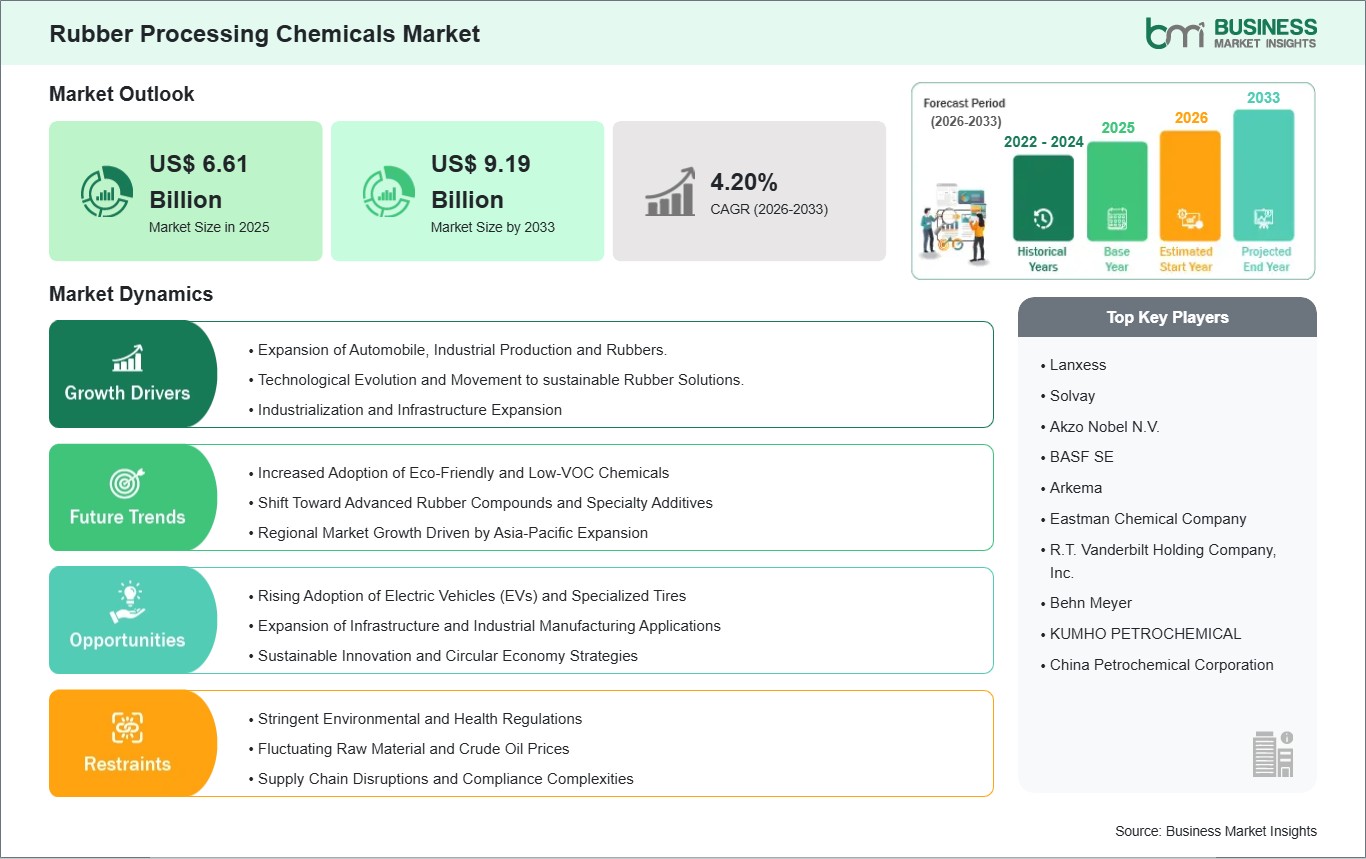
Rubber Processing Chemicals market size is expected to reach US$ 9.19 billion by 2033 from US$ 6.61 billion in 2025. The market is estimated to record a CAGR of 4.2% from 2026 to 2033.

Executive Summary and Global Market Analysis:

The rubber processing chemicals market also is one of the major spaces that contribute to the performance, durability and quality of rubber products that are essential in automotive, industrial, construction, and consumer goods markets. These chemicals are used to improve the effectiveness of the processing, physical properties and stability during manufacturing, storage, transportation and use of rubber products. The chemicals used in the processing of rubber are mostly used with tires, hose, belts, shoe, seals, gaskets and other previously molded or extruded rubber products. The emerging markets and both developed markets have been very much demanded as a result of the increase in the production of vehicles, development of infrastructure and the increasing manufacturing activities.

The growth of the automotive manufacturer, the growing interest in high-performance tires, and the growth in industrial use of rubber are major points that will lead to the growth of the market. The need to develop new technologies of sustainable mobility and sophisticated manufacturing technologies has also contributed to the higher demand for high-quality rubber processing chemicals. A new generation of additives that are environmentally safe, better accelerators and better anti-degradants are increasing the life cycle of products and their performance. Also, there is rapid urbanization and industrialization that has further enhanced the demand of reliable and high-performance rubber materials.

Nevertheless, difficulties like the environmental issues concerning the chemical toxicity, the unstable prices of raw materials and harsh regulations (especially relating to the health and environmental protection) remain. These regulations may raise the cost of production when they are complied with. Nonetheless, the growth opportunities appear to be high with the creation of sustainable, low-toxicity, and bio-based rubber processing chemicals. The chemicals market of rubber processing is projected to witness stable growth throughout the world, which will be maintained by technological innovations and the growing need for environmentally friendly solutions.

Rubber Processing Chemicals Market - Strategic Insights:

global-market-strategic-framework
Get more information on this report

Rubber Processing Chemicals Market Segmentation Analysis:

Key segments that contributed to the derivation of the Rubber Processing Chemicals market analysis are type and application.

  • By type, the Rubber Processing Chemicals market is segmented into anti-degradants, accelerators, flame retardants, processing aid/promoters, and others. The flame retardants segment dominated the market in 2024.
  • By application, the market is segmented into tire and non-tire. The tire segment held the largest share of the market in 2024.

Rubber Processing Chemicals Market Drivers and Opportunities:

Expansion of Automobile, Industrial Production and Rubbers.

It is determined that the increased focus on mobility globally, development of infrastructures and industrial productivity have become one of the most crucial contributors to the positive changes in the rubber processing chemicals market. The automobile industry, industrial machinery, and consumer goods are on the rise, and this has resulted in more production of rubber products like tires, belts, hoses and seals. The result of this rise in rubber production has been a drive in the demand for rubber processing chemicals to boost processing, mechanical strength, durability, heat and wear resistance. These chemicals are very important in maintaining uniform quality and performance of rubber products during the manufacturing process and when they are used.

As an illustration, growing passenger cars, commercial vehicles as well as off-road equipment manufacturing have resulted in high demand of high-performance tires that are greatly dependent on accelerators, antioxidants and vulcanizing agents. Infrastructure and transportation projects are being invested by governments and privately owned industries across the globe, and this is continuing to increase the consumption of rubber. Advanced rubber processing chemicals are used to enable the manufacturer to match performance standards and prolong the life of the product. Demand of quality and efficient rubber processing chemicals is likely to keep increasing as industrial production and vehicle numbers keep increasing especially in the emerging economies.

Technological Evolution and Movement to sustainable Rubber Solutions.

Another significant force that is influencing the market of rubber processing chemicals is the rising concern for technological innovation and sustainability. These are more sophisticated chemical formulations which are being embraced by manufacturers to enhance speed of processing, reduce energy consumption and product performance and environmental impact. The efforts to develop low accelerators, environmentally friendly antioxidants and bio-based processing facilitators have been on the rise as industries are keen to comply with the stringent environmental and safety requirements without compromising the quality of products.

Rubber processing chemicals are used in the manufacture of high-performance and specialty rubber products to serve electric automobiles, renewable energy systems, and high-tech industrial practice. Also, the increased utilization of sustainable manufacturing processes and green materials has resulted in a demand for environmentally compliant rubber chemicals with better thermal stability and ageing resistance. With regulatory demands on increasing sustainability in the industries and the reliance on more sustainable technologies by industries, demand for innovative and high-quality rubber processing chemicals is set to go up steadily in all global markets.

Rubber Processing Chemicals Market Size and Share Analysis:

  • By type, the Rubber Processing Chemicals market is segmented into anti-degradants, accelerators, flame retardants, processing aid/promoters, and others. The flame retardants segment dominated the market in 2024. This segment dominated the Rubber Processing Chemicals market in 2024, driven by stringent fire-safety regulations and increasing demand for flame-resistant rubber products.
  • By application, the market is segmented into tire and non-tire. The tire segment held the largest share of the market in 2024. The tire segment held the largest market share in 2024, supported by high global tire production, growing vehicle ownership, and replacement demand.

Rubber Processing Chemicals Market Report Highlights:

Report Attribute Details
Market size in 2025 US$ 6.61 Billion
Market Size by 2033 US$ 9.19 Billion
Global CAGR (2026 - 2033)4.20%
Historical Data 2022 - 2024
Forecast period 2026-2033
Segments Covered By By Type
  • Anti-Degradants
  • Accelerators
  • Flame Retardants
  • Processing Aid/Promoters
  • Others
By By Application
  • Tire and Non-Tire
Regions and Countries Covered North America
  • US
  • Canada
  • Mexico
Europe
  • Belgium
  • Austria
  • Finland
  • Denmark
  • Greece
  • Poland
  • Romania
  • Russia
  • Ukraine
  • Czech Republic
  • Slovakia
  • Bulgaria
  • Italy
  • Luxembourg
  • Germany
  • Switzerland
  • France
  • Netherlands
  • Norway
  • Portugal
  • Spain
  • Sweden
  • United Kingdom
Asia-Pacific
  • Australia
  • China
  • India
  • Japan
  • South Korea
  • Indonesia
  • Malaysia
  • Philippines
  • Singapore
  • Thailand
  • Vietnam
  • Bangladesh
  • New Zealand
  • Taiwan
South and Central America
  • Brazil
  • Argentina
  • Peru
  • Chile
  • Colombia
Middle East and Africa
  • Bahrain
  • Kuwait
  • Oman
  • Qatar
  • Saudi Arabia
  • United Arab Emirates
  • Turkiye
  • South Africa
  • Egypt
  • Algeria
  • Nigeria
Market leaders and key company profiles
  • Lanxess
  • Solvay
  • Akzo Nobel N.V.
  • BASF SE
  • Arkema
  • Eastman Chemical Company
  • R.T. Vanderbilt Holding Company, Inc.
  • Behn Meyer
  • KUMHO PETROCHEMICAL
Get more information on this report

Rubber Processing Chemicals Market Report Coverage and Deliverables:

The Rubber Processing Chemicals Market Size and Forecast (2022-2033) report provides a detailed analysis of the market covering below areas:

  • Rubber Processing Chemicals market size and forecast at global, regional, and country levels for all the key market segments covered under the scope
  • Rubber Processing Chemicals market trends, as well as market dynamics such as drivers, restraints, and key opportunities
  • Rubber Processing Chemicals market analysis covering key market trends, global and regional framework, major players, regulations, and recent market developments
  • Industry landscape and competition analysis covering market concentration, heat map analysis, prominent players, and recent developments for the Rubber Processing Chemicals market
  • Detailed company profiles, including SWOT analysis

Rubber Processing Chemicals Market Geographic Insights:

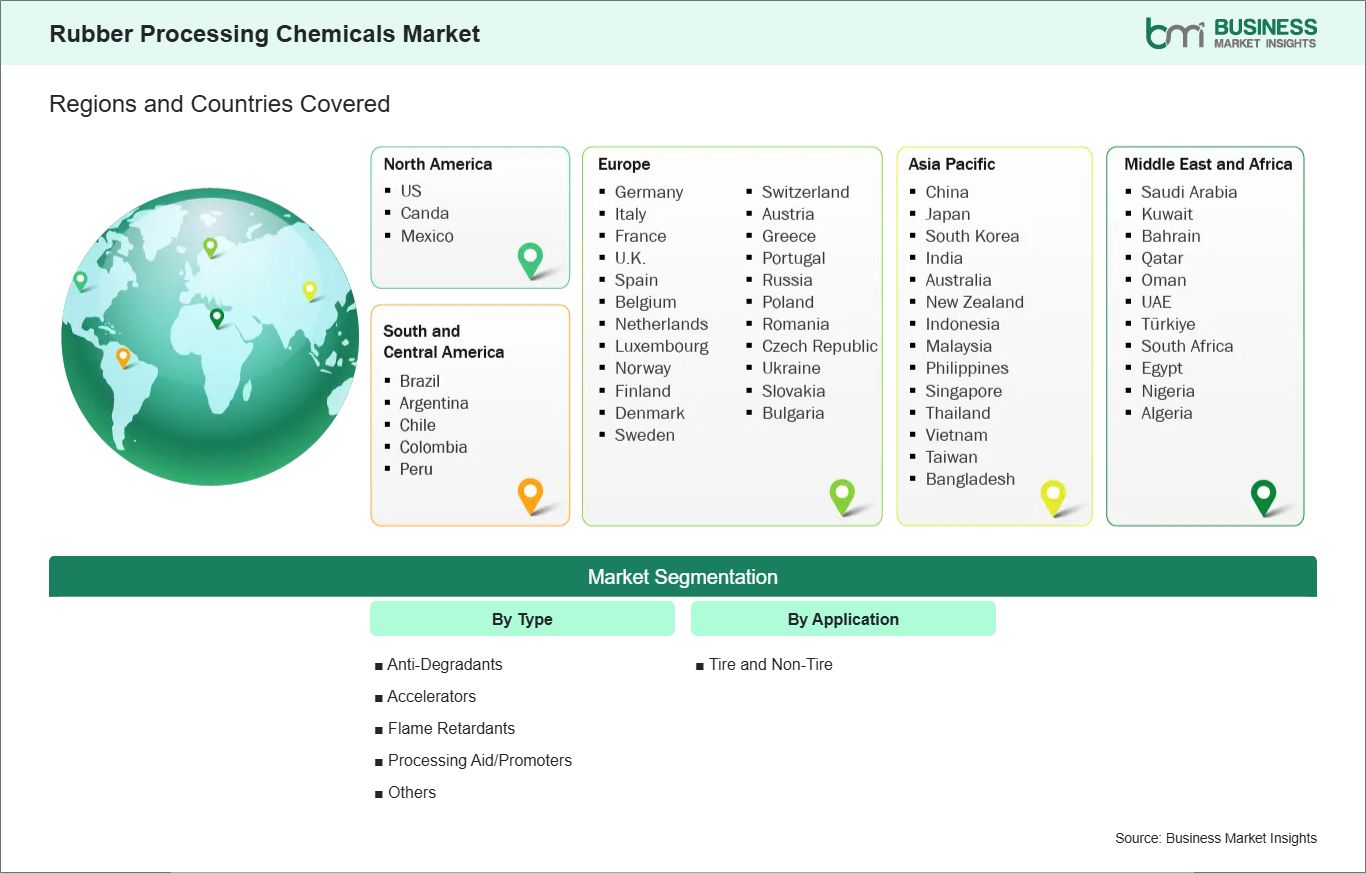
The geographical scope of the Rubber Processing Chemicals market report is divided into five regions: North America, Asia Pacific, Europe, Middle East & Africa, and South & Central America. The Rubber Processing Chemicals market in the Asia Pacific is expected to grow significantly during the forecast period.

The Asia-Pacific Rubber Processing Chemicals market is segmented into China, Japan, South Korea, India, Australia, New Zealand, Indonesia, Malaysia, the Philippines, Singapore, Thailand, Vietnam, Taiwan, Bangladesh, and the Rest of Asia.

The Asia-Pacific market is experiencing robust growth due to the rapid industrialization, development of manufacturing sectors, increase in the level of automotive production, and the rapid urbanization of the region. China and India dominate the market that is backed by massive investments in the automotive manufacturing industry, infrastructure building, and manufacturing of industrial production plants. The growing demand for tires, footwear, construction materials and consumer rubber products are increasing the use of rubber processing chemicals tremendously. Also, the growth of manufacturing of rubber goods and expansion of export-oriented industries are also improving further the demand in the region.

The other trend is the enhanced use of higher chemical technologies of rubber processing technologies such as environmentally friendly accelerators, high-performance anti-degradants, and sustainable processing aids in both tire and non-tire rubber. The development of local chemical production facilities, increased automation in rubber processing, and the increase in the quality and performance requirements are contributing to the consistency of products and efficiency in operations. In addition, the increased production of electric vehicles, development of infrastructure, and export of rubber products is making Asia-Pacific a significant production and supply base of the global rubber processing chemicals. The good government policies, industrial incentives, and ever-growing expansion in manufacturing also strengthen the strong market position in the region.

global-market-geography
Get more information on this report

Rubber Processing Chemicals Market Research Report Guidance:

  • The report includes qualitative and quantitative data in the Rubber Processing Chemicals market across type, application, and geography.
  • The report starts with the key takeaways (chapter 2), highlighting the key trends and outlook of the Rubber Processing Chemicals market.
  • Chapter 3 includes the research methodology of the study.
  • Chapter 4 further includes ecosystem analysis.
  • Chapter 5 highlights the major industry dynamics in the Rubber Processing Chemicals market, including factors that are driving the market, prevailing deterrents, potential opportunities, as well as future trends. Impact analysis of these drivers and restraints is also covered in this section.
  • Chapter 6 discusses the Rubber Processing Chemicals market scenario, in terms of historical market revenues, and forecast till the year 2031.
  • Chapters 7 to 10 cover Rubber Processing Chemicals market segments by type, application, and geography across North America, Europe, Asia Pacific, Middle East and Africa, and South and Central America. They cover the market volume revenue forecast and factors driving the market.
  • Chapter 11 describes the competitive analysis along with the heat map analysis for the key players operating in the market.
  • Chapter 12 describes the industry landscape analysis. It provides detailed descriptions of business activities such as market initiatives, new developments, mergers, and joint ventures globally, along with a competitive landscape.
  • Chapter 13 provides detailed profiles of the major companies operating in the Rubber Processing Chemicals market. Companies have been profiled on the basis of their key facts, business descriptions, products and services, financial overview, SWOT analysis, and key developments.
  • Chapter 14, i.e., the appendix is inclusive of a brief overview of the company, a list of abbreviations, and a disclaimer.

Rubber Processing Chemicals Market News and Key Development:

The Rubber Processing Chemicals market is evaluated by gathering qualitative and quantitative data post primary and secondary research, which includes important corporate publications, association data, and databases. A few of the key developments in the Rubber Processing Chemicals market are:

  • In September 2025, specialty chemicals company LANXESS is expanding production capabilities with the addition of rubber processing promoters at its Bushy Park facility in Goose Creek, South Carolina. The expansion project, currently underway, aims to meet increasing demand and improve supply reliability, with new production expected to come online in November 2025.
  • In December 2025, Kiyosu, Japan, December 24, 2025: Toyoda Gosei Co., Ltd. has commercialized automotive parts (weatherstrips) that incorporate a high percentage of recycled rubber material. Beginning with their adoption in Toyota Motor's new RAV4, the company will expand application of this recycling technology to further contribute to decarbonization and resource circulation. While resource circulation has advanced for materials such as steel and plastic, rubber remains difficult to recycle, and waste rubber is usually incinerated for thermal energy recovery. Recycling rubber requires devulcanization, a process in which heat and pressure breaks the sulfur bonds that give rubber its elasticity. However, this process also breaks other chemical bonds, resulting in reduced strength and leaving behind characteristic odors—long-standing challenges in rubber recycling.

Key Sources Referred:

  • World Bank – Global Trade Indicators
  • European Chemicals Agency
  • International Council of Chemical Associations
  • (International Monetary Fund )IMF
  • World Trade Organization (WTO)
  • International Trade Administration (ITA)
  • Company website
  • Company annual reports
  • Company investor presentations

The List of Companies - Rubber Processing Chemicals Market

  • Lanxess
  • Solvay
  • Akzo Nobel N.V.
  • BASF SE
  • Arkema
  • Eastman Chemical Company
  • R.T. Vanderbilt Holding Company, Inc.
  • Behn Meyer
  • KUMHO PETROCHEMICAL
  • China Petrochemical Corporation
Frequently Asked Questions
How big is the Rubber Processing Chemicals Market?

The Rubber Processing Chemicals Market is valued at US$ 6.61 Billion in 2025, it is projected to reach US$ 9.19 Billion by 2033.

What is the CAGR for Rubber Processing Chemicals Market by (2026 - 2033)?

As per our report Rubber Processing Chemicals Market, the market size is valued at US$ 6.61 Billion in 2025, projecting it to reach US$ 9.19 Billion by 2033. This translates to a CAGR of approximately 4.20% during the forecast period.

What segments are covered in this report?

The Rubber Processing Chemicals Market report typically cover these key segments-

  • By Type (Anti-Degradants, Accelerators, Flame Retardants, Processing Aid/Promoters, and Others)
  • By Application (Tire and Non-Tire)

What is the historic period, base year, and forecast period taken for Rubber Processing Chemicals Market?

The historic period, base year, and forecast period can vary slightly depending on the specific market research report. However, for the Rubber Processing Chemicals Market report:

  • Historic Period : 2022 - 2024
  • Base Year : 2025
  • Forecast Period : 2026-2033
  • Who are the major players in Rubber Processing Chemicals Market?

    The Rubber Processing Chemicals Market is populated by several key players, each contributing to its growth and innovation. Some of the major players include:

  • Lanxess
  • Solvay
  • Akzo Nobel N.V.
  • BASF SE
  • Arkema
  • Eastman Chemical Company
  • R.T. Vanderbilt Holding Company, Inc.
  • Behn Meyer
  • KUMHO PETROCHEMICAL
  • China Petrochemical Corporation
  • Who should buy this report?

    The Rubber Processing Chemicals Market report is valuable for diverse stakeholders, including:

    • Investors: Provides insights for investment decisions pertaining to market growth, companies, or industry insights. Helps assess market attractiveness and potential returns.
    • Industry Players: Offers competitive intelligence, market sizing, and trend analysis to inform strategic planning, product development, and sales strategies.
    • Suppliers and Manufacturers: Helps understand market demand for components, materials, and services related to concerned industry.
    • Researchers and Consultants: Provides data and analysis for academic research, consulting projects, and market studies.
    • Financial Institutions: Helps assess risks and opportunities associated with financing or investing in the concerned market.

    Essentially, anyone involved in or considering involvement in the Rubber Processing Chemicals Market value chain can benefit from the information contained in a comprehensive market report.

    Available Report Formats

    pdf-format excel-format pptx-format
    Buy Now

    Customization Form

    Please tell us your area of interest
    (Market Segments/ Regions and Countries/ Companies)