
Roofing Materials Market Outlook: Size, Share, Trends, Growth Analysis, Competitive Landscape & Forecast, 2026-2033

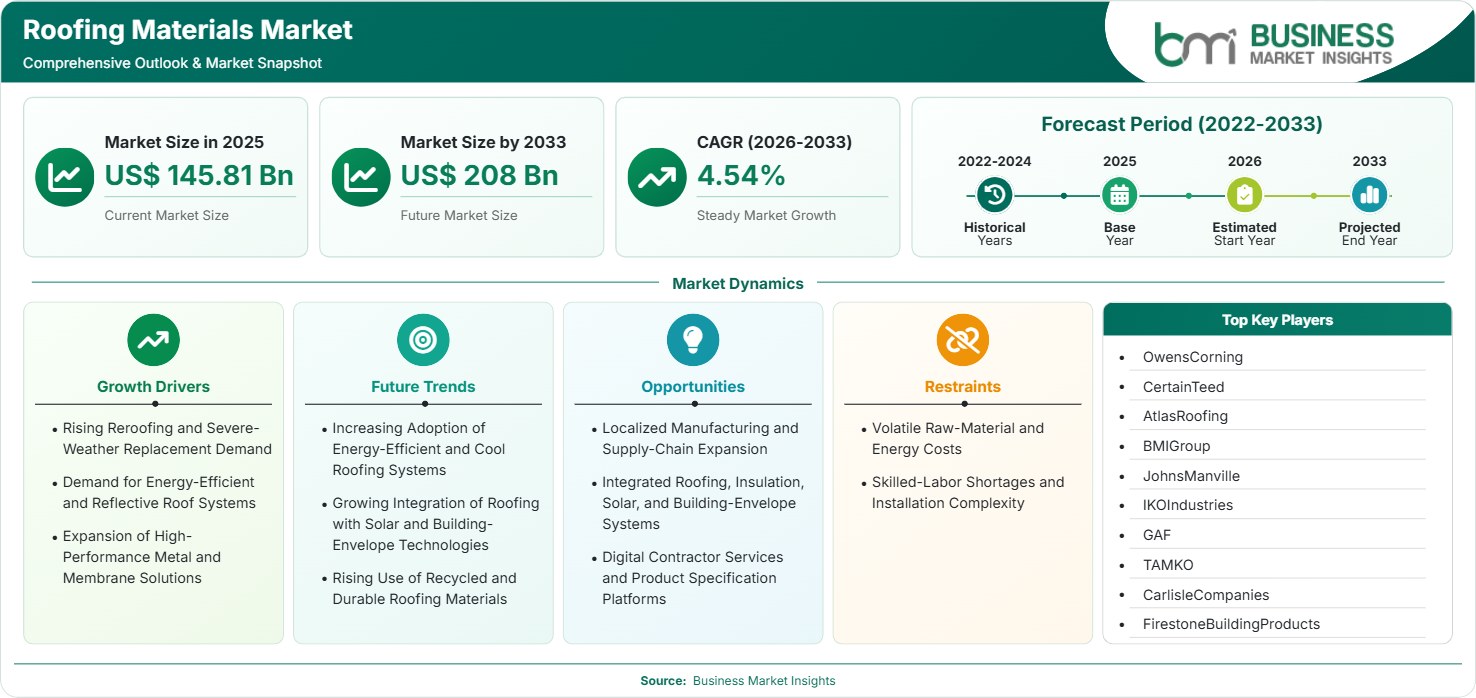
The Roofing Materials Market size was valued at US$ 145.81 Billion in 2025 and is projected to reach US$ 208 Billion by 2033, growing at a CAGR of 4.54% during 2026–2033. Reroofing demand, storm resilience, energy-efficient assemblies, metal adoption, urban housing expansion, and commercial renovation create opportunities for durable, recyclable, high-performance roofing systems in developed and emerging economies.

Report Coverage
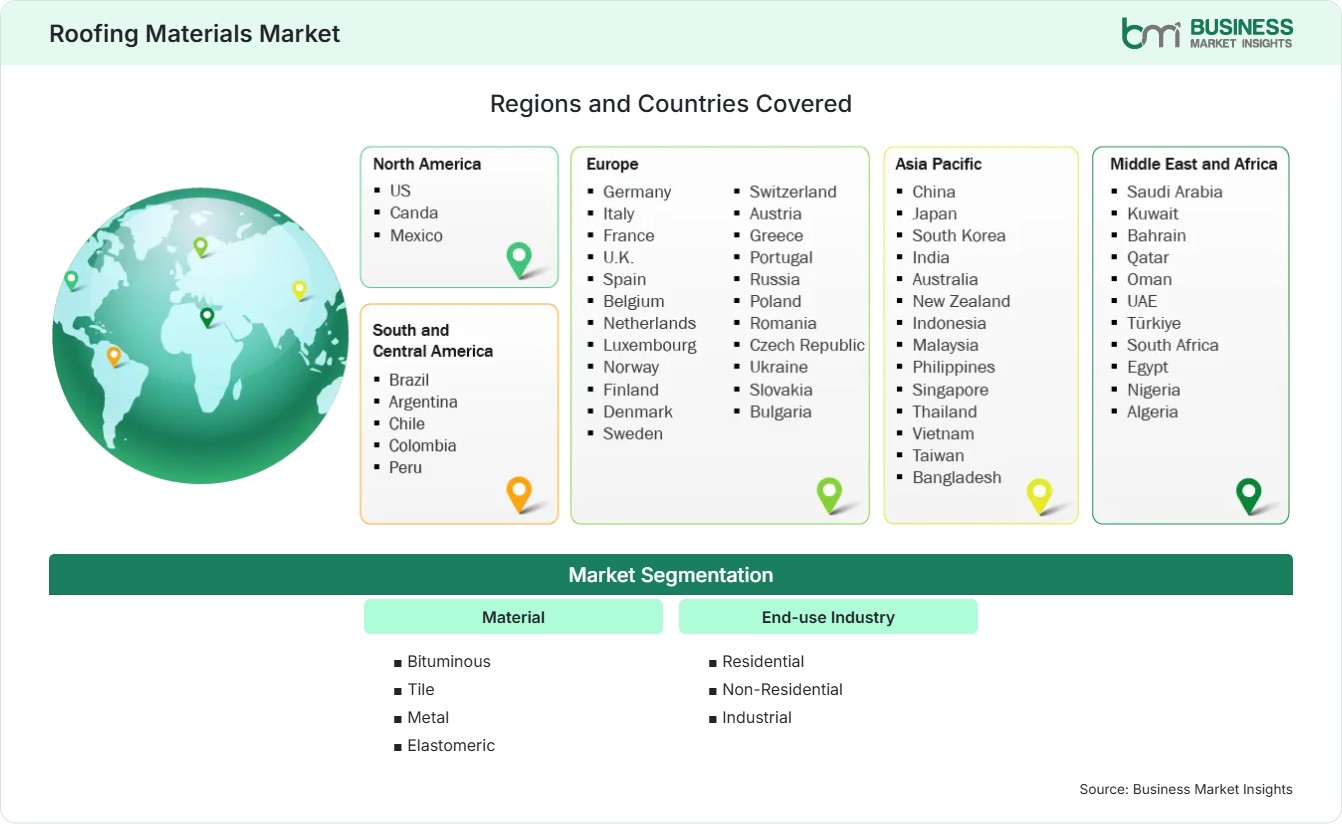
  • Material: Bituminous, Tile, Metal, Elastomeric
  • End-use Industry: Residential, Non-Residential, Industrial
US$ 145.81 Bn Market size in 2025
US$ 208 Bn Market Size by 2033
4.54% CAGR, 2026 - 2033
2026-2033 Forecast Period

AI Overview

Roofing Materials Market Summary

  • North America Region: North America holds a 34%–37% share in 2025, growing at a 4.1%–4.5% CAGR during 2026–2033, supported by reroofing, severe-weather resilience, housing maintenance, premium shingles, commercial refurbishment, contractor demand, and building-envelope modernization. The US market remains the region’s core, with reroofing activity, housing replacement demand, and commercial building maintenance supporting a 4.0%–4.4% CAGR through 2033.
  • Fastest Growing Region: Asia Pacific accounts for a 26%–29% share in 2025 and is projected to expand at a 5.2%–5.7% CAGR during 2026–2033, driven by urbanization, housing construction, industrial facilities, infrastructure investment, rising household incomes, climate adaptation, and expanding modern retail distribution.
  • Leading Segment: Bituminous materials represent a 42%–46% share in 2025 and are estimated to advance at a 4.2%–4.6% CAGR during 2026–2033, supported by broad installer familiarity, competitive installed costs, waterproofing performance, extensive shingle availability, repair compatibility, and established distribution networks.
  • High Growth Segment: Metal materials account for a 17%–21% share in 2025 and are estimated to grow at a 5.4%–5.9% CAGR during 2026–2033, benefiting from long service life, lightweight construction, fire resistance, recyclability, solar integration, architectural flexibility, and increasing demand for resilient roofs.
  • Key Market Opportunity: Replacement roofing, climate-resilient systems, reflective surfaces, integrated insulation, rooftop solar compatibility, recycled content, digital contractor tools, and prefabricated assemblies create attractive opportunities for manufacturers pursuing higher-value building-envelope solutions.
  • Major Market Players: Owens Corning; CertainTeed Corporation; Atlas Roofing Corporation; BMI Group; Johns Manville; IKO Industries Inc.; GAF; TAMKO Building Products LLC; Carlisle Companies Incorporated; Firestone Building Products Company, LLC.
Strategic Insights

Roofing Materials Market: Strategic Insights

Roofing Materials Market Strategic Framework
FREE PDF
Request your free sample
Request free sample
Stakeholder View

Key Takeaways

  • The value chain is increasingly integrated from mineral, polymer, metal, and insulation inputs through manufacturing, distribution, contractor networks, installation, maintenance, and reroofing. Producers with localized capacity can reduce freight exposure and improve service reliability.
  • Metal and advanced membrane systems offer comparatively stronger upside because durability, recyclability, lightweight construction, solar compatibility, and severe-weather performance increasingly influence material selection alongside initial purchase price.
  • Product development is moving toward impact-resistant shingles, reflective surfaces, enhanced membranes, prefabricated components, digital specification tools, and installation systems that reduce labor requirements while improving consistency.
  • Southeast Asia, India, China, and selected Gulf markets provide compelling expansion opportunities because housing construction, industrial facilities, logistics infrastructure, and urban redevelopment are expanding the addressable roofing base.
  • Contractor ecosystems are becoming strategic assets. Warranty programs, training, financing, digital visualization, specification support, and technical services can influence material selection and create recurring manufacturer-distributor relationships.
Geographic Outlook

Roofing Materials Market Regional Highlights

North America Roofing Materials Market

North America held a 34%–37% Roofing Materials Market share in 2025 and is estimated to grow at a 4.1%–4.5% CAGR during 2026–2033. Demand is anchored by residential reroofing, commercial maintenance, severe-weather exposure, and mature distribution. The region benefits from established manufacturers, contractor networks, insurance-driven replacement, and premium shingle adoption. Commercial roofing remains supported by reroofing despite softer new construction conditions.

  • Severe-weather resilience is accelerating adoption of impact-resistant shingles, reinforced membranes, high-wind systems, and complete roof assemblies with stronger warranties.
  • Residential replacement remains an important demand base because aging housing stock creates recurring reroofing requirements even when new-home construction moderates.
  • Manufacturing localization is increasing. Owens Corning and GAF both announced major US capacity investments, reinforcing domestic supply and shortening delivery distances.
  • Reflective roofing and energy-efficient surfaces are gaining relevance as building owners seek lower cooling requirements and improved envelope performance.

US Roofing Materials Market

The US Roofing Materials Market represented approximately 78%–82% of North American demand in 2025 and is estimated to grow at a 4.0%–4.4% CAGR during 2026–2033. Reroofing, storm damage, residential replacement, and commercial maintenance underpin consumption. Manufacturers are expanding domestic capacity while contractors increasingly prioritize products combining installation efficiency, impact resistance, warranties, and aesthetics.

  • New manufacturing investments are strengthening regional supply. GAF began construction of a Newton, Kansas shingle facility expected to create more than 130 skilled jobs.
  • Contractor programs are becoming more sophisticated, combining warranties, training, digital tools, rewards, and technical support to influence product selection.
  • Cool-roof adoption has a measurable energy rationale. DOE guidance identifies potential lifetime energy-cost savings from qualifying efficient roof products, supporting reflective-material investment.

Europe Roofing Materials Market

Europe accounted for a 25%–28% Roofing Materials Market share in 2025 and is projected to register a 4.3%–4.7% CAGR during 2026–2033. Germany, France, Italy, the UK, and Spain remain important demand centers, while Spain and selected Central European markets provide stronger growth opportunities. Energy efficiency, renovation, waterproofing, insulation integration, and rooftop solar compatibility are influencing product specifications.

  • Germany and France remain leading markets because renovation activity, building-performance requirements, and mature construction industries sustain replacement demand.
  • Spain is positioned for stronger growth as BMI Group expands its flat-roof portfolio through the acquisition of Asfaltos ChovA, strengthening waterproofing and insulation capabilities.
  • Integrated roof solutions are gaining importance as owners seek combinations of waterproofing, thermal performance, aesthetics, and renewable-energy compatibility.
  • Sustainability requirements are increasing attention toward recycled content, material durability, lifecycle performance, and systems designed for easier maintenance.

Asia Pacific Roofing Materials Market

Asia Pacific represented a 26%–29% Roofing Materials Market share in 2025 and is projected to expand at a 5.2%–5.7% CAGR during 2026–2033, making it the fastest-growing regional market. China, India, Japan, South Korea, and Australia are major demand centers, while India and Southeast Asia provide stronger growth opportunities. Urban housing, manufacturing facilities, logistics infrastructure, commercial construction, and climate adaptation are expanding demand for modern roof systems.

  • China maintains a large addressable base because industrial, residential, and infrastructure construction supports high-volume demand across metal, tile, membrane, and bituminous systems.
  • India and Southeast Asia offer strong expansion potential as urbanization increases housing requirements and modern construction methods gradually replace informal roofing materials.
  • Australia and Japan favor durable, weather-resistant systems because climatic exposure and mature building standards encourage performance-oriented specifications.
  • Regional manufacturers are increasing interest in lightweight metal, reflective surfaces, waterproof membranes, and insulation-integrated assemblies suited to hot and humid environments.

Rest of World Roofing Materials Market

Rest of World accounted for a 10%–13% share in 2025 and is estimated to expand at a 4.6%–5.1% CAGR during 2026–2033. South and Central America benefit from residential development, commercial refurbishment, and industrial investment, with Brazil and Mexico serving as leading markets. Chile and Colombia provide higher-growth pockets where urban expansion and climate exposure encourage durable materials and improved waterproofing systems.

Middle East and Africa demand is supported by commercial construction, logistics, hospitality, industrial facilities, and infrastructure programs. Saudi Arabia and the UAE remain leading markets, while Egypt and selected Gulf economies provide stronger opportunities. Reflective, insulated, waterproof, and UV-resistant roofing systems are particularly relevant in hot climates.

  • Brazil and Mexico offer scale through residential construction and commercial redevelopment, with distribution reach remaining important for manufacturer expansion.
  • Saudi Arabia and the UAE favor high-performance roofing because heat exposure increases the value of reflective surfaces, insulation, waterproofing, and long-service-life materials.
  • South Africa provides a diversified demand base spanning residential, commercial, industrial, and infrastructure applications, supporting multiple material categories.
  • Climate adaptation creates opportunities for coatings, membranes, reflective systems, and assemblies engineered for intense solar exposure and episodic extreme weather.
Global Market Geography
FREE PDF
Request your free sample
Request free sample
Segment Analysis

Roofing Materials Market Segmentation

Material

The Material segment represented the largest portion of demand in 2025, with an estimated 42%–46% share for Bituminous materials, while the overall segment is projected to maintain a 4.2%–4.6% CAGR during 2026–2033. Established installation practices, broad product availability, cost competitiveness, and reroofing demand support continued adoption across residential and commercial applications.

  • Bituminous: Bituminous products remain widely specified for shingles, modified membranes, and waterproofing because of installer familiarity, broad distribution, competitive costs, and proven weathering performance.
  • Tile: Tile systems serve residential and architectural applications where longevity, appearance, fire performance, and regional construction traditions support continued specification across concrete, clay, and related formats.
  • Metal: Metal roofing is gaining traction because lightweight construction, durability, recyclability, fire resistance, solar compatibility, and architectural versatility support adoption in residential, commercial, agricultural, and industrial projects.
  • Elastomeric: Elastomeric systems support waterproofing and commercial roof maintenance, benefiting from flexible membrane performance, weather resistance, repairability, and suitability for low-slope building applications.

End-use Industry

Residential applications represent the leading end-use category, supported by reroofing, housing construction, storm damage replacement, and homeowner preference for durable aesthetics. The category is estimated to hold a 48%–52% share in 2025 and expand at a 4.3%–4.7% CAGR during 2026–2033, while commercial and industrial applications gain from building-envelope modernization.

  • Residential: Residential demand is shaped by replacement cycles, housing additions, weather events, aesthetics, warranty coverage, and homeowner interest in impact-resistant and energy-efficient roofing products.
  • Non-Residential: Non-residential applications include offices, retail facilities, schools, healthcare buildings, and public structures where lifecycle cost, waterproofing, maintenance access, and energy performance influence specifications.
  • Industrial: Industrial facilities require durable systems capable of handling large roof areas, equipment penetrations, thermal exposure, maintenance traffic, and demanding operational conditions across factories and warehouses.
Market Forces

Roofing Materials Market Dynamics

Key Market Drivers

Rising Reroofing and Severe-Weather Replacement Demand

Reroofing remains a structural demand driver because roof assemblies deteriorate through age, ultraviolet exposure, moisture, wind, hail, and thermal cycling. Replacement remains persistent because asset security, maintenance, durability, and roofing performance become top priorities for the owners of properties. The above-mentioned variables facilitate constant Roofing Materials Market growth due to increased demand for renovation and replacement needs in residential, commercial, and industrial constructions. Additional demand comes from weather damage and other construction renovation. Companies that produce durable products and provide quality services will benefit from repeated replacement expenditures in both mature and developing construction markets.

Demand for Energy-Efficient and Reflective Roof Systems

Energy efficiency is becoming an important consideration in roofing selection as building owners seek to reduce cooling requirements and improve overall building performance. Roof systems may offer value in terms of reflectivity, insulation, ventilation, and energy technologies. The Roofing Materials Market trends have seen an increase in demand for cool roofs, coatings, membranes, and hot-climate solutions. Such innovations will allow roofers to position themselves more effectively on premium markets by focusing on performance and not only cost. Through material sciences and systems integration, suppliers will be able to evolve beyond commodities and develop roof systems with desired properties.

Expansion of High-Performance Metal and Membrane Solutions

Metal and advanced membrane products are gaining strategic importance as customers demand longer service lives, lighter assemblies, improved weather resistance, and compatibility with evolving building designs. The Roofing Materials Market is driven by the growing popularity of metal products as well as membranes. Low-slope membranes are growing in acceptance among commercial building construction companies. The development in the products includes waterproofing, insulation, coatings, edge systems, and accessories, which can be integrated into one system. The integration allows companies to distinguish their product from others not only through the cost of material but also its technical qualities.

Key Market Opportunities

Localized Manufacturing and Supply-Chain Expansion

Regional manufacturing expansion creates opportunities to improve lead times, reduce transportation exposure, and serve fast-growing construction corridors. Roofing Materials Market Forecasts lean toward production within the vicinity due to the need for continuity of supplies and responsiveness, among others. In emerging markets, there are equally good opportunities where local manufacture will decrease dependency on imported materials and products adapted to regional climatic conditions. Businesses that integrate their manufacture with technical centers, distribution collaborations, and contractor training gain competitive advantage in accessing the market. Increased capacity is also an opportunity to automate operations, use recycled materials, increase product diversification, and be more responsive to the demand for construction and harsh weather conditions.

Integrated Roofing, Insulation, Solar, and Building-Envelope Systems

The convergence of roofing, insulation, waterproofing, and renewable-energy requirements is creating higher-value system opportunities. Property owners are looking for products which can help minimize complexity during installation along with enhancing performance regarding thermal efficiency, weather resistance, and longevity. Compatible membranes, structural design, insulation, and waterproofing could help make an integrated system for installing solar power systems on the roof. The Roofing Materials Market can create business prospects through integrating products that will create added value to projects and develop business relations with architects, engineers, contractors, and distributors. This strategy will be especially important for commercial renovation, logistics buildings, warehouses, and energy-intensive buildings where operating costs have a bearing on investment decision-making process.

Digital Contractor Services and Product Specification Platforms

Digital tools are becoming an important commercial differentiator because roofing decisions depend heavily on contractor recommendations, installation quality, product availability, and warranty requirements. Roofing Materials Market Forecasts are increasingly indicating that digitally enabled contractor ecosystems for improving the experience of roofing material selection, project design, installation and post-sale support are gaining popularity. Digital services for roofing materials could be extended to cover measuring, visualizing, specifying the products, managing the projects, funding, scheduling maintenance, and warranty management. These services could improve the level of contractor involvement, foster brand loyalty, and give insights into the projects. This would be particularly effective in case manufacturers link contractors, distributors, home owners, and technical experts on one platform.

Market Restraints and Challenges

Volatile Raw-Material and Energy Costs

Factor: Roofing manufacturing relies on asphalt, polymers, mineral granules, steel, aluminum, chemicals, insulation feedstocks, and energy-intensive processing. Commodity prices, transportation costs, and supply disruptions can materially alter manufacturing economics and contractor pricing.

Impact: The volatility of cost can compress margins of producers, increase project budgets, defer buying decisions, and make consumers opt for cheaper options. This phenomenon is even more pronounced in big business projects that involve significant volumes of materials with restrictions on passing costs through by the manufacturer as per the contract. Producers can hedge themselves against the risk by regionally sourcing supplies, planning inventories, making long-term purchases, manufacturing flexibility, and offering higher value products.

Skilled-Labor Shortages and Installation Complexity

Factor: Roofing installation requires trained labor for flashing, membrane welding, shingle alignment, ventilation, insulation detailing, penetrations, edge systems, and weatherproofing. Skilled-worker shortages can restrict project throughput and increase installation costs, particularly during post-storm demand surges.

Impact: Labor shortages may result in delays, callbacks, poor installations, and reluctance to use technologically sophisticated equipment. This challenge is being addressed through various ways that include training contractors, simplified installation processes easier, pre-assembling parts, digital assistance and advances in fastening or adhesion technology. The CertainTeed's move to offsite construction highlights the wider trend toward manufacturing in a controlled environment and rapid assembly in the field. Nonetheless, training and contractor availability continue to present challenges, particularly in fast-growing markets.

Company Analysis

Competitive Landscape

The Roofing Materials Market analysis indicates that competition is increasingly based on product durability, manufacturing scale, regional distribution, technical support, contractor relationships, sustainability credentials, and integrated building-envelope portfolios.

Company Name

Overview

Products and Services relevant to this market

Owens Corning

US building-products leader with substantial residential and commercial roofing capabilities and an expanding manufacturing network.

Asphalt shingles, roofing components, insulation, underlayments, ventilation products, and complete roofing systems.

CertainTeed Corporation

North American building-materials manufacturer emphasizing performance, resilience, sustainability, and integrated construction solutions.

Asphalt shingles, roofing membranes, underlayments, ventilation, accessories, and roof-integrated building solutions.

Atlas Roofing Corporation

US manufacturer serving residential and commercial construction through roofing and building-envelope products.

Architectural shingles, underlayments, ventilation, insulation, commercial roofing systems, and roofing accessories.

BMI Group

European building-envelope specialist focused on pitched and flat roofing, waterproofing, and insulation.

Bituminous membranes, tiles, waterproofing, insulation, TPO systems, roof accessories, and integrated solutions.

Johns Manville

Building-products manufacturer with strong commercial roofing and insulation capabilities.

TPO, PVC, EPDM, modified bitumen, roofing insulation, adhesives, coatings, and accessories.

IKO Industries Inc.

Global roofing, waterproofing, and insulation manufacturer with substantial North American production and distribution.

Asphalt shingles, commercial membranes, metal roofing, waterproofing, insulation, accessories, and contractor services.

GAF

Standard Industries company and major North American roofing and waterproofing manufacturer.

Shingles, single-ply membranes, coatings, roof insulation, accessories, ventilation, and commercial roofing systems.

TAMKO Building Products LLC

Independent US roofing manufacturer focused on residential shingles, waterproofing, contractor services, and product innovation.

Asphalt shingles, waterproofing, underlayments, accessories, high-wind products, and contractor programs.

Carlisle Companies Incorporated

Building-envelope company pursuing integrated roofing, weatherproofing, insulation, and acquisition-led expansion.

Single-ply membranes, insulation, coatings, edge metal, adhesives, waterproofing, and building-envelope systems.

Firestone Building Products Company, LLC

Established commercial roofing and building-envelope business now operating within Holcim's building-solutions portfolio.

Single-ply membranes, insulation, coatings, roofing accessories, and commercial building-envelope solutions.

Trust & Transparency

Research Methodology

The market analysis combines proprietary research with secondary data from government agencies, company disclosures, regulatory filings, industry databases and expert interviews. Market estimates are validated through data triangulation, cross-market benchmarking and analyst review.

View Full Research Methodology

Questions Answered

Frequently Asked Questions

What is the role of the Roofing Materials Market Report for investors?

The report helps investors assess material shifts, regional demand, competitive positioning, manufacturing investments, contractor ecosystems, building-envelope integration, and emerging opportunities across residential, non-residential, and industrial applications.

What role can roofing play in building decarbonization?

Roofing can support efficiency through reflective surfaces, insulation integration, longer service lives, recyclable materials, and compatibility with rooftop solar. Better roof performance can reduce cooling requirements and improve whole-building energy performance.

How are manufacturers addressing installation labor constraints?

Manufacturers are simplifying installation through prefabricated components, improved adhesives, fastening systems, contractor training, digital guidance, and offsite construction. These approaches can reduce field labor requirements while improving installation consistency and project scheduling.

Why is reroofing strategically important to manufacturers?

Reroofing provides recurring demand independent of new construction cycles. Aging buildings, weather damage, maintenance requirements, and property-value considerations create replacement opportunities, allowing manufacturers and contractors to maintain project pipelines when new-building activity slows.

How does climate influence roofing material selection?

Climate affects material choice through temperature variation, rainfall, wind, hail, ultraviolet exposure, humidity, and snow loads. Hot regions favor reflective and thermally efficient systems, while storm-prone locations place greater emphasis on impact resistance, fastening performance, waterproofing, and high-wind ratings.

Access the Full Roofing Materials Market Report

Get segment-level forecasts, regional estimates, competitive benchmarking, company profiles and downloadable Excel datasets.

Access the full Roofing Materials Market Report
350 pages PDF & Excel | 2026-09-02
Similar Research

Related Market Reports