
Rigid Bulk Packaging Market Size, Share, Trends & Forecast Report, 2026–2033

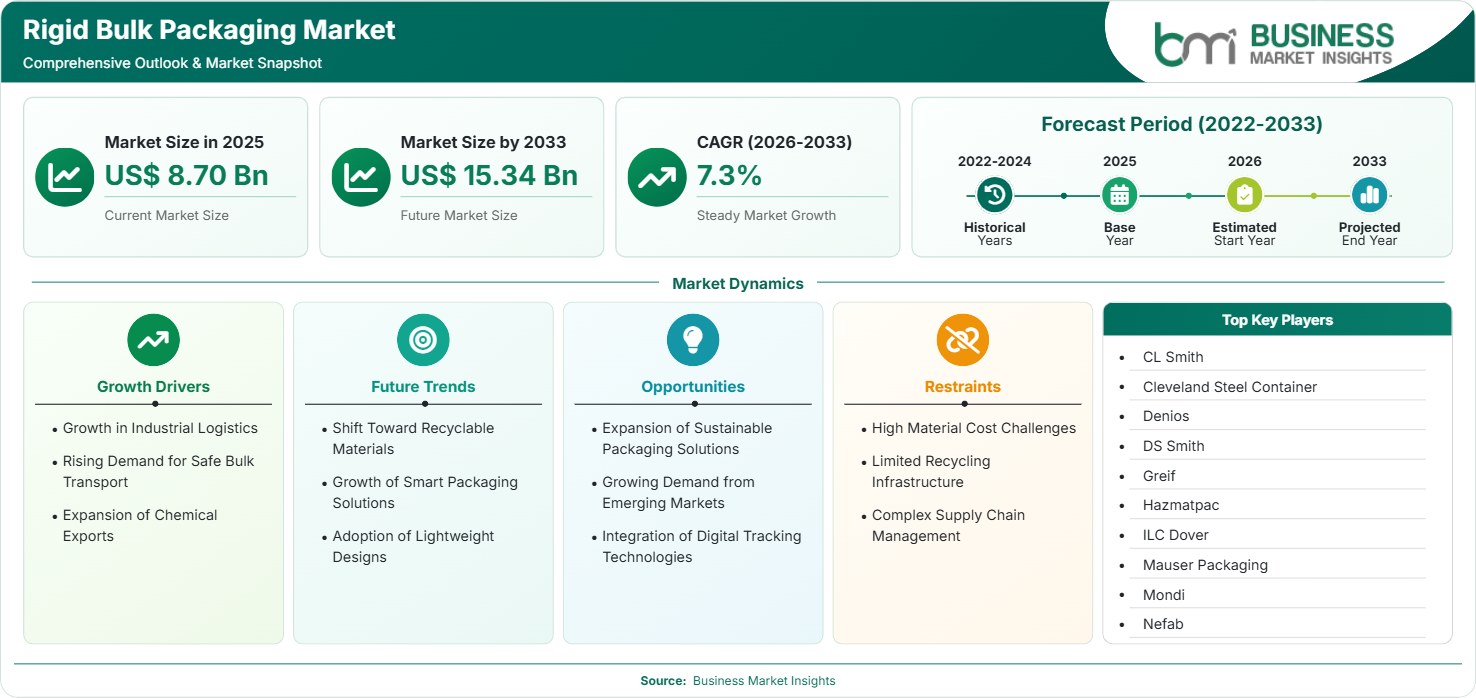
The Rigid Bulk Packaging Market size was valued at US$ 8.70 Billion in 2025 and is projected to reach US$ 15.34 Billion by 2033, growing at a CAGR of 7.3% during 2026–2033, driven by industrial logistics expansion, sustainable material adoption, chemical transport requirements, and opportunities in digitalized packaging systems.

Report Coverage
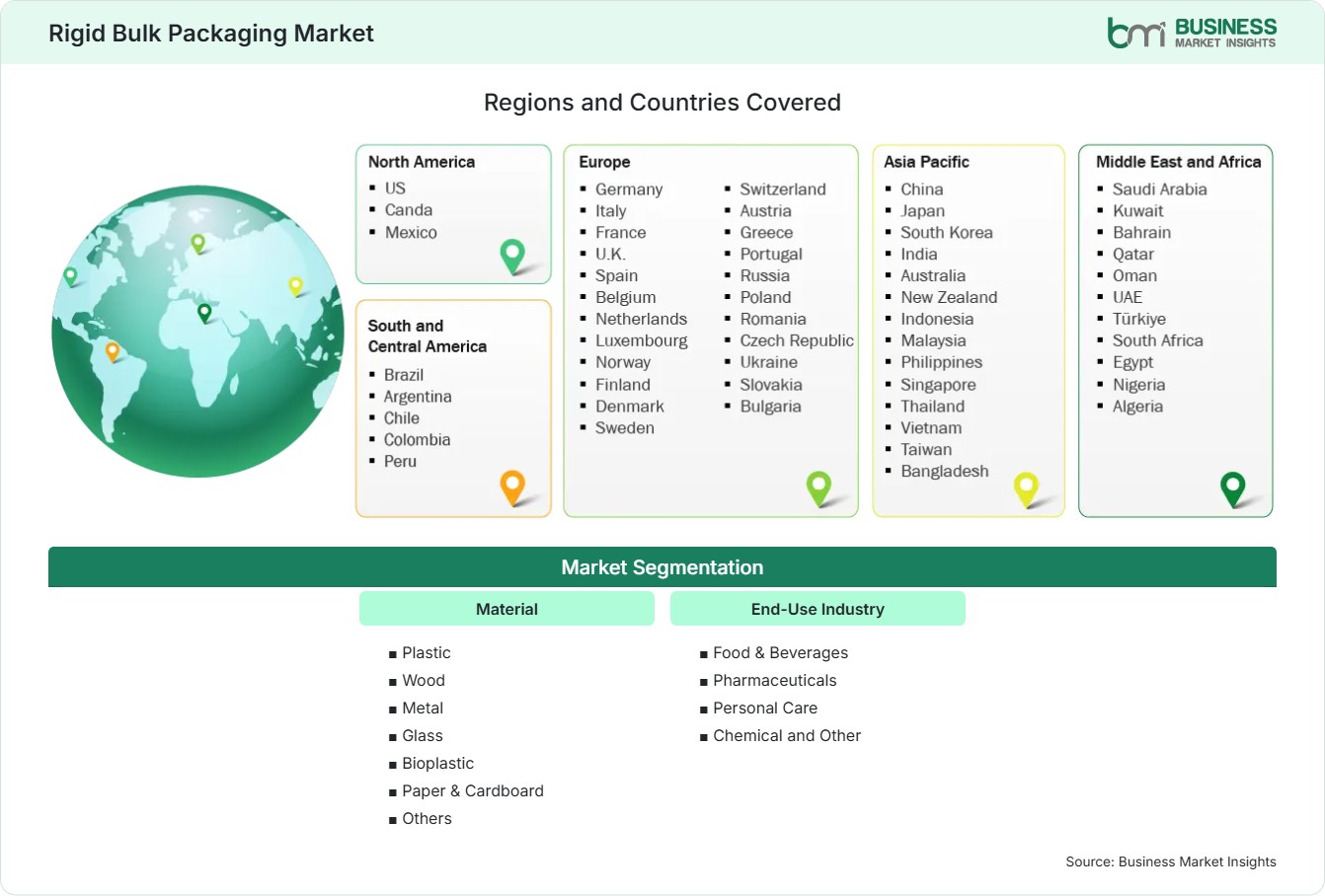
  • Material: Plastic, Wood, Metal, Glass, Bioplastic, Paper & Cardboard, Others
  • End-Use Industry: Food & Beverages, Pharmaceuticals, Personal Care, Chemical and Other
US$ 8.70 Bn Market size in 2025
US$ 15.34 Bn Market Size by 2033
7.3% CAGR, 2026 - 2033
2026-2033 Forecast Period

01 AI Overview

Rigid Bulk Packaging Market Summary

  • North America Region: North America holds a market share of 32%–35% in 2025, growing with a CAGR of 6.8%–7.2%, influenced by chemical logistics, pharmaceutical distribution, and reusable container demand. The US market demonstrates steady adoption with a CAGR of 6.9%–7.3% from 2026–2033 due to advanced supply chains and regulatory compliance.
  • Fastest Growing Region: Asia Pacific holds a market share of 28%–31% in 2025, expanding with a CAGR of 8.1%–8.6%, supported by manufacturing growth, export-oriented industries, infrastructure investments, and increasing demand for durable bulk transport solutions across emerging economies.
  • Leading Segment: Plastic holds a market share of 38%–42% in 2025, expanding with a CAGR of 7.4%–7.8%, driven by lightweight designs, chemical resistance, food-grade applications, and increasing adoption of intermediate bulk containers across industrial sectors.
  • High Growth Segment: Bioplastic demonstrates a market share of 4%–6% in 2025, progressing with a CAGR of 10.2%–11.0%, supported by sustainability targets, renewable material innovation, regulatory pressure, and corporate commitments toward reducing packaging emissions.
  • Key Market Opportunity: Sustainable materials, smart tracking systems, and emerging-market industrialization create opportunities through circular packaging models, improved asset utilization, and advanced solutions addressing environmental compliance and supply chain efficiency.
  • Major Market Players: CL Smith, Cleveland Steel Container, Denios, DS Smith, Greif, Hazmatpac, ILC Dover, Mauser Packaging, Mondi, and Nefab.
02 Strategic Insights

Rigid Bulk Packaging Market: Strategic Insights

Rigid Bulk Packaging Market Strategic Framework
FREE PDF
Request your free sample
Request free sample
03 Stakeholder View

Key Takeaways

  • The supply chain structure is becoming more integrated as manufacturers, material suppliers, logistics providers, and recycling companies collaborate to improve container lifecycle management and reduce operational costs across industrial applications.
  • Food processing, pharmaceutical manufacturing, and chemical transportation represent high-value opportunities because they require reliable bulk containers with strict quality standards, contamination control, and improved traceability capabilities.
  • Innovation is shifting toward lightweight composite designs, recycled polymers, smart identification technologies, and sustainable materials that improve durability while supporting corporate environmental objectives and circular economy initiatives.
  • Asia Pacific presents a strong investment opportunity due to expanding manufacturing hubs, increasing exports, and infrastructure development in countries including China, India, and Southeast Asian economies.
  • Industry consolidation is increasing through partnerships, acquisitions, and capacity expansion initiatives as established packaging providers seek broader geographic coverage and advanced sustainable packaging capabilities.
04 Geographic Outlook

Rigid Bulk Packaging Market Regional Highlights

North America Rigid Bulk Packaging Market

North America market accounted for 32%–35% share in 2025 and is projected to expand at a CAGR of 6.8%–7.2% during 2026–2033. The region benefits from mature industrial infrastructure, strong chemical production, and demand for compliant transport systems. The United States remains the dominant contributor, while Canada supports growth through resource industries and sustainable packaging adoption.

  • Chemical manufacturers are increasing demand for certified containers due to stricter handling standards and safety requirements across industrial supply chains.
  • Pharmaceutical logistics expansion is supporting advanced bulk packaging adoption with improved contamination prevention and traceability features.
  • Recycling initiatives are encouraging manufacturers to integrate recovered materials into durable packaging production systems.
  • Automation in warehouses is increasing demand for standardized and machine-compatible bulk containers.

US Rigid Bulk Packaging Market

The US Rigid Bulk Packaging market represented 27%–30% share in 2025 and is expected to register a CAGR of 6.9%–7.3% between 2026 and 2033. The country maintains leadership through extensive chemical, food processing, and pharmaceutical industries. Strong regulatory frameworks and investments in domestic manufacturing continue to support market expansion and technology adoption.

  • Chemical exports remain a major demand contributor as producers require reliable containers for hazardous and non-hazardous materials.
  • Food and beverage companies are adopting reusable bulk systems to improve operational efficiency and sustainability performance.
  • Manufacturers are integrating tracking technologies to improve asset visibility across logistics networks.

Europe Rigid Bulk Packaging Market

Europe market held 24%–27% share in 2025 and is forecast to grow at a CAGR of 6.5%–7.0% through 2026–2033. The region emphasizes circular economy principles, recycling infrastructure, and sustainable material development. Germany, France, and the United Kingdom remain leading markets, while Poland demonstrates faster adoption with a CAGR of 7.2%–7.7%.

  • Germany is strengthening industrial packaging demand through chemical production and advanced manufacturing activities.
  • France is promoting sustainable packaging solutions through regulatory initiatives and recycling improvements.
  • The United Kingdom is increasing the adoption of reusable containers across food and industrial applications.
  • Poland is expanding packaging demand through manufacturing growth and export-oriented industries.

Asia Pacific Rigid Bulk Packaging Market

Asia Pacific Rigid Bulk Packaging market accounted for 28%–31% share in 2025 and is expected to achieve a CAGR of 8.1%–8.6% from 2026–2033. Rapid industrialization, expanding trade activities, and manufacturing growth are strengthening regional demand. China, India, and Japan lead adoption, while India records higher growth with a CAGR of 8.5%–9.0%.

  • China benefits from extensive chemical production and manufacturing capacity, requiring efficient bulk transportation solutions.
  • India is witnessing increased packaging demand due to industrial expansion and infrastructure development.
  • Japan focuses on advanced reusable packaging systems supported by precision manufacturing requirements.
  • Southeast Asian economies are attracting investments through export-focused industrial growth.

Rest of World Rigid Bulk Packaging Market

Rest of World Rigid Bulk Packaging Market share accounted for 10%–13% share in 2025 and is projected to grow at a CAGR of 7.0%–7.5% during 2026–2033. South and Central America benefit from agricultural exports and chemical industries, while the Middle East and Africa markets gain from energy-related applications and industrial diversification. Brazil and Saudi Arabia represent key growth markets.

  • Brazil is increasing bulk packaging demand through agricultural processing and export supply chains.
  • Mexico supports regional expansion through manufacturing activities and cross-border trade networks.
  • Saudi Arabia is developing industrial packaging demand through chemical and energy sector investments.
  • South Africa is adopting improved transport packaging solutions across the mining and manufacturing industries.
Global Market Geography
FREE PDF
Request your free sample
Request free sample
05 Segment Analysis

Rigid Bulk Packaging Market Segmentation

Material

Material selection determines performance, sustainability, and application suitability across industries. Plastic maintained a leading position with 38%–42% share in 2025 and is projected to grow at a CAGR of 7.4%–7.8% from 2026 to 2034. The Rigid Bulk Packaging scope is expanding through lightweight solutions, recyclable materials, and durable designs that support chemical, food, and pharmaceutical applications while balancing cost and environmental considerations.

  • Plastic: Plastic containers support broad industrial adoption through corrosion resistance, lightweight construction, and compatibility with chemicals, food ingredients, and pharmaceutical materials requiring reliable bulk storage.
  • Wood: Wood-based packaging serves heavy-duty transport applications where strength, repairability, and renewable sourcing benefits support demand across agricultural, industrial, and logistics sectors.
  • Metal: Metal packaging provides superior durability and protection for hazardous materials, chemicals, and industrial products requiring high-impact resistance and extended operational lifecycles.
  • Glass: Glass solutions address specialized applications requiring chemical stability, purity, and contamination prevention, particularly within pharmaceutical and premium food processing environments.
  • Bioplastic: Bioplastic packaging is gaining attention through renewable feedstocks, lower carbon impact potential, and alignment with sustainability strategies adopted by manufacturers and end users.
  • Paper & Cardboard: Paper and cardboard solutions support lightweight applications through recyclable structures, cost efficiency, and increasing demand for environmentally responsible transport packaging alternatives.

End-Use Industry

End-use industries influence adoption patterns through safety standards, transportation requirements, and material compatibility. Chemical applications represented a significant share of demand in 2025 due to hazardous material handling requirements, while the pharmaceutical and food sectors continue expanding through quality control needs. The segment is expected to maintain consistent growth with a CAGR of 7.1%–7.6% from 2026–2034, supported by industrialization, trade expansion, and stricter packaging regulations.

  • Food & Beverages: Food industries adopt bulk packaging for ingredient transportation, storage efficiency, and hygiene compliance while improving supply chain reliability through standardized container formats.
  • Pharmaceuticals: Pharmaceutical companies require specialized packaging systems offering contamination control, durability, and regulatory compliance for sensitive materials and healthcare supply chains.
  • Personal Care: Personal care manufacturers utilize bulk packaging for efficient movement of ingredients, formulations, and finished products while optimizing production and distribution processes.
  • Chemical: Chemical industries remain major users due to requirements for safe transportation, hazardous material protection, and compliance with international handling standards.
06 Market Forces

Rigid Bulk Packaging Market Dynamics

Key Market Drivers

Growth in Industrial Logistics

The growth in the logistics industry is fueling the increased need for standardization and reuse of transport containers in industrial operations. The Rigid Bulk Packaging Market growth will be driven by the increase in international trade, automation in warehousing, and supply chain optimization strategies. As per the report of the World Trade Organization, the trade volumes of global merchandise trade are growing continuously even after the disruption due to the pandemic. There are efforts in industrial sectors to develop containers that can be stacked easily, have longevity, and work well in automated systems.

Rising Demand for Safe Bulk Transport

Safety norms in the chemical industry, pharmaceutical industry, and food industry are contributing to the growth of certified packaging systems for safe transport. Safety norms set by organizations like the International Air Transport Association and other transport regulatory bodies help to enhance packaging practices for hazardous materials. The Rigid Bulk Packaging Market trends are governed by the need for packages that can prevent leakage, withstand impact, and be compatible with materials. There are efforts on the part of firms to provide engineered packages to ensure minimum wastage and improved safety of workers.

Expansion of Chemical Exports

Increased chemical trades are driving the need for robust packaging materials that can withstand various chemicals during transportation through international logistics channels. The chemical industry worldwide still depends on consistent transport packaging solutions to ensure safety and compliance. Higher production capacity in the Asia Pacific and Middle East regions is helping increase shipment volume internationally. The trends in the market have been driven by the demands of chemical exporters who need better-performing packaging material. These trends in Rigid Bulk Packaging are leading to innovations in metal, plastic, and composite packaging.

Key Market Opportunities

Expansion of Sustainable Packaging Solutions

Sustainability measures have provided investment opportunities for packaging companies that are innovating around recycled, renewable packaging products and circular systems. The attention is geared towards enhancing the efficiency of material recovery and extending the reuse cycles of containers to minimize environmental harm. The rising number of corporate emission reductions has also promoted the use of improved sustainability designs. The Rigid Bulk Packaging Market Trends show that there is a rising interest in innovations that provide an equilibrium between toughness and environmental sustainability.

Growing Demand from Emerging Markets

The emerging nations are providing business opportunities by way of developing industries, exports, and infrastructure. The countries in the Asia Pacific, Latin America, and the Middle East region are making more investments in setting up manufacturing units and logistics networks. The Rigid Bulk Packaging Market Forecasts suggest that there is high adoption potential in regions where industries need transportation systems for chemicals, foods, and industrial products. Businesses that plan to develop their manufacturing capacities in the regions will benefit from enhanced logistical efficiency and cost savings.

Integration of Digital Tracking Technologies

The integration of digital tracking technologies has revolutionized the management of containers through real-time tracking, identification, and predictive maintenance. With the help of technologies like RFID and sensors, logistics firms are able to track their container usage and cut down on any losses. There exists an opportunity not only in producing smart containers but also in offering lifecycle management services. Companies involved in building smart container ecosystems have an opportunity to build a recurring revenue model while helping their clients become more efficient.

Market Restraints and Challenges

High Material Cost Challenges

Factor: Rising costs of polymers, metals, and advanced sustainable materials increase manufacturing expenses for producers.

Impact: High costs of production could pose an impact on pricing competitiveness and could delay implementation due to its higher costs on consumers. Volatility in material cost will always remain a problem since it is heavily dependent on commodity and energy prices within the global market. There are ways in which companies have tried to counter the issue by developing lighter products and incorporating recycling processes. The high cost of materials needed for special purposes poses an issue.

Limited Recycling Infrastructure

Factor: Uneven recycling infrastructure across developing regions restricts effective recovery and reuse of packaging materials.

Impact: Inefficient collections will make waste disposal more difficult and decrease the efficiency of circular packaging practices. There are many sectors that struggle with building up their closed-loop system because of the inefficiency of their waste management systems. The companies have been working on creating collaborations and recovering their materials. But there is still variation in the capacity of recycling by regions that affects the sustainability results.

07 Company Analysis

Competitive Landscape

The Rigid Bulk Packaging Market analysis highlights a competitive environment shaped by global manufacturers, specialized container producers, and sustainable packaging providers. Companies compete through material innovation, geographic expansion, customized solutions, regulatory compliance, and lifecycle management services. The market includes established suppliers serving chemical, pharmaceutical, food, and industrial applications.

Company Name

Overview

Products and Services relevant to this market

CL Smith

Packaging manufacturer specializing in industrial containers and customized solutions for diverse sectors.

Produces plastic containers, drums, pails, and bulk packaging solutions for industrial applications.

Cleveland Steel Container

Steel packaging specialist serving industrial markets with durable container solutions.

Provides steel drums, specialty containers, and hazardous material packaging systems.

Denios

Global provider of safety and environmental storage solutions for industries.

Offers hazardous material containers, storage systems, and industrial bulk handling products.

DS Smith

Sustainable packaging company focused on circular packaging solutions.

Provides fiber-based packaging, recyclable solutions, and industrial packaging products.

Greif

Global industrial packaging producer with extensive container manufacturing capabilities.

Supplies drums, intermediate bulk containers, and sustainable industrial packaging solutions.

Hazmatpac

Specialist in hazardous material transportation packaging and compliance solutions.

Manufactures certified hazardous material containers and transport packaging systems.

ILC Dover

Engineering company developing advanced flexible containment technologies.

Provides flexible bulk containers and specialized handling solutions for industries.

Mauser Packaging

Industrial packaging manufacturer serving global chemical and industrial customers.

Produces plastic and metal containers, intermediate bulk containers, and recycling services.

Mondi

Packaging and paper solutions provider focused on sustainable products.

Supplies industrial bags, paper-based packaging, and sustainable packaging technologies.

Nefab

Packaging solutions provider focused on industrial supply chains.

Delivers customized packaging systems, logistics solutions, and protective packaging services.

08 Industry Activity

Recent Developments

March 2026

SCHUTZ GmbH & Co. KGaA announced an investment in a highly automated intermediate bulk container (IBC) production and storage facility at the BASF main plant in Ludwigshafen, Germany. The project, developed with BASF, is intended to strengthen just-in-time supply of industrial IBC packaging, reduce transport distances, and improve supply reliability for bulk chemical packaging applications.

September 2025

Greif, Inc. expanded its sustainable industrial packaging portfolio by launching EcoBalance Low Carbon Emission Steel Drums in collaboration with ArcelorMittal. The new steel drum solution targets customers seeking lower-carbon rigid packaging options for industrial applications, including chemicals, lubricants, and specialty products.

August 2025

Nefab Group AB strengthened its global packaging solutions portfolio through the acquisition of FARUSA Emballage, a Denmark-based supplier specializing in heavy-duty corrugated packaging. The acquisition enhances Nefab’s ability to provide sustainable industrial packaging solutions and supports its expansion across Nordic and global supply chains.

June 2025

DENIOS SE launched new HazMat Stations in North America, providing compliant hazardous material storage solutions with secondary spill containment for drums and bulk containers. The product expansion supports industries handling hazardous chemicals and complements DENIOS’ rigid containment and industrial safety packaging offerings.

10 Trust & Transparency

Research Methodology

The market analysis combines proprietary research with secondary data from government agencies, company disclosures, regulatory filings, industry databases and expert interviews. Market estimates are validated through data triangulation, cross-market benchmarking and analyst review.

View Full Research Methodology

11 Questions Answered

Frequently Asked Questions

What does the Rigid Bulk Packaging Market Report indicate about future industry direction?

The Report indicates that future development will focus on sustainability, smart packaging capabilities, regional manufacturing expansion, and solutions designed for increasingly complex global supply chains.

What role do digital technologies play in packaging management?

Digital technologies improve visibility through tracking systems, sensors, and data platforms. These tools enable companies to monitor container usage, optimize asset utilization, reduce losses, and improve maintenance planning throughout the packaging lifecycle.

Which industries represent major adoption areas for bulk packaging systems?

Chemical, food and beverage, pharmaceutical, and personal care industries represent key adoption areas. These sectors require reliable containers for storage, transportation, contamination prevention, and compliance with industry-specific quality and safety standards.

How are sustainable materials affecting packaging development strategies?

Manufacturers are increasing investments in recycled polymers, renewable materials, and circular packaging models. These approaches help companies address environmental targets while maintaining durability, product protection, and operational efficiency required for industrial transportation applications.

What factors are influencing demand for advanced bulk packaging solutions?

Demand is being shaped by industrial automation, international trade expansion, hazardous material safety requirements, and sustainability objectives. Companies are adopting advanced containers to improve transport efficiency, reduce product losses, and support regulatory compliance across chemical, pharmaceutical, and food supply chains.

Access the Full Rigid Bulk Packaging Market Report

Get segment-level forecasts, regional estimates, competitive benchmarking, company profiles and downloadable Excel datasets.

Access the full Rigid Bulk Packaging Market Report
350 pages PDF & Excel | 2026-07-31