
Respiratory Protective Equipment Rpe Market Outlook: Size, Share, Trends, Growth Analysis, Competitive Landscape & Forecast, 2026–2033

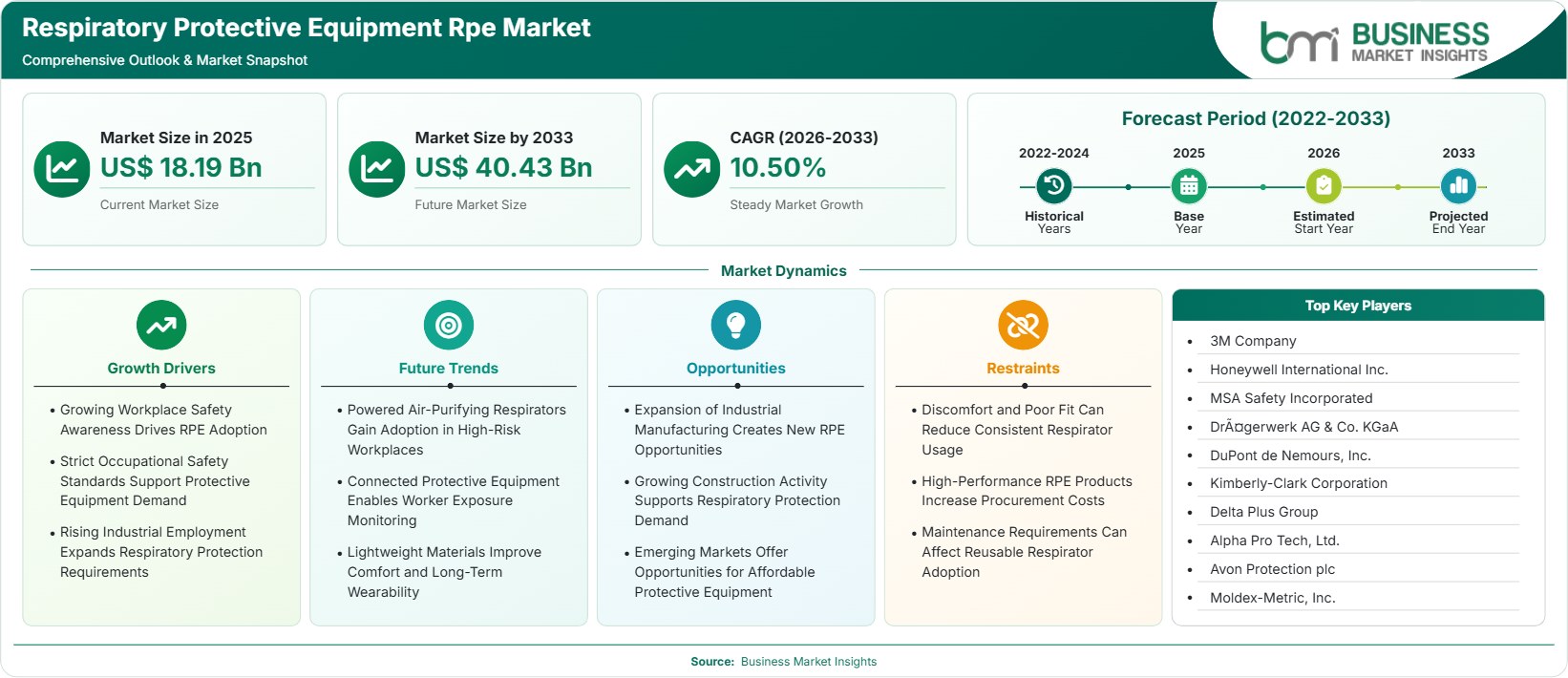
The Respiratory Protective Equipment Market size was valued at US$ 18.19 Billion in 2025 and is projected to reach US$ 40.43 Billion by 2033, growing at a CAGR of 10.50% during 2026–2033, supported by workplace safety requirements, and wider respiratory hazard awareness.

Report Coverage
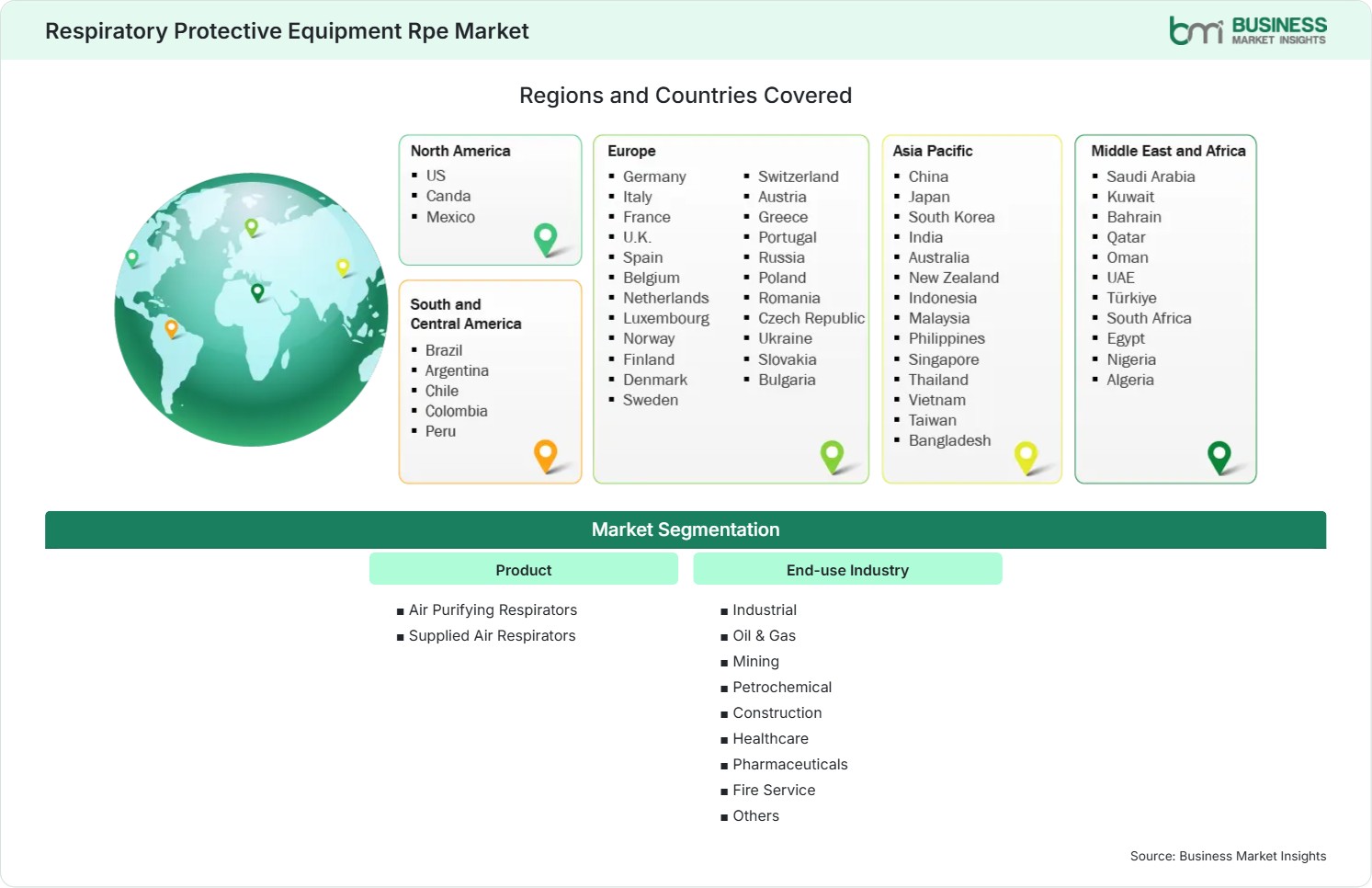
  • Product: Air Purifying Respirators, Supplied Air Respirators
  • End-use Industry: Industrial, Oil & Gas, Mining, Petrochemical, Construction, Healthcare, Pharmaceuticals, Fire Service, Others
US$ 18.19 Bn Market size in 2025
US$ 40.43 Bn Market Size by 2033
10.50% CAGR, 2026 - 2033
2026-2033 Forecast Period

01 AI Overview

Respiratory Protective Equipment Rpe Market Summary

  • North America: holds 30%–33% Respiratory Protective Equipment Market share in 2025, growing at a CAGR of 9.1%–9.7% through 2033, supported by occupational safety requirements, and replacement purchases. The US represents 82%–86% of regional demand, expanding at 9.2%–9.8% CAGR through 2033 as regulatory compliance, industrial employment, and respiratory hazard management sustain procurement.
  • Fastest Growing Region: Asia Pacific holds 28%–31% share in 2025, expanding at 11.7%–12.4% CAGR through 2033, supported by manufacturing expansion, construction activity, and increasing implementation of occupational protection programs.
  • Leading Segment: Air Purifying Respirators holds 72%–76% share in 2025, expanding at 10.1%–10.7% CAGR through 2033, supported by broad industrial applicability, comparatively accessible procurement, and recurring replacement requirements.
  • High Growth Segment: Supplied Air Respirators holds 24%–28% share in 2025, expanding at 11.5%–12.2% CAGR through 2033, supported by hazardous environments requiring controlled breathing-air supply, and specialized applications.
  • Key Market Opportunity: Industrial expansion, construction growth, and emerging-market safety programs are widening the addressable user base, improved fit, and cost-efficient protection.
  • Major Market Players: 3M Company, Honeywell International Inc., MSA Safety Incorporated, Dragerwerk AG & Co. KGaA, DuPont de Nemours, Inc., Kimberly-Clark Corporation, Delta Plus Group, Alpha Pro Tech, Ltd., Avon Protection plc, Moldex-Metric, Inc.
02 Strategic Insights

Respiratory Protective Equipment Rpe Market: Strategic Insights

Respiratory Protective Equipment Rpe Market Strategic Framework
FREE PDF
Request your free sample
Request free sample
03 Stakeholder View

Key Takeaways

  • The supply chain is shifting toward integrated protection portfolios combining respirators, filters, replacement components, and related safety services.
  • Air Purifying Respirators remain the dominant product category because they serve a wider range of occupational applications and generate recurring demand through filter and cartridge replacement.
  • Product development is increasingly focused on lighter construction, improved facial fit, lower breathing resistance, and longer usable life.
  • Asia Pacific provides the strongest expansion opportunity as industrial employment, construction, manufacturing, mining, and workplace safety programs develop simultaneously.
  • Procurement increasingly favors suppliers capable of maintaining consistent product availability, regulatory compliance, and replacement supply.
  • Emerging-market adoption provides a long-term opportunity for manufacturers able to balance affordability with certified protection performance.
04 Geographic Outlook

Respiratory Protective Equipment Rpe Market Regional Highlights

North America Respiratory Protective Equipment Market

North America holds 30%–33% share in 2025 and North America Respiratory Protective Equipment Market forecast to grow at 9.1%–9.7% CAGR through 2033. The region benefits from established occupational safety systems, industrial manufacturing, healthcare, construction, mining, emergency response, and chemical processing. The US accounts for 82%–86% of regional demand and remains the principal procurement center.

  • Occupational safety programs sustain recurring demand because employers must provide appropriate respiratory protection when engineering controls cannot adequately control hazardous airborne exposures.
  • Industrial and construction activities maintain broad demand for filtering facepieces, reusable respirators, cartridges, filters, and higher-protection configurations across diverse workplace environments.
  • Healthcare and emergency response applications support specialized protection requirements, increasing demand for products combining filtration performance with comfort and reliable fit.
  • Product replacement remains important because filters, cartridges, and disposable components have defined service limitations and require systematic replacement within respiratory protection programs.

US Respiratory Protective Equipment Market

The US Respiratory Protective Equipment Market represents 82%–86% of North American demand in 2025 and is forecast to expand at 9.2%–9.8% CAGR through 2033. OSHA requirements and NIOSH approval frameworks create a structured procurement environment. NIOSH remains responsible for testing and approving workplace respirators, reinforcing the importance of certified products. Industrial employment, healthcare, construction, mining, emergency response, and chemical processing support demand.

  • Regulatory requirements create a stable procurement base by linking respiratory protection to documented workplace programs, hazard assessment, suitable equipment selection, and employee training.
  • Industrial users increasingly prioritize reusable systems and efficient replacement management where respiratory hazards create recurring requirements for filters, cartridges, and related components.
  • Emergency response and fire-service applications support demand for higher-protection breathing systems designed for hazardous environments requiring controlled breathing-air supply.

Europe Respiratory Protective Equipment Market

Europe Respiratory Protective Equipment Market holds 24%–27% share in 2025 and is projected to grow at 8.8%–9.5% CAGR through 2033. Germany, France, the UK, Italy, and Spain represent leading markets due to established industrial and healthcare sectors. Poland provides a stronger growth opportunity at 10.2%–10.9% CAGR as manufacturing and construction activity expand. Germany is projected to grow at 8.9%–9.6% CAGR.

  • Germany maintains strong demand through manufacturing, chemicals, pharmaceuticals, construction, and industrial workplaces where structured respiratory protection programs are well established.
  • France and the UK provide stable demand through healthcare, industrial production, construction, emergency services, and occupational safety requirements.
  • Poland offers stronger expansion potential as manufacturing capacity, construction activity, and industrial employment increase requirements for certified respiratory protection.
  • European procurement increasingly emphasizes ergonomic design, environmental considerations, product durability, filtration performance, and regulatory conformity alongside basic protection levels.

Asia Pacific Respiratory Protective Equipment Market

Asia Pacific holds 28%–31% share in 2025 and is projected to grow at 11.7%–12.4% CAGR through 2033. China, Japan, South Korea, India, and Australia represent established demand centers, while India and Southeast Asia provide stronger expansion opportunities. India is projected to grow at 12.5%–13.2% CAGR, supported by manufacturing, construction, pharmaceuticals, healthcare, and industrial employment.

  • China benefits from extensive manufacturing, chemical processing, construction, mining, and industrial activity requiring respiratory protection across varied exposure environments.
  • India provides strong Respiratory Protective Equipment Market growth potential through industrial expansion, infrastructure construction, pharmaceuticals, healthcare development, and increasing attention to workplace safety.
  • Japan and South Korea maintain demand through advanced manufacturing, chemicals, electronics, healthcare, and industrial facilities requiring reliable respiratory protection.
  • Southeast Asia is developing as an additional growth center as manufacturing investment, construction, processing industries, and industrial employment expand.

Rest of World Respiratory Protective Equipment Market

South and Central America Respiratory Protective Equipment Market provide demand through mining, construction, manufacturing, agriculture-related processing, oil and gas, and healthcare. Brazil and Mexico represent major markets, while Colombia and Chile provide additional growth opportunities. Mexico benefits from manufacturing activity, while Brazil has a broad industrial and mining base requiring occupational respiratory protection.

The Middle East and Africa provide emerging opportunities through oil and gas, petrochemicals, construction, mining, industrial development, and healthcare. Rest of World holds 11%–14% share in 2025 and is projected to grow at 8.1%–8.9% CAGR through 2033 as industrial activity and formal safety practices expand.

  • Brazil remains an important demand center because mining, construction, manufacturing, energy, and industrial processing generate diverse respiratory protection requirements.
  • Mexico benefits from manufacturing and industrial activity, supporting demand for respiratory products across production facilities, construction operations, and processing environments.
  • Gulf markets provide opportunities through petrochemical, energy, construction, and industrial activities requiring higher-performance respiratory protection.
  • South Africa contributes demand through mining, industrial operations, construction, and occupational safety programs addressing airborne workplace hazards.
Global Market Geography
FREE PDF
Request your free sample
Request free sample
05 Segment Analysis

Respiratory Protective Equipment Rpe Market Segmentation

Product

Air Purifying Respirators hold 72%–76% Respiratory Protective Equipment Market share in 2025 and are projected to grow at 10.1%–10.7% CAGR through 2033. Their broad industrial applicability, replaceable filtration components, and comparatively accessible procurement support dominance. Supplied Air Respirators address higher-risk environments requiring breathing-air delivery and specialized protection. Their growth is supported by hazardous industrial operations and increasing protection requirements.

  • Air Purifying Respirators (APR): Filter contaminated ambient air before inhalation, supporting broad industrial use through filtering facepieces, reusable respirators, cartridges, and replaceable filters.
  • Supplied Air Respirators: Deliver breathing air from an external source, supporting environments with hazardous concentrations, oxygen limitations, or contaminants requiring higher protection levels.

End-use Industry

Industrial applications hold 24%–28% share in 2025 and are projected to grow at 10.0%–10.6% CAGR through 2033. Manufacturing remains a broad demand base, while Oil & Gas, Mining, Petrochemical, Construction, Healthcare, Pharmaceuticals, and Fire Service serve specialized respiratory protection needs. Expanding employment, stricter safety practices, and increasing hazard awareness support adoption across these end-use industries.

  • Industrial: Manufacturing environments require respiratory protection against particulates, fumes, vapors, gases, and process-related airborne hazards across varied production activities.
  • Oil & Gas: Respiratory protection supports workers exposed to hydrocarbons, gases, vapors, particulates, and maintenance-related hazards throughout extraction and processing activities.
  • Mining: Dust, particulates, gases, and confined operating conditions support demand for dependable respiratory protection with appropriate filtration or supplied-air configurations.
  • Petrochemical: Chemical processing creates requirements for protection against gases, vapors, fumes, and particulates, increasing demand for specialized respirators and replacement components.
  • Construction: Dust, fumes, coatings, demolition activities, and material handling create recurring respiratory protection requirements across indoor and outdoor construction environments.
  • Healthcare: Respiratory protection supports workers facing airborne particles and biological hazards, with fit, filtration, comfort, and correct usage influencing product selection.
  • Pharmaceuticals: Controlled manufacturing environments require respiratory protection against powders, active ingredients, chemical substances, and process-generated particulates.
  • Fire Service: Firefighting and emergency response require higher-protection breathing systems designed for hazardous atmospheres, smoke, toxic gases, and oxygen-deficient conditions.
06 Market Forces

Respiratory Protective Equipment Rpe Market Dynamics

Key Market Drivers

Growing Workplace Safety Awareness Drives RPE Adoption

Awareness of workplace safety is leading to an increase in the focus being paid to respiratory hazards assessment, equipment selection, fit, training, and replacement. There has been a move towards considering respiratory protection as a component of occupational risk management, not just another safety purchase by employers. According to NIOSH, millions of workers in the US use respiratory protection in areas such as health care, construction, public safety, emergency services, and mining. The Respiratory Protective Equipment Market Trends show an increased focus on fit testing, training, inspection, and replacement.

Strict Occupational Safety Standards Support Protective Equipment Demand

Occupational safety standards create a structural demand base by requiring employers to assess respiratory hazards and provide suitable protection where necessary. Demand consequently benefits from both compliance-driven procurement and ongoing program management. Manufacturers with products designed for established regulatory frameworks can address a wide range of industrial requirements. Regulatory enforcement, workplace inspections, internal safety audits, and corporate safety policies can reinforce purchasing continuity, particularly among larger industrial organizations with structured occupational health and safety systems.

Rising Industrial Employment Expands Respiratory Protection Requirements

Increases in industrial employment generate more employees who may be exposed to risks in the airborne hazards through manufacturing, construction, mining, petrochemicals, pharmaceutical industries, and processing industries. New production plants generate more need for procurement of respiratory protection systems, which include initial purchases, replacement, fit testing, training, and maintenance. The effect is strongest where industrial growth occurs alongside formalization of workplace safety practices.

Key Market Opportunities

Expansion of Industrial Manufacturing Creates New RPE Opportunities

Industrial manufacturing expansion is creating opportunities for respiratory protection suppliers as new facilities establish occupational safety programs and existing facilities upgrade protective equipment. Manufacturing processes generate diverse airborne hazards, creating demand for different filtration, cartridge, and respirator configurations. The opportunity is particularly relevant in emerging economies where industrial capacity is expanding while workplace protection practices are becoming more formalized. Suppliers can address this market through scalable product portfolios that balance protection performance, comfort, durability, and procurement cost.

Growing Construction Activity Supports Respiratory Protection Demand

Construction creates a wide range of respiratory hazards associated with dust generation, demolition, cutting, grinding, coatings, material handling, and other site activities. Expanding construction output therefore increases opportunities for respiratory protection suppliers, particularly where workplace safety requirements are becoming more formalized. Product selection varies according to the contaminant, exposure level, work duration, environmental conditions, and compatibility with other protective equipment. Lightweight designs and improved fit can be particularly valuable because construction workers may wear respiratory protection for extended periods under physically demanding conditions.

Emerging Markets Offer Opportunities for Affordable Protective Equipment

Emerging markets provide an expanding addressable user base as industrial employment, manufacturing, construction, healthcare, mining, and processing activities increase. Price sensitivity remains important, making affordability a key factor in product adoption without compromising required protection levels. Suppliers can address this opportunity through efficient manufacturing, regional distribution, standardized product platforms, and appropriately differentiated product ranges. Local availability is important because delayed replacement of filters, cartridges, or respirators can weaken the effectiveness of respiratory protection programs.

Market Restraints and Challenges

Discomfort and Poor Fit Can Reduce Consistent Respirator Usage

Factor: Respirators can create discomfort through heat retention, breathing resistance, facial pressure, restricted communication, and interference with other protective equipment, particularly during extended work periods. Impact: Poor wearer acceptance can reduce consistent usage and weaken the practical effectiveness of respiratory protection programs. Fit is also highly individual, meaning products that perform adequately for one worker may not provide equivalent sealing for another.

High-Performance RPE Products Increase Procurement Costs

Factor: Higher-performance respiratory protection can require advanced filtration media, specialized materials, complex components, certification processes, replacement cartridges, and supporting fit-testing or maintenance requirements. Impact: Increased procurement costs can delay equipment upgrades or encourage price-sensitive buyers to select lower-cost products where protection requirements permit. Suppliers must therefore demonstrate value through durability, service life, comfort, lower replacement frequency, and reliable performance.

07 Company Analysis

Competitive Landscape

The Respiratory Protective Equipment Market analysis indicates competition across diversified safety-equipment manufacturers, respiratory protection specialists, filtration technology providers, and industrial protection suppliers. Competitive differentiation increasingly depends on protection performance, certification, fit, comfort, filtration efficiency, product durability, replacement availability, technical support, and portfolio breadth.

Company Name

Overview

Products and Services relevant to this market

3M Company

Diversified technology and safety company with a broad respiratory protection portfolio serving occupational environments.

Filtering facepieces, reusable respirators, powered air-purifying respirators, filters, cartridges, and respiratory protection support.

Honeywell International Inc.

Diversified industrial technology company with established personal protective equipment capabilities.

Disposable and reusable respirators, filters, cartridges, powered systems, and respiratory protection solutions.

MSA Safety Incorporated

Safety technology provider serving industrial, fire service, infrastructure, and occupational protection markets.

Air-purifying respirators, supplied-air systems, self-contained breathing apparatus, filters, accessories, and related support.

Drägerwerk AG & Co. KGaA

Safety and medical technology company with strong expertise in respiratory and breathing protection.

Respirators, supplied-air systems, self-contained breathing apparatus, respiratory protection accessories, and safety technologies.

DuPont de Nemours, Inc.

Materials and protection technology company serving industrial and chemical protection applications.

Protective materials, respiratory protection-related solutions, filtration technologies, and integrated personal protection offerings.

Kimberly-Clark Corporation

Personal protective equipment provider serving healthcare, industrial, and workplace safety applications.

Disposable respirators, particulate protection products, filtration products, and workplace respiratory protection solutions.

Delta Plus Group

Personal protective equipment manufacturer with broad industrial safety coverage across international markets.

Respiratory protection products, filtering respirators, reusable systems, filters, cartridges, and protective equipment.

Alpha Pro Tech, Ltd.

Protective products manufacturer serving healthcare, construction, and industrial users.

Disposable respirators, particulate protection products, protective apparel, and related workplace safety products.

Avon Protection plc

Specialist protection company focused on respiratory and protective equipment for demanding environments.

Respiratory systems, masks, filters, powered systems, and specialized protection solutions.

Moldex-Metric, Inc.

Respiratory and hearing protection specialist serving occupational safety markets.

Disposable respirators, reusable respirators, filters, cartridges, and respiratory protection accessories.

10 Trust & Transparency

Research Methodology

The market analysis combines proprietary research with secondary data from government agencies, company disclosures, regulatory filings, industry databases and expert interviews. Market estimates are validated through data triangulation, cross-market benchmarking and analyst review.

View Full Research Methodology

11 Questions Answered

Frequently Asked Questions

What factors will influence future product development in Respiratory Protective Equipment Market report?

Future development will emphasize lower weight, improved fit, reduced breathing resistance, greater comfort, longer component life, improved compatibility with other protective equipment.

What industries generate recurring demand for respiratory protection?

Manufacturing, construction, oil and gas, mining, and fire services generate recurring demand because airborne hazards can arise during production, and material handling.

How does fit testing affect respiratory protection procurement?

Fit testing helps determine whether a selected tight-fitting respirator forms an adequate seal for an individual wearer.

Why is supplied-air respiratory protection gaining importance?

Supplied-air systems provide breathing air from an external source and are suited to environments where ambient-air filtration may not provide adequate protection.

Which product category accounts for the largest portion of Respiratory Protective Equipment Market?

Air Purifying Respirators account for the largest portion because they address a wider range of occupational environments and offer multiple disposable and reusable configurations.

Access the Full Respiratory Protective Equipment Rpe Market Report

Get segment-level forecasts, regional estimates, competitive benchmarking, company profiles and downloadable Excel datasets.

Access the full Respiratory Protective Equipment Rpe Market Report
350 pages PDF & Excel | 2026-08-24