
Recycling Bins Market Outlook: Size, Share, Trends, Growth Analysis, Competitive Landscape & Forecast, 2022-2033

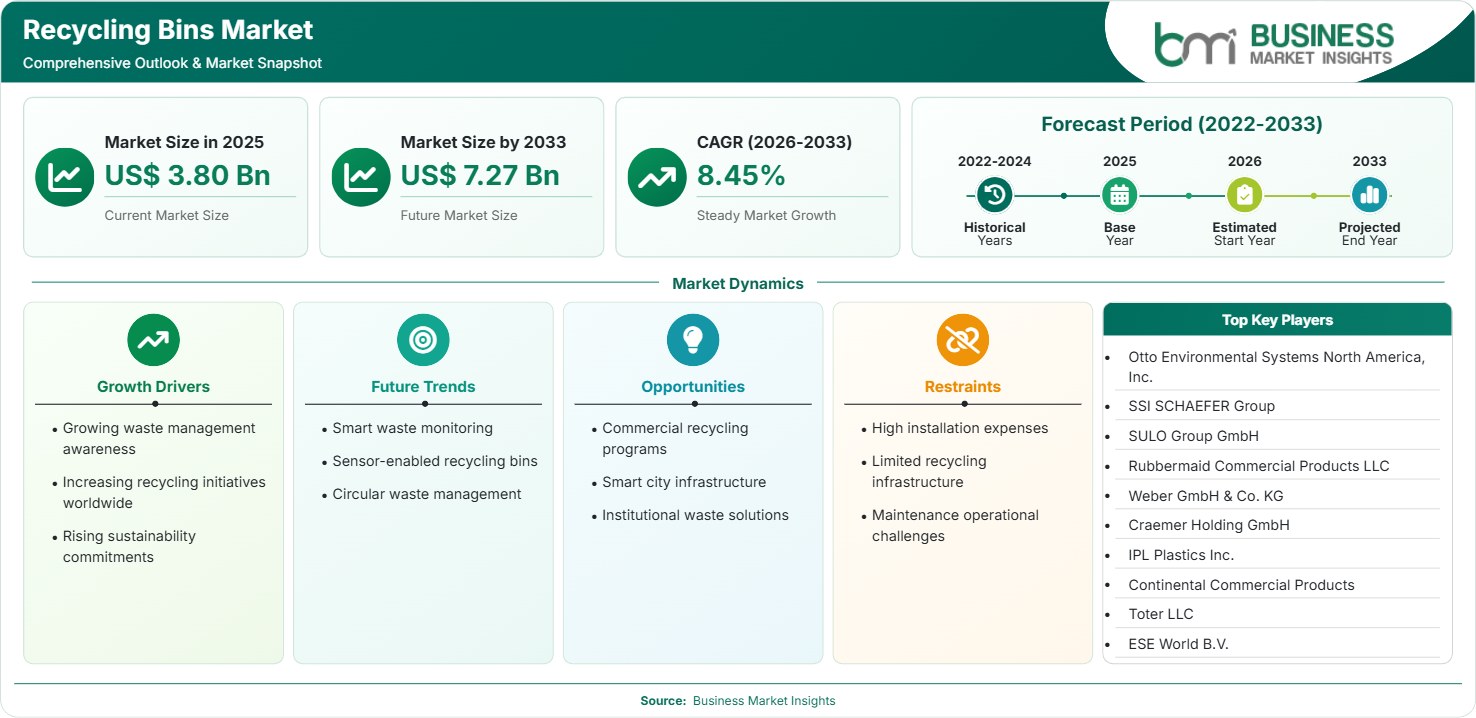
The Recycling Bins Market size was valued at US$ 3.80 billion in 2025 and is projected to reach US$ 7.27 billion by 2033, growing at a CAGR of 8.45% during 2026–2033. Growing waste management awareness, increasing recycling initiatives worldwide, and rising sustainability commitments are driving steady market expansion. Furthermore, commercial recycling programs, smart city infrastructure, and institutional waste management solutions are expected to create significant long-term opportunities for manufacturers and waste management solution providers.

Report Coverage
  • Material: Plastic Lumber, Steel, Fiberglass, Others
  • Application: Residential, Commercial, Public Places
  • Distribution Channel: Shopping Malls, Hypermarkets & Supermarkets, Retail Stores, Online
US$ 3.80 Bn Market size in 2025
US$ 7.27 Bn Market Size by 2033
8.45% CAGR, 2026 - 2033
2026-2033 Forecast Period

AI Overview

Recycling Bins Market Summary

  • North America: North America accounts for 31%–34% of the global market in 2025 and is projected to grow at a CAGR of 8.0%–8.8% through 2033. Strong municipal recycling programs, increasing adoption of sustainable waste management practices, growing investments in smart waste infrastructure, and stringent environmental regulations continue driving regional market growth. The U.S. market is anticipated to register a CAGR of 8.1%–8.9% during the forecast period.
  • Fastest Growing Region: Asia Pacific holds 27%–30% market share in 2025 and is forecast to register the highest CAGR of 9.0%–9.8% through 2033. Rapid urbanization, expanding municipal waste management initiatives, increasing government investments in recycling infrastructure, and rising public awareness regarding environmental sustainability continue strengthening regional demand.
  • Leading Segment: Plastic recycling bins represent 43%–46% of the market in 2025 and are projected to expand at a CAGR of 8.3%–9.1% during 2026–2033. Their lightweight construction, corrosion resistance, cost-effectiveness, durability, and ease of maintenance continue supporting segment leadership across residential, commercial, and institutional applications.
  • High Growth Segment: Commercial applications account for 38%–41% market share in 2025 and are expected to register the fastest CAGR of 8.8%–9.6% through 2033. Increasing implementation of corporate sustainability initiatives, commercial recycling regulations, office waste segregation programs, and green building certifications continue accelerating segment growth.
  • Key Market Opportunity: Expanding investments in smart waste collection systems, sensor-enabled recycling bins, commercial recycling programs, institutional waste management solutions, and smart city infrastructure are creating significant growth opportunities across the global recycling bins industry.
  • Major Market Players: Otto Environmental Systems North America Inc., SSI SCHAEFER Group, SULO Group GmbH, Rubbermaid Commercial Products LLC, Weber GmbH & Co. KG, Craemer Holding GmbH, IPL Plastics Inc., Continental Commercial Products, Toter LLC, and ESE World B.V.
Strategic Insights

Recycling Bins Market: Strategic Insights

Recycling Bins Market Strategic Framework
FREE PDF
Request your free sample
Request free sample
Stakeholder View

Key Takeaways

  • The market ecosystem continues evolving through raw material suppliers, recycling bin manufacturers, municipal authorities, commercial facility managers, distributors, waste management companies, retailers, and smart infrastructure solution providers.
  • Residential recycling, commercial waste segregation, institutional recycling programs, smart waste collection systems, public infrastructure projects, and municipal recycling initiatives represent the largest commercial opportunities across the industry.
  • Continuous innovation in sensor-enabled bins, IoT-based monitoring systems, recycled plastic materials, modular waste collection systems, vandal-resistant designs, and smart waste analytics is significantly improving operational efficiency and sustainability.
  • Asia Pacific offers the strongest long-term investment potential due to rapid urbanization, expanding smart city initiatives, increasing government investments in waste management infrastructure, rising environmental awareness, and growing implementation of organized recycling programs.
  • Strategic collaborations among recycling equipment manufacturers, municipalities, environmental organizations, technology companies, and waste management service providers continue accelerating innovation and commercialization of next-generation recycling solutions.
Geographic Outlook

Recycling Bins Market Regional Highlights

North America Recycling Bins Market

North America accounts for 31%–34% of the global market in 2025 and is projected to expand at a CAGR of 8.0%–8.8% through 2033. Strong environmental regulations, mature recycling infrastructure, growing adoption of smart waste management systems, and increasing investments in sustainable municipal services continue supporting regional growth. The Recycling Bins Market share remains among the highest globally due to widespread implementation of waste segregation programs.

  • Municipal recycling programs drive product demand.
  • Smart waste systems improve collection efficiency.
  • Sustainability initiatives strengthen market growth.
  • Public infrastructure investments support expansion.

US Recycling Bins Market

The United States dominates regional revenue and is expected to register a CAGR of 8.1%–8.9% during the forecast period. Increasing investments in commercial recycling, public waste management modernization, smart city projects, and environmentally responsible infrastructure continue strengthening market expansion.

  • Commercial recycling programs expand rapidly.
  • Smart infrastructure supports waste optimization.
  • Sustainability regulations encourage adoption.

Europe Recycling Bins Market

Europe represents 28%–31% of the global market in 2025 and is projected to grow at a CAGR of 8.0%–8.8% during 2026–2033. Germany leads regional demand, while Poland records the fastest growth supported by circular economy initiatives, strict recycling regulations, expanding municipal waste management systems, and increasing environmental awareness.

  • Circular economy policies support market growth.
  • Germany leads regional recycling infrastructure.
  • Sustainable waste management expands adoption.
  • Public investments strengthen recycling networks.

Asia Pacific Recycling Bins Market

Asia Pacific accounts for 27%–30% of global revenue in 2025 and is expected to register the highest CAGR of 9.0%–9.8% through 2033. China dominates regional demand, while India records the fastest growth owing to rapid urbanization, increasing municipal waste generation, government-led cleanliness initiatives, expanding smart city programs, and rising public participation in recycling activities.

  • Urbanization increases recycling requirements.
  • Smart city projects accelerate infrastructure deployment.
  • Government initiatives strengthen waste segregation.
  • Public awareness supports long-term market growth.

Rest of World Recycling Bins Market

The Rest of World region accounts for 8%–10% of the global market in 2025 and is projected to grow at a CAGR of 7.8%–8.6% during the forecast period. Brazil, the UAE, and South Africa continue witnessing increasing investments in municipal waste management systems, recycling awareness campaigns, and commercial sustainability programs as governments focus on improving environmental performance and reducing landfill waste.

  • Municipal investments improve recycling infrastructure.
  • Commercial sustainability initiatives drive demand.
  • Public awareness supports waste segregation.
  • Recycling programs encourage long-term market expansion.
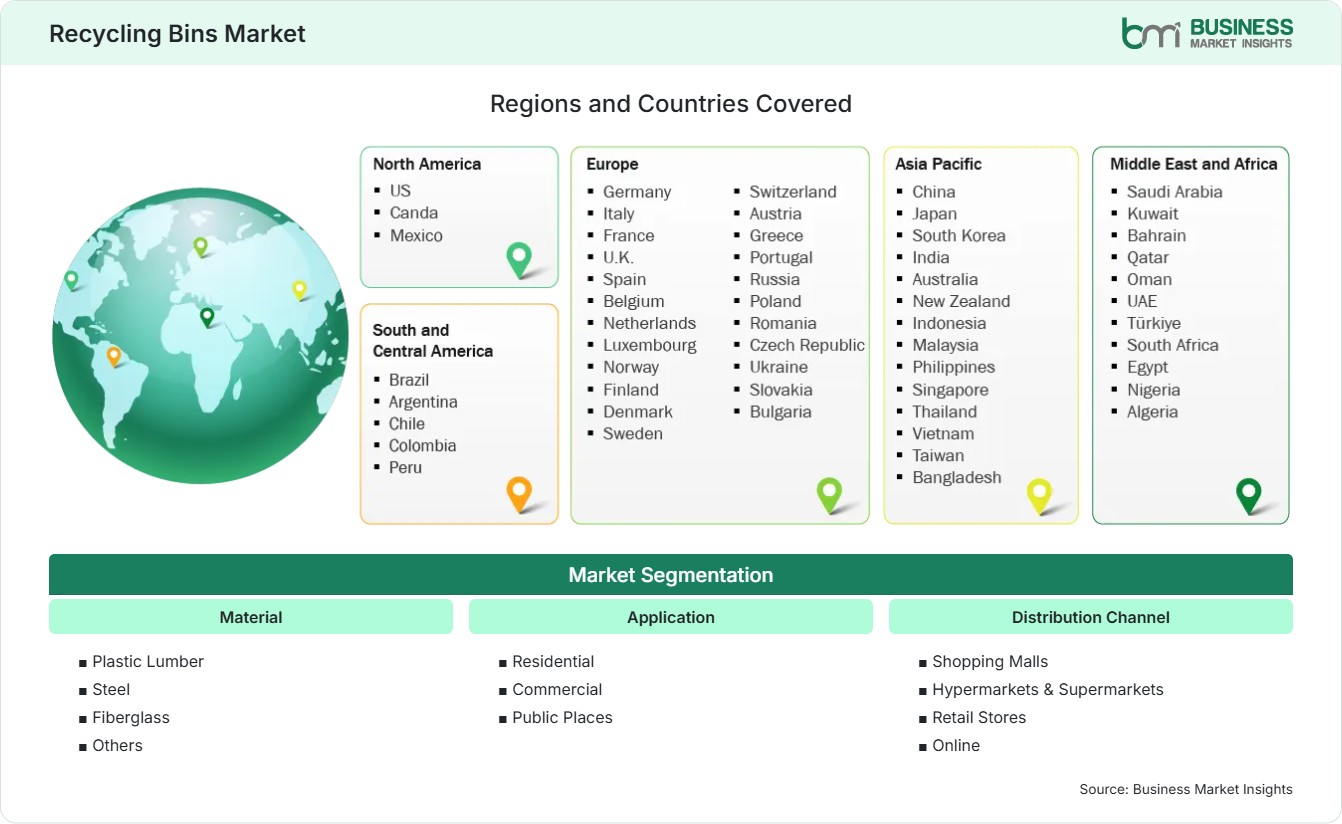
Global Market Geography
FREE PDF
Request your free sample
Request free sample
Segment Analysis

Recycling Bins Market Segmentation

Material

The Material segment accounted for 43%–46% of the overall market in 2025 and is projected to grow at a CAGR of 8.3%–9.1% during Recycling Bins Market Forecasts. Growing demand for durable waste collection systems, increasing municipal recycling initiatives, expanding commercial sustainability programs, and rising environmental awareness continue driving market expansion. Manufacturers are increasingly focusing on lightweight, corrosion-resistant, recyclable, and weather-resistant materials that improve product longevity while reducing maintenance requirements. Continuous innovation in recycled plastics, reinforced polymers, advanced coatings, and sustainable manufacturing technologies is further strengthening demand across residential, commercial, and public waste management applications worldwide.

  • Plastic Lumber: Plastic recycling bins represent the largest segment owing to their lightweight construction, corrosion resistance, cost-effectiveness, long service life, and minimal maintenance requirements. Their ability to withstand varying weather conditions while incorporating recycled plastic materials continues supporting widespread adoption across municipalities, residential communities, commercial facilities, and educational institutions.
  • Steel: Steel recycling bins continue witnessing significant demand due to their superior structural strength, vandal resistance, fire resistance, and suitability for high-traffic public environments such as transportation hubs, parks, airports, and commercial complexes.
  • Fiberglass: Fiberglass recycling bins are increasingly utilized in outdoor applications where superior weather resistance, corrosion protection, UV stability, and long operational life are essential. Their lightweight yet durable construction supports deployment across coastal areas and harsh environmental conditions.
  • Others: Other materials include aluminum, stainless steel, composite materials, wood-plastic composites, and hybrid construction materials developed to enhance durability, sustainability, aesthetics, and operational performance across specialized recycling applications.

Applications

The Applications segment continues expanding as governments, commercial organizations, educational institutions, healthcare facilities, and municipalities increasingly invest in organized waste segregation systems. The Recycling Bins Market trends indicate growing adoption of color-coded recycling bins, smart waste collection systems, and standardized waste segregation infrastructure to improve recycling efficiency and regulatory compliance.

  • Residential: Residential applications account for a significant market share due to increasing household participation in recycling programs, government-led waste segregation campaigns, expanding curbside collection systems, and growing consumer awareness regarding environmental sustainability.
  • Commercial: Commercial applications represent the fastest-growing segment owing to expanding corporate sustainability initiatives, green building certifications, office recycling programs, retail waste management systems, and increasing regulatory compliance requirements across businesses and institutions.
  • Public Places: Public places continue generating substantial demand through installations across parks, railway stations, airports, educational campuses, government buildings, sports venues, shopping districts, tourist attractions, and other high-footfall public spaces where organized waste segregation is increasingly prioritized.

Distribution Channel

The Distribution Channel segment continues evolving with expanding retail availability and growing digital commerce platforms improving product accessibility for residential, institutional, and commercial customers. Manufacturers are strengthening omnichannel sales strategies while expanding partnerships with distributors, facility management companies, municipalities, and online marketplaces.

  • Shopping Malls: Shopping malls continue serving as important distribution channels by offering consumers direct access to a wide range of residential and commercial recycling bins while supporting institutional procurement requirements.
  • Hypermarkets and Supermarkets: Hypermarkets and supermarkets account for a substantial market share due to extensive product availability, competitive pricing, bulk purchasing opportunities, and growing consumer preference for organized retail channels.
  • Retail Stores: Specialized retail stores continue attracting customers through customized product recommendations, commercial waste management solutions, installation guidance, and access to premium recycling equipment.
  • Online: Online distribution is expected to register the fastest growth owing to expanding e-commerce adoption, wider product selection, transparent pricing, convenient product comparisons, home delivery services, and increasing procurement by businesses, municipalities, and institutional customers through digital platforms.
Market Forces

Recycling Bins Market Dynamics

Key Market Drivers

Growing waste management awareness

Growing public awareness regarding environmental conservation, responsible waste disposal, and sustainable resource utilization is significantly increasing demand for recycling bins across residential, commercial, and institutional sectors. Governments, environmental organizations, educational institutions, and private companies continue promoting waste segregation at source through awareness campaigns, educational programs, and recycling initiatives. Consumers are increasingly recognizing the importance of separating recyclable materials from general waste, driving adoption of dedicated recycling bins that improve collection efficiency and support circular economy objectives. This heightened environmental consciousness continues strengthening long-term Recycling Bins Market growth.

Increasing recycling initiatives worldwide

Governments worldwide are implementing comprehensive recycling policies, extended producer responsibility programs, landfill diversion targets, and mandatory waste segregation regulations to improve recycling rates and reduce environmental pollution. Municipal authorities continue expanding curbside recycling services, installing public recycling infrastructure, and investing in organized waste collection systems across cities and communities. These initiatives are encouraging businesses, institutions, and households to deploy standardized recycling bins, creating sustained demand for durable and efficient waste collection solutions across developed and emerging economies.

Rising sustainability commitments

Corporate sustainability goals, ESG initiatives, and net-zero commitments are encouraging organizations across industries to strengthen waste management practices and improve recycling performance. Businesses are increasingly installing recycling bins throughout offices, manufacturing facilities, educational campuses, retail centers, hospitality venues, and healthcare institutions to reduce landfill waste and comply with environmental regulations. Growing consumer preference for environmentally responsible organizations is further motivating companies to invest in comprehensive recycling infrastructure, supporting the continued expansion of the recycling bins market.

Key Market Opportunities

Commercial recycling programs

The rapid expansion of commercial recycling programs presents substantial opportunities for recycling bin manufacturers. Corporate offices, shopping centers, hotels, educational institutions, healthcare facilities, airports, and industrial facilities are implementing structured waste segregation systems to improve operational sustainability and regulatory compliance. Increasing demand for customized recycling stations, branded recycling bins, and centralized waste collection systems is creating new revenue opportunities for manufacturers serving commercial and institutional customers.

Smart city infrastructure

Global investments in smart city development are creating attractive opportunities for intelligent recycling solutions integrated with IoT technologies, fill-level sensors, GPS tracking, RFID identification, and cloud-based waste monitoring platforms. Smart recycling bins enable municipalities to optimize collection routes, reduce operational costs, improve waste collection efficiency, and support data-driven urban waste management strategies. As cities continue investing in digital infrastructure, demand for connected recycling systems is expected to accelerate significantly.

Institutional waste solutions

Educational institutions, hospitals, universities, government offices, transportation hubs, and public facilities are increasingly investing in organized recycling systems to improve sustainability and comply with environmental regulations. Growing institutional procurement of standardized recycling bins, color-coded waste segregation systems, and centralized recycling stations creates significant long-term opportunities for manufacturers offering durable, customizable, and high-capacity waste collection solutions.

Market Restraints and Challenges

High installation expenses

Factor: The large-scale installation of recycling bins in cities, business buildings, educational institutions, transport systems, and public facilities requires substantial financial resources for their acquisition, placement, and maintenance. The installation of smart recycling bins with sensors is even more costly.

Impact: High installation costs can delay purchasing decisions, limit adoption among budget-constrained municipalities and organizations, extend project implementation timelines, and reduce the pace of recycling infrastructure expansion, particularly in developing economies with limited public funding.

Limited recycling infrastructure

Factor: Many developing areas still lack adequate infrastructure, including recycling facilities, materials recovery centers, waste treatment facilities, and efficient waste collection systems, and are hampered by inefficient recycling policies, which undermine the effectiveness of waste segregation despite an increasing number of recycling bins.

Impact: A lack of developed infrastructure hinders the overall efficiency of recycling activities, reduces the return on investment from the waste segregation process, discourages the use of recycling bins, and retards market development.

Company Analysis

Competitive Landscape

The competitive landscape of the Recycling Bins Market analysis is characterized by the presence of established waste management equipment manufacturers, environmental solution providers, and specialized recycling container producers competing through product durability, sustainable material innovation, smart waste management technologies, and customized waste segregation solutions. Companies are investing in recyclable materials, sensor-enabled recycling bins, modular waste collection systems, RFID-enabled tracking technologies, and ergonomic product designs to strengthen their market positions. Strategic collaborations with municipalities, commercial organizations, educational institutions, and smart city developers, along with manufacturing capacity expansions and sustainability-focused product innovations, continue shaping the competitive environment. Growing investments in circular economy initiatives and digital waste management infrastructure are further encouraging companies to diversify their recycling bin portfolios and enhance operational efficiency.

Company Name

Overview

Products and Services Relevant to this Market

Otto Environmental Systems North America Inc.

Manufacturer specializing in waste collection and recycling containers.

Residential recycling bins, commercial waste containers, curbside recycling carts, waste management solutions.

SSI SCHAEFER Group

Global provider of logistics, storage, and waste management solutions.

Recycling bins, waste collection containers, smart waste systems, municipal recycling infrastructure.

SULO Group GmbH

International manufacturer of environmental and waste management products.

Recycling bins, waste containers, smart recycling solutions, municipal waste collection systems.

Rubbermaid Commercial Products LLC

Manufacturer of commercial cleaning and waste management products.

Commercial recycling bins, indoor recycling stations, waste collection systems, institutional recycling solutions.

Weber GmbH & Co. KG

European manufacturer of plastic waste and recycling containers.

Mobile recycling bins, residential waste containers, municipal recycling systems, commercial waste solutions.

Craemer Holding GmbH

Industrial plastics manufacturer specializing in logistics and waste containers.

Plastic recycling bins, heavy-duty waste containers, industrial recycling solutions.

IPL Plastics Inc.

Manufacturer of sustainable plastic products and waste management containers.

Recycling bins, curbside recycling carts, plastic waste collection systems, municipal recycling products.

Continental Commercial Products

Provider of commercial cleaning and waste management equipment.

Commercial recycling containers, indoor waste stations, institutional recycling solutions.

Toter LLC

Manufacturer of durable waste and recycling containers.

Two-wheel recycling carts, residential recycling bins, commercial waste containers, waste collection solutions.

ESE World B.V.

Global supplier of waste collection and recycling systems.

Recycling containers, smart waste bins, municipal waste collection equipment, environmental management solutions.

Industry Activity

Recent Developments

July 2025

PreZero inaugurated one of Europe's most advanced AI-powered recycling sorting facilities in Sollenau, Austria, strengthening recycling infrastructure and supporting the efficient collection and processing of recyclable materials from municipal recycling bins.

June 2025

DURABLE launched the DURASORT® Recyclables Collector, a new modular recycling bin system designed for offices, public buildings, and industrial facilities to improve waste separation and recycling efficiency.

May 2025

TOMRA Collection unveiled the TOMRA T70 Dual BottleGlide reverse vending machine at the Reuse Economy Expo 2025 in Paris, introducing a new solution for reusable glass container collection and supporting circular recycling systems.

January 2025

Biffa launched a new range of commercial recycling bins manufactured with 80% recycled plastic, creating a closed-loop solution by converting end-of-life wheelie bins into new recycling containers.

Trust & Transparency

Research Methodology

The market analysis combines proprietary research with secondary data from government agencies, company disclosures, regulatory filings, industry databases and expert interviews. Market estimates are validated through data triangulation, cross-market benchmarking and analyst review.

View Full Research Methodology

Questions Answered

Frequently Asked Questions

What future opportunities are highlighted in the Recycling Bins Market Report?

Major opportunities include commercial recycling programs, smart city infrastructure, institutional waste management solutions, IoT-enabled recycling bins, AI-driven waste monitoring systems, and expanding circular economy initiatives.

Who are the major companies operating in the market?

Leading companies include Otto Environmental Systems North America Inc., SSI SCHAEFER Group, SULO Group GmbH, Rubbermaid Commercial Products LLC, Weber GmbH & Co. KG, Craemer Holding GmbH, IPL Plastics Inc., Continental Commercial Products, Toter LLC, and ESE World B.V.

Which material holds the largest market share?

Plastic recycling bins dominate the market with a 43%–46% share in 2025 owing to their lightweight construction, durability, corrosion resistance, affordability, and widespread adoption across residential, commercial, and municipal applications.

Which region dominates the market?

North America leads the market with a 31%–34% share in 2025, while Asia Pacific is expected to register the fastest growth due to rapid urbanization, expanding recycling infrastructure, smart city development, and increasing environmental awareness.

What is driving the growth of the Recycling Bins Market?

The market is driven by growing waste management awareness, increasing recycling initiatives worldwide, rising sustainability commitments, expanding municipal recycling programs, and continuous investments in smart waste management infrastructure.

Access the Full Recycling Bins Market Report

Get segment-level forecasts, regional estimates, competitive benchmarking, company profiles and downloadable Excel datasets.

Access the full Recycling Bins Market Report
350 pages PDF & Excel | 2026-08-04